Where Did the $362 Million Go? Hyperliquid Counters FUD, A Decentralization Route Debate Behind the Reconciliation

marsbitОпубліковано о 2025-12-24Востаннє оновлено о 2025-12-24

Анотація

A technical report published on December 20, 2025, accused Hyperliquid, a decentralized exchange, of multiple severe issues—including insolvency and a "God mode backdoor"—claiming it was a centralized platform disguised as a blockchain. Hyperliquid issued a detailed response refuting the claims. The most serious allegation—a $362M shortfall in user funds—was debunked. The discrepancy arose because the accuser overlooked native USDC on HyperEVM during Hyperliquid’s transition from an L2 to an independent L1. Total reserves across Arbitrum and HyperEVM matched user balances. Other accusations were partially addressed: some code was testnet-related, limited broadcast nodes were an anti-MEV measure, and chain freezes were part of upgrade procedures. However, Hyperliquid did not fully respond to claims about unqueryable governance proposals and a lack of a cross-chain "escape hatch" for withdrawals. The exchange also compared itself to competitors like Lighter and Aster, criticizing their reliance on centralized sequencers and lack of transparency, while highlighting its own fully on-chain state verification. Additionally, Hyperliquid addressed community concerns about insider trading, attributing significant short selling to a former employee. The incident underscores broader challenges in DeFi transparency as protocols grow more complex, emphasizing the crypto mantra: "Don’t trust, verify."

On December 20, 2025, a technical article titled "Reverse Engineering Hyperliquid," published on blog.can.ac, directly deconstructed Hyperliquid's binary files through reverse engineering, accusing it of nine serious issues ranging from "insolvency" to a "God Mode backdoor." The article bluntly stated:

"Hyperliquid is a centralized trading platform disguised as a blockchain."

In response to the FUD, the official Hyperliquid team issued a lengthy reply. Perhaps this was not merely a simple refutation of rumors but also a declaration of war regarding "who truly possesses decentralized trading infrastructure." While the official response successfully clarified the fund security issues, it left intriguing "gaps" in some sensitive areas of decentralization.

Where Did the $362 Million Go? The Audit Blind Spot Under the "Dual Ledger" System

The most damaging accusation was that user assets within the Hyperliquid system were $362 million short compared to the on-chain reserves. If true, this would mean it was a "chain-based FTX" operating on fractional reserves.

However, upon verification, this was a misinterpretation due to information asymmetry caused by an "architecture upgrade." The auditor's logic was: Hyperliquid reserves = USDC balance on the Arbitrum cross-chain bridge. Based on this logic, they checked the cross-chain bridge address and found the balance was indeed less than the total user deposits.

Hyperliquid responded that it is undergoing a complete evolution from an "L2 AppChain" to an "independent L1." During this process, asset reserves have become a two-track system:

The accuser completely ignored the native USDC on HyperEVM. According to on-chain data (as of the time of writing):

· Arbitrum cross-chain balance: 3.989 billion USDC (verifiable on Arbiscan)

· HyperEVM native balance: 362 million USDC (verifiable on Hyperevmscan)

· HyperEVM contract balance: 59 million USDC

Total solvency = 3.989B + 0.362B + 0.059B ≈ 4.351B USDC

This figure completely matches the Total User Balances on HyperCore. The alleged "$362 million gap" is precisely the native assets that have already migrated to HyperEVM. This is not a disappearance of funds but a transfer of funds between different ledgers.

Checklist of 9 Accusations: What Was Clarified? What Was Avoided?
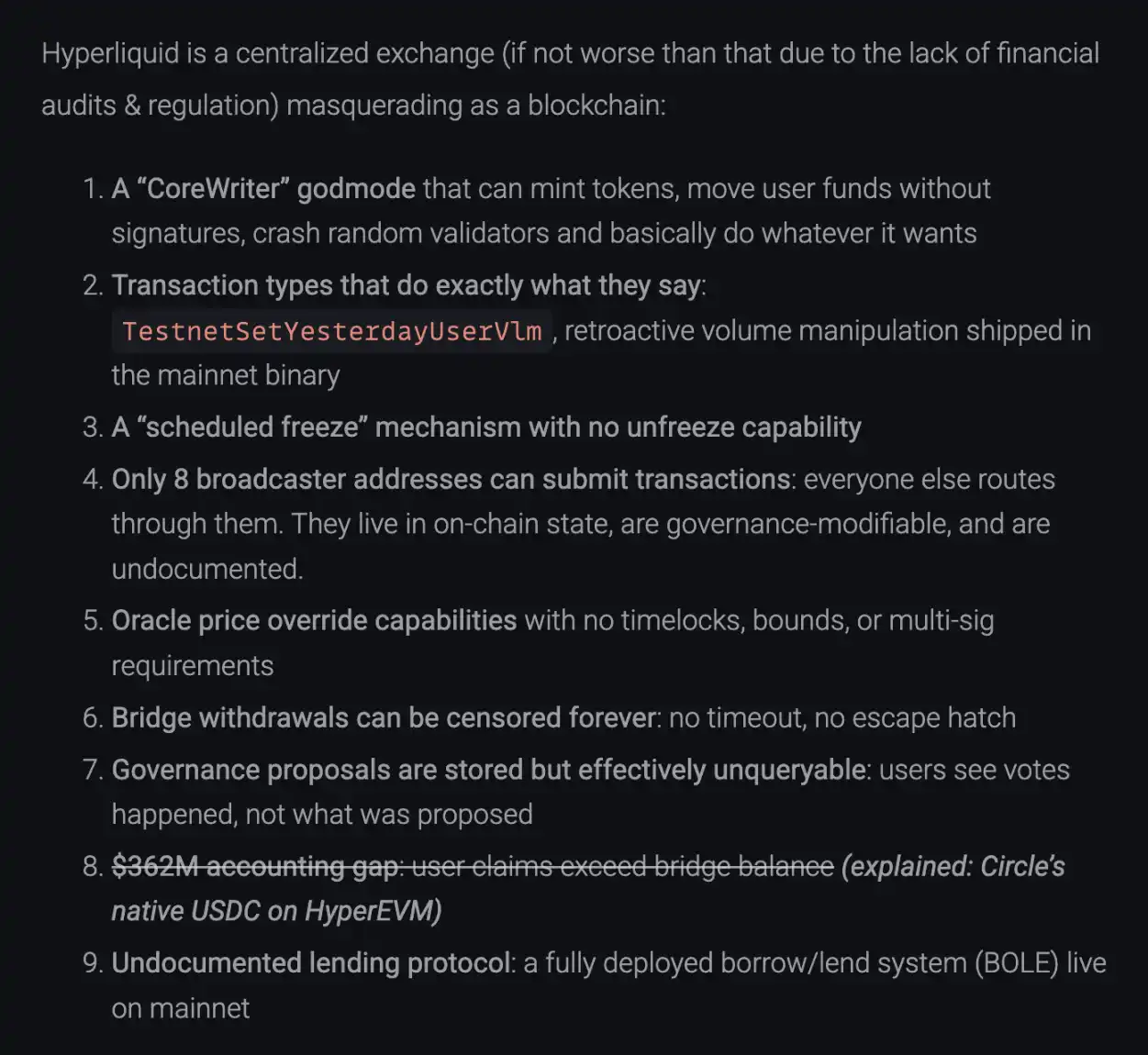
Clarified Accusations

Accusation: "CoreWriter" God Mode: Accused of being able to print money out of thin air and misappropriate funds.

Response: Officially explained that this is an interface for L1 to interact with HyperEVM (e.g., staking), with restricted permissions and no ability to misappropriate funds.

Accusation: $362 million funding gap.

Response: As described above, it was due to not accounting for Native USDC.

Accusation: Undisclosed lending protocol.

Response: Official pointed out that the spot/lending function (HIP-1) documentation is publicly available and in a pre-release stage, not secretly operating.

Acknowledged Accusations with Reasonable Explanations

Accusation: Binary file contains code to "modify trading volume" (TestnetSetYesterdayUserVlm).

Response: Acknowledged existence. Explained as testnet (Testnet) residual code used to simulate fee logic; the mainnet nodes have physically isolated this path, making execution impossible.

Accusation: Only 8 broadcast addresses can submit transactions.

Response: Acknowledged. Explained as an anti-MEV (Maximal Extractable Value) measure to prevent user transactions from being front-run. Committed to implementing a "multi-proposer" mechanism in the future.

Accusation: The chain can be "plannedly frozen" with no revocation function.

Response: Acknowledged. Explained as a standard process for network upgrades (Upgrade), requiring a full network pause to switch versions.

Accusation: Oracle price can be instantly overwritten.

Response: Explained as a system security design. To liquidate bad debt promptly during extreme volatility (like 10x), the validator oracle indeed does not have a time lock.

Missing / Vague Responses

In our review, two accusations were not directly addressed or fully resolved in the official response:

Accusation: Governance proposals are unqueryable. Users can only see that voting occurred, but the on-chain data does not contain the specific text content of the proposals.

Response: The official did not address this point in the long post. This means Hyperliquid's governance remains a "black box" for ordinary users—you can only see the results, not the process.

Accusation: Cross-chain bridge has no "escape hatch." Withdrawals could be censored indefinitely, and users cannot force withdrawals back to L1.

Response: Although the official explained that locking the bridge during the POPCAT incident was for safety, it did not refute the architectural fact of "no escape hatch." This indicates that at the current stage, the inflow and outflow of user assets highly depend on the permission of the validator set, lacking the anti-censorship forced withdrawal capability of L2 Rollups.

"Throwing Shade" at Competitors

The most interesting aspect of this incident is that it forced Hyperliquid to show its cards, giving us an opportunity to re-examine the landscape of the Perp (Perpetuals)赛道. The official response unusually "threw shade" at competitors, targeting Lighter, Aster, and even industry giant Binance.

It stated, "Lighter uses a single centralized sequencer, and its execution logic and zero-knowledge (ZK) circuits are not public. Aster uses centralized matching and even offers dark pool trading, which can only be achieved with a single centralized sequencer and an unverifiable execution process. Other protocols that include open-source contracts lack a verifiable sequencer."

Hyperliquid unabashedly categorized these competitors as relying on a "Centralized Sequencer." The official emphasized: on these platforms, no one except the sequencer operator can see the complete state snapshot (including order book history, position details). In contrast, Hyperliquid attempts to eliminate this "privilege" by having all validators execute the same state machine.

This wave of "throwing shade" might also stem from Hyperliquid's concerns about its current market share. According to DefiLlama's trading volume data for the past 30 days, the market has shown a tripartite balance of power:
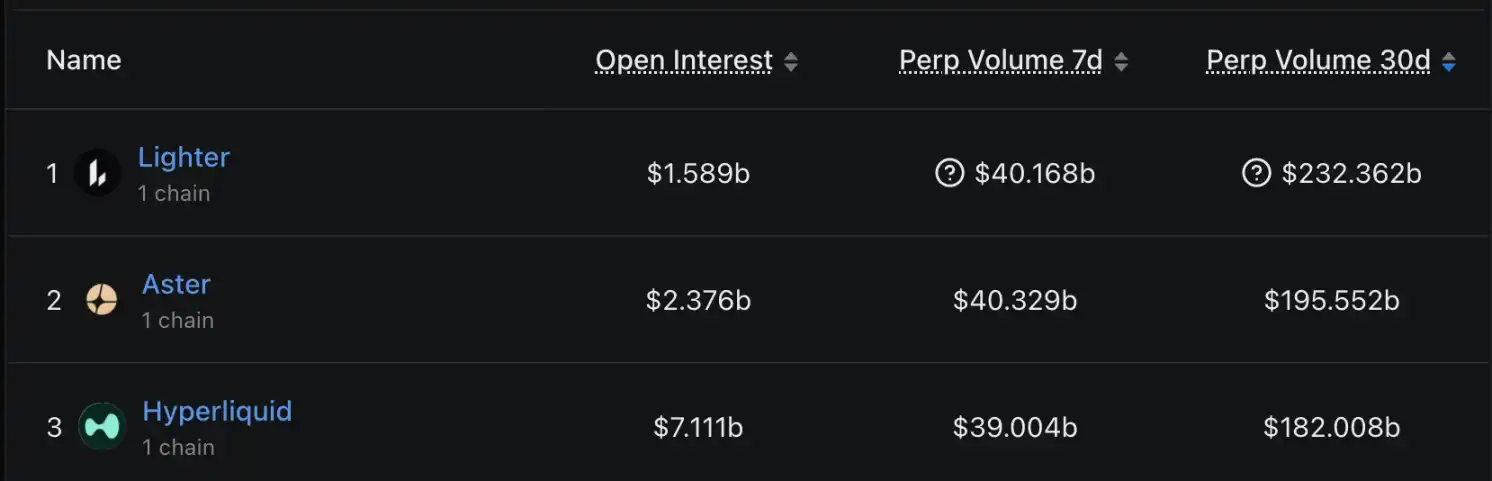
· Lighter: Trading volume $232.3 billion, temporarily leading,约占 26.6%.

· Aster: Trading volume $195.5 billion,位居第二,约占 22.3%.

· Hyperliquid: Trading volume $182.0 billion,位居第三,约占 20.8%.

Facing the trading volume of latercomers Lighter and Aster surpassing its own, Hyperliquid attempts to play the "transparency" card—meaning "although I have 8 centralized broadcast addresses, my entire state is on-chain and verifiable; while you can't even check yours." However, it is worth noting that although Hyperliquid's trading volume is slightly lower than the top two, it呈现碾压态势 in terms of Open Interest (OI).

Public Sentiment Response: Who is Shorting HYPE?

Beyond technical and fund issues, the community is also highly concerned about recent rumors that HYPE tokens were allegedly shorted and dumped by "insiders." In response, a Hyperliquid team member gave a定性回应 on Discord for the first time: "The shorting address starting with 0x7ae4 belongs to a former employee." This individual was once a team member but was fired in early 2024. The personal trading behavior of this former employee is unrelated to the current Hyperliquid team. The platform emphasized that it currently implements extremely strict HYPE trading restrictions and compliance reviews for all在职 employees and contractors, strictly prohibiting insider trading using their positions.

This response attempts to downgrade the accusation of "team misconduct" to "personal behavior of a former employee." However, regarding the transparency of token distribution and unlocking mechanisms, the community might still expect more detailed disclosure.

Don't Trust, Verify

Hyperliquid's clarification tweet can be considered a textbook example of crisis PR—relying not on emotional output but on data, code links, and architectural logic. It did not stop at proving its innocence but instead went on the offensive, strengthening its brand and advantage of "full state on-chain" by comparing competitor architectures.

Although the FUD was disproven, the profound thought left for the industry by this incident is far-reaching. As DeFi protocols evolve towards independent application chains (AppChain), architectures become increasingly complex, and asset distribution becomes more fragmented (Bridge + Native). The traditional method of checking balances by "looking at the contract balance" has become ineffective.

For Hyperliquid, proving "the money is there" is only the first step. How to gradually transfer the permissions of those 8 submission addresses while maintaining the advantages of high performance and anti-MEV, truly achieving the transition from "transparent centralization" to "transparent decentralization," is the necessary path to becoming the "ultimate DEX."

For users, this incident once again confirms the iron law of the crypto world: don't trust any narrative, verify every byte.


Пов'язані питання

QWhat was the core accusation made in the 'Reverse Engineering Hyperliquid' blog post regarding user funds?

AThe blog post accused Hyperliquid of having a 362 million USDC shortfall, suggesting it was operating as a fractional-reserve exchange with user assets not fully backed by on-chain reserves.

QHow did Hyperliquid explain the alleged 362 million USDC discrepancy in its reserves?

AHyperliquid clarified that the 'missing' 362 million USDC was not a shortfall but was part of the native USDC balance on its new HyperEVM chain, which the accuser had failed to account for in their audit. The total reserves across Arbitrum and HyperEVM matched user balances.

QWhich two specific accusations did the article note were not fully addressed or resolved in Hyperliquid's official response?

AThe two accusations were: 1) Governance proposals are unqueryable (users cannot see the proposal text, only the voting result), and 2) The cross-chain bridge has no 'escape hatch' (users cannot force a withdrawal to L1, making withdrawals reliant on validator approval).

QWhat key competitive advantage did Hyperliquid claim over its rivals Lighter and Aster in its response?

AHyperliquid claimed its key advantage is transparency through 'full state on-chain,' arguing that while it uses 8 broadcast addresses, its entire state (like order book history) is publicly verifiable, unlike competitors it accused of relying on opaque, centralized sequencers.

QAccording to the article, what was Hyperliquid's explanation for the address that was shorting its HYPE token?

AHyperliquid stated that the address shorting HYPE belonged to a former employee who had been fired in early 2024 and that this was a personal trading action unrelated to the current team, which operates under strict trading restrictions.

Пов'язані матеріали

The Value Distribution of Stablecoins

**Summary: The Value Distribution of Stablecoins** The article argues that stablecoins are evolving from mere trading tools into broader channels for dollar access. It divides the stablecoin ecosystem into four layers to analyze how value is distributed: 1. **Issuance Layer:** Mints stablecoins, holds reserve assets, and captures the spread between reserve yield and user costs (e.g., Tether, Circle). This layer currently earns the largest profit margin. 2. **Infrastructure Layer:** Connects stablecoins to the traditional financial system, handling fiat on/off-ramps, banking integration, compliance (KYC/AML), and asset management (e.g., Bridge, BVNK). This is the "unglamorous" but critical work, building the essential bridges between crypto and real-world finance. 3. **Acquiring/Distribution Layer:** Integrates stablecoins into merchant systems, manages payment flows, and provides enterprise financial software (e.g., Stripe, Coinbase). They act as the access point for businesses. 4. **Application Layer:** The end-users and businesses that ultimately use stablecoins for payments, settlements, or as a store of value. They benefit from convenience but have little pricing power. The core thesis is that while the issuance layer currently dominates profits, the often-overlooked **infrastructure layer holds significant long-term potential**. The real challenge and barrier to mass adoption is not the on-chain transfer of stablecoins (which is simple), but the complex "last mile" integration into existing business workflows, banking systems, and regulatory frameworks across different countries. Companies in this layer are currently in a "land grab" phase, investing heavily to build networks, secure bank partnerships, and establish compliance pathways. While their position is currently pressured by the profitable issuers above and distribution platforms below, the article suggests that if stablecoins become a default financial rail for businesses, the infrastructure providers who have done the hard work of integration will ultimately gain strong pricing power and become entrenched, essential players.

marsbit5 год тому

The Value Distribution of Stablecoins

marsbit5 год тому

The Value Distribution of Stablecoins

The Value Distribution of Stablecoins The article argues that stablecoins are evolving from a mere trading tool into a broad "dollar channel." It analyzes the industry's value chain through four layers: 1. **Issuance Layer (e.g., Tether, Circle):** The top layer that mints stablecoins, holds reserve assets, and captures the thickest interest rate spread. 2. **Infrastructure Layer (e.g., Bridge, BVNK):** Connects stablecoins to the traditional financial system, handling critical but complex "dirty work" like fiat on/off-ramps, banking integration, compliance (KYC/AML), and cross-border settlement. 3. **Acquiring/Distribution Layer (e.g., Stripe, Coinbase):** Embeds stablecoins into merchant systems, manages payment flows, and integrates with enterprise software. 4. **Application Layer:** End-users and businesses that ultimately use stablecoins for payments, settlement, or storing value. The author posits that while the issuance layer currently captures the most profit, the most overlooked and potentially critical layer is infrastructure. The core challenge for stablecoin adoption isn't the on-chain transfer (which is simple), but bridging the gap between blockchain and the real-world financial system. This involves solving practical problems for businesses: fiat conversion, reconciliation, tax handling, and user onboarding. Infrastructure companies are currently in a difficult "land-grab" phase—building networks, securing banking relationships, and achieving compliance country-by-country. They face pressure from both the profitable issuance layer above and distribution platforms below. However, the author suggests this layer is building a crucial moat. Once stablecoins become a default business rail, the infrastructure players who have done the hard work of integration may gain significant, durable value and pricing power.

链捕手5 год тому

The Value Distribution of Stablecoins

链捕手5 год тому

Торгівля

Спот
Ф'ючерси

Популярні статті

Що таке ATWO

I. Вступ до проектуArena Two - це децентралізована інтерактивна платформа, яка дозволяє фанатам грати активну, токенізовану роль у результатах подій в реальному часі. На відміну від традиційних моделей трансляції, які зменшують фанатів до пасивних глядачів, Arena Two використовує технологію блокчейн, щоб дозволити фанатам безпосередньо голосувати в реальному часі та впливати на результати на полі.II. Інформація про токенНазва токена: ATWO(Arena Two)III. Пов'язані посиланняВебсайт:https://arenatwo.com/Експлорери:https://basescan.org/token/0x499D35eBE6cEe9B2Ac35Fd003fcBbeeB9CFc7B32Twitter:https://x.com/arenatwoXПримітка: Вступ до проекту взято з матеріалів, опублікованих або наданих офіційною командою проекту, які є лише для довідки і не є інвестиційною порадою. HTX не несе відповідальності за будь-які прямі або непрямі збитки, що виникають внаслідок цього.

339 переглядів усьогоОпубліковано 2026.05.18Оновлено 2026.06.02

Що таке ATWO

Як купити ATWO

Ласкаво просимо до HTX.com! Ми зробили покупку Arena Two (ATWO) простою та зручною. Дотримуйтесь нашої покрокової інструкції, щоб розпочати свою криптовалютну подорож.Крок 1: Створіть обліковий запис на HTXВикористовуйте свою електронну пошту або номер телефону, щоб зареєструвати обліковий запис на HTX безплатно. Пройдіть безпроблемну реєстрацію й отримайте доступ до всіх функцій.ЗареєструватисьКрок 2: Перейдіть до розділу Купити крипту і виберіть спосіб оплатиКредитна/дебетова картка: використовуйте вашу картку Visa або Mastercard, щоб миттєво купити Arena Two (ATWO).Баланс: використовуйте кошти з балансу вашого рахунку HTX для безперешкодної торгівлі.Треті особи: ми додали популярні способи оплати, такі як Google Pay та Apple Pay, щоб підвищити зручність.P2P: Торгуйте безпосередньо з іншими користувачами на HTX.Позабіржова торгівля (OTC): ми пропонуємо індивідуальні послуги та конкурентні обмінні курси для трейдерів.Крок 3: Зберігайте свої Arena Two (ATWO)Після придбання Arena Two (ATWO) збережіть його у своєму обліковому записі на HTX. Крім того, ви можете відправити його в інше місце за допомогою блокчейн-переказу або використовувати його для торгівлі іншими криптовалютами.Крок 4: Торгівля Arena Two (ATWO)Легко торгуйте Arena Two (ATWO) на спотовому ринку HTX. Просто увійдіть до свого облікового запису, виберіть торгову пару, укладайте угоди та спостерігайте за ними в режимі реального часу. Ми пропонуємо зручний досвід як для початківців, так і для досвідчених трейдерів.

234 переглядів усьогоОпубліковано 2026.05.18Оновлено 2026.06.02

Як купити ATWO

Що таке ZEST

I. Вступ до проектуПротокол Zest - це протокол кредитування Bitcoin, який дозволяє постачальникам ліквідності Bitcoin отримувати дохід у Bitcoin через професійно керовані кредитні пулли.II. Інформація про токенНазва токена: ZEST (Протокол Zest)III. Пов'язані посиланняВебсайт:https://www.zestprotocol.com/Експлорери:https://bscscan.com/token/0x5506599c722389a60580b5213ea1da60d64754a1Twitter:https://twitter.com/ZestProtocolПримітка: Вступ до проекту взято з матеріалів, опублікованих або наданих офіційною командою проекту, які є лише для довідки і не є інвестиційною порадою. HTX не несе відповідальності за будь-які прямі або непрямі збитки, що виникають внаслідок цього.

194 переглядів усьогоОпубліковано 2026.05.19Оновлено 2026.06.02

Що таке ZEST

Обговорення

Ласкаво просимо до спільноти HTX. Тут ви можете бути в курсі останніх подій розвитку платформи та отримати доступ до професійної ринкової інформації. Нижче представлені думки користувачів щодо ціни A (A).

活动图片