The Value Distribution of Stablecoins

链捕手Опубліковано о 2026-06-15Востаннє оновлено о 2026-06-15

Анотація

The Value Distribution of Stablecoins The article argues that stablecoins are evolving from a mere trading tool into a broad "dollar channel." It analyzes the industry's value chain through four layers: 1. **Issuance Layer (e.g., Tether, Circle):** The top layer that mints stablecoins, holds reserve assets, and captures the thickest interest rate spread. 2. **Infrastructure Layer (e.g., Bridge, BVNK):** Connects stablecoins to the traditional financial system, handling critical but complex "dirty work" like fiat on/off-ramps, banking integration, compliance (KYC/AML), and cross-border settlement. 3. **Acquiring/Distribution Layer (e.g., Stripe, Coinbase):** Embeds stablecoins into merchant systems, manages payment flows, and integrates with enterprise software. 4. **Application Layer:** End-users and businesses that ultimately use stablecoins for payments, settlement, or storing value. The author posits that while the issuance layer currently captures the most profit, the most overlooked and potentially critical layer is infrastructure. The core challenge for stablecoin adoption isn't the on-chain transfer (which is simple), but bridging the gap between blockchain and the real-world financial system. This involves solving practical problems for businesses: fiat conversion, reconciliation, tax handling, and user onboarding. Infrastructure companies are currently in a difficult "land-grab" phase—building networks, securing banking relationships, and achieving compliance...

Author:@0xjiawei

Previous chapters discussed the broad trend: stablecoins are evolving from mere trading instruments into a generalized channel for US dollars.

This chapter examines how the stablecoin pie is divided.
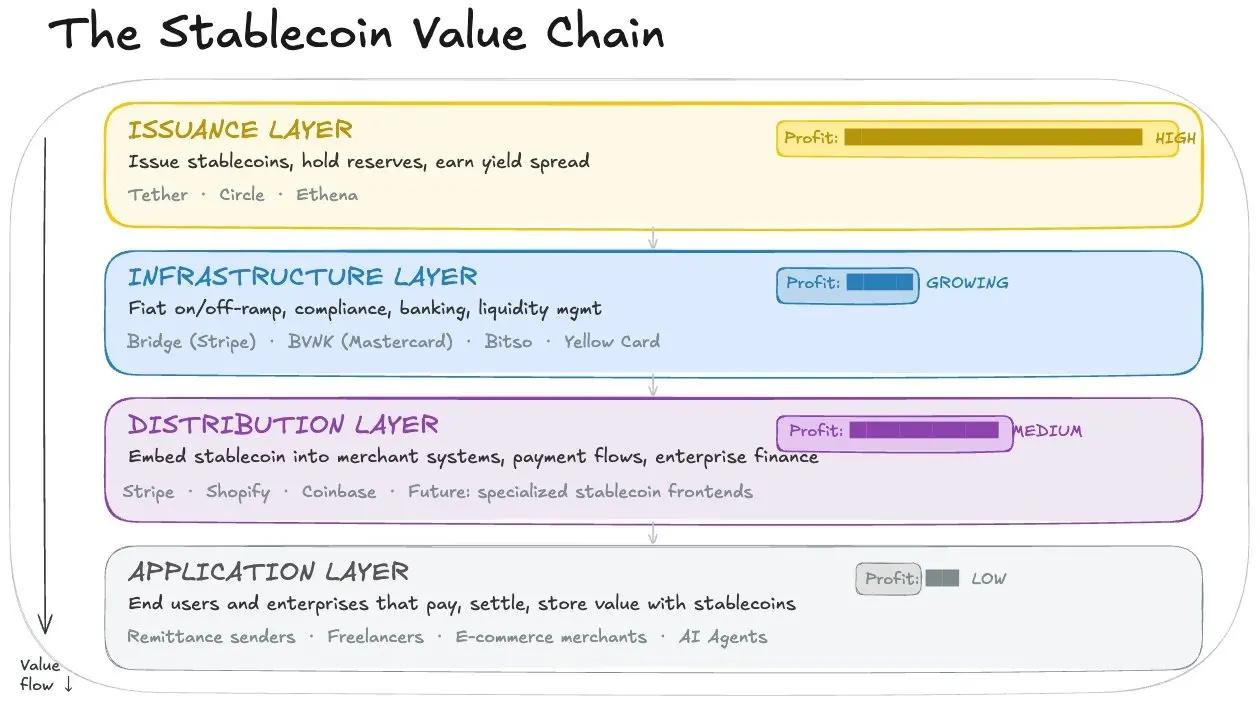
I categorize stablecoins into four layers:

  1. Issuance Layer: Mints stablecoins, holds reserve assets, earns the spread. Representatives: Tether and Circle;
  2. Infrastructure Layer: Connects stablecoins to the real-world financial system—fiat on/off ramps, bank integrations, asset management, compliance. Representatives: Bridge (acquired by Stripe), BVNK (acquired by Mastercard), Bitso, Yellow Card, etc.
  3. Acquiring/Distribution Layer: Embeds stablecoins into merchant systems, manages payment flows, enterprise financial software. Representatives: Stripe, Infini, Coinbase.
  4. Application Layer: End-users and businesses that use stablecoins for payments, settlement, and storage of value.

The Issuance Layer receives user funds and captures the thickest spread; the middle two layers profit from volume, distribution fees, and underlying infrastructure; the Application Layer enjoys convenience but has little bargaining power.

I believe the Infrastructure Layer is currently underappreciated.

It handles the "dirty work": integrating with banks, handling KYC/AML, processing local fiat on/off ramps, connecting merchants, APIs, card networks, and solving settlement and regulatory issues across different countries.

Conversely, this is also where its moat lies. Because technically, transferring USDC on-chain is not the hard part. The real difficulty is penetrating the real world—getting a Latin American company, an African payment provider, or an overseas platform to incorporate stablecoins into their daily cash flows. Someone has to do this dirty work.

The On-Chain Part is Easiest, the Bridge to Reality is Hardest

At first glance, stablecoin payments seem straightforward: fast on-chain transfers, low fees—isn't it just about distributing the product to users?

But the real challenge for stablecoins is the vast gap between the chain and the real-world financial system. Businesses have decision and migration costs; they won't switch their entire workflow just because they heard stablecoins settle in 1 second.

A series of questions arise: How to convert fiat to stablecoins? How to convert back? How to handle reconciliation and taxation? Will the bank block us later? Do users still need to learn how to use a wallet?

The core work of the Infrastructure Layer is bridging the two sides: connecting to the chain and wallets on one end, and to banks, local payment networks, enterprise systems, and compliance on the other.

Stripe's acquisition of Bridge in 2025 bought its stablecoin orchestration system—helping businesses integrate stablecoin capabilities into their operations. Mastercard's announced acquisition of BVNK in March 2026 had similar reasoning.

In other words, traditional payment companies are competing to become the default gateway for businesses using stablecoins.

The key to scaling stablecoin payments lies here.

Paving the Way

Looking further into the Infrastructure Layer:

  1. On/Off Ramps + Currency Exchange. Most business scenarios involve the process "local currency → stablecoin → local currency." This involves banking relationships, compliance, liquidity, and other issues.
  2. API + Account Layer. Businesses need a set of financial capabilities embedded into their workflows—account opening, payments, fund splitting, clearing, reconciliation. This is somewhat like financial SaaS, similar to the Neobank concept.
  3. Payment Network Connectivity. The more payment rails, banks, and regions connected, the more dependent clients become, gradually increasing switching costs.
  4. Capital Efficiency. Helping businesses reduce idle funds, waiting times, and FX losses.

I believe its characteristics dictate a path of initial hardship followed by reward.

  • Grunt Work: It requires connecting banks, achieving compliance, obtaining licenses, and building local teams country by country.
  • Front-loaded Investment to Capture Entry Points: Businesses won't easily switch their payment infrastructure. Those who first secure large clients, banking relationships, compliance pathways, and local fiat rails will later benefit from network effects. Currently, these companies are in a "land grab" phase, far from harvest time.
  • Squeezed by Upstream and Downstream: Upstream issuers take the spread first, while downstream platforms want to control the user interface. The infrastructure layer is in the middle, in an awkward position—"everyone needs you, but no one wants you to earn too much."

Currently, it is in the intermediate stage of moving toward "bargaining power formation."

If we only look at today, the Issuance Layer takes the largest profit, while the Infrastructure Layer is thinner and more capital-intensive.

But if we're talking about how to invest in stablecoins, the seigniorage logic of the Issuance Layer is already well understood by the market, with pricing increasingly revolving around interest rates, regulation, and profit sharing. The Infrastructure Layer is less noticeable today, often simply because it's still in the early investment phase. Bargaining power and user habits haven't fully solidified yet.

Once stablecoins further become the default rails for enterprise funds, the true beneficiaries will be those who, over the years, successfully bridged stablecoins into real-world commercial systems.


Пов'язані питання

QAccording to the article, how many layers is the stablecoin ecosystem divided into? Name them.

AThe stablecoin ecosystem is divided into four layers: 1. Issuance Layer, 2. Infrastructure Layer, 3. Acquirer/Distribution Layer, and 4. Application Layer.

QWhich layer does the author believe is currently undervalued or underappreciated, and why?

AThe author believes the Infrastructure Layer is currently undervalued. It's considered less glamorous because it involves difficult 'dirty work' like bank integration, KYC/AML, local fiat on/off-ramps, merchant onboarding, and solving cross-border regulatory issues. However, this complexity also creates its moat.

QWhat is the core challenge for enabling widespread stablecoin payment adoption, as described in the article?

AThe core challenge is bridging the gap between the blockchain and the real-world financial system. While moving tokens on-chain is technically simple, the real difficulty lies in integrating stablecoins into business workflows, handling fiat conversions, accounting, tax compliance, and overcoming enterprise decision and switching costs.

QWhat strategic moves by traditional payment companies (Stripe and Mastercard) does the article mention, and what is their goal?

AThe article mentions Stripe's acquisition of Bridge in 2025 and Mastercard's announcement to acquire BVNK in 2026. Their goal is to secure the role of becoming the default gateway/entry point for businesses wanting to integrate stablecoin capabilities into their operations.

QWhat are the three key characteristics of the Infrastructure Layer that make it a 'first bitter, then sweet' business?

A1. It involves hard 'dirty work' requiring country-by-country bank integrations, compliance, licensing, and local team building. 2. It requires significant upfront investment to capture market entry points (clients, banking relationships, compliance paths) before network effects can develop. 3. It is squeezed between the profitable upstream Issuance Layer and the downstream platforms that want to control user access, making its position initially precarious.

Пов'язані матеріали

Dylan Patel: Founder of SemiAnalysis, Praised by Jensen Huang, is a 'Beekeeper' and 'Forum Enthusiast'

Dylan Patel, founder of the independent research firm SemiAnalysis, has an unconventional background. A former beekeeper from rural Georgia, he entered the semiconductor world as a self-taught "forum warrior," discussing chip technology anonymously online from a young age. He launched the SemiAnalysis blog in May 2020, which later transitioned to a paid subscription model. The firm has grown from a one-person operation to a global team of around 60, with a dedicated teardown lab. Its detailed, technically-focused analysis on semiconductor supply chains, AI infrastructure, and products has earned significant industry recognition. Notably, NVIDIA founder Jensen Huang has publicly cited their reports. In a landmark case, a critical 2024 report on AMD's MI300X GPU software stack led to a 90-minute call with AMD CEO Lisa Su, who thanked him for the constructive feedback. SemiAnalysis later acknowledged AMD's improvements. The firm's influence on markets was seen when a report on NVIDIA's Rubin memory configuration was partially shared, affecting memory stock prices. Dylan Patel emphasized the importance of context, contrasting the shared excerpt with the report's actual title. SemiAnalysis, now a multi-faceted consultancy with revenue projected to reach $100 million, is known for its deep technical insights that influence major industry players and investment decisions.

marsbit7 хв тому

Dylan Patel: Founder of SemiAnalysis, Praised by Jensen Huang, is a 'Beekeeper' and 'Forum Enthusiast'

marsbit7 хв тому

Dylan Patel: SemiAnalysis, Praised by Jensen Huang, is Founded by a 'Beekeeper and Forum Warrior'

Dylan Patel, founder of the independent research firm SemiAnalysis, has an unconventional background. Growing up in rural Georgia, he later worked as a beekeeper in Minnesota. His entry into semiconductors began as a self-taught "forum warrior," engaging anonymously in online tech communities from a young age. In May 2020, he started the SemiAnalysis blog on WordPress, later moving it to Substack as a paid subscription service. The firm has since evolved from a one-person operation into a global company with around 60 employees, featuring a dedicated chip teardown lab. Its revenue, reaching $20 million last year, is projected to surpass $100 million this year. SemiAnalysis is highly regarded in the AI and semiconductor industry for its deep technical analysis. NVIDIA founder Jensen Huang has publicly praised its reports. In a notable instance, a critical report on AMD's MI300X GPU software shortcomings prompted a 90-minute call with CEO Lisa Su, who thanked Patel for the "constructive feedback." A later report acknowledged AMD's subsequent improvements. The firm's analyses have significant market impact. For example, a June report discussing potential memory configuration changes in NVIDIA's next-generation servers was cited as a factor in pressure on memory-related stocks. Patel plans to establish a venture capital firm, having already made personal investments in about 20 startups. SemiAnalysis combines roles as a consultancy, model platform, and tech lab, focusing on the practical bottlenecks in AI infrastructure.

Odaily星球日报12 хв тому

Dylan Patel: SemiAnalysis, Praised by Jensen Huang, is Founded by a 'Beekeeper and Forum Warrior'

Odaily星球日报12 хв тому

Ethereum Q1 Report: On-chain Activity Hits Record High, Tokenized Assets Lead the Industry

Ethereum Q1 2026 Report: On-chain activity hits record high, tokenized assets lead the industry. In Q1 2026, Ethereum's network experienced a unique divergence: on-chain activity soared while USD-denominated metrics declined. Monthly active users reached 13.2 million, transactions hit 200.4 million, and TPS averaged 25.78, all setting new highs. However, total value locked (TVL) fell 11.0% to $316.2B, DEX volume dropped 24.0% to $134.5B, and ETH's fully diluted market cap fell 30.3% to $290B. A key driver was the Blob Parameter Fork (BPO#2) in January, which increased data capacity and caused a sharp 47.9% drop in layer-1 transaction fees despite higher usage. Etherean's tokenized asset market cap reached $203.4B, up 42.9% year-over-year. While stablecoins ($178.9B) saw a slight dip, tokenized funds ($19.4B, +73.1% YoY), commodities ($4.7B, +325.9% YoY), and stocks ($365.1M) grew strongly. Ethereum dominates cross-chain comparisons, holding 71% of TVL, 79.2% of active loans, 61.8% of stablecoins, and 73% of tokenized funds among top chains. The report highlights a "Jevons Paradox" scenario: network expansion reduces per-transaction costs but unleashes latent demand, driving long-term growth. Ethereum's strategy mirrors Amazon's early focus on scale over profit. Its open, neutral foundation is seen as critical for institutional adoption, as evidenced by growing activity from firms like BlackRock and JPMorgan. The roadmap targets further scalability, aiming for thousands of TPS by 2029 to solidify its role as a global financial settlement layer.

marsbit15 хв тому

Ethereum Q1 Report: On-chain Activity Hits Record High, Tokenized Assets Lead the Industry

marsbit15 хв тому

Торгівля

Спот
Ф'ючерси
活动图片