When the World Cup Collides with Agents: From Web2 to Web3, How Are Wallets Evolving into Agentic Wallets?

marsbitОпубліковано о 2026-06-19Востаннє оновлено о 2026-06-19

Анотація

World Cup as a Catalyst for Agentic Wallets: From Web2 to Web3 This article explores how the World Cup provides a real-world scenario for observing the evolution of digital wallets from simple asset managers towards "Agentic Wallets"—intelligent, AI-powered interfaces. Using the example of prediction markets like Polymarket, it illustrates how AI Agents can lower the barrier to Web3 interaction. Instead of navigating complex DApps, users can express intent in natural language (e.g., "I think Portugal will win") within platforms like Discord or web pages. The Agent then interprets this intent, finds the relevant market, and seamlessly guides the user through the on-chain transaction via their wallet. The core shift is from wallets as mere "function menus" for signing transactions to "intent interpreters" that understand user goals. The article highlights parallel developments in traditional finance, such as Mastercard's "Agent Pay" and WeChat Pay's AI tests, which focus on granting AI controlled, authorized, and auditable payment capabilities. This underscores a broader trend of AI entering the financial layer. However, the article emphasizes that the primary challenge for Agentic Wallets in Web3 is not automation but establishing clear security boundaries. Unlike traditional systems with chargebacks, on-chain transactions are often irreversible. Therefore, future wallets must ensure users retain ultimate control and comprehension. They need to transparently communicate an ...

The World Cup is an excellent scenario for observing changes in wallets.

Daily fan discussions about team qualifications, changes in championship odds, etc., become tradable, priced behaviors in prediction markets like Polymarket. Therefore, World Cup prediction events integrated by mainstream Web3 wallets, viewed over a longer timeline, can indeed be considered a lightweight entry point and starting point for users to engage with on-chain interactions (Extended reading: The World Cup Frenzy, Prediction Markets Take the Stage: How Are Polymarkets Tearing Open a Portal for Mass Adoption?).

Simultaneously, another earlier but more imaginative change is worth noting: when AI Agents begin to enter the wallet scenario, the way users interact with the on-chain world is also poised to change.

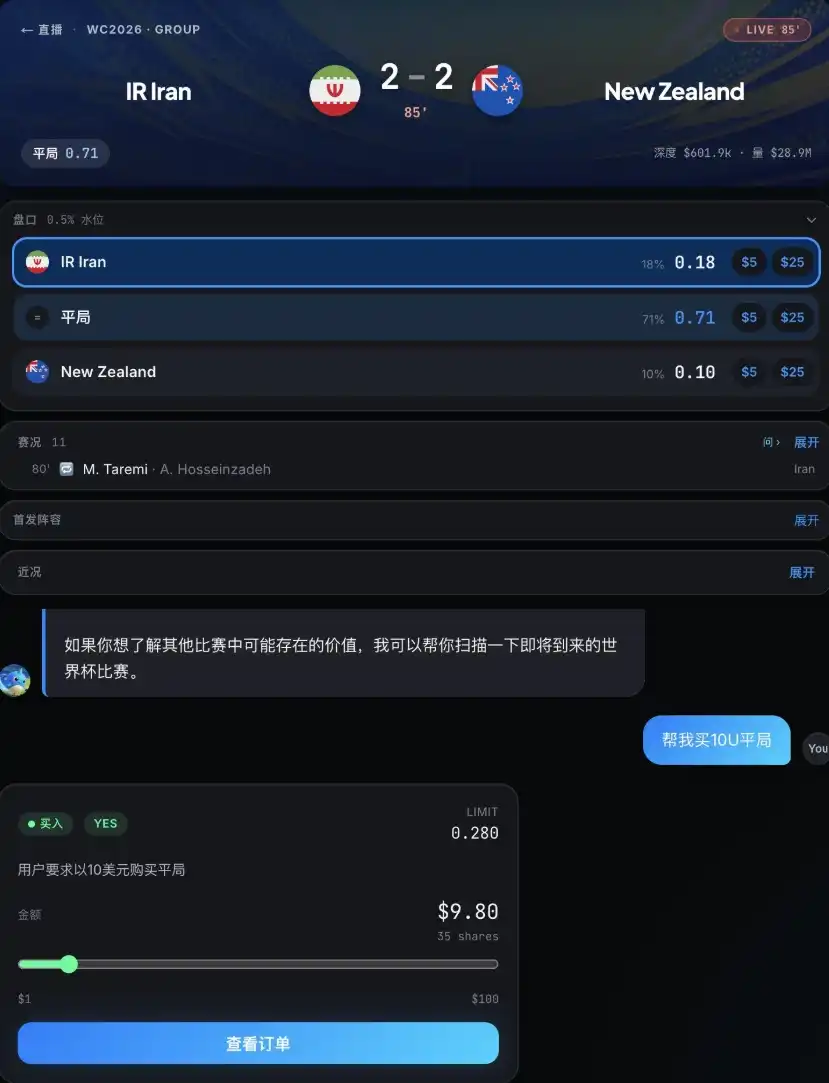
For instance, in this World Cup-related exploration, imToken started experimenting with integrating AI Agents into actual use cases. Features like the web-based proxy and the one in Discord can help users more naturally complete betting transactions based on specific prediction needs, allowing users to no longer operate solely within the wallet app but to easily participate in prediction markets in scenarios like Discord or web pages, seamlessly guided back on-chain by the Agent.

This could very well be an early form of the Agentic Wallet—the future Web3 wallet might not be limited to a wallet application but will likely be an 'AI wallet form' that is as ubiquitous as possible.
I. The World Cup Experiment: When Agents Start Understanding 'Intent'

Returning to our perennial question, over the past decade, the core problem wallets solved was clear: where assets are stored, who controls the private key, and who signs transactions.

For example, when users open imToken, it's mainly to check balances, perform transfers/interactions, and manage multi-chain assets. Consequently, wallets at this stage resemble asset and signature gateways. It's sufficient for users to know what they plan to do and then use the wallet to complete the final step.

But the change in the Agentic era lies in the fact that users might not initially know what they need to click.

In a World Cup scenario, an average user might not first think, 'I need to open Polymarket, find a specific market, evaluate the odds, and complete the transaction.' They are more likely to say, 'What are the highlights of tonight's match?', 'I'm confident Portugal will qualify; are there relevant markets?', 'Is this betting line already too low?', or 'If I just want to participate with a small amount, what's the process?'

Previously, these questions might have been scattered across WeChat groups, social media discussions, or search engines, requiring users to piece information together and execute step by step. However, with Agent intervention, the interaction method has changed significantly: users only need to express a general intent, and the Agent will proactively break it down into a path, with the wallet then responsible for turning that path into a series of on-chain actions.

So, this is definitely not as simple as adding a chat box to the wallet.

The real change is that wallets are starting to evolve from 'function menus' into 'intent interpreters.' Previously, wallets primarily required users to decide whether to transfer, swap, stake, or connect to a DApp? Future wallets might be more straightforward, requiring users to simply tell them in natural language what they want to accomplish.

This is why a mass event like the World Cup is well-suited as an entry point for Agentic Wallets. It naturally provides context, users naturally have the desire to express themselves, and they naturally need to make judgments. The Agent doesn't need to start by managing complex asset portfolios for users, especially those involving intricate asset management with higher risks. It can first help users find interaction paths within a specific scenario before handing final control back to the wallet and the user.

The web-based and Discord-based proxies capable of on-chain interaction mentioned at the beginning of the article, which imToken piloted, are typical examples. They bring wallet capabilities to a lighter-weight entry point, allowing users to find interaction paths through an Agent on an event page, within a World Cup scenario, without necessarily first opening the app or entering the traditional DApp browser.

This indicates that the boundaries of wallets are expanding outward.

Previously, wallet entry points were relatively clear: users opened the app, entered the asset page, clicked functions, and connected to DApps. Future wallet entry points might be scattered across more places, such as web pages, Discord, Telegram, AI chat boxes, event pages, developer tools, or even a lightweight wallet interface generated by the user.

From this perspective, World Cup predictions are not the main point; the key is that they allow wallets, for the first time, to more naturally position themselves ahead of 'user intent.'

II. From Agent Pay: AI is Entering the Payment Layer

If viewed only within the Crypto sphere, Agentic Wallets might still be easily understood as a narrative concept—AI helping users watch markets, find opportunities, and make trades, sounding reminiscent of the last wave of AI Agent hype.

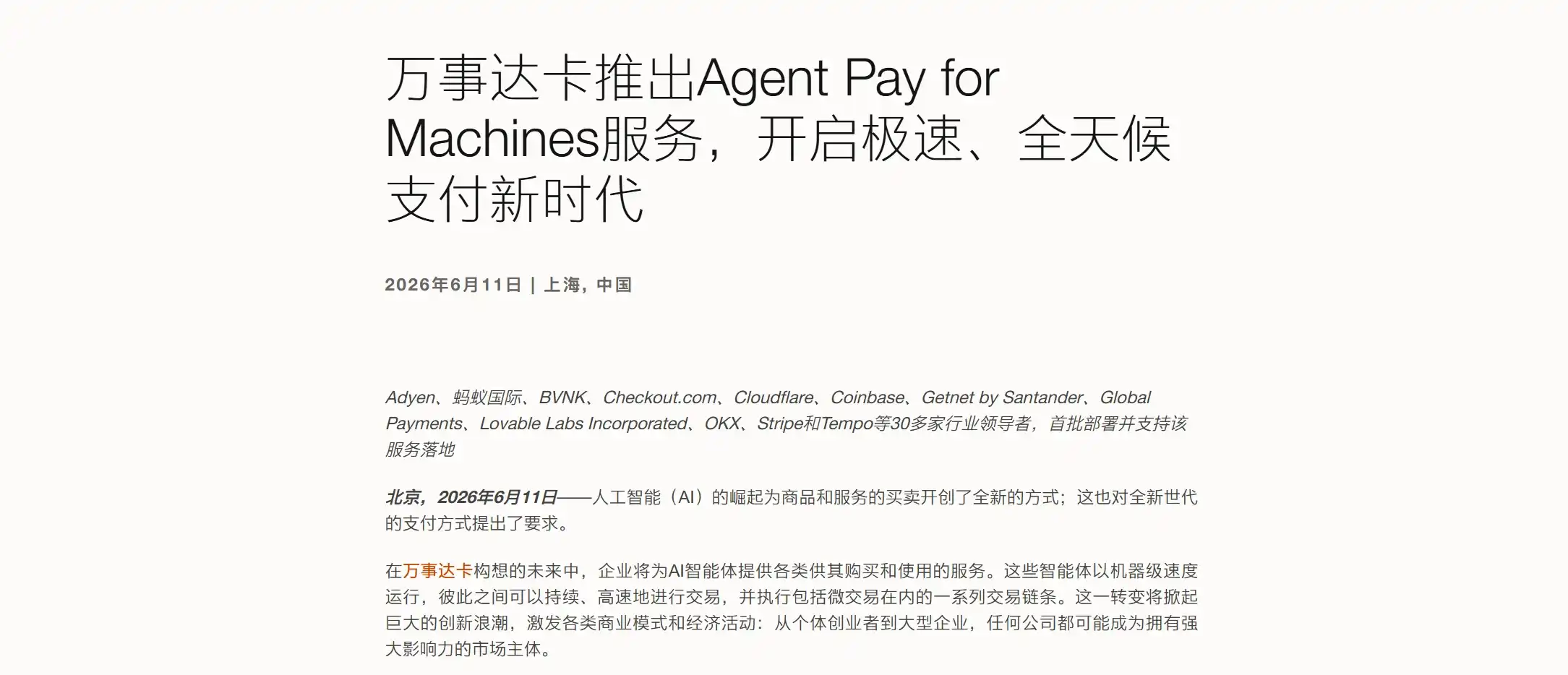
But Mastercard's launch of Agent Pay for Machines on June 10th suddenly made this matter extend beyond Web3.

Mastercard's definition of Agent Pay is clear: enabling trusted AI Agents to participate in payments with user authorization, including how Agents are identified, authorized, verified within the payment network, and how merchants, issuers, and users know a transaction was assisted by an Agent.
This is highly similar to the problems faced by Web3 wallets.

When AI only helps you write copy, the cost of errors is usually manageable. But once AI starts participating in asset interactions, the problem shifts: does it actually have permission? Is its understanding of user intent accurate? Are the services it calls trustworthy? Does the transaction it initiates exceed boundaries? If the outcome doesn't match user expectations, who provides recourse?

Mastercard's answer is to redesign the 'trusted Agent's' identity, tokens, authorization, risk control, and dispute handling within the payment network.

This signal is crucial. If the Agentic concept in the Web3 circle still carries a bit of geeky imagination, the fact that traditional financial giants are starting to design payment infrastructure for Agentic Commerce indicates this has entered a more realistic business context.

Looking closer, domestic payment giants are also moving in this direction. WeChat Pay is testing AI payment features in collaboration with Tencent's intelligent agent product WorkBuddy, such as launching an 'AI Exclusive Card' within the WeChat wallet. Based on disclosed information, the core of such products is not to let AI spend money arbitrarily but to set boundaries for intelligent agent payments through methods like recharge limits, payment authorization scopes, and password verification confirmations.

This logic aligns with Mastercard's Agent Pay: AI can participate in payments, but it must be identified, authorized, restricted, and audited.

Web3 wallets face the on-chain version of the same problem. The difference is that traditional payment systems emphasize the network, merchants, issuers, and compliance responsibilities; on-chain wallets emphasize private keys, signatures, authorizations, contract calls, and user self-custody.

Precisely because of this, Agentic Wallets cannot simply copy the traditional payment path. After all, in traditional payments, users can rely on banks, card networks, merchants, dispute resolution, and risk control systems. But in the on-chain world, once a transaction is on-chain, there's often no undo button.

The higher the efficiency brought by AI Agents, the more critical the last line of security defense borne by the wallet becomes. Therefore, future wallets cannot just let Agents 'do things'; they must ensure Agents 'can only operate within user-allowed boundaries.'

This is also why Web3 might actually be more suitable for discussing Agentic Wallets.

III. The Agentic Era: How Are Wallets Redefining On-Chain Interaction?

When many discuss AI Agents, they easily drift towards an extreme imagination: in the future, AI will automatically trade for me, manage my finances, find airdrops, and arbitrage.

This direction is certainly attractive, but for wallets, the real difficulty is not 'automation' but 'a sense of boundaries.'

Because a wallet is not an ordinary application. In ordinary apps, if AI recommends the wrong song, writes the wrong passage, or clicks the wrong page, it's at most an experience issue. But in a wallet, if AI misunderstands an instruction, calls the wrong contract, or grants excessive permissions, it could become a real asset risk (Extended reading: Sign Isn't Just Signing: When an AI Agent Signs for You, Who Holds the Control?).

Therefore, the primary question for Agentic Wallets is not 'how much can AI do for the user?' but 'how does the user know what AI is doing?'

This is also why imToken has consistently emphasized control over the past few years. From self-custody wallets to multi-chain asset management, to today's AI co-creation and Agent exploration, the truly continuous thread isn't about having more and more features, but about users always being able to understand, confirm, and control their digital world.

In the Agentic era, this thread becomes more concrete.

Wallets need to let users understand who this Agent is, what capabilities it can call, how long the authorization lasts, whether it can operate across DApps, when it requires my reconfirmation, whether I can pause or revoke it with one click... These questions might sound tedious, but they are the foundation upon which Agentic Wallets can truly be established.

Because the power of an AI Agent lies precisely in its ability to simplify complex processes. The user says one thing, and the Agent can break it down into a dozen-step execution path. This is good for experience but also a challenge for security. The longer the path and the more intermediate steps, the more the wallet needs to bring key nodes back into the user's view.

Good wallet interactions in the future might not involve showing users more technical details, but translating complex transactions into language users can understand:

  • You are authorizing a specific Agent to call a specific contract within the next 24 hours;
  • This operation can use at most a certain amount of USDC;
  • It can only access World Cup-related prediction markets, not touch your other assets;
  • Each transaction exceeding a certain amount requires reconfirmation;
  • Authorization automatically expires after a set period;
  • You can pause this Agent anytime within the wallet;

This might sound like a distant future, but it's already starting from some small scenarios. The World Cup prediction event is one event-based entry point, and imToken's pilot web-based Agent and Discord Agent are community-based entry points.

Especially at times like these, wallets cannot retreat to the background.

Трендові криптовалюти

Пов'язані питання

QWhat is the main change in the way users interact with the blockchain when AI Agents enter the wallet scene, as discussed in the article?

AThe main change is the shift from users knowing exactly which functions to execute (like transfer, swap, or staking) to users expressing their general intent in natural language. The AI Agent then interprets this intent, breaks it down into actionable steps, and guides the user to complete the corresponding on-chain actions seamlessly.

QAccording to the article, why is the World Cup a suitable entry point for observing the development of Agentic Wallets?

AThe World Cup is suitable because it provides a natural context where users have a strong desire to express opinions, make judgments, and participate in prediction markets. This setting allows AI Agents to help users find interaction paths within a specific, low-risk scenario before tackling more complex asset management, making the transition to Agentic Wallets more user-friendly and gradual.

QWhat key challenge must Agentic Wallets address, as highlighted by the comparison with Mastercard's Agent Pay and traditional payment systems?

AThe key challenge is establishing clear boundaries and control for AI Agents. While AI can enhance efficiency, it must be properly identified, authorized, restricted, and audited, especially when handling financial transactions. Unlike traditional payment systems with built-in safeguards, on-chain transactions are often irreversible, making it crucial for wallets to ensure users understand, confirm, and maintain control over what the Agent is doing.

QWhat is the core principle that should remain consistent for wallets from self-custody to the Agentic era, as emphasized in the article?

AThe core consistent principle is that users must always be able to understand, confirm, and control their digital world. In the Agentic era, this translates to features that let users know who the Agent is, what permissions it has, the duration of its authorization, when reconfirmation is needed, and the ability to pause or revoke its access at any time.

QHow is the physical or conceptual 'entrance' of the wallet changing with the advent of Agentic Wallets?

AThe wallet's 'entrance' is expanding and becoming more ubiquitous. Instead of being confined to a dedicated wallet application, wallet capabilities are beginning to appear in various interfaces like web pages, Discord, Telegram, AI chatboxes, activity pages, and developer tools. This allows users to initiate and complete on-chain interactions from more diverse and lightweight starting points.

Пов'язані матеріали

Behind the AI Scorecards Lies a Chinese 'Question Setter'

Behind the AI scorecards that dominate industry discussions—benchmarks like MMLU-Pro, MMMU, and MMMU-Pro—stands a Chinese-Canadian researcher: Wenhu Chen. As an assistant professor at the University of Waterloo and founder of the TIGER Lab, Chen has become a key "exam-setter" for evaluating large language and multimodal models. Chen first gained broader recognition with MMLU-Pro, a more challenging and stable update to the popular MMLU benchmark. As top models like OpenAI’s o3 began achieving near-perfect scores on the original MMLU, it became difficult to distinguish their true capabilities. MMLU-Pro introduced more complex reasoning questions, expanded answer choices, and filtered out ambiguous or simple items, effectively reintroducing differentiation among state-of-the-art models. His work on MMMU addressed the evaluation of multimodal models, requiring them to integrate visual information (like charts, diagrams, or tables) with textual knowledge across diverse academic subjects. Even the strongest models initially scored only around 56-59%, highlighting significant room for improvement in genuine multimodal reasoning. MMMU-Pro further refined this by preventing models from bypassing visual cues. Chen’s research focus has long been on complex information understanding and reasoning. His background—including a PhD at UC Santa Barbara, research at Google/DeepMind on Gemini, and now a role in Meta’s superintelligence lab—provides deep insight into model development and their potential weaknesses. His TIGER Lab also builds models (e.g., for video understanding and generation), ensuring his evaluation benchmarks are grounded in practical challenges. While AI headlines often spotlight company leaders and product launches, Chen’s work exemplifies the critical, behind-the-scenes contributions of researchers crafting the rigorous standards that define and drive progress in AI capabilities.

marsbit44 хв тому

Behind the AI Scorecards Lies a Chinese 'Question Setter'

marsbit44 хв тому

STRC Unpegged by 11%, Can Strategy's Perpetual Motion Machine Keep Turning?

STRC, the perpetual preferred stock of MicroStrategy, is experiencing a persistent de-pegging from its target par value of $100, with the discount recently widening to over 11%. This de-anchoring challenges the core design of STRC, which was intended as a stable, income-oriented security operating near $100. As a crucial funding engine for MicroStrategy's Bitcoin acquisition strategy, STRC's price reflects market confidence in the company's entire capital model. The company's "capital flywheel" relies on issuing STRC at or above $100 via an At-the-Market (ATM) program to raise cash for buying Bitcoin, thereby boosting company equity and theoretically supporting STRC's value. A monthly adjustable dividend mechanism was designed to maintain this peg. Despite raising the dividend to 11.5% and increasing payment frequency, the de-pegging persists. Market concerns extend beyond technical factors like leveraged arbitrage unwinding. Analysts point to MicroStrategy's limited cash reserves relative to its ~$1.7 billion annual dividend obligation for preferred shares. While the company counters that its vast Bitcoin holdings could cover decades of payments, this argument hinges on the potential need to sell Bitcoin—a shift from its longstanding "hodl" narrative. The company's recent sale of a small amount of BTC, framed as a test, amplified these liquidity and strategy concerns. If STRC remains discounted, impairing MicroStrategy's ability to raise cheap capital, fears may grow that the company could sell more Bitcoin to meet obligations. This scenario could transform MicroStrategy from a major market buyer into a potential seller, posing significant downside risk for Bitcoin. The re-pegging of STRC is thus a key indicator for the health of MicroStrategy's capital structure and its market impact.

Odaily星球日报58 хв тому

STRC Unpegged by 11%, Can Strategy's Perpetual Motion Machine Keep Turning?

Odaily星球日报58 хв тому

Silicon Valley's Most Sought-After New Role Has Emerged

Silicon Valley's New Most Wanted Job: The Rise of the Forward Deployment Engineer The AI industry is witnessing a significant shift. The focus has moved from developing cutting-edge models to deploying them effectively within enterprises. This has made the "Forward Deployment Engineer" (FDE) a critical and highly sought-after role at major firms like OpenAI, Anthropic, and Google. For the past three years, the industry prioritized model scientists. However, companies are now facing a harsh reality: purchasing powerful AI tools does not guarantee productivity gains or organizational change. The biggest hurdle is not the technology itself, but integrating it into complex legacy systems, workflows, and corporate cultures. This includes challenges like data silos, compliance requirements, and internal resistance. The FDE role, pioneered by Palantir Technologies, addresses this "last-mile" problem. FDEs are deployed on-site with clients for extended periods. Their job is to deeply understand the client's specific organizational structure, processes, and pain points, then tailor and implement the AI solution accordingly. They combine skills in technology, project management, and organizational change. A clear signal of this trend emerged in May 2026 when three AI giants made major moves. Anthropic launched a $1.5B joint venture for enterprise deployment. OpenAI formed an independent deployment subsidiary, DeployCo, with over $4B in commitments and acquired a deployment consultancy. Google Cloud's CEO publicly announced a large-scale recruitment drive for FDEs. This shift represents a fundamental change in the software business model: from selling tools to selling guaranteed outcomes. FDEs are the agents of this change, responsible for delivering a working system within the production environment, not just a demo. Real-world cases, such as challenges at Goldman Sachs (compliance barriers) and Target (internal cultural resistance), illustrate that the primary obstacles to AI adoption are organizational, not technical. An FDE's value lies in navigating these human and procedural complexities to facilitate a successful "AI migration." In essence, as core AI technology becomes more accessible and affordable, the true premium is shifting to the human expertise required to understand organizations and drive change—making the FDE role pivotal for the next phase of the AI revolution.

marsbit58 хв тому

Silicon Valley's Most Sought-After New Role Has Emerged

marsbit58 хв тому

Options Don't Work in DeFi? Vitalik Might Not Agree

For years, the prevailing view has been that options struggle to gain traction in DeFi due to complexity, fragmented liquidity, and lack of natural demand compared to products like perpetual futures. However, a recent algorithmic stablecoin design proposed by Vitalik Buterin presents a different perspective, using options not as a standalone trading product, but as foundational infrastructure for other financial instruments. In this design, one unit of ETH is split into two components: a "stable" side (P) that retains value up to a specified strike price, and an "upside" side (N) that captures all appreciation above that strike. Combined, they always equal one ETH, eliminating debt, margin, and liquidation risks inherent in typical collateralized debt position (CDP) stablecoins. The stable component essentially mimics the payoff of a covered call option. To function as a stablecoin, this structure requires continuously rolling deep in-the-money calls, which introduces challenges like rollover slippage, predictable transaction flow vulnerable to front-running, and persistent liquidity needs. A core hurdle is finding consistent buyers for the leveraged ETH upside exposure (N). While it offers leverage without funding rates or liquidation, it must compete with simpler alternatives like direct call options or perpetuals. The system's scalability depends on a sustained demand for this specific form of leverage. The author draws parallels to their experience with Rysk, where earlier versions of DeFi options protocols struggled. The breakthrough came with Rysk V12, which aligns incentives: asset holders generate yield by selling covered calls against their holdings, while market makers efficiently acquire the desired option exposure. This demonstrates that options can find product-market fit when embedded as a risk distribution and pricing engine within structured products, stablecoins, or yield-generating assets, rather than marketed as a complex direct trading instrument. Vitalik's proposal reinforces this architectural approach—using fully collateralized, non-custodial, and physically settled options as a fundamental building block. The real opportunity for options in DeFi may lie not in becoming the next perpetual swap, but in powering the next generation of on-chain financial products.

marsbit2 год тому

Options Don't Work in DeFi? Vitalik Might Not Agree

marsbit2 год тому

Торгівля

Спот
Ф'ючерси

Популярні статті

Як купити F

Ласкаво просимо до HTX.com! Ми зробили покупку Synfutures (F) простою та зручною. Дотримуйтесь нашої покрокової інструкції, щоб розпочати свою криптовалютну подорож.Крок 1: Створіть обліковий запис на HTXВикористовуйте свою електронну пошту або номер телефону, щоб зареєструвати обліковий запис на HTX безплатно. Пройдіть безпроблемну реєстрацію й отримайте доступ до всіх функцій.ЗареєструватисьКрок 2: Перейдіть до розділу Купити крипту і виберіть спосіб оплатиКредитна/дебетова картка: використовуйте вашу картку Visa або Mastercard, щоб миттєво купити Synfutures (F).Баланс: використовуйте кошти з балансу вашого рахунку HTX для безперешкодної торгівлі.Треті особи: ми додали популярні способи оплати, такі як Google Pay та Apple Pay, щоб підвищити зручність.P2P: Торгуйте безпосередньо з іншими користувачами на HTX.Позабіржова торгівля (OTC): ми пропонуємо індивідуальні послуги та конкурентні обмінні курси для трейдерів.Крок 3: Зберігайте свої Synfutures (F)Після придбання Synfutures (F) збережіть його у своєму обліковому записі на HTX. Крім того, ви можете відправити його в інше місце за допомогою блокчейн-переказу або використовувати його для торгівлі іншими криптовалютами.Крок 4: Торгівля Synfutures (F)Легко торгуйте Synfutures (F) на спотовому ринку HTX. Просто увійдіть до свого облікового запису, виберіть торгову пару, укладайте угоди та спостерігайте за ними в режимі реального часу. Ми пропонуємо зручний досвід як для початківців, так і для досвідчених трейдерів.

222 переглядів усьогоОпубліковано 2024.12.21Оновлено 2026.06.02

Як купити F

Обговорення

Ласкаво просимо до спільноти HTX. Тут ви можете бути в курсі останніх подій розвитку платформи та отримати доступ до професійної ринкової інформації. Нижче представлені думки користувачів щодо ціни F (F).

活动图片