What’s Next For The Crypto Market Structure Bill? Key Dates And Turning Points Ahead

bitcoinistОпубліковано о 2026-03-05Востаннє оновлено о 2026-03-05

Анотація

The future of the CLARITY Act, also known as the crypto market structure bill, remains uncertain after the March 1 deadline passed without a breakthrough. Despite concerns, negotiations between the banking industry and crypto representatives are reportedly continuing behind the scenes. A key sticking point is the disagreement over stablecoin yields. While there is broad agreement that stablecoin balances should not earn interest, crypto firms are attempting to create alternative mechanisms—such as membership programs, rewards, or staking—that could effectively replicate annual percentage yields (APY). Banking representatives are pushing for any such activity to be clearly defined as "active," "bona fide," and "time-locked." Attention is now turning to the Senate Banking Committee, which is considering potential markup dates in mid-to-late March. This would provide additional time to address unresolved issues, including DeFi provisions and ethics concerns, before a possible vote.

The future of the CLARITY Act — widely referred to as the crypto market structure bill — remains uncertain after the March 1 deadline set by the White House passed without the expected breakthrough between the banking industry and crypto representatives.

Key Hurdle In Crypto Bill Negotiations

Despite concerns that talks may be stalling, reporting from Crypto In America suggests discussions are continuing behind the scenes. Eleanor Terrett cited a banking industry source with direct knowledge of the negotiations who pushed back on the idea that the process is unraveling.

According to that source, both sides are still actively reviewing and contributing to draft legislative language and were never strictly bound to the March 1 timeline. “Overindexing on March 1 is a mistake,” the source said.

Still, tensions remain. Another banking source acknowledged that while there is broad agreement in principle that stablecoin balances should not earn interest, disagreements persist over how that principle should be implemented.

According to this source, crypto companies are attempting to structure alternative mechanisms — such as membership programs, rewards systems, or staking arrangements — that could effectively replicate annual percentage yields (APY) on stablecoin holdings. The source said:

There’s agreement in-principle that stablecoin balances shouldn’t earn interest, but crypto firms are still trying to backdoor APY on balances through membership programs, rewards, and staking. I think that’s what’s holding up the deal right now.

Bank representatives are reportedly pushing for any lending or staking activity to be clearly defined as “active,” “bona fide,” and “time-locked,” meaning returns must be tied strictly to genuine investment performance rather than resembling passive interest.

Senate Banking Eyes March Markup

On Capitol Hill, attention is turning to procedural milestones. The Senate Banking Committee is reportedly considering potential markup dates in mid-to-late March.

Such a timeline would give negotiators several additional weeks to address unresolved matters, including decentralized finance (DeFi) provisions and ethics-related concerns, before the bill advances to a possible vote.

Amanda Tuminelli, executive director of the DeFi Education Fund, said DeFi discussions have recently taken a backseat to the yield dispute but described the broader process as progressing. She further noted:

I think overall things are moving, and it feels like issues are being closed out, but DeFi has taken a backseat to the yield conversation. We’re waiting for Senate Banking to announce the next markup date and updated text, so I think everyone is anxiously awaiting to see what the next draft looks like.

For now, the path forward hinges on resolving the stablecoin yield dispute and finalizing legislative language that can satisfy enough stakeholders to move ahead.

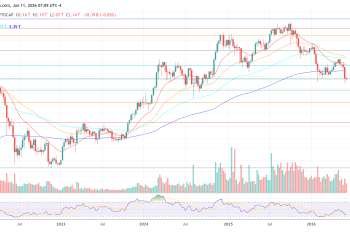
The daily chart shows the total market cap valuation’s drop toward $2.3 trillion. Source: TOTAL on TradingView.com

Featured image from OpenArt, chart from TradingView.com

Пов'язані питання

QWhat is the main reason the crypto market structure bill (CLARITY Act) did not meet the March 1 deadline?

AThe main reason is a disagreement over how to implement the principle that stablecoin balances should not earn interest. Crypto companies are attempting to create alternative mechanisms like membership programs or staking to effectively replicate yields, which is causing a hold-up.

QAccording to the article, what are banking representatives insisting on regarding lending or staking activities?

ABanking representatives are pushing for any lending or staking activity to be clearly defined as 'active,' 'bona fide,' and 'time-locked.' This means returns must be tied strictly to genuine investment performance rather than resembling passive interest.

QWhat is the next key procedural milestone for the Senate Banking Committee regarding this bill?

AThe Senate Banking Committee is reportedly considering potential markup dates in mid-to-late March, which would give negotiators several additional weeks to address unresolved issues.

QWhich specific issue has recently taken a backseat in the negotiations, according to Amanda Tuminelli?

AAccording to Amanda Tuminelli, discussions concerning decentralized finance (DeFi) provisions have recently taken a backseat to the yield dispute over stablecoins.

QWhat is the primary condition for the bill to move forward, as stated in the article's conclusion?

AThe path forward hinges on resolving the stablecoin yield dispute and finalizing legislative language that can satisfy enough stakeholders to move ahead.

Пов'язані матеріали

Can Generative Models Finally Be Trained End-to-End? The Core Is a For Loop

This article introduces a novel training paradigm for generative models called Explorative Modeling (XM), which enables true end-to-end training. Traditionally, powerful generative models like autoregressive and diffusion models are not trained end-to-end. They are trained to predict a single small step but require iterative multi-step sampling for inference. This "exposure bias" leads to error accumulation and limits performance. The core challenge XM addresses is "mode blurring." In generative tasks, a single input (e.g., "generate a dog") corresponds to many valid outputs (multiple modes). Standard training objectives like reconstruction loss force the model to average these modes, producing unrealistic, blurry outputs. To avoid this, existing models break generation into many small, almost deterministic steps, sacrificing end-to-end training. XM tackles this by restructuring the training loop itself. Its key insight is to amplify "generative expressivity." For each training input, instead of generating one sample, the model generates K candidate outputs. Only the candidate closest to the real data is used for computing the loss and updating the model via backpropagation. This simple "best-of-K" mechanism is implemented as a short for-loop. By exploring multiple possibilities, the model learns to distribute its guesses across different modes rather than collapsing to their uninformative average. The paper demonstrates that "exploration" acts as a new, powerful scaling axis. Gains from XM increase with model size, data scale, and compute. Experiments show improvements in FID scores for image generation and significant efficiency gains, sometimes outperforming larger models without exploration. When pushed to the limit, XM enables fully single-step, end-to-end generative models. In robotics tasks, an "Explorative Policy" matched the performance of a 100-step Diffusion Policy with a single forward pass, drastically improving inference speed. While the best-of-K concept is not entirely new, the authors' contribution lies in formally understanding it as a direct method to boost generative expressivity without fragmenting the generation process. This work suggests that as models scale, enhancing exploration during training may become crucial for overcoming fundamental performance bottlenecks.

marsbit11 хв тому

Can Generative Models Finally Be Trained End-to-End? The Core Is a For Loop

marsbit11 хв тому

Annual Salary of Millions Competing for Electricians, Meta Rushes to Open Its Own Technical School

The AI boom is facing an unexpected bottleneck: a severe shortage of skilled construction workers and electricians. As tech giants like Meta, OpenAI, and Alphabet race to build massive data centers—such as OpenAI's $16 billion "Stargate" project—they are hitting a critical labor wall. The U.S. needs an estimated 130,000 more electricians, 240,000 construction workers, and 150,000 supervisors by 2030 for AI infrastructure alone, but tens of thousands of electrician jobs go unfilled each year. While AI companies offer high premiums, with electricians earning up to $280,000 annually, worker scarcity still causes massive losses—delays on a single project can cost $14.2 million per month. The complexity of building AI data centers, which require immense power (equivalent to powering hundreds of thousands of homes), sophisticated electrical systems, and advanced liquid cooling solutions, demands highly skilled technicians who are in short supply. To combat this, companies are investing heavily in training. Meta has committed $115 million to a free training school offering tuition, housing, and stipends, targeting 5,000 new workers. OpenAI is partnering with unions to secure skilled labor. These efforts are paying off, with a significant rise in Gen Z interest in trade schools over college. However, the power demands are staggering. AI data centers are driving a rapid surge in electricity consumption, projected to account for up to 12% of U.S. power use by 2028 and raising costs for consumers. Furthermore, the construction boom is project-based, leading to a potential future glut of trained workers once building peaks, which could depress wages industry-wide. The race for AI supremacy now depends as much on skilled hands as on advanced chips.

marsbit1 год тому

Annual Salary of Millions Competing for Electricians, Meta Rushes to Open Its Own Technical School

marsbit1 год тому

Торгівля

Спот
活动图片