What Is the Cost of Bitcoin Mining Companies Going All-In on AI?

marsbitОпубліковано о 2026-08-18Востаннє оновлено о 2026-08-18

Анотація

Bitcoin mining companies are undergoing a massive transformation, pivoting from cryptocurrency mining to AI infrastructure and high-performance computing (HPC) services. This shift is driven by the severe profitability crisis in Bitcoin mining following the 2024 halving and the October 2025 market crash, which pushed mining costs as high as $140,000 while Bitcoin's price fell to around $63,000. In response, major public miners like Core Scientific and TeraWulf are rebranding as "energy infrastructure platforms" or "AI cloud service providers." Their revenue structures have flipped, with AI/HPC hosting now constituting over 70-80% of quarterly revenue, dramatically surpassing declining Bitcoin mining income. They are securing massive, long-term contracts worth tens of billions of dollars with tech giants like AMD, CoreWeave, and Anthropic, locking in future cash flow. However, this all-in bet on AI carries significant risks. The AI compute market lacks Bitcoin's self-correcting mechanism, where unprofitable miners exit, reducing network difficulty and boosting profitability for those who remain. An AI compute supply glut could rapidly drive prices down, making today's lucrative long-term contracts burdensome. Furthermore, the transition is largely one-way; retrofitting facilities for AI and signing decade-plus contracts makes it nearly impossible to return to mining when its profitability eventually rebounds. Some companies, like Marathon Digital and Hut 8, are taking a mor...

Written by: Prathik Desai

Compiled by: Luffy, Foresight News

Over the past year, every major publicly-traded Bitcoin miner has faced a survival crisis. A look at their financial reports reveals they are shedding their identity as "miners."

Now they are repackaging and repositioning themselves, calling themselves "energy infrastructure platforms," "vertically integrated AI cloud service providers," or "digital infrastructure enterprises built on electricity, land, and computing power."

Behind this rebranding lies a transformation in their revenue structure, with their market capitalization now exceeding valuations from when they were purely Bitcoin mining companies.

On the surface, the story seems wonderful. Struggling miners have seized the opportunity, embraced the explosive demand for AI inference computing power, and found a path to self-rescue. But if we take a broader perspective, they are also giving up some crucial things.

This article will explain why a 180-degree shift away from Bitcoin mining could backfire on miners in the future.

What Sparked This Transformation?

The Bitcoin block reward halving in April 2024 forced miners to make a choice: either mine Bitcoin, hold it, and wait to sell at a higher price, or retrofit their hardware to diversify into high-performance computing (HPC). In October 2024, Bitcoin's price rose from below $70,000, peaking at $124,000 in October 2025. This rally led some miners to continue mining and hoarding their output.

However, the market liquidation event on October 10, which wiped $19 billion from the crypto market's capitalization within 24 hours, triggered a downturn that has yet to be fully recovered from.

The current Bitcoin price of around $63,000 is nearly halved from last October's high. At this level, selling mined Bitcoin yields almost no profit. Bitcoin mining costs are affected by both electricity prices and network difficulty. The comprehensive mining cost rose from about $40,000 in February 2024 to a range of $90,000-$110,000 between October 2025 and July 2026. By August this year, Bitcoin's comprehensive mining cost hit a new high, soaring to $140,000.
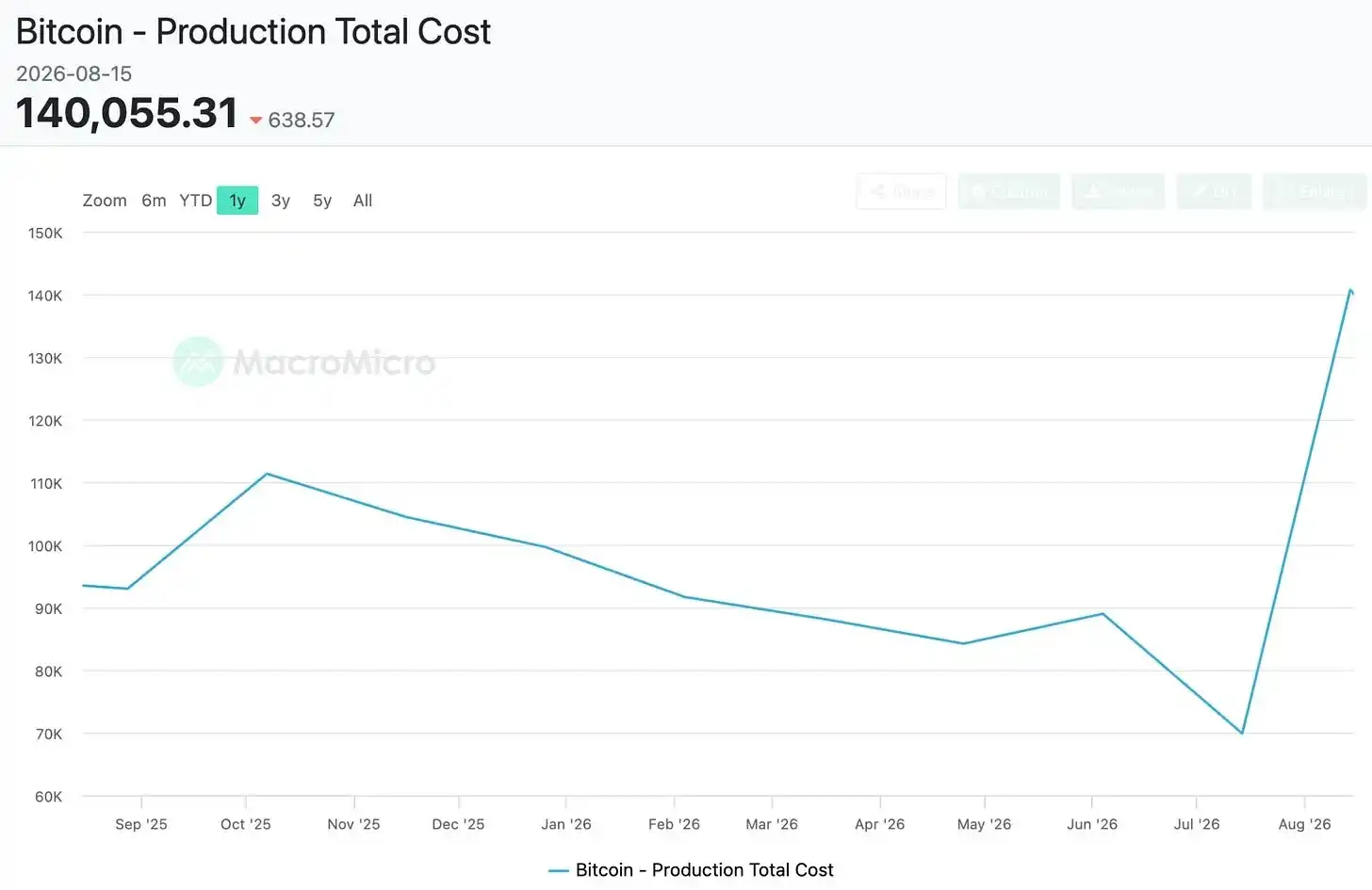
Source: MacroMicro

During the same period of worsening mining conditions, massive capital has flooded into the AI inference sector.

Bitcoin miners use ASIC chips to run complex algorithms and obtain block rewards. This hardware infrastructure is highly similar to the underlying requirements for high-performance computing and AI inference. This makes the transition to AI inference less daunting for miners, significantly lowering the barrier to entry. For miners seeking profitable outlets, pivoting to AI seems like a natural move.

Almost the entire listed mining sector has collectively changed course. The shift in revenue structure over the past few quarters vividly illustrates the scale of this transformation.

Take Core Scientific as an example: In Q2 2025, data center hosting services for AI and HPC generated only $10.6 million in quarterly revenue; during the same period, revenue from mining and selling Bitcoin was $62.4 million. Twelve months later, their positions were almost completely reversed. In Q2 2026, hosting revenue was $136.7 million, while mining revenue shrank by 65% to $21.5 million.

The proportion of hosting revenue to total company revenue skyrocketed from 14% last year to 83%.

TeraWulf's HPC leasing revenue already accounts for 71% of its total revenue. This business line had no revenue in the same period last year but reached $32 million in Q2 2026; during the same period, crypto asset mining revenue shrank by about 75%, remaining at only $13 million.
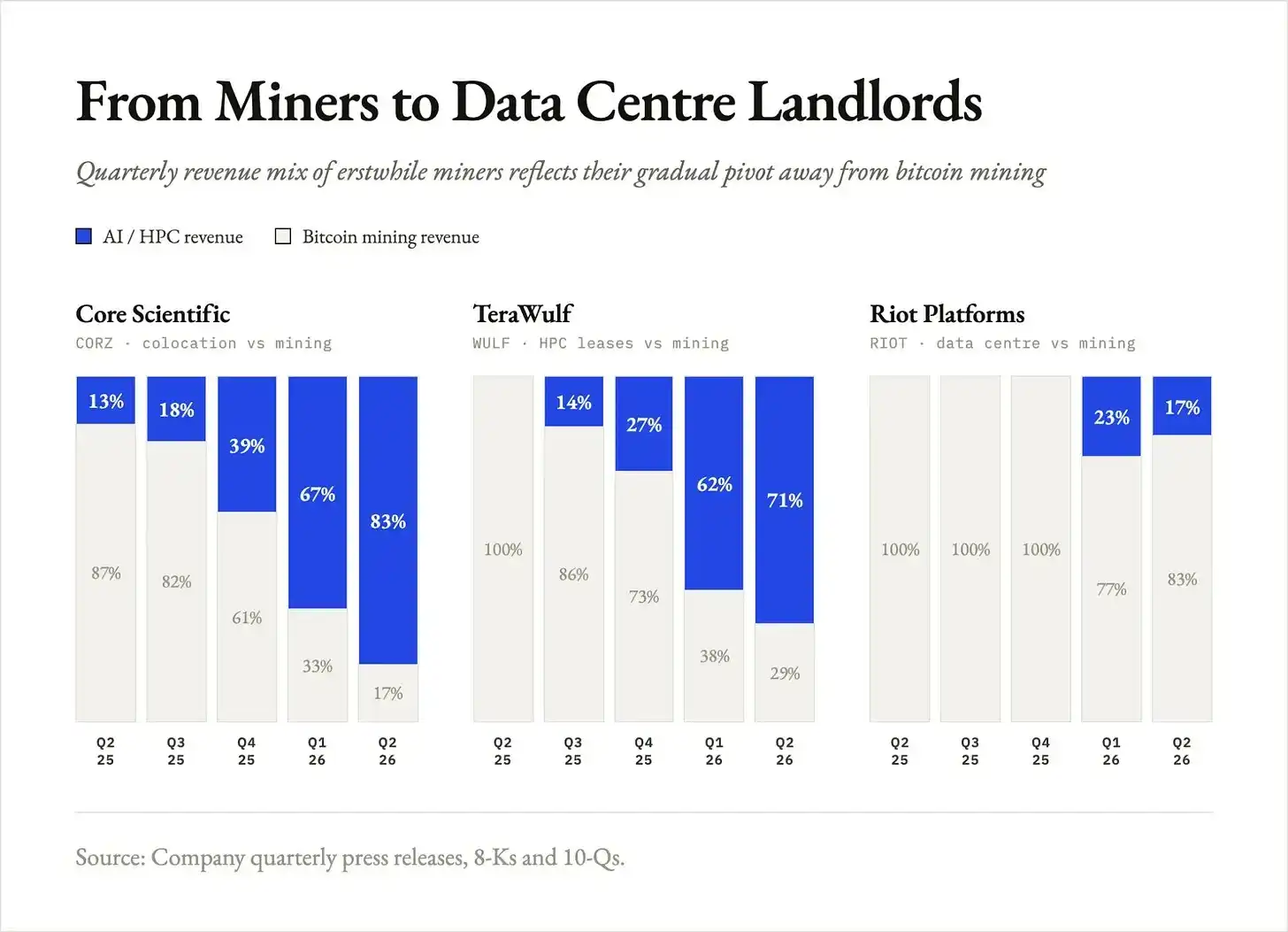
Many miners are also retrofitting their existing mining facilities and hardware to accommodate AI and HPC businesses.

A Worrisome Land Grab

The shift from Bitcoin mining to AI computing power has turned into a collective stampede. Beyond allocating existing capacity to AI, former Bitcoin miners are frantically securing electricity, land, and signing numerous demand orders. The total value of contracts already in place amounts to tens of billions of dollars.

Core Scientific has committed up to 2.5GW of available computing capacity to AMD and CoreWeave, with potential total revenue exceeding $24 billion over the contract period. Hut 8 holds 949 megawatts of contracted computing power with a base contract value of $26.6 billion and has secured $7.5 billion in new project financing.

TeraWulf signed a 20-year lease agreement worth approximately $19 billion with Anthropic and acquired a gigawatt-scale campus in Kentucky to meet computing demand. Over the past six months, Riot Platforms completed multiple leases totaling 241 megawatts, corresponding to a contract size of about $10 billion. Just last week, IREN delivered its first batch of AI cloud deployment nodes to Microsoft—a five-year contract valued at $9.7 billion; it also secured a 5GW partnership with Nvidia and continues acquiring power sites in Texas and Spain to supply computing needs.

This series of massive contracts has ignited market enthusiasm. Compared to miners' past businesses, signing 20-year leases with leading cloud providers promises more stable cash flow. After a full year of mining losses, locking in contracts for up to fifteen years seems like solid, tangible reality.

However, much market commentary underestimates the hidden risks.

Despite the hardship of mining, Bitcoin mining possesses a characteristic that AI hosting lacks: a self-healing mechanism. When mining becomes unprofitable, miners shut down their machines; when enough miners exit, the Bitcoin network difficulty automatically adjusts downward. The remaining miners, with the same equipment and electricity costs, can achieve higher returns.
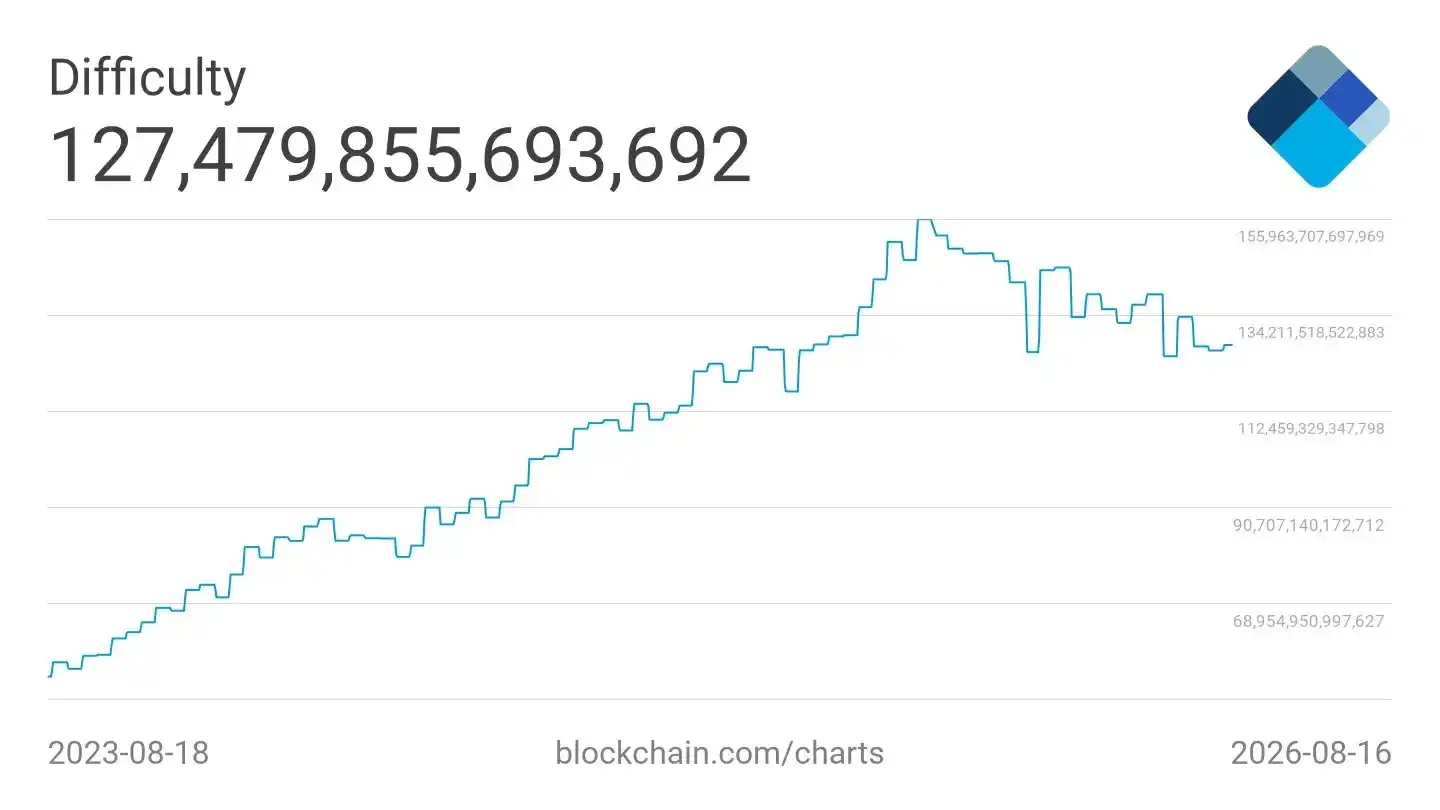
After many miners switched to the AI sector, Bitcoin's network difficulty has dropped from its peak of around 156 trillion in 2025 to 127.5 trillion. Every company exiting mining is making the mining rewards higher for those who remain.

However, the AI computing power industry lacks this automatic adjustment mechanism. If too many players flood in, causing an oversupply of computing power, prices will be driven down.

Although overall demand for AI computing is rising, prices may actually fall—seemingly contrary to basic economic principles. In fact, several AI companies have already lowered their service prices. In the early days of the industry, with hardware and supporting resources scarce, service providers could charge high premiums. Now, cloud giants worldwide are competing for megawatt-level power resources, and this scarcity has attracted a large number of Bitcoin miners and data center operators to massively expand capacity. Once new supply fills the demand gap, computing power prices will decline rapidly.

When prices fall, the 15-20 year long-term leases miners are signing at today's high prices will look prohibitively expensive in hindsight.

There is another tricky aspect to this transition: the path is largely one-way. Converting a mining facility into an AI computing campus is straightforward; the power infrastructure is already in place. But once you replace ASIC miners with H100 GPUs and sign a 20-year lease, you'll be tightly bound by this contract for the next two decades, unable to easily switch back to mining.

When market cycles reverse in the future, with Bitcoin prices breaking away from the $60,000 low and network difficulty decreasing, mining will inevitably become profitable again. By then, former miners who have completely transformed, constrained by multi-year long-term leases, can only watch the opportunity pass by. Worse still, if the actual revenue from AI computing falls short of the optimistic expectations at signing, a double blow will follow.

So, should miners not transform and just wait patiently for the mining cycle to turn? I don't think so. For most companies, transformation is a forced choice for survival. With a comprehensive mining cost of $140,000 and the coin price at only $63,000, continuing to mine is commercially unviable; AI is the only immediate lifeline.

But the will to survive drives companies to make extreme choices. The risk lies precisely with those players who go all-in on AI: forced by survival pressure, they completely abandon Bitcoin mining, destroy/replace all ASIC miners, and lock themselves into decades-long contracts in a nascent industry that will still experience price corrections.

However, not all miners have chosen a complete 180-degree turn; some companies have been more cautious.

Those With Hedging Options Hold the Advantage

Marathon Digital, the listed mining company with the largest Bitcoin treasury, has taken a cautious path. In Q2 2026, it sold 30% of its Bitcoin holdings to reduce debt, but it has not abandoned its Bitcoin mining equipment. Instead, it chose another way to fund its AI expansion.

MARA used its remaining Bitcoin as collateral to secure $150 million in funding through a 2026 credit facility to finance its AI business expansion. As of June 30, its balance sheet still holds over 35,000 Bitcoins while maintaining a flexible, load-adjustable mining operation.

Hut 8 has also not abandoned mining. It spun off its Bitcoin mining business into a new, wholly-owned subsidiary, American Bitcoin Corp, while the parent company focuses on HPC and AI infrastructure.

By keeping mining machines running and maintaining Bitcoin inventories, these companies hold an option abandoned by those who have gone all-in on the transformation. When mining becomes profitable again, they can switch their power load back to mining; companies deeply tied to long-term AI contracts can only watch from the sidelines.

Treating old mining operations as baggage and betting everything on AI computing is gambling on an unproven future. But historical patterns are easy to predict: chips, computers, smartphones—every emerging technology sees product prices fall as the industry matures. Signs of price softening have already appeared in the AI computing power industry.

Companies like Marathon and Hut 8 are not missing out on the AI boom. They haven't liquidated everything to buy GPUs. Instead, they retain some mining capacity and Bitcoin holdings, treating AI as a diversification strategy rather than betting all their capital on an immature sector that will undergo price re-evaluation. As long as the ASIC miners are still there, when mining becomes more profitable and AI computing premiums fade, they can switch the load back to mining Bitcoin.

From a broader perspective, these companies are essentially power operators; the hardware on top is either ASIC miners or H100 graphics cards. Companies that can flexibly allocate power resources between mining and AI computing based on which business yields higher returns will not be entirely at the mercy of market cycles and narratives.


Трендові криптовалюти

Пов'язані питання

QWhat is the main reason leading major listed Bitcoin mining companies to shift their focus towards AI and high-performance computing (HPC)?

AThe primary driver is a severe survival crisis triggered by the Bitcoin block reward halving in April 2024 and a subsequent sharp drop in Bitcoin's price. With the current price of Bitcoin around $63,000 and the all-in mining cost having soared to as high as $140,000, continuing to mine and sell Bitcoin is largely unprofitable. Simultaneously, the explosive growth in demand for AI inference computing power offers a seemingly viable and lucrative alternative business model.

QWhat is a key long-term risk for miners who sign large, multi-year contracts for AI compute capacity at current high prices?

AA major risk is being locked into long-term (e.g., 15-20 year) contracts at peak prices. As more players enter the AI compute market and supply expands, the scarcity premium is likely to diminish, leading to a decline in compute pricing. Companies that signed contracts based on current high valuations may find their contracts economically burdensome in the future, while being unable to easily switch back to Bitcoin mining.

QHow does the Bitcoin mining industry's self-adjusting mechanism contrast with the dynamics of the AI compute market?

ABitcoin mining has a built-in self-healing mechanism: when mining becomes unprofitable, miners shut off machines, leading to a decrease in the network's mining difficulty. This automatically improves profitability for the remaining miners. In contrast, the AI compute market lacks such an automatic adjustment. If an oversupply of compute power develops, prices can be driven down without a corresponding automatic mechanism to restore profitability for suppliers.

QWhich mining companies are cited as examples of taking a more cautious, diversified approach to the AI shift, and what does this approach involve?

AMarathon Digital (MARA) and Hut 8 are cited as examples. Their cautious approach involves not fully abandoning Bitcoin mining. Marathon used part of its Bitcoin treasury as collateral for loans to fund AI expansion while retaining its mining hardware and a significant Bitcoin reserve. Hut 8 spun off its Bitcoin mining into a separate subsidiary while focusing the parent company on HPC/AI. This preserves the optionality to switch power back to mining if it becomes more profitable again.

QAccording to the article, what fundamental capability gives flexible miners a strategic advantage over those who are 'all-in' on AI?

AThe fundamental advantage is being able to act as flexible power operators. Companies that retain both Bitcoin mining hardware (ASICs) and AI computing hardware (GPUs) can dynamically allocate their electricity and infrastructure resources based on which application—Bitcoin mining or AI compute—offers higher returns at any given time. This flexibility protects them from being solely dependent on the volatile cycles of either market.

Пов'язані матеріали

Dutch Prosecutors Seize $2.55 Million in Cryptocurrency Linked to Bankrupt Company Knaken

Dutch prosecutors have liquidated all remaining cryptocurrency assets belonging to the bankrupt trading platform Knaken, recovering $2.55 million for creditors. However, the court-appointed trustee warned that the platform's 6,300 affected clients will likely recover only a small portion of their investments, estimated between $11.6 and $13.9 million. The trustee, Carl Hamm, stated that the platform operated with a significant structural deficit, mixing client investments with operational expenses, rather than fully covering user deposits. Investigations reveal that Knaken's owner, Ronald J., transferred $2.67 million from company accounts to a private entity he owned—a transaction the court described as a conflict of interest. Despite financial troubles beginning as early as 2020, Knaken continued to expand its client base and secured high-profile sponsorship deals with major Dutch football clubs, without disclosing its difficulties to the Dutch Central Bank. The platform also issued participation certificates and took loans from clients. Prior to the bankruptcy declaration, Dutch authorities seized and sold Knaken's remaining crypto reserves under a law permitting the liquidation of rapidly depreciating assets. This $2.55 million is currently the only liquid asset in the bankruptcy estate. Some legal counsel for the victims questioned whether authorities overstepped by liquidating client assets. In response, Ronald J. contested some of the trustee's claims, asserting that Knaken acted as a broker with verifiable trade logs and that separate banking structures were later implemented for client funds. He acknowledged an asset shortfall but is actively working on a creditor settlement plan. The trustee is currently assessing the feasibility of any proposed settlement.

cryptonews.ru27 хв тому

Dutch Prosecutors Seize $2.55 Million in Cryptocurrency Linked to Bankrupt Company Knaken

cryptonews.ru27 хв тому

Upbit and Bithumb Report Revenue Decline for the First Six Months of 2026

Major South Korean crypto exchanges Upbit and Bithumb reported their financial results for the first half of 2026. Both saw revenue decline by approximately 50% year-over-year, to $288.9 million for Upbit's parent company Dunamu and $119.5 million for Bithumb, attributed to lower market activity and trading volumes impacting commission income. Despite the revenue drop, both exchanges remained operationally profitable. Dunamu posted an operating profit of $78.9 million (27% margin), while Bithumb's was $10.5 million (8.8% margin). Bithumb significantly cut costs, including sales incentives and advertising. A key divergence emerged in net profit. Dunamu achieved a net profit of $76.7 million. In contrast, Bithumb reported a net loss of $76.9 million, driven by $109.8 million in non-operating expenses, including losses from digital asset disposals, revaluation, and provisions for regulatory proceedings. Both exchanges show high dependence on trading commissions, which constituted about 97% of Dunamu's and nearly 100% of Bithumb's revenue. Client assets on both platforms fell by around 35%. This trend reflects the broader South Korean market, where Q2 2026 trading volume across five major licensed exchanges fell 49.5% year-over-year. Both companies also faced operational challenges, including an investigation into Bithumb's CEO and a hacking incident at Upbit in November 2025.

cryptonews.ru29 хв тому

Upbit and Bithumb Report Revenue Decline for the First Six Months of 2026

cryptonews.ru29 хв тому

Ondo State-based Company QQQon Raises $2.3 Million in Ethereum Investment Amid Surge in Tokenized Stocks

Company QQQon from the state of Ondo attracted $2.3 million in Ethereum investment amid the growth of tokenized stocks. This follows a single Ethereum transaction where a trader spent $2,328,595.73 to purchase 3,167.53 $QQQon tokens. Ondo Finance stated this seven-figure purchase signals tokenized stocks are moving beyond an experimental phase. Ondo Stocks, the company's tokenized ETF platform, recently surpassed $1 billion in Total Value Locked (TVL), with total trading volume reaching $27 billion since its September 2025 launch. $QQQon allows blockchain investors access to various US stocks. The large transaction indicates growing institutional interest in a market traditionally dominated by small retail trades. Furthermore, Ondo has enabled its tokens, like $QQQon and $SPYon, to be used as collateral for DeFi loans, transforming them from passive assets into productive investment tools. Ondo has expanded trading to 24/7 operations across multiple blockchains and now offers over 430 tokenized stocks and ETFs. While the tokenized stock market remains small compared to traditional equities, it is growing rapidly, valued at over $1.7 billion as of June 2026, a 149% year-over-year increase. Regulatory bodies like the SEC have emphasized that securities laws apply regardless of tokenization. Ondo's TVL has seen remarkable growth, from approximately $192 million in January 2024 to about $3.51 billion currently, an 18.3x increase, positioning it as a leading platform in the Real-World Asset (RWA) sector alongside names like BlackRock's BUIDL and Circle's USYC.

cryptonews.ru32 хв тому

Ondo State-based Company QQQon Raises $2.3 Million in Ethereum Investment Amid Surge in Tokenized Stocks

cryptonews.ru32 хв тому

Торгівля

Спот

Популярні статті

Що таке BITCOIN

Розуміння HarryPotterObamaSonic10Inu (ERC-20) та його позиції у крипто-просторі Останніми роками ринок криптовалют спостерігав за зростанням популярності мем-коінів, які привертають інтерес не тільки трейдерів, але й тих, хто шукає спілкування та розважальну цінність. Серед цих унікальних токенів є HarryPotterObamaSonic10Inu (ERC-20), інтригуючий проект, що поєднує культурні посилання з тканинами криптовалюти. Ця стаття досліджує ключові аспекти HarryPotterObamaSonic10Inu, вивчаючи його механізми, спільноту та його взаємодію з ширшим крипто-ландшафтом. Що таке HarryPotterObamaSonic10Inu (ERC-20)? Як випливає з його назви, HarryPotterObamaSonic10Inu є мем-коіном, побудованим на блокчейні Ethereum, класифікованим за стандартом ERC-20. На відміну від традиційних криптовалют, які можуть підкреслювати практичну корисність або інвестиційний потенціал, цей токен процвітає завдяки розважальній цінності та силі своєї спільноти. Проект спрямований на створення середовища, де зацікавлені користувачі можуть об'єднуватися, ділитися ідеями та брати участь у заходах, натхненних різноманітними культурними явищами. Однією з примітних особливостей HarryPotterObamaSonic10Inu є нульовий податок на транзакції. Цей привабливий елемент має на меті заохочувати торгівлю та участь у спільноті, позбавлену додаткових витрат, які можуть відлякувати дрібних трейдерів. Загальна пропозиція монет становить один мільярд токенів, що позначає намір підтримувати суттєву циркуляцію в межах спільноти. Творець HarryPotterObamaSonic10Inu (ERC-20) Походження HarryPotterObamaSonic10Inu дещо окутане таємницею; деталі про творця залишаються невідомими. Розвиток цього токена позбавлений впізнаваної команди або чіткої стратегії, що не є рідкістю в секторі мем-коінів. Натомість проект виник органічно, а його розвиток значною мірою залежить від ентузіазму та участі його спільноти. Інвестори HarryPotterObamaSonic10Inu (ERC-20) Щодо зовнішніх інвестицій та підтримки, HarryPotterObamaSonic10Inu також залишається невизначеним. Токен не зазначає жодних відомих інвестиційних фондів або значної організаційної підтримки. Натомість життєва сила проекту полягає в його базовій спільноті, яка інформує про його зростання та стійкість через колективні дії та залученість у крипто-просторі. Як працює HarryPotterObamaSonic10Inu (ERC-20)? Як мем-коін, HarryPotterObamaSonic10Inu функціонує передусім поза традиційними рамками, що часто регулюють вартість активів. Є кілька відмінних аспектів, що визначають, як працює проект: Транзакції без податку: Завдяки відсутності податкових зборів на транзакції, користувачі можуть вільно купувати та продавати токен, не турбуючись про приховані витрати. Залучення спільноти: Проект процвітає завдяки взаємодії спільноти, використовуючи соціальні медіа для створення шуму та сприяння залученню. Обговорення, обмін контентом та залученість є ключовими елементами, що допомагають розширити його охоплення та зміцнити лояльність серед прихильників. Відсутність практичної корисності: Слід зазначити, що HarryPotterObamaSonic10Inu не пропонує конкретної корисності в рамках фінансової екосистеми. Натомість він класифікується як токен, що призначений в основному для розваги та спільнотних активностей. Культурне посилання: Токен кмітливо вплітає елементи популярної культури, щоб привернути інтерес, зв'язуючи з ентузіастами мемів та крипто-стежками. HarryPotterObamaSonic10Inu ілюструє, як мем-коіни функціонують інакше, ніж традиційні криптовалютні проекти, увійшовши на ринок як інноваційні соціальні конструкти, а не утилітарні активи. Хронологія HarryPotterObamaSonic10Inu (ERC-20) Історія HarryPotterObamaSonic10Inu відзначена кількома значними етапами: Створення: Токен виник з вірусного мему, захопивши уяву багатьох крипто-ентузіастів. Конкретні дати створення недоступні, що підкреслює його органічний розвиток. Лістинг на біржах: HarryPotterObamaSonic10Inu з'явився на різних біржах, дозволяючи зручніший доступ і торгівлю спільноти. Ініціативи залучення спільноти: Ведення діяльності, спрямованої на покращення взаємодії спільноти, включаючи конкурси, кампанії в соціальних мережах та створення контенту від фанатів та прихильників. Плани на майбутнє: Дорожня карта проекту включає запуск колекції NFT, мерчандайзинг та електронну комерцію, пов'язану з його культурними темами, що далі залучає спільноту та намагається додати більше вимірів до його екосистеми. Ключові моменти про HarryPotterObamaSonic10Inu (ERC-20) Спільнотний підхід: Проект надає пріоритет колективному внеску та креативності, забезпечуючи, щоб участь користувачів була в центрі його розвитку. Класифікація як мем-коін: Це є його епігенез розважальної криптовалюти, що відрізняється від традиційних інвестиційних інструментів. Жодного прямого відношення до Bitcoin: Незважаючи на схожість у назві, HarryPotterObamaSonic10Inu є відмінним і не має жодного зв’язку з Bitcoin або іншими усталеними криптовалютами. Зосередженість на співпраці: HarryPotterObamaSonic10Inu створено для того, щоб надати простір для співпраці та обміну історіями серед його власників, забезпечуючи шлях для творчості та спільного зв'язку. Перспективи на майбутнє: Амбіція розширитися за межі початкової концепції в NFT та мерчандайз відкриває шлях для проекту потенційно потрапити в більш мейнстрімні сфери цифрової культури. Оскільки мем-коіни продовжують захоплювати уяву спільноти криптовалют, HarryPotterObamaSonic10Inu (ERC-20) вирізняється своїми культурними зв'язками та орієнтованим на спільноту підходом. Хоча він може не відповідати типовій моделі утилітарного токена, його суть полягає в радощах і товариськості, що підтримуються серед його прихильників, підкреслюючи еволюційну природу криптовалют в усе більш цифрову епоху. Оскільки проект продовжує розвиватися, важливо спостерігати за тим, як динаміка спільноти вплине на його траєкторію в постійно змінюваному ландшафті технології блокчейн.

2.8k переглядів усьогоОпубліковано 2024.04.01Оновлено 2024.12.03

Що таке BITCOIN

Як купити BTC

Ласкаво просимо до HTX.com! Ми зробили покупку Bitcoin (BTC) простою та зручною. Дотримуйтесь нашої покрокової інструкції, щоб розпочати свою криптовалютну подорож.Крок 1: Створіть обліковий запис на HTXВикористовуйте свою електронну пошту або номер телефону, щоб зареєструвати обліковий запис на HTX безплатно. Пройдіть безпроблемну реєстрацію й отримайте доступ до всіх функцій.ЗареєструватисьКрок 2: Перейдіть до розділу Купити крипту і виберіть спосіб оплатиКредитна/дебетова картка: використовуйте вашу картку Visa або Mastercard, щоб миттєво купити Bitcoin (BTC).Баланс: використовуйте кошти з балансу вашого рахунку HTX для безперешкодної торгівлі.Треті особи: ми додали популярні способи оплати, такі як Google Pay та Apple Pay, щоб підвищити зручність.P2P: Торгуйте безпосередньо з іншими користувачами на HTX.Позабіржова торгівля (OTC): ми пропонуємо індивідуальні послуги та конкурентні обмінні курси для трейдерів.Крок 3: Зберігайте свої Bitcoin (BTC)Після придбання Bitcoin (BTC) збережіть його у своєму обліковому записі на HTX. Крім того, ви можете відправити його в інше місце за допомогою блокчейн-переказу або використовувати його для торгівлі іншими криптовалютами.Крок 4: Торгівля Bitcoin (BTC)Легко торгуйте Bitcoin (BTC) на спотовому ринку HTX. Просто увійдіть до свого облікового запису, виберіть торгову пару, укладайте угоди та спостерігайте за ними в режимі реального часу. Ми пропонуємо зручний досвід як для початківців, так і для досвідчених трейдерів.

5.6k переглядів усьогоОпубліковано 2024.12.12Оновлено 2026.06.02

Як купити BTC

Що таке $BITCOIN

ЦИФРОВЕ ЗОЛОТО ($BITCOIN): Комплексний аналіз Вступ до ЦИФРОВОГО ЗОЛОТА ($BITCOIN) ЦИФРОВЕ ЗОЛОТО ($BITCOIN) — це проект на основі блокчейну, що працює в мережі Solana, який має на меті поєднати характеристики традиційних дорогоцінних металів з інноваціями децентралізованих технологій. Хоча він має таку ж назву, як і Bitcoin, який часто називають “цифровим золотом” через його сприйняття як засобу збереження вартості, ЦИФРОВЕ ЗОЛОТО є окремим токеном, розробленим для створення унікальної екосистеми в ландшафті Web3. Його мета — позиціонувати себе як життєздатний альтернативний цифровий актив, хоча деталі щодо його застосувань і функціональностей все ще розробляються. Що таке ЦИФРОВЕ ЗОЛОТО ($BITCOIN)? ЦИФРОВЕ ЗОЛОТО ($BITCOIN) — це токен криптовалюти, спеціально розроблений для використання в блокчейні Solana. На відміну від Bitcoin, який виконує широко визнану роль зберігання вартості, цей токен, здається, зосереджується на більш широких застосуваннях і характеристиках. Помітні аспекти включають: Інфраструктура блокчейну: Токен побудований на блокчейні Solana, відомому своєю здатністю обробляти швидкі та низьковартісні транзакції. Динаміка постачання: ЦИФРОВЕ ЗОЛОТО має максимальне постачання, обмежене 100 квадрильйонами токенів (100P $BITCOIN), хоча деталі щодо його обігового постачання наразі не розголошуються. Утиліта: Хоча точні функціональності не викладені, є вказівки на те, що токен може бути використаний для різних застосувань, потенційно пов'язаних з децентралізованими додатками (dApps) або стратегіями токенізації активів. Хто є творцем ЦИФРОВОГО ЗОЛОТА ($BITCOIN)? На даний момент особа творців і команди розробників, що стоять за ЦИФРОВИМ ЗОЛОТОМ ($BITCOIN), залишається невідомою. Ця ситуація є типовою для багатьох інноваційних проектів у сфері блокчейну, особливо тих, що пов'язані з децентралізованими фінансами та феноменом мем-коінів. Хоча така анонімність може сприяти культурі, орієнтованій на спільноту, вона посилює занепокоєння щодо управління та підзвітності. Хто є інвесторами ЦИФРОВОГО ЗОЛОТА ($BITCOIN)? Доступна інформація вказує на те, що ЦИФРОВЕ ЗОЛОТО ($BITCOIN) не має жодних відомих інституційних спонсорів або помітних венчурних капіталовкладень. Проект, здається, працює за моделлю “рівний до рівного”, зосереджуючись на підтримці та прийнятті спільноти, а не на традиційних шляхах фінансування. Його активність і ліквідність переважно розташовані на децентралізованих біржах (DEX), таких як PumpSwap, а не на встановлених централізованих торгових платформах, що ще більше підкреслює його підхід знизу вгору. Як працює ЦИФРОВЕ ЗОЛОТО ($BITCOIN) Операційні механізми ЦИФРОВОГО ЗОЛОТА ($BITCOIN) можна детальніше розглянути на основі його дизайну блокчейну та характеристик мережі: Механізм консенсусу: Використовуючи унікальний proof-of-history (PoH) Solana в поєднанні з моделлю proof-of-stake (PoS), проект забезпечує ефективну валідацію транзакцій, що сприяє високій продуктивності мережі. Токеноміка: Хоча конкретні дефляційні механізми не були детально описані, велике максимальне постачання токенів вказує на те, що воно може задовольняти мікротранзакції або нішеві випадки використання, які ще потрібно визначити. Інтероперабельність: Існує потенціал для інтеграції з більш широкою екосистемою Solana, включаючи різні платформи децентралізованих фінансів (DeFi). Однак деталі щодо конкретних інтеграцій залишаються невизначеними. Хронологія ключових подій Ось хронологія, яка підкреслює значні віхи, пов'язані з ЦИФРОВИМ ЗОЛОТОМ ($BITCOIN): 2023: Початкове розгортання токена відбувається на блокчейні Solana, позначене його адресою контракту. 2024: ЦИФРОВЕ ЗОЛОТО набуває видимості, оскільки стає доступним для торгівлі на децентралізованих біржах, таких як PumpSwap, що дозволяє користувачам торгувати ним проти SOL. 2025: Проект спостерігає спорадичну торгову активність і потенційний інтерес до ініціатив, очолюваних спільнотою, хоча на даний момент не зафіксовано жодних значних партнерств або технічних досягнень. Критичний аналіз Сильні сторони Масштабованість: Основна інфраструктура Solana підтримує високі обсяги транзакцій, що може підвищити утиліту $BITCOIN у різних сценаріях транзакцій. Доступність: Потенційно низька торгова ціна за токен може привабити роздрібних інвесторів, сприяючи більш широкій участі завдяки можливостям дробового володіння. Ризики Відсутність прозорості: Відсутність публічно відомих спонсорів, розробників або процесу аудиту може викликати скептицизм щодо стійкості та надійності проекту. Волатильність ринку: Торгова активність сильно залежить від спекулятивної поведінки, що може призвести до значної волатильності цін і невизначеності для інвесторів. Висновок ЦИФРОВЕ ЗОЛОТО ($BITCOIN) постає як цікавій, але неоднозначний проект у швидко розвиваючійся екосистемі Solana. Хоча він намагається використати наратив “цифрового золота”, його відхід від встановленої ролі Bitcoin як засобу збереження вартості підкреслює необхідність чіткішого розмежування його передбачуваної утиліти та структури управління. Майбутнє прийняття та адаптація, ймовірно, залежатиме від вирішення поточної непрозорості та більш чіткого визначення його операційних та економічних стратегій. Примітка: Цей звіт охоплює синтезовану інформацію, доступну станом на жовтень 2023 року, і можуть відбутися події, що виходять за межі дослідницького періоду.

508 переглядів усьогоОпубліковано 2025.05.13Оновлено 2025.05.13

Що таке $BITCOIN

Обговорення

Ласкаво просимо до спільноти HTX. Тут ви можете бути в курсі останніх подій розвитку платформи та отримати доступ до професійної ринкової інформації. Нижче представлені думки користувачів щодо ціни BTC (BTC).

活动图片