Web3 Fund Global Expansion Guide: Deconstructing the Compliance Frameworks of Six Major Global Crypto Funds

marsbitОпубліковано о 2026-03-20Востаннє оновлено о 2026-03-20

Анотація

A Guide to Web3 Fund Structures: Analyzing Six Major Global Crypto Fund Compliance Frameworks As crypto assets evolve from simple trading to professional asset management, Web3 projects, quantitative teams, and high-net-worth individuals increasingly adopt fund structures. The choice of legal framework is a foundational decision impacting risk isolation, tax treatment, and long-term compliance. This article analyzes six major fund structures suited for different strategies and investor profiles: - **Cayman SPC**: An umbrella company structure allowing multiple segregated portfolios under one entity. Ideal for multi-strategy teams seeking risk isolation and rapid product iteration. - **Cayman ELP**: A limited partnership form common in VC/PE, offering flexible profit distribution, tax transparency, and investor privacy. - **BVI Approved Fund**: A low-cost, fast-setup solution for early-stage teams managing under $100M, with simplified compliance and up to 20 investors. - **Singapore VCC**: An onshore structure with regulatory credibility, umbrella fund options, and potential tax exemptions (13O/13U), suitable for family offices and teams establishing a local presence. - **Hong Kong LPF**: A localized limited partnership offering convenience for Asian-based operations, banking, and legal services, with potential profit tax exemption. - **Hong Kong OFC**: An open-ended corporate structure ideal for liquid strategies, ETFs, or public offerings, supported by government subsidie...

Original Authors: Zhang Qianwen, Cheng Chuying

Introduction

As crypto assets evolve from simple trading activities to professional asset management, an increasing number of Web3 project teams, quantitative teams, and high-net-worth individuals are adopting fund structures to manage crypto assets. In this process, the choice of a fund's legal structure is no longer a matter of formality; it is a fundamental decision directly impacting risk isolation, tax treatment, and long-term compliant operations.

From a regulatory practice perspective, differences in fund establishment systems, regulatory requirements, and tax arrangements across various jurisdictions determine the investment strategies and fundraising targets they are suited for. Whether it's multi-strategy quantitative trading, primary market investments, or family office asset allocation, there is no "optimal structure," only a "suitable structure" that matches the business model.

This article deconstructs six major global crypto fund structures, analyzing their core mechanisms and applicable scenarios to provide reference for managers' compliance planning.

Cayman SPC: The "Umbrella Company" Suitable for Multi-Strategy Operations

The SPC (Segregated Portfolio Company) is a corporate form in the Cayman Islands. Its key feature is the ability to establish multiple, legally independent investment portfolios (SPs) under a single legal entity.

  • Core Mechanism: Risk Segregation

The assets and liabilities of each SP are legally separate. For example, if Strategy A loses money, its creditors can only claim against A's assets and cannot touch the funds of Strategy B. This is crucial in the highly volatile crypto market, effectively preventing one strategy's "meltdown" from dragging down the entire operation.

  • Applicable Scenarios:

When a manager simultaneously runs both high-risk and low-risk strategies, an SPC ensures that accounts are kept separate and do not interfere with each other. Additionally, launching a new product simply involves creating a new sub-fund under the existing SPC, eliminating the need to register a new company. This offers low cost and high speed, making it suitable for teams looking to quickly incubate new strategies.

Cayman ELP: The "Partnership Structure" Suitable for Primary Market Investments

Unlike the corporate structure of an SPC, the ELP (Exempted Limited Partnership) is a partnership structure established under the Exempted Limited Partnership Law. It does not have independent legal personality but is a contractual relationship between a General Partner (GP) and Limited Partners (LPs). ELPs are widely used in venture capital (VC) and private equity (PE).

  • Core Mechanism: Clear Division of Roles

The GP (General Partner) is responsible for managing the money and making investments, bearing unlimited liability (in practice, a limited company is often used as the GP to isolate risk). The LP (Limited Partner) provides capital, does not participate in management, and their liability is limited to their contribution.

  • Applicable Scenarios:

Primary market investments involve complex profit distribution. The Partnership Agreement allows for flexible terms on how and when profits are shared. Furthermore, ELPs are tax-transparent, meaning the fund itself does not pay tax, and the list of LPs does not need to be publicly disclosed, balancing tax efficiency and privacy protection.

BVI Approved Fund: The "Entry-Level Compliance Solution" for Small Teams

For smaller, early-stage teams, the BVI (British Virgin Islands) Approved Fund offers a compliant option with low barriers to entry and controllable costs.

  • Core Mechanism: Filing-Based, Simplified Regulation

Establishment is fast, typically approved within two to three days of submitting materials. It is not mandatory to hire an auditor or a local custodian, significantly reducing operational costs.

  • Applicable Scenarios

Suitable for teams with assets under management below $10 million who are still in the strategy validation phase. It allows for establishing a compliant entity at a lower cost to build a track record. The investor cap is 20 persons, and the asset size cap is $100 million, making it suitable for fundraising within a familiar circle or community.

Singapore VCC: The "Onshore Fund Structure" Balancing Compliance and Practicality

The VCC (Variable Capital Company) is a fund vehicle introduced by Singapore that retains the flexibility of offshore funds while having the regulatory backing of the Monetary Authority of Singapore (MAS).

  • Core Mechanism: Umbrella Structure + Tax Incentives

The VCC also supports the establishment of multiple sub-funds with asset segregation. Most importantly, it can apply for the 13O/13U tax exemption scheme, where qualifying investment income is tax-exempt, and dividends are not subject to withholding tax.

  • Applicable Scenarios

Suitable for teams looking to set up an office in Singapore, obtain work visas, or establish a family office. It offers an internationally recognized compliant identity while protecting investor privacy (the shareholder register is not public), making it attractive to capital seeking long-term stability.

Hong Kong LPF: The "Cross-Border Fund Channel" Connecting Asian Markets

The LPF (Limited Partnership Fund) is a localized fund structure launched by Hong Kong, modeled on the Cayman ELP. It is registered and managed in Hong Kong and governed by Hong Kong law.

  • Core Mechanism: Localized Limited Partnership

Structurally similar to the Cayman ELP, but all legal matters and bank communication are handled locally in Hong Kong, with no time zone or language barriers.

  • Applicable Scenarios

If the team is primarily based in Asia, the LPF offers convenience in lawyer liaison, bank account opening, and daily maintenance. Coupled with Hong Kong's Unified Fund Exemption (UFE) regime, qualifying funds can enjoy profits tax exemption, offering a friendly tax environment.

Hong Kong OFC: The "Open-Ended Fund Structure" Suitable for Public Offerings or ETF Issuance

The OFC (Open-ended Fund Company) is a corporate-type open-ended fund with independent legal personality, allowing flexibility in handling investor subscriptions and redemptions.

  • Core Mechanism: Variable Capital, Flexible Structure

An OFC can increase or decrease shares based on subscription and redemption demands, bypassing the restrictions of capital reduction in traditional companies. It can be used for private placements or apply for public offerings (requires SFC authorization).

  • Applicable Scenarios:

To encourage OFC development, the Hong Kong government offers a subsidy covering up to 70% of the establishment costs (capped at HKD 1 million per company), effectively reducing startup costs. Additionally, the OFC is currently one of the mainstream structures in Hong Kong for issuing virtual asset ETFs and fundraising from the public, making it suitable for highly liquid trading strategies.

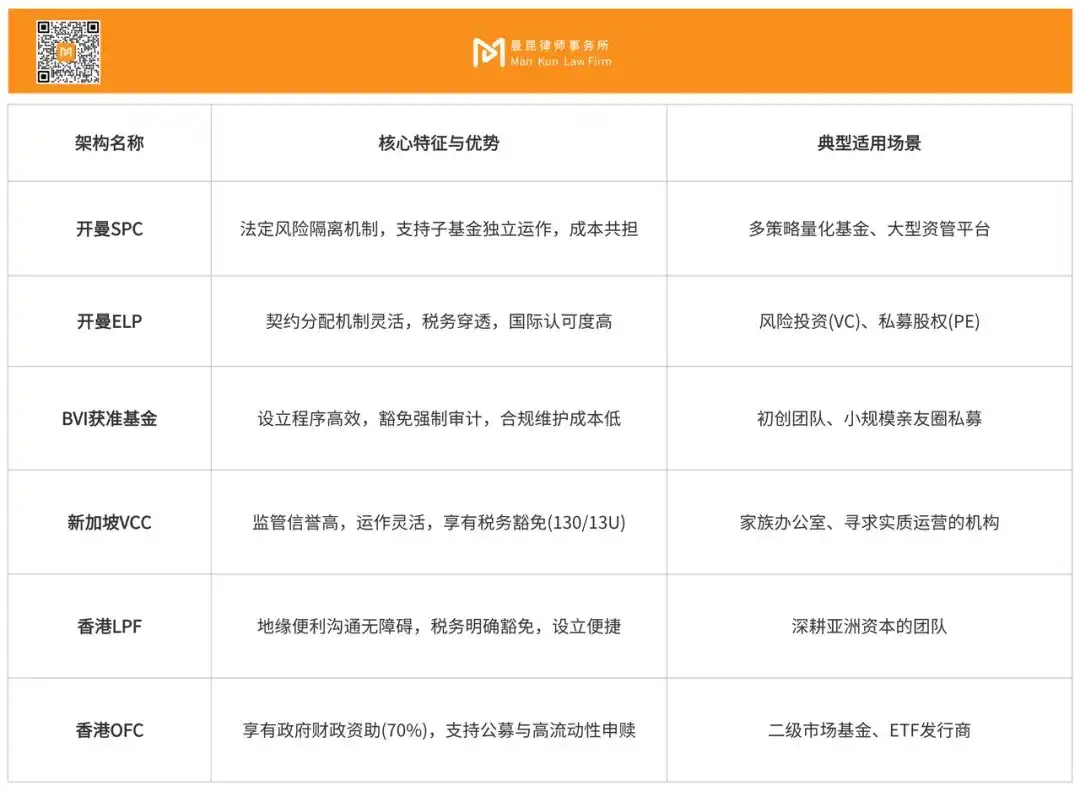
Overview of Core Characteristics of the Six Structures

Based on the above analysis, the legal characteristics and applicable scenarios of the six mainstream fund structures are summarized below:
Conclusion

In the field of crypto assets, the question regarding fund structures is never "whether to establish one," but rather "when to establish it and in what form." Different legal structures correspond not only to how taxes are paid and how regulations are applied but also to how risks are borne, how investors participate, and how the future operational model will succeed.

The fund structures introduced in this article are neither good nor bad in themselves; the key is whether they match your business model, investment strategy, and target investors. For managers who are already operating or plan to operate crypto assets in a fund format, thinking through and finalizing the structure early is itself an important form of risk control.


Пов'язані питання

QWhat is the main advantage of using a Cayman Islands SPC structure for a crypto fund?

AThe main advantage is its ability to provide risk isolation through multiple segregated portfolios (SPs) within a single legal entity, ensuring that the assets and debts of one strategy do not affect others.

QWhich fund structure is most suitable for early-stage teams with smaller assets under management (AUM) and why?

AThe BVI Approved Fund is most suitable because it has a low compliance threshold, fast setup (approved in 2-3 days), reduced operational costs (no mandatory auditor or local custodian), and is designed for teams with AUM below $100 million and up to 20 investors.

QHow does the Singapore VCC structure benefit teams looking to establish a presence in Singapore?

AThe Singapore VCC offers regulatory backing from the Monetary Authority of Singapore (MAS), allows for multiple sub-funds with asset segregation, and provides tax exemptions (e.g., under 13O/13U schemes) on qualifying investment income, making it attractive for setting up offices, obtaining work visas, or establishing family offices.

QWhat makes the Hong LPF a convenient option for teams primarily based in Asia?

AThe Hong Kong LPF is convenient because all legal matters, banking communication, and daily maintenance are handled locally in Hong Kong, eliminating language and time zone barriers, and it benefits from tax exemptions under the Unified Fund Exemption (UFE) regime.

QWhich fund structure is ideal for issuing public offerings or virtual asset ETFs, and what support does it receive?

AThe Hong Kong OFC (Open-ended Fund Company) is ideal for public offerings or ETF issuance due to its flexible capital structure that allows for share redemptions and subscriptions. It also receives government support, including up to 70% subsidy on setup costs (capped at HKD 1 million per company).

Пов'язані матеріали

Morning Post | Bitmine Plans to Raise $300 Million Through Preferred Stock Issuance; Polymarket Accuses Kalshi of Commercial Espionage

ChainCatcher's Daily Crypto Brief: Key developments from the past 24 hours include significant funding moves, regulatory actions, and market predictions. Bitmine announced a $300 million preferred stock fundraising. Polymarket accused rival prediction platform Kalshi of corporate espionage, citing numerous suspicious coincidences in product launches, a claim Kalshi strongly denied. The U.S. Department of Justice, in a joint "Disruption Week" anti-fraud operation with companies like Coinbase and Meta, froze over $3.8 million in cryptocurrency linked to scams. In infrastructure news, Macau completed its integration with the multi-central bank digital currency bridge, mBridge, aiming to build efficient cross-border payment channels. Cosmos Labs acquired the block explorer Mintscan. Market-wise, Geoffrey Kendrick, Standard Chartered's Head of Digital Assets Research, stated Bitcoin is nearing a bottom around $63,000, maintaining a year-end target of $100,000. He noted stability in U.S. spot Bitcoin ETF holdings. Ahead of SpaceX's anticipated IPO, internal insiders at Rocket Lab (RKLB) sold over $18.41 million in stock. In tokenization, Goldman Sachs partnered with Apex and Archax to launch a tokenized real estate fund. The meme token tracker GMGN reported the top trending tokens: on Ethereum, HEX, SHIB, LINK, PEPE, mUSD; on Solana, TROLL, swarms, WORLDCUP, neet, Buttcoin; and on Base, PEPE, toby, ODDS, ELSA, SKI.

链捕手4 хв тому

Morning Post | Bitmine Plans to Raise $300 Million Through Preferred Stock Issuance; Polymarket Accuses Kalshi of Commercial Espionage

链捕手4 хв тому

55TB to 28TB? The Rumor and Panic Behind Rubin's Memory Being Halved

Title: 55TB to 28TB? The Rumor and Panic Behind the Potential Halving of Rubin's Memory. On June 4th, a report from SemiAnalysis suggested NVIDIA's next-gen Vera Rubin NVL72 AI rack may ship with roughly 28TB of SOCAMM DRAM per rack instead of the anticipated 55TB, primarily using 96GB modules. This sparked a market panic, causing Micron's stock to drop over 10% on fears of halved memory demand. However, the article argues this panic is misguided for several key reasons. First, SOCAMM modules are socketed and upgradeable, not soldered. Lower initial configuration doesn't mean permanent demand loss. Second, the primary driver is a severe 2026 LPDDR5X supply shortage, not diminished need. NVIDIA is likely prioritizing rack shipments with available components. Third, with fixed total LPDDR5X supply, using less per rack could allow NVIDIA to ship *more* racks, not necessarily reducing overall memory orders. Micron's sharp drop was also attributed to a broader semiconductor sell-off triggered by Broadcom's earnings, with the SemiAnalysis report providing a convenient narrative for profit-taking after Micron's massive rally. In summary: the report on lower default configurations is likely accurate, but interpreting it as a demand collapse is wrong. The real risk for Micron lies in its reportedly minimal HBM4 share for Rubin, not in potentially flexible SOCAMM demand. The sell-off appears more like a correction amplified by coinciding negative catalysts.

marsbit20 хв тому

55TB to 28TB? The Rumor and Panic Behind Rubin's Memory Being Halved

marsbit20 хв тому

Exclusive from Yingke | Tang Wenbin's 'Yuanli Lingji' Merges with Logistics Robotics Company, and Secures Investment from Zhipu, SenseTime, Jieyue, and Others

Exclusive report: Embodied AI company "Yuanli Lingji" recently completed a new round of financing from major AI model firms including Zhipu AI, Stepfun, and SenseTime, alongside continued investments from industrial backers like Huaqin and SAIC Hengxu. Founded in March 2025 by Tang Wenbin, former co-founder and CTO of Megvii, Yuanli Lingji is a general-purpose embodied AI model company. In a notable move, the company has merged with logistics robotics firm "Atomix" (formerly known as Yuanli Juhe) through a share acquisition. Atomix, which originated from Megvii's logistics robotics business led by Tang in 2016 and was spun off in July 2024, has grown to become the world's second-largest supplier of pallet shuttle robots, with annual revenue nearing 1 billion RMB and over 500 projects globally for clients like Uniqlo and CATL. This merger aims to break the industry's "data deadlock" by combining Atomix's extensive real-world operational data from more than 20 countries with Yuanli Lingji's model training capabilities. The company's embodied AI model "DM0" utilizes a cross-domain training approach, integrating internet semantics, autonomous driving rules, and robotics data to achieve hardware-agnostic, precise manipulation even with a compact 2.4B parameter size. The collective investment from key AI players and the strategic merger signal a shift in the competitive landscape, as major model companies pivot from language tokens to physical actions ("from Token to Action"). The industry is entering a consolidation phase where hardware, AI models, data, and application scenarios converge to scale embodied intelligence, a trend mirrored by recent moves from giants like ByteDance and Skild AI.

marsbit28 хв тому

Exclusive from Yingke | Tang Wenbin's 'Yuanli Lingji' Merges with Logistics Robotics Company, and Secures Investment from Zhipu, SenseTime, Jieyue, and Others

marsbit28 хв тому

U.S. Stock Market Trends: Dow Hits New High, Nasdaq Falls, Whom Did Broadcom's Slap Wake Up?

U.S. Stocks Split: Dow Hits Record High as Nasdaq Slips; Broadcom's Plunge Sparks Rotation On June 4, the U.S. stock market saw a sharp divergence. The Dow Jones surged 875 points (+1.73%) to a record high of 51,561.93, while the Nasdaq Composite edged down 0.09%. The S&P 500 rose 0.41%. The primary catalyst was a sharp sell-off in AI-related chip stocks, led by Broadcom (AVGO). Despite reporting a 143% year-over-year jump in AI semiconductor revenue to $10.8 billion, the company's shares plunged about 14%. This was triggered by its maintained long-term AI revenue target, which failed to meet heightened expectations for a stock that had gained 55% this quarter and traded at a high P/E ratio. The slide dragged down the broader semiconductor sector and the technology板块. Conversely, money rotated into sectors like Healthcare (+3.14%), Financials (+2.67%), and Real Estate (+1.87%). UnitedHealth and Goldman Sachs were major contributors to the Dow's gains. The rotation was attributed to a search for value outside overheated tech names and a slight dip in Treasury yields. In other major news, SpaceX confirmed its IPO for June 12, targeting a record $75 billion raise at a ~$1.75 trillion valuation. Additionally, initial jobless claims rose to a four-month high, adding nuance to the labor market narrative ahead of the key May non-farm payrolls report. The day's action signaled that while the AI growth story remains intact, excessive valuations are prompting a market reassessment. Funds are moving, at least temporarily, from high-flying tech to more defensive and value-oriented sectors. The sustainability of this rotation hinges on upcoming economic data, particularly the jobs report, and the market's absorption of the massive SpaceX IPO.

marsbit31 хв тому

U.S. Stock Market Trends: Dow Hits New High, Nasdaq Falls, Whom Did Broadcom's Slap Wake Up?

marsbit31 хв тому

From 'Old Dogs' to 'New Darlings': How AI is Revaluing Old Infrastructure, from Dell to Nokia

"Old Dogs" Become AI's New Darlings: Revaluing Legacy Infrastructure The AI investment narrative is shifting. Beyond the spotlight on core chipmakers like Nvidia, a new wave of interest is rising for legacy tech companies—Dell, HPE, Nokia, Cisco, Corning, Western Digital—once labeled as slow-growth, outdated stories. This resurgence stems from AI's evolution from model development to real-world deployment, creating massive demand for physical infrastructure. As AI moves into data center construction and enterprise adoption, the focus turns to who can actually build and deliver complex systems. These established players hold decades of experience in supply chains, integration, networking, and enterprise delivery—assets now critical for scaling AI. The revaluation can be grouped into three key infrastructure areas: 1. **Servers & Integration (e.g., Dell, HPE):** They are becoming essential system integrators, transforming GPUs into full-scale AI servers with networking, power, and cooling, then delivering them to clients. Strong recent earnings and AI-specific revenue/order growth for Dell and HPE underscore this shift. 2. **Networking & Connectivity (e.g., Corning, Nokia, Cisco):** As AI clusters grow, high-speed data transfer becomes paramount. Corning benefits from fiber demand for data center links, Nokia is exploring AI-integrated wireless networks (AI-RAN), and Cisco sees surging orders for data center switches—all critical for efficient AI operations. 3. **Storage (e.g., Western Digital, Seagate):** The AI data explosion requires vast capacity. Beyond high-speed memory (HBM), there's growing need for high-capacity HDDs to store training data, logs, video, and cold/archival data cost-effectively. This revaluation, however, is not a blanket endorsement. True reassessment requires concrete proof: AI-driven orders and revenue growth, upward revisions to company guidance, and sustainable improvements in profit quality, not just top-line sales. In essence, AI is not turning all old tech firms into high-growth stocks; it is selectively re-pricing the "old assets" of companies that are mission-critical for building the new AI infrastructure, transforming their legacy capabilities into renewed growth engines.

marsbit40 хв тому

From 'Old Dogs' to 'New Darlings': How AI is Revaluing Old Infrastructure, from Dell to Nokia

marsbit40 хв тому

Торгівля

Спот
Ф'ючерси
活动图片




