War Doesn't Just Drive Up Oil Prices, Why Is Circle's Stock Price Soaring?

marsbitОпубліковано о 2026-03-30Востаннє оновлено о 2026-03-30

Анотація

A class of companies, like defense contractors and oil giants, typically benefit from global instability. Circle, the issuer of the USDC stablecoin, unexpectedly joined this group as its stock price surged over 150% in five weeks, while the broader crypto market remained down 44% from its peak. The core of Circle's business is holding US Treasuries to back each USDC in circulation. The interest earned on these bonds constitutes about 90% of its quarterly revenue, making the Federal Funds rate its primary driver. The recent price surge was triggered by geopolitical conflict in the Middle East, which drove oil prices up approximately 35%. This raised inflation concerns, leading markets to drastically scale back expectations for Federal Reserve interest rate cuts in 2026. Higher-for-longer interest rates mean Circle's treasury reserves continue to generate elevated yields, translating to more revenue and a rising stock price. This macroeconomic shift caused a short squeeze, as a significant portion of Circl's stock was shorted based on the expectation of falling rates. However, the bullish narrative extends beyond a macro trade. Despite a net loss for FY2025, USDC's supply has reached a new all-time high of $79 billion, and its transaction volume now surpasses that of the larger USDT. This growth is attributed to its use as a payment infrastructure for cross-border transfers, tokenized assets, and AI agent micropayments, especially in regions where traditional banking becomes ...

Article Author: Thejaswini M A

Article Translation: Block unicorn

Preface

There is a category of companies that actually benefit when the world situation deteriorates. Defense contractors, oil giants, gold mining companies. These are the obvious examples, companies whose business models are built on instability and factor that instability into their pricing.

Circle was not supposed to be in this category. Its token is always worth $1, by design. Stability is the core of its product. Yet, Circle's stock price has soared from $49.90 on February 5th to around $123 today, more than doubling in just over five weeks. Meanwhile, the entire cryptocurrency market is still down 44% from its October peak.

As the world becomes increasingly turbulent, a company whose product is designed to maintain a stable price has become one of the market's hottest trades.

I want to explain how this works, why it's more interesting than it seems, and what it tells us about the difference between what Circle is and what the market is currently paying for.


What is Circle (Of course, we'll come back to this)

Strip away the branding, the payment concepts, and the infrastructure building, and you find the essence of Circle: it holds U.S. Treasury bonds. Every dollar of USDC in circulation is backed by one dollar's worth of short-term government bonds. The interest on these bonds belongs to Circle. This accounts for about 90% of the company's revenue each quarter. Its business model is not complicated: Circle is a money market fund that issues a stablecoin.

This means Circle's revenue has only one key factor: the federal funds rate. When interest rates are high, Treasury yields are high, and Circle earns more for every USDC it issues. When rates are low, revenue decreases. Everything else is secondary.

Here is the sequence of events that led to the 150% rebound in the stock price from its February low.
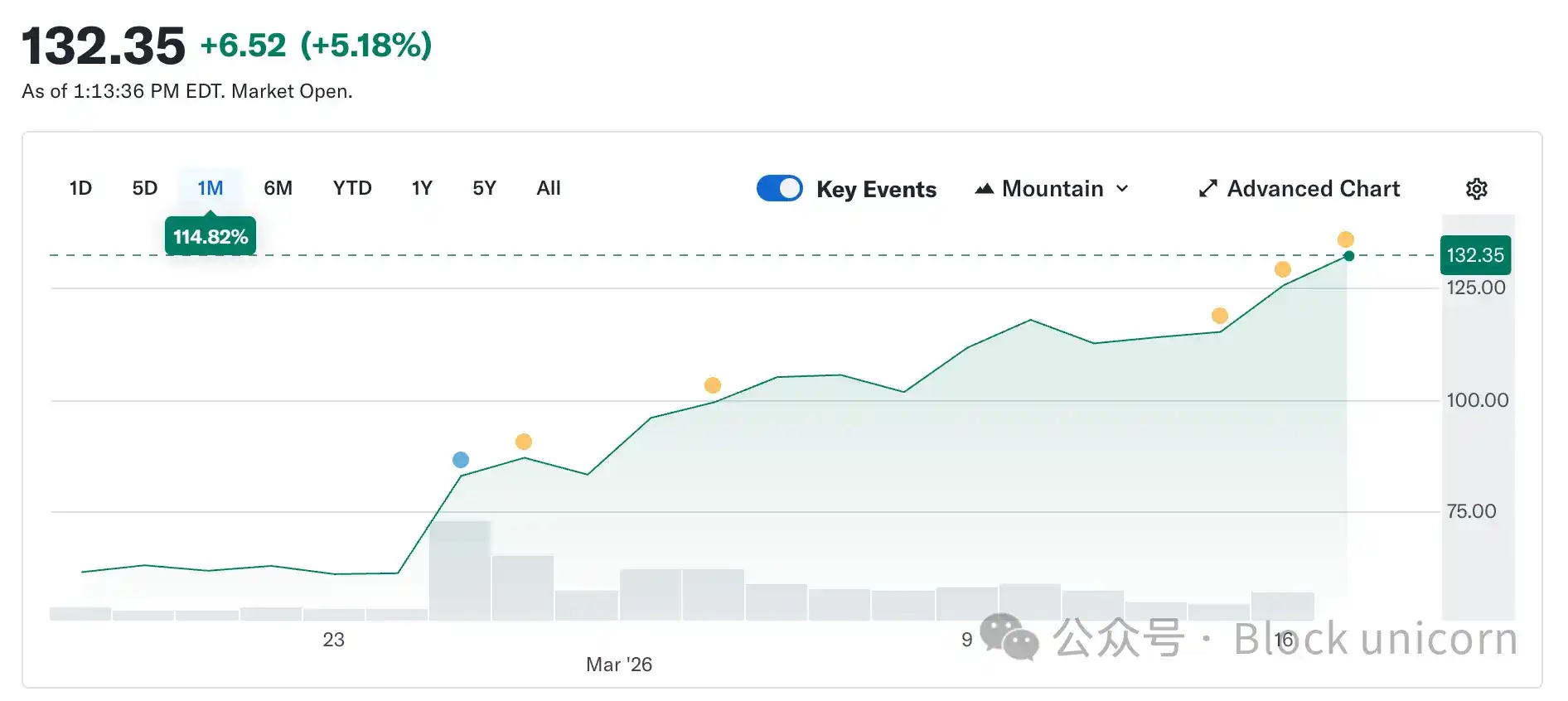
Since February 28th, the Iran conflict has pushed oil prices up by about 35%. Oil above $100 means inflation worries, and inflation worries mean the Fed would be seen as reckless to cut rates. Holding rates steady on March 18th was practically a foregone conclusion. Even before the war, the CME's FedWatch showed a probability of over 90% for no change. What the war really affected was the market's outlook for the entire year. Before the conflict, the market expected two 25-basis-point cuts in 2026. After the conflict, that was reduced to one cut, and not until after September. The probability of no cuts at all in 2026 nearly doubled. With rates staying higher for longer, the yield on Circle's Treasury reserves continues to be high. Higher yields mean more revenue. More revenue means a higher stock price. War breaks out, and a stablecoin issuer benefits. This was completely unexpected.

For context, the bearish expectation that drove Circle's stock down to $49 in February was essentially a bet on rate cuts. The market expected the Fed to cut multiple times in 2026, which would directly compress Circle's reserve income. A rough estimate: at the current USDC supply of $79 billion, each 25-basis-point cut would reduce Circle's annualized revenue by $40-60 million. Two cuts would reduce its revenue by nearly $100 million by year-end. The war changed this expectation overnight. Not because Circle itself changed, but because the macroeconomic backdrop that was supposed to weaken the thesis no longer applicable.


How the Squeeze Started

While the interest rate story keeps the stock price high, the initial explosive rise came from positioning.

Before the Q4 earnings report on February 25th, about 17.8% of Circle's float was sold short. Hedge funds had built significant short positions. Their logic was that rates would eventually fall, reserve income would decrease, and the company had no minimum revenue floor independent of rates. From a fundamental perspective, this argument seemed sound. Then, Circle reported EPS of $0.43, beating the consensus estimate of $0.16. Revenue was $770 million, above the expected $749 million. On-chain USDC volume approached $12 trillion for the quarter, up 247% year-over-year. The shorts covered. The stock surged 35% in a single trading day. According to 10x Research, hedge funds lost about $500 million on their short positions in one day. Subsequently, this short squeeze intensified, extending the post-earnings gains.


The Coinbase Problem

Here is the part that doesn't make it into the rally narrative.

Circle had a net loss of $70 million in 2025, not a profit. Q4 was excellent, but the full year was not. To understand why, you need to know about the Coinbase agreement, which is the most important yet most overlooked key to Circle's business.

When USDC was first launched in 2018, Circle and Coinbase formed a joint consortium to manage it. The consortium was dissolved in 2023, and Circle took full control of USDC issuance. However, Coinbase retained a share of the revenue.

Coinbase takes 100% of the reserve income from USDC held on its platform and splits everything else 50/50 with Circle. In 2024, this arrangement sent $908 million of Circle's total distribution cost of $1.01 billion directly to Coinbase. Roughly 54 cents of every dollar Circle earns flows to a company that doesn't issue the token or handle the reserves. By early 2025, Coinbase held 22% of the total USDC supply, up from 5% in 2022. The more USDC grows on Coinbase's platform, the more revenue flows to Coinbase.
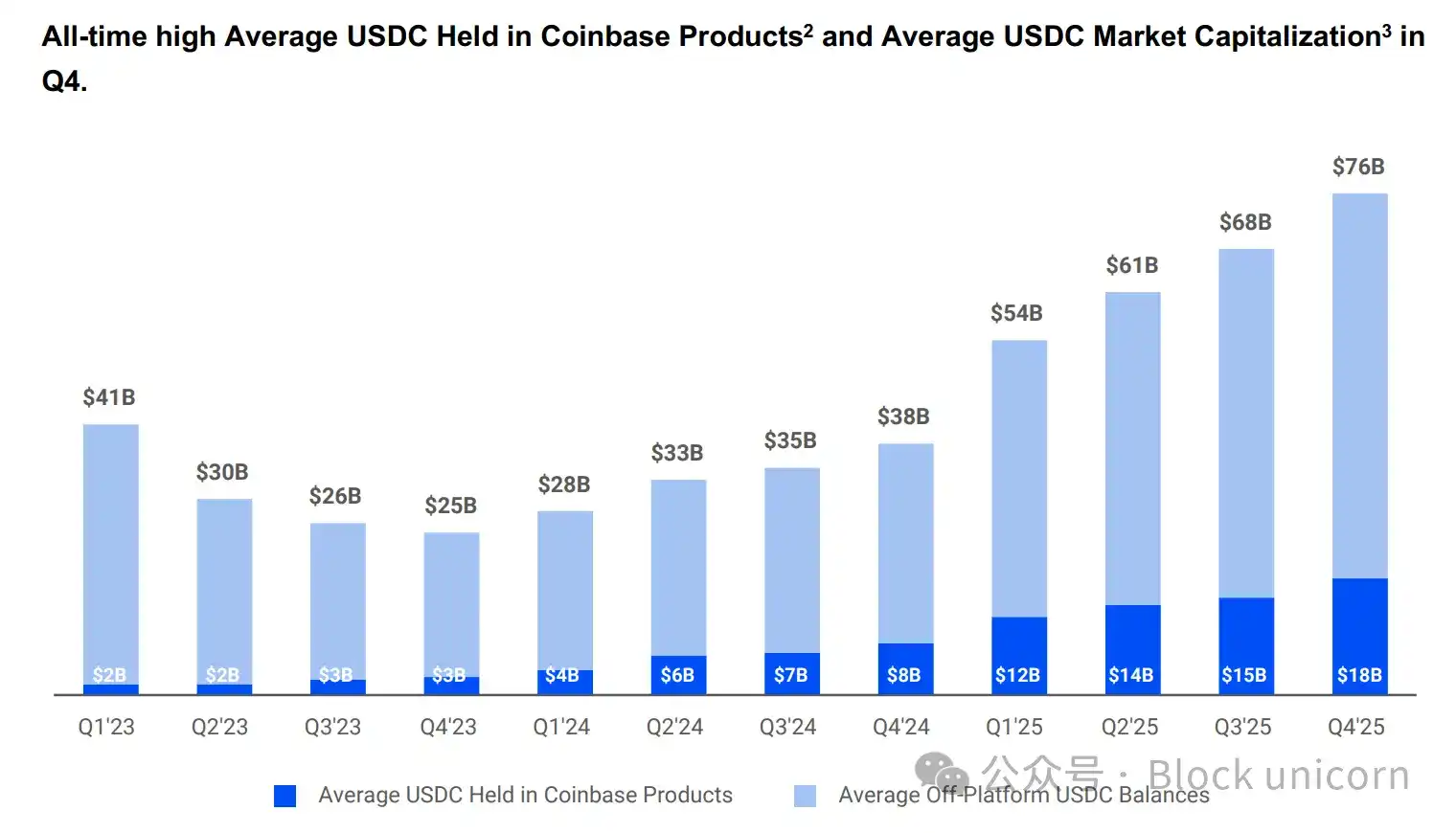
The agreement automatically renews every three years, and Circle cannot unilaterally exit it. The outcome of the next renegotiation will directly impact Circle's margins. In Q4 2025, distribution costs alone were $461 million, up 52% year-over-year. The full-year net loss of $70 million was partly due to a one-time post-IPO stock-based compensation expense of $424 million, which made the book loss look worse than the actual business condition. But Circle's core business still faces a structural cost problem that no interest rate environment can completely solve.

The market is pricing Circle as infrastructure. The income statement shows it's an interest rate trade with high distribution costs. Both views can be true, but they are priced differently. Right now, the market is paying for the best version of both views simultaneously.

What Makes This More Than Just a Macro Trade?

The recent USDC supply reached a new all-time high of $79 billion, while the entire crypto market is down 44% from its October peak. This divergence is worth noting. Speculative assets typically fall when the market falls. The reason USDC continues to grow is that people use it to move money, not hold it as a speculative asset. During the Iran conflict, demand for USDC surged in the Middle East precisely because the traditional banking system became unreliable. When normal payment channels break down, people use USDC for remittances and cross-border transfers. This is how payment infrastructure behaves under stress: usage increases, not decreases.

Transaction data confirms this. In February alone, adjusted USDC volume was about $1.26 trillion, compared to USDT volume of $514 billion over the same period. Even though Tether's market cap remains much larger at $184 billion versus USDC's $79 billion. The total supply gap is vast. But USDC's transaction volume now exceeds that of USDT.

Dormant supply and active settlement are two different concepts. The former refers to where people park their money, the latter refers to what people use when they need to move value.

Druckenmiller made an enlightening point this week. In a Morgan Stanley interview recorded on January 30th and released earlier, he said he expects the global payment system to be based on stablecoins in the next 10 to 15 years and called crypto "a solution looking for a problem." One of the most authoritative macro investors of our time perfectly split the crypto space in two: stablecoins as inevitable infrastructure, and everything else still looking for a reason to exist. This is the bullish thesis for crypto.


The Infrastructure Bet

Tokenized assets have grown from about $1.5 billion in early 2023 to about $26.5 billion today. Many of these products, including BlackRock's tokenized treasury fund BUIDL (now holding over $2 billion in assets), rely on USDC for subscription, redemptions, and settlement processing. Prediction markets processed over $22 billion in volume in 2025, mostly settled in USDC. Polymarket alone. Visa now supports over 130 stablecoin-linked cards across 50 countries, with an annualized settlement volume of about $4.6 billion.

Tokenized assets have grown from about $1.5 billion in early 2023 to about $26.5 billion today. Many of these products, including BlackRock's tokenized treasury fund BUIDL (now holding over $2 billion in assets), rely on USDC for subscription, redemptions, and settlement processing. Prediction markets processed over $22 billion in volume in 2025, mostly settled in USDC. Polymarket alone. Visa now supports over 130 stablecoin-linked cards across 50 countries, with an annualized settlement volume of about $4.6 billion.

Circle is also building the infrastructure underneath all of this. The Circle Payment Network connects 55 financial institutions with $5.7 billion in annual volume, enabling banks and payment providers to move USDC cross-border and convert it directly into local currency. Circle's own Layer-1 blockchain, Arc, is designed for full institutional support. Its settlement infrastructure does not rely on Ethereum or Solana. While Ethereum and Solana are not yet large enough to impact revenue, they are both forward-looking strategic investments for a future where rates might be lower.

The AI layer, while small in amount, is significant. Data released by Circle's Global Head of Marketing in March showed that over the past nine months, AI agents completed 140 million payments totaling $43 million. 98.6% of these transactions were settled in USDC, with an average transaction size of $0.31. Over 400,000 AI agents now have purchasing power. While the amounts are still small, the direction is clear. If AI agents need to pay each other for compute, data access, and API calls with extremely high frequency and极光very small amounts (under $0.25), they need a payment method that settles instantly and costs nothing. Circle built Nanopayments for this. Nanopayments offer gas-free USDC transfers as low as $0.000001, with transactions batched off-chain and settled in batches. The testnet currently supports 12 blockchains including Arbitrum, Base, and Ethereum.

This is what the market is currently paying $123 per share for Circle. A company at the center of tokenized finance, AI agent commerce, cross-border payments, and prediction markets, benefiting from the regulatory tailwinds of the GENIUS Act and the potential passage of the CLARITY Act before summer. Bernstein has a $190 price target, Clear Street has a $136 target, and Seaport Global, the most bullish on Wall Street for Circle, has a $280 target.


The Lingering Tension

Here, I want to be candid about what the bullish narrative often glosses over.

Circle's profitability relies on a high-interest-rate environment. But this is not sustainable. The Fed will eventually cut rates. When that happens, the yield on the Treasuries backing USDC will fall, and Circle's interest income will decrease accordingly.

Circle knows this. It has been expanding into transaction fees, corporate services, payment networks, and Arc. These businesses operate independently of the interest rate environment. But currently, this revenue is minimal. Reserve income remains the key.

So you have these two situations sitting on the same stock price, but they are not the same investment.

The infrastructure thesis argues that USDC is becoming a genuine payment pipeline. It is regulated, transparent, and increasingly integrated into the traditional financial system, and its utility is not affected by interest rate fluctuations. This thesis is supported by data such as transaction volume, institutional integration, Druckenmiller's comments, and Macquarie calling stablecoins the foundational layer of global financial infrastructure. If this thesis is correct, then Circle is undervalued regardless of the interest rate environment, because its potential market covers the entire global payment system.

The interest rate trade thesis argues that Circle is a bet on rates staying high for a long time, and the stock price already reflects the expectation that the Fed will not cut significantly. If this thesis is the driver of the stock price, then every percentage point the Fed eventually cuts will be a headwind, and the stock is already priced above what fundamentals would support under normal rates.

Both views are priced in. The war makes it difficult for the market to decide which one it favors.

Perhaps the most important thing to understand about CRCL right now is not whether it can reach $190, but whether you are investing in infrastructure or a better-marketed Treasury yield proxy. The former is a long-term hold, the latter expires the moment Jerome Powell changes his mind.

For now, the war is keeping both alive. Oil prices played a key role, and the company's true value lies somewhere in the blank space between these two scenarios: it has figured out how to create internet money denominated in dollars, but now it has to figure out how to survive when dollar yields are no longer 5%.


Трендові криптовалюти

Пов'язані питання

QWhy did Circle's stock price surge by over 150% in five weeks despite the broader crypto market being down 44% from its October peak?

ACircle's stock price surged due to a combination of factors: a short squeeze after strong Q4 earnings, and macroeconomic shifts caused by geopolitical tensions (Iran conflict). The war drove oil prices up, increasing inflation concerns and leading to expectations that the Federal Reserve would keep interest rates higher for longer. Since Circle's primary revenue comes from interest earned from its USDC reserves (mostly short-term U.S. government bonds), higher interest rates directly boost its income.

QWhat is the core business model of Circle, and what is its main source of income?

ACircle's core business model is that of a money market fund that issues a stablecoin (USDC). Each USDC in circulation is backed by one dollar's worth of short-term U.S. government bonds. The interest earned on these bonds constitutes approximately 90% of the company's quarterly revenue. Its income is therefore highly dependent on the federal funds rate.

QWhat is the 'Coinbase Problem' and how does it impact Circle's profitability?

AThe 'Coinbase Problem' refers to a revenue-sharing agreement between Circle and Coinbase. Coinbase takes 100% of the reserve income from USDC held on its platform and splits the remaining income from all other sources 50/50 with Circle. In 2024, this arrangement directed $908 million of Circle's total distribution cost of $1.01 billion to Coinbase. This structural cost significantly impacts Circle's margins and was a key reason for the company's net loss in 2025.

QHow did geopolitical conflict contribute to the demand for USDC, according to the article?

AGeopolitical conflict, specifically the Iran conflict mentioned, increased demand for USDC as traditional banking systems became less reliable. People in affected regions, such as the Middle East, turned to USDC for remittances and cross-border transfers. This demonstrates its utility as payment infrastructure that sees increased usage during times of stress, unlike speculative assets which typically decline.

QWhat are the two competing narratives the article presents for valuing Circle's stock, and what is the key tension between them?

AThe two narratives are: 1) The Infrastructure Bet: That USDC is becoming essential global payment infrastructure, with a vast potential market independent of interest rates. 2) The Interest Rate Trade: That Circle's stock is a bet on high interest rates persisting, and its current price is inflated by the expectation that the Fed will not cut rates significantly. The key tension is that the infrastructure narrative supports long-term holding, while the interest rate narrative would collapse the moment the Federal Reserve begins to cut rates, reducing Circle's primary revenue stream.

Пов'язані матеріали

When the World Cup Collides with Agents: From Web2 to Web3, How Are Wallets Evolving into Agentic Wallets?

World Cup as a Catalyst for Agentic Wallets: From Web2 to Web3 This article explores how the World Cup provides a real-world scenario for observing the evolution of digital wallets from simple asset managers towards "Agentic Wallets"—intelligent, AI-powered interfaces. Using the example of prediction markets like Polymarket, it illustrates how AI Agents can lower the barrier to Web3 interaction. Instead of navigating complex DApps, users can express intent in natural language (e.g., "I think Portugal will win") within platforms like Discord or web pages. The Agent then interprets this intent, finds the relevant market, and seamlessly guides the user through the on-chain transaction via their wallet. The core shift is from wallets as mere "function menus" for signing transactions to "intent interpreters" that understand user goals. The article highlights parallel developments in traditional finance, such as Mastercard's "Agent Pay" and WeChat Pay's AI tests, which focus on granting AI controlled, authorized, and auditable payment capabilities. This underscores a broader trend of AI entering the financial layer. However, the article emphasizes that the primary challenge for Agentic Wallets in Web3 is not automation but establishing clear security boundaries. Unlike traditional systems with chargebacks, on-chain transactions are often irreversible. Therefore, future wallets must ensure users retain ultimate control and comprehension. They need to transparently communicate an Agent's permissions, spending limits, authorized durations, and provide easy ways to pause or revoke access. The World Cup experiments represent early steps toward wallets that are not just applications but ubiquitous, intelligent interfaces that simplify Web3 while keeping users securely in control.

marsbit1 год тому

When the World Cup Collides with Agents: From Web2 to Web3, How Are Wallets Evolving into Agentic Wallets?

marsbit1 год тому

Options Don't Work in DeFi? Vitalik Might Not Agree

For years, the prevailing view has been that options struggle to gain traction in DeFi due to complexity, fragmented liquidity, and lack of natural demand compared to products like perpetual futures. However, a recent algorithmic stablecoin design proposed by Vitalik Buterin presents a different perspective, using options not as a standalone trading product, but as foundational infrastructure for other financial instruments. In this design, one unit of ETH is split into two components: a "stable" side (P) that retains value up to a specified strike price, and an "upside" side (N) that captures all appreciation above that strike. Combined, they always equal one ETH, eliminating debt, margin, and liquidation risks inherent in typical collateralized debt position (CDP) stablecoins. The stable component essentially mimics the payoff of a covered call option. To function as a stablecoin, this structure requires continuously rolling deep in-the-money calls, which introduces challenges like rollover slippage, predictable transaction flow vulnerable to front-running, and persistent liquidity needs. A core hurdle is finding consistent buyers for the leveraged ETH upside exposure (N). While it offers leverage without funding rates or liquidation, it must compete with simpler alternatives like direct call options or perpetuals. The system's scalability depends on a sustained demand for this specific form of leverage. The author draws parallels to their experience with Rysk, where earlier versions of DeFi options protocols struggled. The breakthrough came with Rysk V12, which aligns incentives: asset holders generate yield by selling covered calls against their holdings, while market makers efficiently acquire the desired option exposure. This demonstrates that options can find product-market fit when embedded as a risk distribution and pricing engine within structured products, stablecoins, or yield-generating assets, rather than marketed as a complex direct trading instrument. Vitalik's proposal reinforces this architectural approach—using fully collateralized, non-custodial, and physically settled options as a fundamental building block. The real opportunity for options in DeFi may lie not in becoming the next perpetual swap, but in powering the next generation of on-chain financial products.

marsbit1 год тому

Options Don't Work in DeFi? Vitalik Might Not Agree

marsbit1 год тому

Conversation with Investor Zheng Di: MicroStrategy's Coin Sale Experiment, AI Economy, and Opportunities in US Stocks

Frontier tech investor Zheng "Didier" Di discusses the recent Bitcoin price drop, the financial strategy shift at MicroStrategy, the AI-driven surge in U.S. stocks, and the evolving role of crypto exchanges. Didier posits that the recent BTC decline stems less from macro factors or ETF outflows, and more from market repricing due to MicroStrategy's new financial structure. Following a wave of preferred stock and debt issuance (STRC, STRZ, etc.), MicroStrategy must now manage cash flow to pay dividends, potentially leading to a market expectation of sustained, small-scale BTC sales to maintain its "per-share bitcoin neutral" principle. Didier views this as a financial "experiment" testing market capacity for such recurring sell pressure, which, while creating near-term structural headwinds, likely avoids a true "death spiral" absent major new external shocks. Shifting to AI, Didier argues that tokens are becoming the new form of labor, with AI models and compute (tokenized inputs) increasingly replacing human roles in execution and middle-management. This drives enterprise efficiency and higher margins, fueling the sustained rally in U.S. semiconductor, data center, and infrastructure stocks. He foresees an emerging "machine economy" where automated agents transact and collaborate on-chain. Regarding crypto exchanges offering U.S. equities, Didier sees this as a natural evolution. With few crypto-native assets generating lasting value, exchanges are pivoting towards real-world assets (RWAs) like stocks and bonds. This doesn't necessarily cannibalize crypto but reflects a maturing industry focusing on blockchain's core utilities: decentralized choice and efficient settlement. He notes that trading logic for crypto natives doesn't need to drastically change, as meme-driven and fundamentalist strategies find analogs in U.S. markets. The "1011 event" (likely referring to a major market crash) severely damaged crypto market liquidity, marking a probable end to the altcoin speculative cycle, with capital flowing towards the deeper liquidity of U.S. markets. For the macro outlook, Didier is cautious about near-term market pressure from potential mega-IPOs (e.g., SpaceX) and the U.S. midterm elections, which could bring more regulatory scrutiny. Long-term, he remains bullish on AI's productivity gains and its convergence with blockchain/Web3, predicting a shift from speculative frenzy to a more institutionalized, industrial phase for the crypto sector.

marsbit2 год тому

Conversation with Investor Zheng Di: MicroStrategy's Coin Sale Experiment, AI Economy, and Opportunities in US Stocks

marsbit2 год тому

Playnance’s $GCOIN Lists on KoinBX Amid Rapid Growth in India

Playnance's native token, $GCOIN, has been listed on the cryptocurrency exchange KoinBX as of June 18. This move aims to enhance accessibility for its rapidly growing community, particularly in India, where the blockchain-powered Web3 iGaming ecosystem has gained significant traction. Over 130 partners in Playnance's "Be the Boss" program have built communities engaging thousands of active players in the region. The "Be the Boss" model allows participants to create and manage their own gaming communities, earning rewards tied to community activity. CEO Pini Peter noted India's high engagement, with community leaders successfully building player networks. One partner, Dr. Nicolas, reported earning over $57,000 through the program in recent months, highlighting both the financial rewards and the opportunity to grow an engaged community. $GCOIN serves as the ecosystem's core utility token, incentivizing participation and aligning the interests of players and community leaders ("Bosses"). The listing on KoinBX is part of Playnance's strategy to expand globally, increasing the token's utility and accessibility by combining community ownership, gamified engagement, and blockchain-based incentives. Founded in 2020, Playnance is a Web3 iGaming infrastructure company focused on creating live, non-custodial, on-chain products to onboard mainstream users. It currently processes approximately one million transactions daily, aiming to simplify the user experience while maintaining full on-chain transparency.

TheNewsCrypto2 год тому

Playnance’s $GCOIN Lists on KoinBX Amid Rapid Growth in India

TheNewsCrypto2 год тому

Торгівля

Спот
Ф'ючерси

Популярні статті

Як купити WAR

Ласкаво просимо до HTX.com! Ми зробили покупку WAR (WAR) простою та зручною. Дотримуйтесь нашої покрокової інструкції, щоб розпочати свою криптовалютну подорож.Крок 1: Створіть обліковий запис на HTXВикористовуйте свою електронну пошту або номер телефону, щоб зареєструвати обліковий запис на HTX безплатно. Пройдіть безпроблемну реєстрацію й отримайте доступ до всіх функцій.ЗареєструватисьКрок 2: Перейдіть до розділу Купити крипту і виберіть спосіб оплатиКредитна/дебетова картка: використовуйте вашу картку Visa або Mastercard, щоб миттєво купити WAR (WAR).Баланс: використовуйте кошти з балансу вашого рахунку HTX для безперешкодної торгівлі.Треті особи: ми додали популярні способи оплати, такі як Google Pay та Apple Pay, щоб підвищити зручність.P2P: Торгуйте безпосередньо з іншими користувачами на HTX.Позабіржова торгівля (OTC): ми пропонуємо індивідуальні послуги та конкурентні обмінні курси для трейдерів.Крок 3: Зберігайте свої WAR (WAR)Після придбання WAR (WAR) збережіть його у своєму обліковому записі на HTX. Крім того, ви можете відправити його в інше місце за допомогою блокчейн-переказу або використовувати його для торгівлі іншими криптовалютами.Крок 4: Торгівля WAR (WAR)Легко торгуйте WAR (WAR) на спотовому ринку HTX. Просто увійдіть до свого облікового запису, виберіть торгову пару, укладайте угоди та спостерігайте за ними в режимі реального часу. Ми пропонуємо зручний досвід як для початківців, так і для досвідчених трейдерів.

268 переглядів усьогоОпубліковано 2024.12.11Оновлено 2026.06.02

Як купити WAR

Обговорення

Ласкаво просимо до спільноти HTX. Тут ви можете бути в курсі останніх подій розвитку платформи та отримати доступ до професійної ринкової інформації. Нижче представлені думки користувачів щодо ціни WAR (WAR).

活动图片