Wall Street 'Withdraws' from Bitcoin Basis Arbitrage: CME Falls Out of Favor, the Golden Age of Arbitrage Comes to an End

marsbitОпубліковано о 2026-01-22Востаннє оновлено о 2026-01-22

Анотація

Wall Street is retreating from the once-lucrative Bitcoin basis trade, as narrowing spreads between spot and futures prices have made the strategy barely profitable. The cash-and-carry trade, which involved buying Bitcoin spot (often via ETFs) and selling futures to capture the premium, has seen annualized returns drop to around 5%, down from nearly 17% a year ago, barely covering funding and execution costs. This compression has led to a significant shift in market structure: CME's Bitcoin futures open interest has fallen below Binance's for the first time since 2023, indicating a withdrawal of hedge funds and large US accounts from this specific arbitrage strategy. While CME was the preferred venue for this institutional trade, Binance's dominance in perpetual futures has remained steady. The approval of spot Bitcoin ETFs initially fueled the trade's popularity but also accelerated its decline by attracting capital that quickly eroded the arbitrage opportunity. The market is now maturing, with participants shifting from simple leveraged directional bets to using options, hedges, and expressing views through diverse instruments like ETFs. This increased efficiency has naturally narrowed price disparities between venues. As the era of easy, high returns from basis trading ends, participants are expected to seek more complex strategies in decentralized markets and other crypto assets.

Original Title: Wall Street Pulls Back From Bitcoin』s Money-Spinning Basis Trade

Original Author: Sidhartha Shukla, Bloomberg

Original Compilation: Peggy, BlockBeats

Editor's Note: The once considered 'surefire' Bitcoin basis arbitrage is quietly losing its appeal: the open interest between CME and Binance is shifting, and the spread has narrowed to the point where it barely covers funding and execution costs.

On the surface, this is a squeeze in arbitrage opportunities; at a deeper level, the crypto derivatives market is maturing. Institutions no longer need to rely on 'arbitrage' for returns, and traders are shifting from leverage to options and hedging. The era of high returns through simple strategies is fading, and new competition will emerge in more complex and refined strategies.

Below is the original text:

The crypto derivatives market is undergoing a quiet yet significant change: one of the most stable and profitable trading strategies is showing signs of faltering.

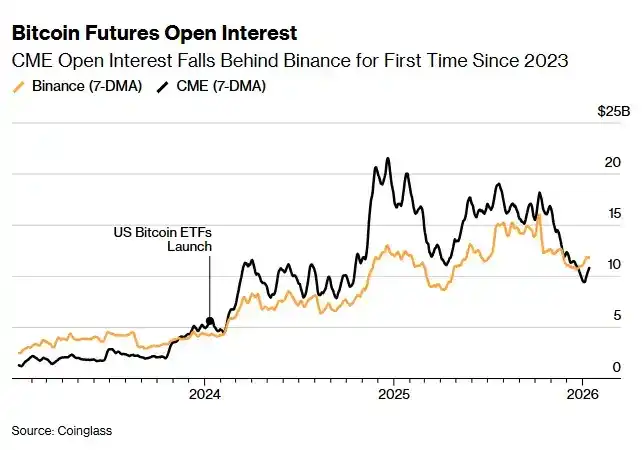
The 'cash-and-carry' trade, commonly used by institutions—buying Bitcoin spot while selling futures to profit from the spread—is collapsing. This not only signals a rapid compression of arbitrage opportunities but also releases a deeper message: the structure of the crypto market is changing. The open interest of Bitcoin futures on the Chicago Mercantile Exchange (CME) has fallen below that of Binance for the first time since 2023, further indicating that the highly profitable arbitrage opportunities of the past are being rapidly eroded as spreads narrow and market access becomes more efficient.

After the launch of spot Bitcoin ETFs in early 2024, CME once became the preferred venue for Wall Street trading desks to execute such strategies. This operation is highly similar to the 'basis trade' in traditional markets: buying Bitcoin spot through ETFs while selling futures contracts to profit from the spread between the two.

In the months following the ETF approval, the annualized return of this so-called 'delta-neutral strategy' often reached double digits, attracting billions of dollars in capital—capital that was indifferent to the direction of Bitcoin's price movement, focusing solely on capturing the returns. However, it was precisely the ETF that drove the rapid expansion of this trade that also sowed the seeds of its demise: as more trading desks rushed in, the arbitrage spread was quickly erased. Today, the returns from this trade are barely enough to cover funding costs.
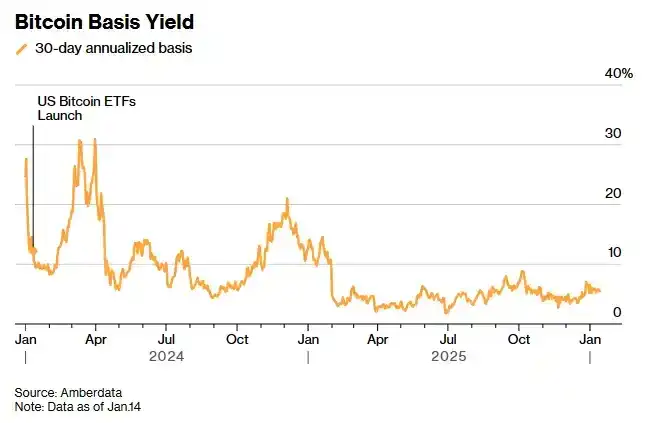
According to data compiled by Amberdata, the current annualized return for a one-month period is hovering around 5%, near its lowest level in recent years. Greg Magadini, Director of Derivatives at Amberdata, noted that around this time last year, the basis was close to 17%, but has now fallen to about 4.7%, barely enough to cover the threshold of funding and execution costs. Meanwhile, the one-year U.S. Treasury yield is around 3.5%, making the trade increasingly less attractive.

Against the backdrop of narrowing spreads, the open interest of CME Bitcoin futures has fallen from a peak of over $21 billion to below $10 billion, according to data compiled by Coinglass. In contrast, Binance's open interest has remained relatively stable, at around $11 billion. James Harris, CEO of digital asset management firm Tesseract, stated that this change reflects more of a pullback by hedge funds and large U.S. accounts, rather than a broad retreat from crypto assets after Bitcoin prices peaked in October.

Exchanges like Binance are the primary venues for perpetual contracts. These contracts are settled, priced, and margin-calculated continuously, often updated multiple times a day. Perpetual contracts, commonly referred to as 'perps,' account for the largest share of crypto trading volume. Last year, CME also launched smaller-sized, longer-term futures contracts covering crypto assets and equity indices, offering futures positions close to the spot market, allowing investors to hold contracts for up to five years without frequent rollovers.

Harris of Tesseract noted that historically, CME has been the preferred venue for institutional capital and 'cash-and-carry' trades. He added that CME's open interest being overtaken by Binance is 'a significant signal that the market participation structure is shifting.' He described the current situation as a 'tactical reset,' driven by lower returns and thinning liquidity, rather than a loss of market confidence.

According to a statement from CME Group, 2025 is a key inflection point for the market: as regulatory frameworks become clearer and investor expectations for the sector improve, institutional capital is expanding from single bets on Bitcoin to tokens like Ethereum, Ripple's XRP, and Solana.

CME Group stated: 'Our average daily nominal open interest for Ethereum futures in 2024 was about $1 billion, and by 2025, this number has grown to nearly $5 billion.'
Although the Federal Reserve's interest rate cuts have reduced funding costs, this has not driven a sustained rebound in the crypto market since the collective crash of various tokens on October 10. Current borrowing demand is weak, decentralized finance (DeFi) yields are low, and traders are more inclined to use options and hedging tools rather than directly leveraging directional bets.

Le Shi, Managing Director of market maker Auros in Hong Kong, stated that as the market matures, traditional participants now have more channels to express directional views, from ETFs to direct access to exchanges. This increase in choice has narrowed the price differences between trading venues, naturally compressing the arbitrage opportunities that once drove the growth of CME's open interest.

Le said: 'There is a self-balancing effect here.' He believes that as market participants continue to flock to the lowest-cost trading venues, the basis narrows, and the motivation to engage in cash-and-carry trades diminishes accordingly.

On Wednesday, Bitcoin fell by 2.4% at one point to $87,188 before paring losses. This decline briefly erased all gains for the year.

Bohumil Vosalik, Chief Investment Officer of 319 Capital, stated that the era of nearly risk-free high returns may be over, forcing traders to turn to more complex strategies in decentralized markets. For high-frequency and arbitrage-focused institutions, this means they need to look elsewhere for opportunities.

Original Link

Пов'язані питання

QWhat is the main reason for the decline in the profitability of Bitcoin basis trades according to the article?

AThe main reason is the rapid compression of arbitrage spreads due to increased market efficiency and massive inflows from Wall Street trading desks after the launch of spot Bitcoin ETFs, which has pushed returns down to levels that barely cover funding and execution costs.

QHow has the open interest in Bitcoin futures on CME changed compared to Binance, and what does this shift indicate?

AThe open interest in Bitcoin futures on CME has fallen below that of Binance for the first time since 2023, dropping from a peak of over $21 billion to under $10 billion. This shift indicates a tactical reset where hedge funds and large US accounts are pulling back from basis trades due to lower yields, rather than a broad retreat from crypto assets.

QWhat specific trading strategy used by institutions is discussed in the article, and how does it work?

AThe strategy discussed is the 'cash-and-carry' trade, also known as basis trade. It involves buying Bitcoin spot (often through ETFs) and simultaneously selling Bitcoin futures contracts to profit from the price difference (basis) between the spot and futures markets.

QWhat does the article suggest about the future of trading opportunities in the crypto derivatives market?

AThe article suggests that the era of easy, high returns from simple arbitrage strategies is ending. Future opportunities will require more complex and sophisticated strategies, as traders move towards options, hedging, and seeking alpha in decentralized markets.

QAccording to the article, what broader market development is contributing to the maturation of the crypto derivatives landscape?

AThe broader market development is the increasing clarity and improved regulatory framework, which has encouraged institutional capital to expand beyond Bitcoin into other tokens like Ethereum, XRP, and Solana, as evidenced by the growth in CME's Ethereum futures open interest.

Пов'язані матеріали

Has the 'Digital Gold' Narrative for BTC Failed?

**Title: Has the "Digital Gold" Narrative for Bitcoin Failed?** The article argues that Bitcoin's "digital gold" narrative remains valid despite a recent sharp price decline (from a peak near $126k in Oct 2025 to briefly under $61k in Feb 2026). It presents a long-term investment framework based on three core points: **1. Viewing Bitcoin as an Asset:** Bitcoin is presented as a superior potential store of value compared to gold. Key arguments are its absolute scarcity (21 million cap), superior portability, and transparent auditability via its public ledger. While acknowledging its current use in early, volatile stages (~3-4% global adoption), the author draws parallels to the early, disruptive phases of the internet and e-commerce. **2. Understanding the Recent Downturn:** The current ~50% correction is framed as a predictable, consensus-driven cycle following its post-halving peak (the 2024 halving preceded the Oct 2025 high). A crucial factor is a historic "changing of hands": the influx of new institutional buyers via ETFs allowed early, low-cost holders (miners, OG believers) to take profits. The author notes that while severe, Bitcoin's historical drawdowns (e.g., 93% in 2011, 77% in 2021-22) have been progressively smaller, suggesting maturing holder structure and decreasing volatility over time. **3. The Long-Term Perspective:** The long-term thesis hinges on Bitcoin capturing a portion of gold's market value. With Bitcoin's market cap at ~$1.4 trillion (at $70k) versus gold's ~$20 trillion, significant upside potential exists if the "digital gold" narrative is partially realized. However, the author strongly cautions that short-term risks remain, the bottom is unpredictable, and high volatility is inherent. The real risk is not Bitcoin failing but poor personal position management (over-leverage, wrong capital) and a lack of deep understanding, which can force investors out during severe downturns. The conclusion uses Amazon's 95% crash post-2000 dot-com bubble and subsequent 42x recovery as an analogy. The ultimate question is not if Bitcoin's price will rise, but if an investor's strategy and conviction can withstand the volatility to see the long-term play out. The recent divergence (gold up, Bitcoin down) is posed not as a narrative failure, but as potential evidence of this ongoing, painful transition from a speculative asset to a mainstream allocation.

marsbit8 год тому

Has the 'Digital Gold' Narrative for BTC Failed?

marsbit8 год тому

Has BTC's 'Digital Gold' Narrative Failed?

The article discusses Bitcoin's "digital gold" narrative, its recent price drop, and long-term outlook through the perspective of "Jason". It argues the narrative is not a failure but that Bitcoin represents a superior, new asset class due to its fixed supply (21 million), portability, and auditability. The piece compares its current ~3-4% global adoption rate to early internet/e-commerce, suggesting significant growth potential. Regarding the 2025-2026 price decline (from ~$126k to briefly under $61k), the author views it as a predictable, consensus-driven sell-off within Bitcoin's ~4-year cycle post-halving, exacerbated by a major "handover" from early, low-cost holders to new institutional buyers via ETFs. A key observation is that historical peak-to-trough drawdowns have lessened over time (e.g., 93% in 2011 to ~50% in 2026), indicating maturing volatility as holder structure changes. For the long term, the author uses a simple framework: Bitcoin's total market cap (~$1.4T at $70k) is only about 7% of gold's (~$20T). Even capturing 30-50% of gold's value would imply substantial upside. However, the article strongly cautions against viewing this as investment advice, emphasizing extreme volatility and the critical importance of risk management, position sizing, and deep fundamental understanding to survive severe drawdowns. It concludes by drawing a parallel to Amazon's 95% crash in 2000 and subsequent 42x recovery, stressing that the key is surviving market cycles to realize long-term potential.

链捕手8 год тому

Has BTC's 'Digital Gold' Narrative Failed?

链捕手8 год тому

From Code to Cognition: A Ten-Thousand-Word Guide to the Evolution of the Robot Brain

"From Code to Cognition: The Evolution of Robot Brains" The journey of robotic intelligence has shifted dramatically from manually coded systems to AI-driven brains. For decades, robots relied on layered software stacks—perception, state estimation, planning, control—each handcrafted. While predictable, they lacked adaptability. The 2010s saw deep learning revolutionize perception (e.g., object detection) and control (via reinforcement learning), but learned skills remained narrow. The arrival of Large Language Models (LLMs) marked a turning point. LLMs acted as high-level planners, interpreting natural language instructions and generating sequences of actions for traditional robotic systems to execute. However, true integration came with Visual-Language-Action (VLA) models, which fused vision, language, and motion prediction into a single network. Pioneered by models like RT-2 and open-source projects like OpenVLA, VLAs enable robots to reason and act directly from visual input and commands. The most advanced humanoid robots now employ a "dual-brain" architecture: a slow-thinking, large VLA (System 2) for reasoning and planning, and a fast-reacting, small network (System 1) for high-frequency motion control, sometimes with an even lower-level System 0 for balance. This split balances cognition with the physics of real-time movement. Computation is split between onboard hardware (e.g., NVIDIA Jetson) for safety-critical control loops and cloud/edge servers for non-critical tasks like learning and interfaces. A crucial driver is the open-source ecosystem—models like GR00T and OpenVLA allow startups to build upon pre-trained brains and fine-tune them with their own data, accelerating development. Despite progress, current systems struggle with recovery from errors, sample inefficiency, and long-horizon tasks. This has spurred the rise of **World Models**—neural networks that predict the consequences of actions. By simulating possible futures before acting (like NVIDIA Cosmos or Meta V-JEPA), robots can plan, recover, and generalize better. This represents the next frontier: shifting intelligence from learned reactions to an internal model of physics and cause-and-effect. The field is rapidly evolving. While not yet at its "ChatGPT moment," the convergence of cheaper hardware, scalable simulation, and world models points toward robots that are increasingly capable, adaptive, and useful. The question is shifting from "what can robots do?" to "what *should* they do?"

marsbit9 год тому

From Code to Cognition: A Ten-Thousand-Word Guide to the Evolution of the Robot Brain

marsbit9 год тому

Торгівля

Спот
Ф'ючерси
活动图片