VCs on 2025 Crypto Investments: 84% of 118 Tokens Break Issue Price, Only One Type of Company is Quietly Making Money

marsbitОпубліковано о 2026-04-22Востаннє оновлено о 2026-04-22

Анотація

Crypto investor Ching Tseng categorizes the market into four quadrants based on two axes: crypto-native vs. traditional finance (TradFi)-oriented, and having traction vs. no traction. In 2025, 84.7% of 118 tracked token launches fell below their issuance price, with a median fully diluted valuation drop of 71%. Crypto-native projects without traction are experiencing massive capital destruction, often relying on speculative narratives without sustainable revenue or user retention. Crypto-native teams with traction, often built in prior cycles, generate real revenue but face structural challenges with their tokens lacking direct value capture mechanisms. While some have implemented successful buyback programs, the core issue remains finding growth beyond crypto volatility. TradFi-oriented startups without traction face long, costly enterprise sales cycles but benefit from a robust M&A environment, with crypto acquisitions reaching a record $8.6 billion in 2025. The current winners are TradFi-oriented companies with traction, particularly in the Real World Asset (RWA) tokenization space, which grew from $5.5B to $18.6B in 2025. They are winning through enterprise sales, building alliances, and improving unit economics on established compliance stacks. Their main risk is being bypassed by large incumbent institutions building their own infrastructure. The overarching theme is market maturation, where narrative alone is insufficient for long-term success.

Author: Ching Tseng

Compiled by: Deep Tide TechFlow

Deep Tide Guide: Investor Ching Tseng categorizes crypto companies into four quadrants: crypto-native/traditional finance-oriented, with traction/without traction. In 2025, 84.7% of 118 token issuances broke their issue price. Crypto-native projects without traction are massively destroying capital, while traditional finance-oriented companies with traction are capturing the $18 billion RWA market. This article clarifies where the money is flowing and which tokenomics models have failed.

Sitting on the investor side this year, I found that almost every crypto founder I met can be classified into one of four categories. The two axes are simple: crypto-native vs. traditional finance-oriented, with traction vs. without traction. Four quadrants, covering about 75% of the market.

The challenges faced by each quadrant are completely different. Here is my breakdown.
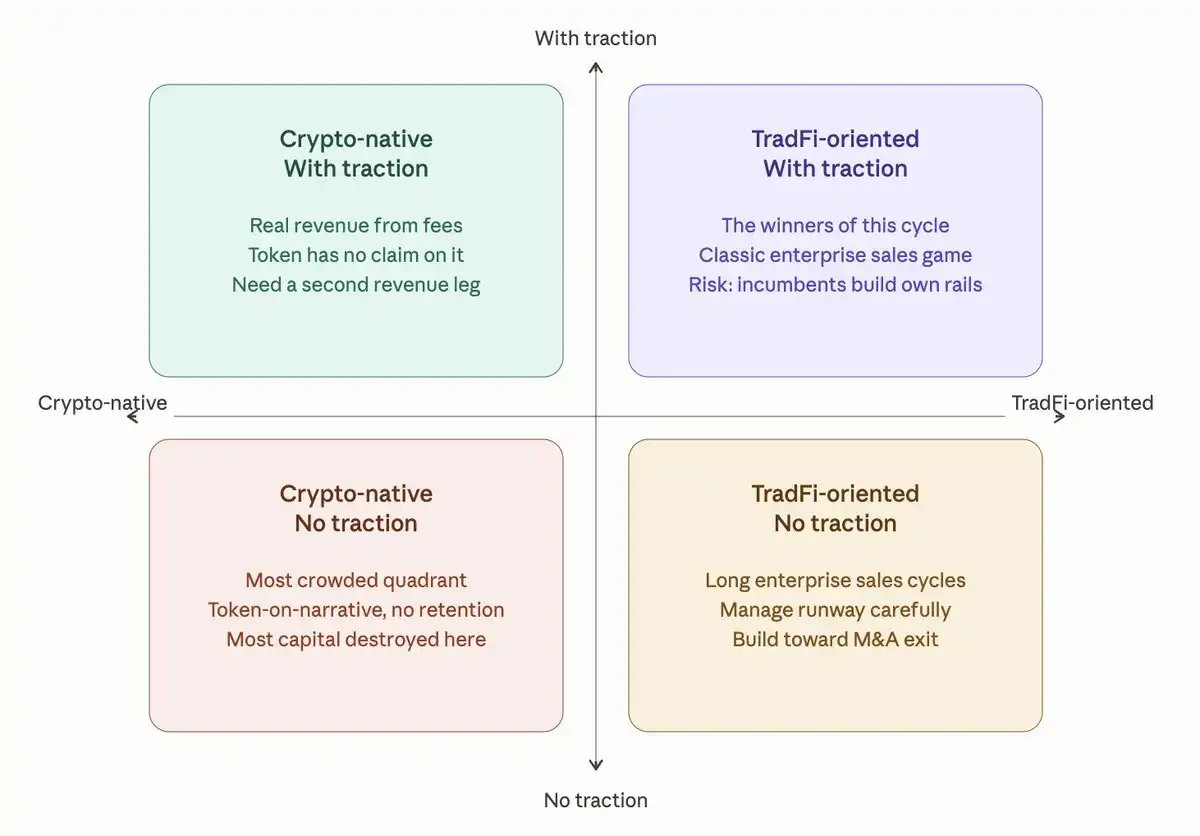
Crypto-Native, Without Traction

This is the most crowded quadrant and the area where capital is being destroyed most severely.

These teams are still showcasing TVL numbers that were inflated in the last cycle but cannot explain why they worked back then. They ask for valuations of $20 million, $30 million, sometimes even $200 million, with only a utility token and a roadmap, claiming the token has a "clear use case" because it is used to pay fees or for governance voting.

The data is brutal. Among the 118 token issuances tracked in 2025, 84.7% fell below their issue price, with the median fully diluted valuation dropping by 71%. Some of the most hyped "native DeFi L1s" of this cycle saw their TVL drop by over 90% in the first year after launch, with tokens following a similar trend. AI-related token groups saw an average annual return of -50%, with several top performers of 2024 pulling back over 80% from their peaks.

The pattern is consistent. Initial traction comes from users seeking quick profits rather than genuinely liking your product. Tokens priced based on narratives, without revenue or user retention to support their valuations, bled in 2025. Massive emissions exposed that on-chain activity was primarily mercenary behavior.

What this quadrant needs to internalize is: the long-term value of a token comes from the team's ability to generate revenue and return capital to holders, not from artificial utility that forces users to spend it. Regulation still prevents anyone from publicly saying "the token is equity," but empirically, that is the only model that works. Everything else is, at best, a cyclical trade.

If you are here, the honest approach is not to issue another token. It is to return to the basics: who are your real users, what are they willing to pay for, and how can you capture a portion of that?

Crypto-Native, With Traction

This quadrant is full of teams that built something real many years ago, often in the last cycle, and have been quietly earning decent revenue from trading, lending, or exchange fees. The teams are small, cash flow covers salaries, and the product works.

Sounds good? But they also have challenges to overcome.

Most issued tokens early and are now stuck with a structural problem: revenue exists, but the token has no mechanical claim to it. Some of the largest products in the market handle monthly trading volumes of tens or even hundreds of millions of dollars, but for years the direct value captured by the token has been zero. No matter how good the revenue/profits are, the market does not truly trade the token at a consistent multiple; the market prices expected growth, not current economic conditions.

The buyback debate is the other half of the story for this quadrant. Some protocols that promised weekly fee-funded buybacks in early 2025 saw their prices rise over 40% in the following month. Others running automated, fee-funded buyback programs cumulatively bought back over $1 billion in tokens within seven months, with single-day buybacks nearing $4 million at their peak. DeFi buybacks totaled approximately $2 billion in 2024-2025.

Buybacks sound like the answer. Sometimes they are. But for teams in this quadrant without excess revenue, buying back tokens is just burning future runway to defend a price that may not hold. The harder and better question is, can you grow a second revenue line not tied to crypto volatility? Because if traditional finance-oriented competitors build better distribution into institutions while you are still surviving on altcoin traders, your moat will quickly turn into commodity-priced infrastructure.

Traditional Finance-Oriented, Without Traction

This group ballooned in 2024-2025. Custody tools, compliance middleware, tokenization rails, on-chain forex, institutional settlement—all genuinely useful. All expensive. All have enterprise sales cycles measured in quarters, not weeks.

The problem is not the product. It's the math. Founders raised $15 million to $30 million assuming institutions would come, but even onboarding a tier-1 bank client can take 12-18 months and requires compliance infrastructure that eats a year of burn before the first dollar of revenue lands.

The good news is that the exit environment for this quadrant is exceptionally healthy. Crypto M&A hit a record $8.6 billion in 2025, with over 140 VC-backed crypto companies acquired, a 59% jump year-over-year. Several of the largest deals saw existing giants paying hundreds of millions to billions of dollars for distribution, licenses, and enterprise relationships in derivatives, trading infrastructure, and payment rails.

If you are in this quadrant, the cool-headed play is: manage valuation and cash runway like your life depends on it, aim for a meaningful M&A outcome, because it is real. Don't price yourself out of the acquirer pool. Don't burn 24 months of runway chasing one enterprise logo. Build complementary partnerships with larger players who might ultimately want to acquire you.

Traditional Finance-Oriented, With Traction

The winners of the current regime.

Tokenized real-world assets grew from $5.5 billion at the start of 2025 to $18.6 billion by year-end, a 3.4x growth in twelve months. The largest tokenization platforms now handle billions in institutional liquidity, with market leaders holding around 20% share, supporting one of the world's largest tokenized treasury funds with nearly $3 billion AUM.

These companies aren't trying to convince anyone crypto is the future. Their institutional clients have already decided. The game now is straightforward enterprise sales: win more banks, more asset managers, more issuers; build alliance structures where an institution buying one of your products naturally buys three more from your partners; compress unit economics on the compliance and custody stack you've already built.

If the team is a pure service provider, this becomes a classic enterprise software war: sales velocity, net retention, integration depth.

The primary risk for this quadrant is not from crypto-native competition. It's from existing behemoths, large asset managers and global banks, eventually building their own rails, bypassing the startups that helped them adapt to the chain. The window is real, but not infinite.

The four quadrants appear different on the surface but are all navigating the same underlying shift: the market is maturing.

This doesn't mean narrative is dead. Institutions also chase hot themes, as anyone who has watched semiconductor and AI valuations over the past two years knows. But in a mature market, the half-life of pure narrative is shorter. It can still get you started, but it cannot keep you going.


Трендові криптовалюти

Пов'язані питання

QAccording to the article, what percentage of the 118 token launches tracked in 2025 fell below their issuance price?

A84.7% of the 118 token launches tracked in 2025 fell below their issuance price.

QWhich quadrant of crypto companies is described as the current winners of the system and is capitalizing on the RWA market?

AThe 'Traditional Finance-Oriented, With Traction' quadrant is described as the current winners, capitalizing on the tokenized real-world asset (RWA) market which grew to $18.6 billion.

QWhat is the primary risk for companies in the 'Traditional Finance-Oriented, With Traction' quadrant?

AThe primary risk is not from crypto-native competitors, but from existing giants like large asset managers and global banks who may build their own on-chain infrastructure, bypassing the startups that helped them adapt.

QWhat does the data suggest is the only empirically working model for a token's long-term value?

AThe data suggests that the only empirically working model is one where the token is treated as equity, meaning the team generates revenue and returns capital to holders, rather than forcing artificial utility.

QWhat was the total value of crypto M&A (Mergers and Acquisitions) in 2025, as stated in the article?

ACrypto M&A reached a record $8.6 billion in 2025.

Пов'язані матеріали

Real Vision Founder: When Machines Take Over the Global Economy, Cryptocurrency Becomes Their Sole Payment Channel

In approximately two years, the vast majority of global economic activity will be conducted without direct human involvement, according to Raoul Pal, founder of Real Vision. This new economy will be driven by billions of autonomous AI agents executing trades, hedging, and clearing amongst themselves in milliseconds—far faster than human perception. This shift is driven by a fundamental crisis in the old economy: shrinking workforces and stagnant productivity in aging Western societies. Unable to generate organic growth, governments resort to debt and currency debasement. The proposed solution is a new, silicon-based labor force. However, this machine economy cannot function on human banking systems. Banks are ill-suited for machines, requiring human identity verification, struggling with sub-cent transactions, and operating too slowly with weekend closures. In contrast, blockchain technology offers instantaneous, borderless settlements 24/7, with programmable money and precision to 18 decimal places. It is the only viable payment rail for machines. The core of this transformation is tokenization—converting real-world assets and data into machine-readable, tradable packets. This goes far beyond tokenizing stocks or bonds; it encompasses data, identity, energy, storage, and compute, creating entirely new markets where machines buy and sell information. While some fear job losses, Pal argues the focus is misplaced. The real disruption is to the human wage system, which historically priced scarce human labor. When silicon labor becomes abundant and cheap, compensation mechanisms must change. Wealth will flow to the owners of the machines and the foundational infrastructure they run on—the blockchain networks. For the first time, this infrastructure is globally accessible. Pal's conclusion: individuals should seek to own a part of this foundational layer, as it will capture the value of the coming machine-driven economic singularity.

marsbit1 год тому

Real Vision Founder: When Machines Take Over the Global Economy, Cryptocurrency Becomes Their Sole Payment Channel

marsbit1 год тому

Company Managing $2.8 Billion in Bitcoin Makes Optimistic Statement About BTC!

Dylan LeClair, CFO of MetaPlanet, commented on the recent sharp sell-offs in crypto markets and growing criticism towards Bitcoin-holding companies. He compared the current pessimism to the 2022 crash, suggesting price corrections and liquidations have set the stage for Bitcoin's next growth phase. LeClair acknowledged that the recent BTC price drop created negative perceptions of corporate balance sheet holdings but called this a cyclical phenomenon. He referenced similar criticism faced by MicroStrategy in 2021/22, noting that while such companies can underperform BTC during downturns due to leveraged structures, the long-term trend reverses. He argued that for Bitcoin to reach a multi-trillion-dollar asset class, integration with traditional capital markets is essential, and retail "cold storage" alone is insufficient. Addressing criticism from some Bitcoin purists, LeClair defended the use of equities and debt instruments as necessary bridges to attract institutional capital with varying risk tolerances. LeClair suggested the market may have bottomed, citing institutional funds rotating from Bitcoin-related assets into AI stocks at the end of Q2, creating artificial selling pressure. He downplayed exaggerated fears like quantum computing threats, predicting that once sellers are exhausted, Bitcoin will surge sharply without significant news catalysts.

cryptonews.ru4 год тому

Company Managing $2.8 Billion in Bitcoin Makes Optimistic Statement About BTC!

cryptonews.ru4 год тому

Capital is Moving from Cryptocurrency Speculation to Tokenized RWA Assets

In 2026, tokenized real-world assets (RWA) became one of the fastest-growing areas in crypto. Investors, weary of market volatility, are shifting capital from speculative crypto trading towards assets offering stable yield. These include tokenized government bonds (e.g., T-bills), private credit, real estate income, commodities, and money market funds. Data shows a clear preference for transparent, regulated products. Deposits into RWA protocols more than tripled year-on-year, reaching $7.4 billion in Q2, while spot trading activity surged 220%. The total on-chain value of tokenized RWAs exceeded $30 billion in 2026, more than doubling from the previous year, and approached $38 billion by August. RWA acts as a bridge between traditional finance and blockchain, not a replacement. It allows banks and asset managers to launch regulated products on public blockchains, while DeFi users gain access to previously unavailable real-world assets. Blockchain provides 24/7 settlements, transparency, programmability, and lower fees, while traditional finance contributes capital, regulation, and proven products. Tokenized private credit remains the largest RWA category (over $7 billion on-chain), benefiting from blockchain's cost reduction and transparency. Treasury bills are the fastest-growing institutional segment, driven by higher interest rates. Tokenized commodities, especially gold, are expanding, combining asset safety with blockchain trading ease. Real estate, though smaller, is also growing steadily. Tokenization is increasingly viewed as core financial infrastructure.

cryptonews.ru4 год тому

Capital is Moving from Cryptocurrency Speculation to Tokenized RWA Assets

cryptonews.ru4 год тому

Торгівля

Спот

Популярні статті

Як купити ONE

Ласкаво просимо до HTX.com! Ми зробили покупку Harmony (ONE) простою та зручною. Дотримуйтесь нашої покрокової інструкції, щоб розпочати свою криптовалютну подорож.Крок 1: Створіть обліковий запис на HTXВикористовуйте свою електронну пошту або номер телефону, щоб зареєструвати обліковий запис на HTX безплатно. Пройдіть безпроблемну реєстрацію й отримайте доступ до всіх функцій.ЗареєструватисьКрок 2: Перейдіть до розділу Купити крипту і виберіть спосіб оплатиКредитна/дебетова картка: використовуйте вашу картку Visa або Mastercard, щоб миттєво купити Harmony (ONE).Баланс: використовуйте кошти з балансу вашого рахунку HTX для безперешкодної торгівлі.Треті особи: ми додали популярні способи оплати, такі як Google Pay та Apple Pay, щоб підвищити зручність.P2P: Торгуйте безпосередньо з іншими користувачами на HTX.Позабіржова торгівля (OTC): ми пропонуємо індивідуальні послуги та конкурентні обмінні курси для трейдерів.Крок 3: Зберігайте свої Harmony (ONE)Після придбання Harmony (ONE) збережіть його у своєму обліковому записі на HTX. Крім того, ви можете відправити його в інше місце за допомогою блокчейн-переказу або використовувати його для торгівлі іншими криптовалютами.Крок 4: Торгівля Harmony (ONE)Легко торгуйте Harmony (ONE) на спотовому ринку HTX. Просто увійдіть до свого облікового запису, виберіть торгову пару, укладайте угоди та спостерігайте за ними в режимі реального часу. Ми пропонуємо зручний досвід як для початківців, так і для досвідчених трейдерів.

502 переглядів усьогоОпубліковано 2024.12.12Оновлено 2026.06.02

Як купити ONE

Обговорення

Ласкаво просимо до спільноти HTX. Тут ви можете бути в курсі останніх подій розвитку платформи та отримати доступ до професійної ринкової інформації. Нижче представлені думки користувачів щодо ціни ONE (ONE).

活动图片