Valentine’s Day Crypto Warning: US Attorney Issues Crypto-Fueled Romance Scam Alert

ccn.comОпубліковано о 2026-02-14Востаннє оновлено о 2026-02-14

Анотація

The US Department of Justice has issued a Valentine’s Day warning about cryptocurrency-fueled romance scams. Fraudsters typically approach victims on dating sites or social media, using fake profiles and stolen photos to build emotional trust over weeks or months. They then fabricate emergencies and request payments in crypto, gift cards, or wire transfers—methods that are difficult to reverse. Recent cases include a Colorado man who lost $1.4 million after meeting a woman on a dating app who persuaded him to invest in crypto. According to Chainalysis, crypto scams received at least $14 billion in 2025, with impersonation scams surging by 1,400% compared to the previous year. Authorities advise conducting reverse image searches, consulting trusted friends before sending money, and reporting suspicious activity to the FBI.

Key Takeaways

  • The Department of Justice has issued a crypto warning as Valentine’s Day hits.
  • Real-world losses are escalating.
  • Crypto scam activity surged in 2025.

U.S. federal prosecutors are warning Americans not to let Valentine’s Day turn into a costly heartbreak, as romance scammers increasingly demand payment in cryptocurrency.

The U.S. Attorney’s Office for the Northern District of Ohio on Thursday urged the public to remain vigilant against online crypto romance scams that exploit victims’ trust and emotions.

Try Our Recommended Crypto Exchanges
Sponsored
Disclosure
We sometimes use affiliate links in our content, when clicking on those we might receive a commission at no extra cost to you. By using this website you agree to our terms and conditions and privacy policy.
"}' data-trk="6970dbafcbd599f15ce64045" href="https://links.ccn.com/links?code=6985b71f73f50d4865cba0f2" rel="nofollow" target="_blank">
ChangeNow<\/h3>"}' data-trk="6970dbafcbd599f15ce64045" href="https://links.ccn.com/links?code=6985b71f73f50d4865cba0f2" rel="nofollow" target="_blank">

ChangeNow

promotions
Receive 0.4% of the volume from each transaction with your referral link.<\/strong>"}' data-trk="6970dbafcbd599f15ce64045" href="https://links.ccn.com/links?code=6985b71f73f50d4865cba0f2" rel="nofollow" target="_blank"> Receive 0.4% of the volume from each transaction with your referral link.
Coins
217
Claim Offer
"}' data-trk="6899b9831836d97539c51aa6" href="https://links.ccn.com/links?code=693293fa4a5bcb6231949c97" rel="nofollow" target="_blank">
Bitunix<\/h3>"}' data-trk="6899b9831836d97539c51aa6" href="https://links.ccn.com/links?code=693293fa4a5bcb6231949c97" rel="nofollow" target="_blank">

Bitunix

promotions
Receive up to $100,000 worth of exclusive gifts for newcomers upon registration.<\/strong>"}' data-trk="6899b9831836d97539c51aa6" href="https://links.ccn.com/links?code=693293fa4a5bcb6231949c97" rel="nofollow" target="_blank"> Receive up to $100,000 worth of exclusive gifts for newcomers upon registration.
Coins
151
Claim Offer
"}' data-trk="67adf8d4f12aaec7e4808bf5" href="https://links.ccn.com/links?code=693291aa4a5bcb62319448b2" rel="nofollow" target="_blank">
Bitget<\/h3>"}' data-trk="67adf8d4f12aaec7e4808bf5" href="https://links.ccn.com/links?code=693291aa4a5bcb62319448b2" rel="nofollow" target="_blank">

Bitget

promotions
New user rewards up to 6,200 USDT.<\/strong>"}' data-trk="67adf8d4f12aaec7e4808bf5" href="https://links.ccn.com/links?code=693291aa4a5bcb62319448b2" rel="nofollow" target="_blank"> New user rewards up to 6,200 USDT.
Coins
89
Claim Offer
Explore All Offers

DOJ Flags Valentine’s Day Crypto Warning

Federal prosecutors said fraudsters typically approach victims on dating websites, social media platforms, and messaging apps, posing as romantic partners.

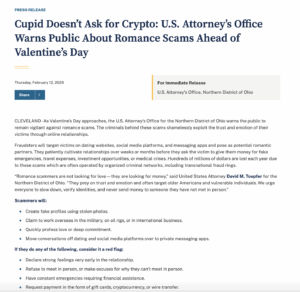
In a stark warning , titled “Cupid Doesn’t Ask for Crypto,” the DOJ explained how bad actors cultivate relationships over weeks or months before fabricating emergencies, travel needs, or medical crises.

Among the clearest warning signs, according to the Justice Department, are requests for payment in crypto, gift cards, or wire transfers, methods favored by scammers because they are hard to reverse.

The office said scammers frequently create fake profiles using stolen photos, claim to work overseas in the military or international business, and profess deep affection quickly.

The DOJ has issued a Valentine’s Day warning about crypto. | Source: DOJ

They often move conversations off mainstream dating platforms to private messaging apps and avoid meeting in person.

“Romance scammers are not looking for love — they are looking for money,” said U.S. Attorney David M. Toepfer for the Northern District of Ohio.

Adding: “They prey on trust and emotion and often target older Americans and vulnerable individuals. We urge everyone to slow down, verify identities, and never send money to someone they have not met in person.”

Regional Cases Underscore Growing Threat

Victims are advised to conduct reverse image searches of profile photos, consult trusted friends before sending funds, and report suspicious activity to the FBI’s Internet Crime Complaint Center (IC3).


In the report, authorities cited recent regional cases, including a Ghanaian national charged in an alleged scheme that took more than $8 million from elderly victims.

Last September, a Colorado man was also reported to have lost $1.4 million after falling victim to a crypto-linked romance scam.

The man, who first spoke to 9News , said he met a woman on Ashley Madison, a website marketed to married people seeking affairs.

After weeks of video chatting and exchanging photos, their conversations shifted to the woman’s interest in crypto and her view of it as a good opportunity for him.

Over roughly six weeks, the man said he made four separate cryptocurrency transfers, ultimately losing $1.4 million in retirement funds and life savings.

Crypto Scams Surge in 2025

The warning comes amid a broader surge in cryptocurrency-related fraud.

Blockchain analytics firm Chainalysis said in its 2026 report that crypto scams received at least $14 billion in on-chain funds last year, up sharply from initial 2024 estimates of $9.9 billion.

Based on historical trends, the firm projected that the 2025 total could exceed $17 billion as more illicit wallets are identified.

The average scam payment rose to $2,764 in 2025 from $782 in 2024, a 253% year-on-year increase, according to Chainalysis.

Impersonation scams, also known as Pig Butchering scams, recorded a 1,400% surge in inflows compared with the previous year.


Top Trending Crypto Articles
  • Best Exchanges Check Out Our Recommended Exchanges Here
  • Buy Crypto Fast How To Buy Crypto with a Credit Card Now
  • Safe Crypto Gambling See Our Picks for the Best Crypto Gambling Sites

Пов'язані питання

QWhat is the main warning issued by the U.S. Department of Justice regarding Valentine's Day?

AThe U.S. Department of Justice has issued a warning about romance scammers who increasingly demand payment in cryptocurrency, urging the public to remain vigilant against online crypto romance scams that exploit victims' trust and emotions.

QWhat are some of the red flags mentioned by the DOJ to identify crypto romance scams?

ARed flags include requests for payment in cryptocurrency, gift cards, or wire transfers; scammers creating fake profiles using stolen photos; claiming to work overseas in the military or international business; professing deep affection quickly; and moving conversations off mainstream platforms to private messaging apps while avoiding in-person meetings.

QHow much did crypto scams receive in on-chain funds in 2025 according to Chainalysis?

AAccording to Chainalysis, crypto scams received at least $14 billion in on-chain funds in 2025, with projections that the total could exceed $17 billion as more illicit wallets are identified.

QWhat was the average scam payment in 2025 compared to 2024?

AThe average scam payment rose to $2,764 in 2025, which is a 253% increase from the $782 average in 2024.

QWhat advice does the DOJ give to avoid falling victim to these scams?

AThe DOJ advises victims to conduct reverse image searches of profile photos, consult trusted friends before sending funds, and report suspicious activity to the FBI’s Internet Crime Complaint Center (IC3). They also emphasize never sending money to someone they have not met in person.

Пов'язані матеріали

The Value Distribution of Stablecoins

**Summary: The Value Distribution of Stablecoins** The article argues that stablecoins are evolving from mere trading tools into broader channels for dollar access. It divides the stablecoin ecosystem into four layers to analyze how value is distributed: 1. **Issuance Layer:** Mints stablecoins, holds reserve assets, and captures the spread between reserve yield and user costs (e.g., Tether, Circle). This layer currently earns the largest profit margin. 2. **Infrastructure Layer:** Connects stablecoins to the traditional financial system, handling fiat on/off-ramps, banking integration, compliance (KYC/AML), and asset management (e.g., Bridge, BVNK). This is the "unglamorous" but critical work, building the essential bridges between crypto and real-world finance. 3. **Acquiring/Distribution Layer:** Integrates stablecoins into merchant systems, manages payment flows, and provides enterprise financial software (e.g., Stripe, Coinbase). They act as the access point for businesses. 4. **Application Layer:** The end-users and businesses that ultimately use stablecoins for payments, settlements, or as a store of value. They benefit from convenience but have little pricing power. The core thesis is that while the issuance layer currently dominates profits, the often-overlooked **infrastructure layer holds significant long-term potential**. The real challenge and barrier to mass adoption is not the on-chain transfer of stablecoins (which is simple), but the complex "last mile" integration into existing business workflows, banking systems, and regulatory frameworks across different countries. Companies in this layer are currently in a "land grab" phase, investing heavily to build networks, secure bank partnerships, and establish compliance pathways. While their position is currently pressured by the profitable issuers above and distribution platforms below, the article suggests that if stablecoins become a default financial rail for businesses, the infrastructure providers who have done the hard work of integration will ultimately gain strong pricing power and become entrenched, essential players.

marsbit5 год тому

The Value Distribution of Stablecoins

marsbit5 год тому

The Value Distribution of Stablecoins

The Value Distribution of Stablecoins The article argues that stablecoins are evolving from a mere trading tool into a broad "dollar channel." It analyzes the industry's value chain through four layers: 1. **Issuance Layer (e.g., Tether, Circle):** The top layer that mints stablecoins, holds reserve assets, and captures the thickest interest rate spread. 2. **Infrastructure Layer (e.g., Bridge, BVNK):** Connects stablecoins to the traditional financial system, handling critical but complex "dirty work" like fiat on/off-ramps, banking integration, compliance (KYC/AML), and cross-border settlement. 3. **Acquiring/Distribution Layer (e.g., Stripe, Coinbase):** Embeds stablecoins into merchant systems, manages payment flows, and integrates with enterprise software. 4. **Application Layer:** End-users and businesses that ultimately use stablecoins for payments, settlement, or storing value. The author posits that while the issuance layer currently captures the most profit, the most overlooked and potentially critical layer is infrastructure. The core challenge for stablecoin adoption isn't the on-chain transfer (which is simple), but bridging the gap between blockchain and the real-world financial system. This involves solving practical problems for businesses: fiat conversion, reconciliation, tax handling, and user onboarding. Infrastructure companies are currently in a difficult "land-grab" phase—building networks, securing banking relationships, and achieving compliance country-by-country. They face pressure from both the profitable issuance layer above and distribution platforms below. However, the author suggests this layer is building a crucial moat. Once stablecoins become a default business rail, the infrastructure players who have done the hard work of integration may gain significant, durable value and pricing power.

链捕手5 год тому

The Value Distribution of Stablecoins

链捕手5 год тому

How to Do Research Well: Deliberately Practice the Real Skills That Matter

No one truly teaches you how to do research. You're often given a desk, a pre-selected problem, and vague instructions to "create something new." Consequently, many people reverse-engineer the job based on visible outputs—papers, posts, announcements—learning only how to *appear* like a researcher rather than how to *become* one. True research capability is built from stacking small, trainable skills, nearly all of which can be developed through deliberate practice. **Pick Your Own Problem:** Most researchers absorb problems from advisors or trends, lacking the underlying reasoning. Choosing a problem you genuinely care about, as John Schulman advises, leads to original work. Develop "taste" like a muscle: predict experiment outcomes, guess paper results from methods, and track which findings remain important over time. **Upgrade Your Inputs:** Relying on shared reading lists (arXiv hot lists, filtered group chats) leads to unoriginal conclusions. Undervalued old literature often holds crucial insights (e.g., MoE, LSTM, backpropagation). Richard Sutton's "The Bitter Lesson" or Claude Shannon's 1952 talk on creative thinking are more predictive than lengthy modern surveys. Breadth matters as much as depth: draw from neuroscience, mechanism design, hardware knowledge, and honest statistics. Read papers directly, especially appendices and limitations sections. **Write Everything Down:** As Paul Graham noted, writing exposes flaws in seemingly mature ideas. Writing is the cheapest defense against self-deception. Following Feynman's principle, Darwin programmatically wrote down facts contradicting his theory to combat memory bias. Maintain a detailed log of hypotheses, setups, predictions, results, and updated understandings. Reviewing past logs fosters essential humility.

marsbit7 год тому

How to Do Research Well: Deliberately Practice the Real Skills That Matter

marsbit7 год тому

Торгівля

Спот
Ф'ючерси
活动图片