USDC gets major banking push from Standard Chartered – Details!

ambcryptoОпубліковано о 2026-07-03Востаннє оновлено о 2026-07-03

Анотація

Standard Chartered and Circle have partnered to bring USD Coin (USDC) closer to traditional banking. The collaboration enables institutional clients to mint and redeem USDC directly through Standard Chartered's banking platform, starting in the Dubai International Financial Centre (DIFC) with plans for expansion. This integrated service combines banking, custody, and digital asset offerings, eliminating the need for separate accounts with Circle. Standard Chartered claims it is the first Global Systemically Important Bank to provide such a service. The partnership is significant as the stablecoin market has grown substantially, with USD-pegged stablecoin supply nearly doubling from about $160 billion to around $300 billion over the past 24 months. While Tether (USDT) remains the market leader, USDC is the second-largest stablecoin, maintaining a supply of $70-$80 billion. This scale and Circle's established corporate presence make USDC a likely choice for institutional adoption through this new banking-led access.

Standard Chartered and Circle are bringing USD Coin [USDC] closer to traditional banking. This new partnership will help institutions mint and redeem USDC through bank-led rails, starting in Dubai’s DIFC.

USDC minting moves to Standard Chartered’s banking platform

Standard Chartered and Circle have created a way for institutional clients to mint and redeem USDC through a bank-led process. This would be instead of setting up separate accounts directly with Circle.

The financial giant has stated that it is the first Global Systemically Important Bank to offer this kind of USDC service. According to its statement, the company announced,

AD

By embedding USDC access directly within Standard Chartered’s institutional offering, Standard Chartered will bring together banking, custody, and digital asset services within one integrated offering…

The first rollout will happen through the Dubai International Financial Centre, with expansion to other markets planned. The service is said to also support payment-related use cases later.

The scale makes it that much important

This development comes at a good time though, especially since stablecoins are no longer a niche product. In fact, Artemis showed that USD-pegged stablecoin supply has nearly doubled over the past 24 months. We went from about $160 billion to around $300 billion by July 2026.
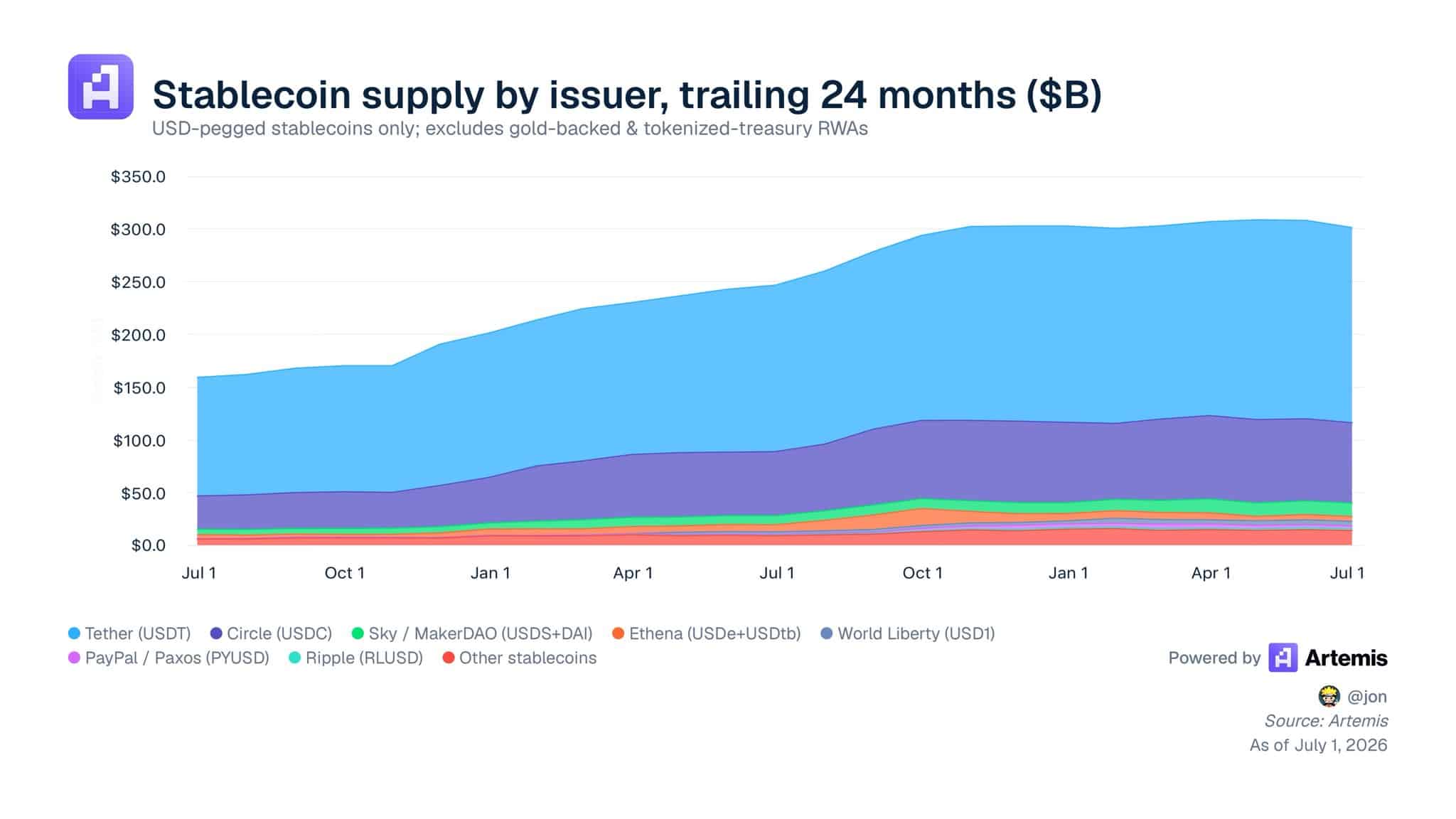
Source: Artemis

While USDT [Tether] still leads the market, Circle’s USDC is still the second-largest stablecoin. It is also one of the greater corporate plays in the space. That becomes important when you think of Standard Chartered’s move, with the bank building access around a stablecoin that already has scale.

USDC supply has stayed around the $70 billion-$80 billion range in recent months, so that demand has held up even with new issuers entering the market. So, while stablecoins may have multiple long-term winners, Circle is still one of the names institutions are most likely to work with.


Final Summary

  • Standard Chartered and Circle will let institutions mint and redeem USDC.
  • USDC is the second-largest stablecoin, with 70B-$80B in supply.

Трендові криптовалюти

Пов'язані питання

QWhat is the main partnership announced between Standard Chartered and Circle regarding USDC?

AStandard Chartered and Circle have partnered to allow institutional clients to mint and redeem the USD Coin (USDC) stablecoin through a bank-led process within Standard Chartered's platform, starting in Dubai's DIFC.

QHow is Standard Chartered positioning itself with this new USDC service?

AStandard Chartered is positioning itself as the first Global Systemically Important Bank (G-SIB) to offer this kind of integrated USDC minting and redemption service for institutions.

QWhat is one key benefit for institutional clients mentioned in the article regarding this partnership?

AA key benefit for institutional clients is that they can access USDC services (minting and redeeming) directly through Standard Chartered's integrated banking, custody, and digital asset offering, eliminating the need to set up separate accounts directly with Circle.

QWhat data does the article cite to show the growth of USD-pegged stablecoins?

AThe article cites data from Artemis showing that the supply of USD-pegged stablecoins has nearly doubled over the past 24 months, growing from about $160 billion to around $300 billion by July 2026.

QWhat is the current approximate supply range of USDC, and how does it rank among stablecoins?

AUSDC's supply has stayed around the $70 billion to $80 billion range in recent months, making it the second-largest stablecoin in the market after USDT (Tether).

Пов'язані матеріали

Solana Ecosystem Shows Signs of Recovery: On-Chain Governance Upgrade, Tokenized Stocks and Meme Coins Heat Up

Solana Ecosystem Shows Signs of Revival: Governance Upgrades, Tokenized Stocks, and Memecoins Heat Up While the broader crypto market faces a downturn, Solana has shown relative strength with its price rising nearly 15% recently. This resilience is attributed to warming ecosystem activity, particularly in tokenized stocks and memecoins, coupled with a major upgrade to its on-chain governance. In the Real World Assets (RWA) sector, Solana now leads all public chains in both the number of unique holder wallets and the quantity of RWA assets. Its tokenized stock weekly trading volume has surged to a record $1.42 billion, capturing about 96% of the market share, largely driven by the Backpack exchange. Simultaneously, the Solana memecoin sector has reignited, fueled by the rapid ascent of the ANSEM token following endorsements from a prominent crypto influencer. This has boosted activity across platforms like Pump.fun and increased fee revenue for several Solana-based exchanges. A key development is the launch of Solana Governance Proposals (SGP), a new on-chain mechanism. It allows validators with at least 100,000 SOL delegated to submit proposals for community vote, enhancing decentralized decision-making. SGP will operate alongside the existing technical proposal process (SIMD), focusing on broader ecosystem governance. Despite these positive signals in specific areas, overall on-chain activity and transaction volumes still lag behind previous bull market peaks, indicating the recovery remains partial rather than ecosystem-wide.

marsbit13 хв тому

Solana Ecosystem Shows Signs of Recovery: On-Chain Governance Upgrade, Tokenized Stocks and Meme Coins Heat Up

marsbit13 хв тому

While Semiconductor Stocks Plunge, Anthropic Plans to Develop a 2nm Chip

Anthropic, the AI company behind Claude, is exploring the development of its own custom AI chip, according to a report from The Information. The company is in early discussions with Samsung Electronics to manufacture the chip using Samsung's most advanced 2-nanometer process and packaging technology. While the project is still in preliminary stages, including defining chip specifications, and could be abandoned, it marks a strategic step for Anthropic. The move comes as the company seeks greater control over its computing costs and hardware optimization, particularly for inference tasks to run its models more efficiently and cheaply. Samsung's potential involvement follows its participation as a strategic investor in Anthropic's recent $65 billion funding round. For Samsung, partnering with a major AI lab represents a significant opportunity for its foundry business to compete with market leader TSMC in advanced semiconductor manufacturing. Anthropic's CEO, Dario Amodei, has previously highlighted the immense financial challenge of securing enough computing power for anticipated growth, making cost-effective inference a critical focus. The company would join other tech giants like Google, Amazon, Microsoft, Meta, and OpenAI in pursuing custom AI silicon. However, analysts note this trend creates deeper interdependencies rather than independence, as US AI labs become more tightly woven into Asian semiconductor supply chains. Despite this move, Anthropic remains heavily reliant on a multi-cloud, multi-vendor strategy for its immediate computing needs. It has secured massive, long-term commitments for capacity from Amazon Web Services (Trainium chips), Google (TPUs), and even leased a large GPU cluster from xAI. For now, Nvidia continues to dominate the AI chip market, with its share reportedly growing to 74%.

链捕手15 хв тому

While Semiconductor Stocks Plunge, Anthropic Plans to Develop a 2nm Chip

链捕手15 хв тому

Korean Companies Following Strategy in Accumulating Cryptocurrency: From Bull Market to Delisting?

Title: Korean DAT Companies Following "Strategy" Bitcoin Hoarding Model Face Delisting Amid Bear Market Summary: Several Korean KOSDAQ-listed companies, known as Digital Asset Trusts (DATs), are at risk of being delisted due to a combination of stricter regulatory thresholds and a downturn in crypto markets. These firms, inspired by models like Strategy and Japan's Metaplanet, raised capital to buy Bitcoin, relying on a cycle of rising crypto prices to boost their stock value. However, recent reforms in Korea have raised the minimum market capitalization required to stay listed from 150 billion won to 200 billion won (approx. $1.3M), with a further increase to 300 billion won set for next January. The new rules also close loopholes like reverse stock splits used to artificially inflate share prices. The situation is exacerbated by a significant drop in Bitcoin's price from its 2025 peak and a weak KOSDAQ market. While the main KOSPI index has surged nearly 95% year-to-date, KOSDAQ has fallen about 10%, draining liquidity from smaller companies. Many DATs now hover near or below the new market cap thresholds and must also book substantial valuation losses on their Bitcoin holdings. Analysts suggest that without a sustained recovery in both crypto prices and broader market interest in KOSDAQ stocks, these companies have limited options to avoid delisting, marking a precarious moment for Korea's crypto-linked public companies.

marsbit25 хв тому

Korean Companies Following Strategy in Accumulating Cryptocurrency: From Bull Market to Delisting?

marsbit25 хв тому

Korean Companies That Learned to Hoard Coins from MicroStrategy: From Bull Market to Delisting?

South Korean companies that adopted the “Digital Asset Treasury” (DAT) strategy—issuing shares to buy and hold Bitcoin, inspired by MicroStrategy—now face delisting risks on the KOSDAQ market. New regulations effective July 1, 2026, tightened listing maintenance rules, notably raising the minimum market capitalization threshold from 150 billion KRW to 200 billion KRW (about $1.3 million), with a further increase to 300 billion KRW scheduled for January 2027. Companies failing to meet both the share price and market cap requirements for specified periods risk being designated for delisting, with fewer options for financial engineering like stock splits to artificially boost prices. The downturn in cryptocurrency prices has severely impacted these firms. Bitcoin, which peaked above $120,000 in mid-2025, has fallen below $60,000, forcing DAT companies to report large valuation losses. Compounding this, the KOSDAQ index has dropped about 10% year-to-date, while the main KOSPI index surged nearly 95%, diverting investor interest away from smaller-cap stocks. Examples like BitPlanet (holding 300 BTC) and Parataxis Ethereum currently hover just above the new market cap limits, but face heightened scrutiny and potential delisting starting in 2027. Industry analysts warn that the combination of weak crypto markets, a struggling KOSDAQ, and stricter regulations creates a significant survival challenge for these companies, highlighting the risks of business models overly reliant on volatile digital asset prices.

链捕手29 хв тому

Korean Companies That Learned to Hoard Coins from MicroStrategy: From Bull Market to Delisting?

链捕手29 хв тому

Торгівля

Спот

Популярні статті

Як купити PUSH

Ласкаво просимо до HTX.com! Ми зробили покупку Push Protocol (PUSH) простою та зручною. Дотримуйтесь нашої покрокової інструкції, щоб розпочати свою криптовалютну подорож.Крок 1: Створіть обліковий запис на HTXВикористовуйте свою електронну пошту або номер телефону, щоб зареєструвати обліковий запис на HTX безплатно. Пройдіть безпроблемну реєстрацію й отримайте доступ до всіх функцій.ЗареєструватисьКрок 2: Перейдіть до розділу Купити крипту і виберіть спосіб оплатиКредитна/дебетова картка: використовуйте вашу картку Visa або Mastercard, щоб миттєво купити Push Protocol (PUSH).Баланс: використовуйте кошти з балансу вашого рахунку HTX для безперешкодної торгівлі.Треті особи: ми додали популярні способи оплати, такі як Google Pay та Apple Pay, щоб підвищити зручність.P2P: Торгуйте безпосередньо з іншими користувачами на HTX.Позабіржова торгівля (OTC): ми пропонуємо індивідуальні послуги та конкурентні обмінні курси для трейдерів.Крок 3: Зберігайте свої Push Protocol (PUSH)Після придбання Push Protocol (PUSH) збережіть його у своєму обліковому записі на HTX. Крім того, ви можете відправити його в інше місце за допомогою блокчейн-переказу або використовувати його для торгівлі іншими криптовалютами.Крок 4: Торгівля Push Protocol (PUSH)Легко торгуйте Push Protocol (PUSH) на спотовому ринку HTX. Просто увійдіть до свого облікового запису, виберіть торгову пару, укладайте угоди та спостерігайте за ними в режимі реального часу. Ми пропонуємо зручний досвід як для початківців, так і для досвідчених трейдерів.

583 переглядів усьогоОпубліковано 2024.12.13Оновлено 2026.06.02

Як купити PUSH

Обговорення

Ласкаво просимо до спільноти HTX. Тут ви можете бути в курсі останніх подій розвитку платформи та отримати доступ до професійної ринкової інформації. Нижче представлені думки користувачів щодо ціни PUSH (PUSH).

活动图片