US banks could soon issue stablecoins under FDIC plan to implement GENIUS Act

cointelegraphОпубліковано о 2025-12-16Востаннє оновлено о 2025-12-16

Анотація

The Federal Deposit Insurance Corp. (FDIC) has proposed a framework allowing regulated U.S. banks to issue payment stablecoins through subsidiaries, as part of implementing the GENIUS Act. The proposal outlines approval requirements, including assessments of financial condition, management quality, and redemption policies. Once approved, the FDIC would serve as the primary regulator. The GENIUS Act, signed into law by President Trump in July, establishes a comprehensive regulatory framework requiring stablecoin issuers to maintain one-to-one reserves with U.S. dollars or other high-quality liquid assets. The legislation is seen as a way to strengthen the U.S. dollar's global reach, with the stablecoin market exceeding $300 billion, largely dominated by dollar-pegged tokens.

The Federal Deposit Insurance Corp. (FDIC) is moving forward with rule-making under the US GENIUS Act by proposing a framework for how regulated banks could apply to issue payment stablecoins, a key early step in implementing the law’s stablecoin provisions.

In a 38-page document posted to the FDIC’s website, the agency detailed proposed approval requirements for the issuance of payment stablecoins by subsidiaries of FDIC-supervised institutions.

As Bloomberg reported, the proposal is subject to a public consultation period before advancing to the next stage of the rulemaking process.
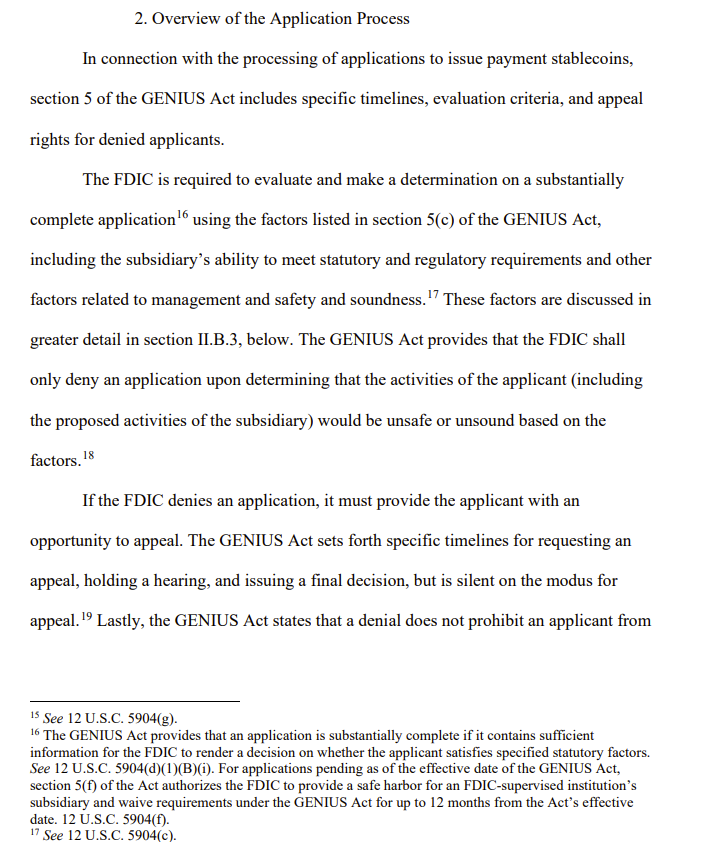
Excerpts from the FDIC’s proposed framework for bank-issued payment stablecoins. Source: FDIC

Under the proposal, banks would apply to issue payment stablecoins through a subsidiary, with the FDIC assessing both the subsidiary and its parent institution against criteria set out in the GENIUS Act. These include the ability to meet stablecoin issuance standards, the institution’s financial condition, management quality, redemption policies and other safety and soundness considerations.

Once approved, the FDIC would serve as the primary federal regulator overseeing the subsidiary’s payment stablecoin activities.

The FDIC is the US agency responsible for insuring bank deposits and supervising member institutions. In recent years, it has taken a more active role in shaping how banks engage with digital assets, including reconsidering the use of reputational risk in bank supervision. As Cointelegraph reported in October, this shift could impact how financial institutions interact with crypto-related businesses.

Related: US stablecoin rules split global liquidity with Europe, CertiK warns

Washington’s historic embrace of stablecoins

The GENIUS Act — short for Guiding and Establishing National Innovation for US Stablecoins — cleared the Senate in June and was signed into law by US President Donald Trump the following month.

The legislation establishes a comprehensive regulatory framework for payment stablecoins, including requirements that issuers maintain one-to-one reserve backing with US dollars or other approved high-quality liquid assets.
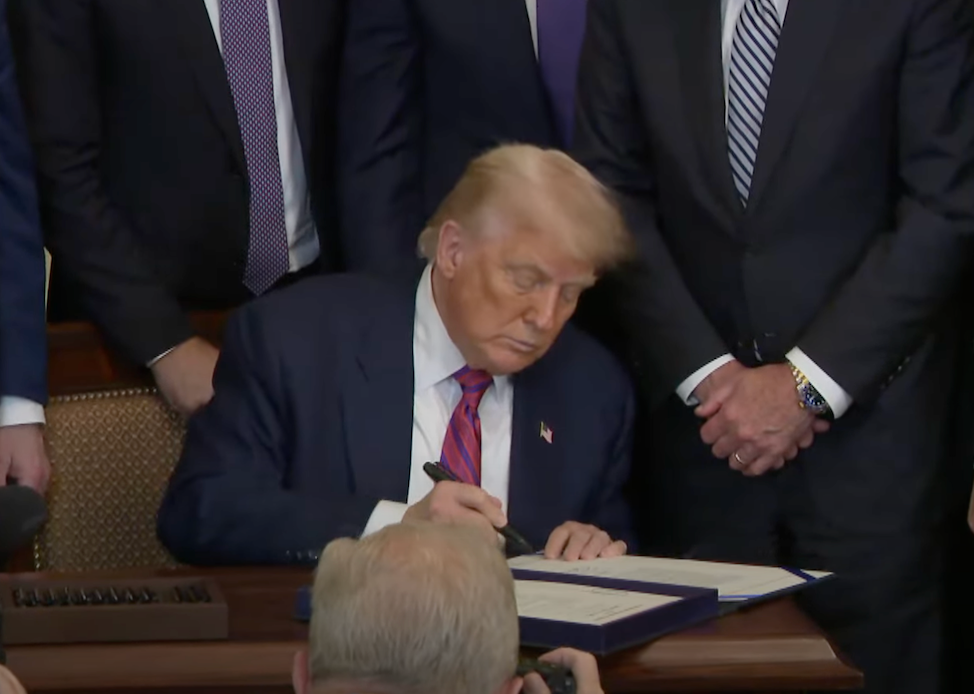
US President Donald Trump signed the GENIUS Act on July 18. Source: Associated Press

The GENIUS Act was widely welcomed by the cryptocurrency industry, with senior executives from major companies including Coinbase, Circle, Robinhood and Gemini attending President Donald Trump’s signing of the bill.

Some industry participants view the legislation as a tool to strengthen US dollar liquidity and extend the dollar’s global reach through stablecoins, a view echoed by US Treasury Secretary Scott Bessent.

The total value of stablecoins in circulation has climbed above $300 billion globally, driven almost entirely by US dollar-pegged tokens.

Related: Crypto Biz: Corporate stablecoin race heats up with Citi, Western Union at the helm

Пов'язані матеріали

Huawei Cloud Rejects Token Price War, Zhou Yuefeng Seeks a New Winning Formula for AI Cloud

At the 2026 Huawei Cloud INSPIRE Creator Conference, CEO Zhou Yuefeng outlined Huawei Cloud's distinct strategy in the competitive AI cloud market. Instead of engaging in price wars based on token volume or Maas revenue—a common focus for rivals like Alibaba Cloud and ByteDance's Volcano Engine—Huawei Cloud is shifting the competition towards real-world productivity gains. Zhou highlighted three core differentiators: a fully domestic computing stack (Ascend, Kunpeng), a focus on government and enterprise clients rather than consumer internet, and a deep commitment to open-source ecosystems. To this end, Huawei Cloud launched a suite of new products under the "Agentic Infra" paradigm, including the AICS Lingqu computing cluster, AMS memory storage, and the ModelArts Next platform. These aim to solve enterprise challenges in deploying AI agents, such as latency, memory, scheduling, and security. The strategy further involves creating specialized industry zones ("AI Dream Factories") for sectors like healthcare and embodied intelligence. For example, a smart medical zone developed with Shanghai Ruijin Hospital aims to democratize expert-level diagnostic capabilities. In essence, Huawei Cloud is positioning itself not as a commodity token provider, but as the foundational infrastructure for industrial AI, leveraging its domestic supply chain and hybrid cloud solutions to serve sectors where productivity, not just scale, is the ultimate measure of value.

marsbit8 хв тому

Huawei Cloud Rejects Token Price War, Zhou Yuefeng Seeks a New Winning Formula for AI Cloud

marsbit8 хв тому

70% of the Public Opposes AI, Americans Hope the U.S. Loses the AI War

70% of Americans believe AI development is moving too fast, with growing public resistance evolving from online criticism to real-world protests and violence. This widespread anti-AI sentiment stems from fears of job losses, rising utility costs, environmental damage, threats to democracy, and financial instability. Key incidents illustrate the backlash: Google's former CEO Eric Schmidt was loudly booed at a graduation for promoting AI; AI company ads are vandalized; protests and even violent attacks target AI firms and data centers. Polls show deep public pessimism and strong local opposition to data center construction, often surpassing resistance to nuclear power plants. The core grievances are economic and practical: AI is seen as automating jobs, concentrating wealth, and increasing household electricity and water bills due to massive data center resource demands. Environmentalists also oppose AI's high energy use and carbon emissions. This opposition has turned AI into a major political issue in the US. While the Trump administration prioritizes AI innovation for global competition, bipartisan pushback is growing. Democrats and factions within the MAGA movement are forming temporary alliances to support stricter regulations and local bans on new data centers, pressuring the administration to choose between its tech industry backers and its voter base. The situation highlights a profound national divide over AI's future.

marsbit42 хв тому

70% of the Public Opposes AI, Americans Hope the U.S. Loses the AI War

marsbit42 хв тому

Agents Take Over Traffic Distribution Power: What Are Tencent, ByteDance, and Alibaba Competing For?

In the race to dominate the AI era's entry point, China's tech giants—Tencent, ByteDance, and Alibaba—are aggressively deploying AI Agents to control the future of traffic distribution. Alibaba is pursuing a dual-track "closed loop + openness" strategy. Its Qianwen app is evolving into a super-Agent integrated across its ecosystem (Taobao, Alipay, etc.) to handle complex tasks like travel planning. Concurrently, it is opening its platform to external brands (Luckin Coffee, KFC) and has launched a B2B Agent platform, "Wukong," targeting enterprise automation. Its other flagship, Quark, aims to be an "AI super search box" for information and tasks. ByteDance is executing an omnipresent "sprawl strategy." Its Doubao app boasts over 300 million monthly active users and is evolving into a default AI entry point for daily life, with plans for paid versions and e-commerce integration. Its core weapon is the Kouzi platform, a visual "AI assembly factory" for developers to build custom Agents. ByteDance is also pushing hardware integration, collaborating on AI phones and developing smart glasses to embed Doubao everywhere. Tencent is playing its long-held "ultimate card" by quietly embedding an AI Agent directly into WeChat. This Agent, accessible via a swipe, can understand user commands and automatically execute tasks by calling upon WeChat's millions of mini-programs (e.g., finding and ordering coffee). This leverages WeChat's unparalleled 1.4-billion-user ecosystem to position the app as an AI-powered "service operating system," a move that could dramatically reshape the competitive landscape. The core battleground is shifting from competing for "user screen time" to competing to be the "default execution layer" for user intent. The business model is evolving from an "attention economy" to an "intent economy," where the Agent that can most efficiently fulfill a user's need gains control over service access and token flow. This represents a fundamental change in how users connect with digital services, making the fight for the Agent入口 (entry point) a pivotal moment for redefining industry leadership in the AI age.

marsbit2 год тому

Agents Take Over Traffic Distribution Power: What Are Tencent, ByteDance, and Alibaba Competing For?

marsbit2 год тому

Торгівля

Спот
Ф'ючерси

Популярні статті

Як купити SOON

Ласкаво просимо до HTX.com! Ми зробили покупку SOON (SOON) простою та зручною. Дотримуйтесь нашої покрокової інструкції, щоб розпочати свою криптовалютну подорож.Крок 1: Створіть обліковий запис на HTXВикористовуйте свою електронну пошту або номер телефону, щоб зареєструвати обліковий запис на HTX безплатно. Пройдіть безпроблемну реєстрацію й отримайте доступ до всіх функцій.ЗареєструватисьКрок 2: Перейдіть до розділу Купити крипту і виберіть спосіб оплатиКредитна/дебетова картка: використовуйте вашу картку Visa або Mastercard, щоб миттєво купити SOON (SOON).Баланс: використовуйте кошти з балансу вашого рахунку HTX для безперешкодної торгівлі.Треті особи: ми додали популярні способи оплати, такі як Google Pay та Apple Pay, щоб підвищити зручність.P2P: Торгуйте безпосередньо з іншими користувачами на HTX.Позабіржова торгівля (OTC): ми пропонуємо індивідуальні послуги та конкурентні обмінні курси для трейдерів.Крок 3: Зберігайте свої SOON (SOON)Після придбання SOON (SOON) збережіть його у своєму обліковому записі на HTX. Крім того, ви можете відправити його в інше місце за допомогою блокчейн-переказу або використовувати його для торгівлі іншими криптовалютами.Крок 4: Торгівля SOON (SOON)Легко торгуйте SOON (SOON) на спотовому ринку HTX. Просто увійдіть до свого облікового запису, виберіть торгову пару, укладайте угоди та спостерігайте за ними в режимі реального часу. Ми пропонуємо зручний досвід як для початківців, так і для досвідчених трейдерів.

176 переглядів усьогоОпубліковано 2025.05.23Оновлено 2026.06.02

Як купити SOON

Обговорення

Ласкаво просимо до спільноти HTX. Тут ви можете бути в курсі останніх подій розвитку платформи та отримати доступ до професійної ринкової інформації. Нижче представлені думки користувачів щодо ціни SOON (SOON).

活动图片