UK Crypto Regulation Enters Countdown: What Changes Are in the FCA's New Rules?

Foresight NewsОпубліковано о 2026-07-02Востаннє оновлено о 2026-07-02

Анотація

UK Crypto Regulation Enters Countdown: Key Changes in FCA's New Rules The UK Financial Conduct Authority (FCA) has published its final crypto asset regulatory policy, marking a shift from consultation to implementation. The new regime, set to fully expand from October 25, 2027, moves crypto businesses from registration to authorisation. A critical window from September 30, 2026, to February 28, 2027, allows existing firms to apply for transitional provisions, enabling them to continue operating while their authorisation is reviewed. Existing registrations will not automatically convert. The rules cover a broad range of activities including stablecoin issuance, custody, trading platform operation, arranging deals, staking, and lending. Authorised firms must meet new prudential capital requirements, with permanent minimum capital ranging from £750,000 for proprietary trading to £75,000 for arranging deals. They must also hold a basic liquid asset buffer for operational resilience. Market integrity rules now apply to trading platforms and intermediaries, covering areas like insider trading and requiring best execution checks against at least three UK-authorised venues. Custodians face enhanced client asset protection rules (CASS 17), focusing on ownership, reconciliation, and private key management. For stablecoins, issuers must provide full backing from issuance and allow redemption at par value within a T+1 timeframe. Reserve assets are categorised into core (e.g., demand...


Written by: KarenZ, Foresight News


A countdown clock is rewriting the UK crypto market.


If a platform helps users buy crypto, facilitates trading, custodies assets, or issues stablecoins in the UK, the core questions it faces next are straightforward: does its business fall under the FCA's new regulatory scope? Does it need to apply for authorization? Can it continue operating during the application review period?


At the end of June 2026, the UK Financial Conduct Authority (FCA) issued a set of crypto asset regulatory policy statements covering stablecoin issuance, custody, trading platforms, intermediaries, staking, lending, market abuse, disclosure, prudential capital, and the applicability of the FCA Handbook.


According to the FCA's Crypto Roadmap, this marks the transition of UK crypto regulation from years of consultation to the final rule-making stage.


From Registration to Authorization


The UK has previously regulated the crypto industry, but its scope was relatively limited. Since January 2020, crypto asset trading service providers and custodian wallet providers operating in the UK have needed to register with the FCA under anti-money laundering regulations; in 2023, financial promotion rules began to apply to crypto asset marketing.


This change goes further. The FCA stated that the UK Parliament passed the *Financial Services and Markets Act 2000 (Cryptoassets) Regulations 2026* on February 4, 2026, bringing a broader range of crypto asset activities into the FCA's regulatory perimeter for the first time. Under the new regime, the full scope of regulated activities will be extended from October 25, 2027.


This regime covers a significant number of entities. The relevant activities listed by the FCA include: issuing qualifying stablecoins, custodying crypto assets, operating qualifying crypto asset trading platforms, trading qualifying crypto assets (as principal or agent), arranging qualifying crypto asset trading services (including crypto lending), arranging qualifying crypto asset staking services, and more.


In other words, regarding crypto-specific regulation, the UK regulator is not targeting just one segment. Issuance, trading, matching, brokerage, custody, staking, lending—if an activity falls within the definitions of the new regime, it will likely need to enter the FCA's authorization system.


The Most Critical Window, Determining Whether Business Can Continue During Review


For crypto companies already operating in the UK market, the period from September 30, 2026, to February 28, 2027, is the most crucial to watch.


The FCA stated that if a firm wishes to rely on the *savings provisions*, which are transitional grandfathering clauses, the application window is planned to open on September 30, 2026, and close on February 28, 2027. Eligible companies that submit applications within this window can continue to carry out specified activities before the FCA makes its decision.


This is not a mere date reminder. It determines whether existing firms can continue operating while awaiting authorization review. Missing the window may cause a company to lose the protection to continue relevant business during the transition period.


The FCA also explicitly stated that existing registrations will not be automatically converted. Firms currently registered under the *Financial Services and Markets Act 2000 (FSMA)* or the *Money Laundering Regulations*, authorized under payment service or electronic money rules, or relying on FSMA s.21 approval for financial promotions—if their business falls within the scope of the new regulated crypto asset activities—will still need to obtain the corresponding authorization.


This will force many companies to re-evaluate their business boundaries. Models that were sufficient under anti-money laundering registration or financial promotion rules may no longer suffice under the new regime. Companies must first determine if they fall within the regulatory scope, then prepare authorization applications, capital arrangements, risk control systems, and client asset protection mechanisms.


Beyond Authorization: Capital and Risk Control Thresholds


Obtaining authorization is not the only challenge. This time, the FCA has broken down many compliance requirements that were previously easily relegated to slogans into more concrete rules.


Regarding prudential capital, PS26/12 sets out the permanent minimum capital requirements for different businesses. Firms trading qualifying crypto assets as principal: £750,000; issuing qualifying stablecoins: £350,000; custodying crypto assets, providing qualifying crypto asset staking services, operating qualifying crypto asset trading platforms: £150,000; trading as agent and arranging trades: £75,000.
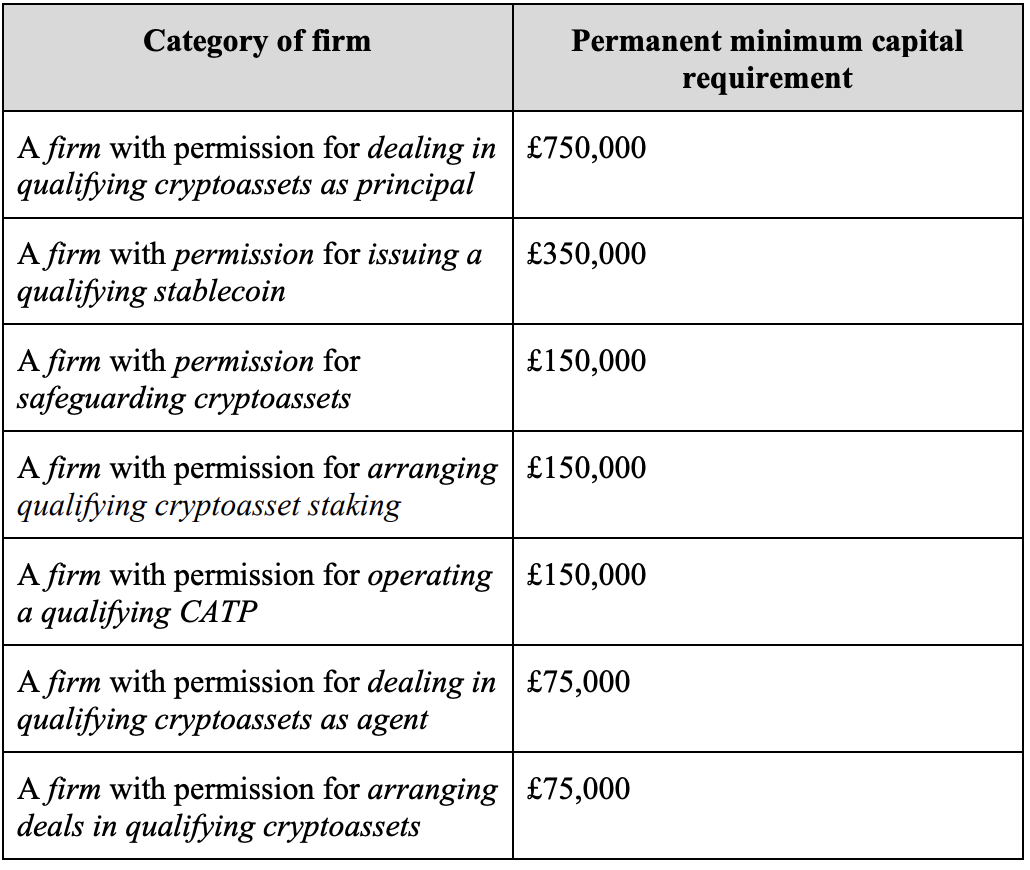


These figures may not seem high, but they are just the baseline. The FCA explained that a firm's minimum own funds requirement is the highest of three values: the permanent minimum capital requirement, the fixed overheads requirement, and the K-factor requirement. The permanent minimum capital is the baseline, while the K-factor is further calculated based on the scale of business activities and risk exposure. The FCA also emphasized that the permanent minimum capital is an authorization threshold; firms cannot obtain authorization first and then gradually meet the requirement in phases afterwards.


The FCA has also introduced a basic liquid asset requirement. Relevant firms must hold core liquid assets amounting to one-third of the fixed overheads requirement plus 1.6% of the total value of client guarantees. The purpose of this liquidity buffer is pragmatic: firms cannot meet capital requirements only on paper; they must also have sufficient liquid assets to support operations, orderly wind-down, or handling client-related obligations under stress scenarios.


Trading platforms and intermediaries also face more detailed market conduct rules. In its press release, the FCA stated that the new framework will introduce market integrity rules covering areas like insider trading and market manipulation; in the regime overview, the FCA also included trading platforms and intermediaries within the scope of activity rules in PS26/11, specifically mentioning requirements such as best execution and price checks across multiple execution venues. PS26/11 further stipulates that relevant firms need to establish client order handling procedures to ensure client orders are executed promptly, fairly, and expeditiously, and to reference prices from at least 3 reliable UK authorized execution venues for price checks where possible.


If there are fewer than 3 UK authorized venues where the order can be executed, existing available venues should be checked. The FCA simultaneously emphasized that this is not a mechanical price comparison for each trade, nor does it require orders to be executed only at the 3 venues checked. It requires firms to use reliable price sources to validate their execution policies and be able to demonstrate that the execution outcomes delivered to clients are at least as good as those that would have been achieved in comparable circumstances at these UK authorized venues.


The focus for custody businesses is client asset protection. In PS26/11, the FCA confirmed that CASS 17 protection requirements will apply to client crypto assets, with rule focuses including ownership, record keeping, asset reconciliation, and private key management. In short, platforms cannot merely state that "assets are transparent on-chain"; they must also prove they know which assets belong to which clients, whether their ledgers match on-chain assets, and that private key control will not be compromised due to internal processes or external attacks.


The FCA's cost-benefit analysis provides a more tangible figure: it estimates that custody protection rules could prevent approximately £60 million in consumer losses annually.


Lending and staking are also brought into a more detailed consumer protection framework. For crypto lending, the FCA retains core protection requirements for retail clients, including enhanced disclosure, client consent, appropriateness tests, record keeping, over-collateralization, and negative balance protection. Negative balance protection means that a retail client's losses in a crypto borrowing arrangement should not exceed the market value of the collateral they have specifically provided for that borrowing.


For staking services, the FCA retains requirements for disclosure, contract terms, client consent, and record keeping, but makes adjustments for automatic staking arrangements, allowing clients to consent to ongoing staking covering current and future holdings, provided relevant conditions are met and annual notifications are given.


Stablecoins Placed Beside Payment Ambitions


Stablecoins are a category of activity treated separately within this regulatory framework.


The FCA stated that qualifying stablecoins issued in the UK will be required to be fully backed and redeemable at par value, to support their use as "money-like instruments."


The core of PS26/10 is to require stablecoin issuers to establish an auditable mechanism around backing assets, redemption, disclosure, and asset protection. The FCA's final rules require UK stablecoin issuers to provide full backing for their stablecoins from the moment they are minted, including tokens held by the issuer itself; tokens that have been permanently destroyed no longer require backing asset coverage. The FCA's reasoning is direct: stablecoins are liquid, and if unsupported tokens enter the market, it could undermine confidence in their 1:1 peg.


Regarding redemption, the FCA requires UK stablecoin issuers to provide the right to redeem at par value and complete redemptions within a T+1 timeframe. However, the final rules adjust the starting point: T+1 no longer starts from the submission of a complete redemption request, but from when the issuer receives the stablecoins to be redeemed into its wallet. This allows AML/KYC checks to be completed before T+1, avoiding squeezing anti-money laundering reviews into the redemption timeline.


Regarding backing assets, the FCA divides stablecoin reserves into two tiers: core backing assets and expanded backing assets.


Core backing assets include demand deposits and short-term government debt instruments; expanded backing assets include longer-term government debt instruments, shares in public debt CNAV money market funds, and repo or reverse repo arrangements with government debt instruments as the underlying and a maturity not exceeding 7 days.


The FCA sets two liquidity requirements: First, issuers must meet the On-demand Deposit Requirement (ODDR), meaning they must hold at least 5% of the backing asset pool as demand deposits. Second, issuers must also meet the Core Backing Asset Requirement (CBAR), meaning they must hold an additional percentage of core backing assets, with the percentage being the higher of 5% and the highest single-day redemption ratio over the past 180 redemption days. Demand deposits used to meet the ODDR cannot also be used to meet the CBAR.


The focus of this design is to prevent issuers from allocating more to long-term or complex assets for yield, yet being unable to provide sufficient high-liquidity assets during concentrated user redemptions.


Beyond this, there is a larger regulatory division of labor. The FCA and the Bank of England issued a joint statement on the same day explaining the regulatory pathway for systemic stablecoin issuers. "General UK stablecoin issuers" are regulated by the FCA; if a UK stablecoin issuer is designated by HM Treasury as having "systemic importance," it may transition from sole FCA regulation to joint regulation by the FCA and the Bank of England.


PS26/10 also mentions that in the Bank of England's draft rules, the backing asset composition for systemic stablecoins may shift to a maximum of 70% UK sovereign debt with a remaining maturity of less than 6 months, and a minimum of 30% central bank deposits; individual stablecoins may also be subject to a provisional issuance cap of £40 billion and required to offer T+0 redemption.


This indicates that the UK does not view stablecoins solely as exchange-denominated tools. As long as they continue to approach payment and settlement scenarios, regulatory focus will expand from investment risk to reserve safety, redemption stability, and financial infrastructure reliability.


Summary


The FCA still cautions that the vast majority of crypto assets are highly speculative, and consumers may lose all their principal. The new rules do not eliminate such risks, nor do they endorse crypto assets. What they change is another matter: the UK is beginning to address crypto business using more comprehensive financial regulatory language.


Under the new framework, crypto-related companies must also demonstrate whether capital is sufficient, how client assets are protected, whether trade execution is fair, if stablecoins can be redeemed according to rules, and who is responsible if risks get out of control.


By October 25, 2027, when the countdown ends, those that truly remain will be the companies that can clearly articulate their business boundaries, client assets, capital buffers, and risk responsibilities.

Трендові криптовалюти

Пов'язані питання

QWhat is the most crucial application window for existing crypto firms under the new UK FCA regime, and what does it allow?

AThe most crucial window is from September 30, 2026, to February 28, 2027. Firms that submit their applications during this period and meet the conditions can rely on the 'savings provisions' (transitional arrangements). This allows them to continue their designated crypto-related activities while the FCA processes their application for authorization.

QWill a firm's existing registration with the FCA (e.g., for AML purposes) automatically convert into a full authorization under the new crypto regime?

ANo. Existing registrations under the Money Laundering Regulations, authorizations under the Payment Services or E-money rules, or financial promotions approvals will NOT automatically convert to authorization. Any firm whose activities fall within the scope of the new regulated crypto asset business must apply for and obtain the appropriate FCA authorization.

QWhat are the key new regulatory requirements for a crypto asset custodian under the FCA's final rules (PS26/11)?

AKey requirements for custodians under PS26/11 include: Client Asset (CASS 17) protection rules focused on client asset segregation, accurate record-keeping, regular reconciliation of holdings on and off-chain, and secure private key management. The rules aim to ensure firms can prove which assets belong to which client and that private keys are not at risk from internal failures or external attacks.

QHow does the FCA's new framework (PS26/10) structure the reserve assets for 'Qualifying Stablecoin' issuers?

AThe FCA structures stablecoin reserves into two tiers. 'Core backing assets' include demand deposits and short-term government debt instruments. 'Expanded backing assets' include longer-term government debt, CNAV money market fund shares, and short-term repos (≤7 days). Issuers must also meet specific liquidity buffers: a 5% On-demand Deposit Requirement (ODDR) and a Core Backing Asset Requirement (CBAR) based on peak redemption history.

QWhat is the potential regulatory path for a stablecoin issuer deemed 'systemically important' in the UK?

AA stablecoin issuer designated by HM Treasury as 'systemically important' would move from being regulated solely by the FCA to a dual-regulatory regime with joint supervision by the FCA and the Bank of England (BoE). The BoE's proposed rules for such issuers could include stricter reserve asset requirements (e.g., up to 70% in short-term UK sovereign debt and at least 30% in central bank deposits) and a potential T+0 redemption timeframe.

Пов'язані матеріали

On the Eve of Its U.S. Journey, SK Hynix Plummets Sharply

Just before its highly anticipated U.S. listing, SK Hynix saw its share price plummet dramatically, losing over 14% in a single day. The sell-off was triggered by market fears of a potential slowdown in AI capital expenditure. This followed a news report suggesting Meta might sell "excess AI compute," which was later amended to remove the word "excess." The initial phrasing sparked a chain reaction in investor sentiment, linking it to a potential peak in AI demand. Despite the sharp downturn, the article argues this is likely an overreaction driven by market sentiment and structural de-leveraging, rather than a fundamental reversal of the AI trend. The author points out that even if Meta proceeds, it could be an optimization of existing assets, not a systemic demand contraction. SK Hynix is in the final stages of its U.S. IPO via an ADR listing on Nasdaq, aiming to raise approximately $29.4 billion—one of the largest such offerings ever. The funds are earmarked for expanding domestic Korean production capacity for HBM (High Bandwidth Memory) and advanced packaging. A key motivation for the U.S. listing is to achieve a valuation re-rating, escaping the so-called "Korea discount" and tapping into the higher valuation multiples typically given to AI-related semiconductor stocks in the U.S. market. In conclusion, the article views the current price drop as a potential buying opportunity, suggesting the long-term industry fundamentals for SK Hynix—particularly its leading position in the crucial HBM market—remain strong. The significant capital raised from the IPO is also seen as a factor that could provide underlying support for the stock post-listing.

Odaily星球日报42 хв тому

On the Eve of Its U.S. Journey, SK Hynix Plummets Sharply

Odaily星球日报42 хв тому

Торгівля

Спот

Популярні статті

Що таке DOGE M

Doge Matrix ($doge m): Нова порода криптовалюти, що керується спільнотою Вступ У постійно змінюваному ландшафті криптовалюти нові проекти постійно з'являються, кожен з яких прагне привернути увагу інвесторів та ентузіастів. Одним з останніх учасників цього домену є Doge Matrix, представлений тикером $doge m. Цей проект привернув увагу завдяки своїм корінням у популярній культурі мемів навколо Dogecoin, закріплюючи своє місце в просторі web3. Ця стаття має на меті надати всебічний аналіз Doge Matrix, охоплюючи його огляд, творця, інвесторів, функціональність, хронологію та помітні аспекти. Що таке Doge Matrix ($doge m)? Doge Matrix — це проект криптовалюти, що керується спільнотою, який, здається, будує на широкій привабливості Dogecoin, цифрової валюти, відомої своїм маскотом Shiba Inu та мем-походженням. Хоча загальні цілі Doge Matrix не є детально визначеними, він характеризується зобов'язанням залучати участь та підтримку спільноти. На відміну від традиційних криптовалют, які часто підкреслюють корисність або внутрішню цінність через підлягаючі технології, Doge Matrix позиціонує себе в просторі, що охоплює культурне явище криптовалют, особливо приваблюючи тих, хто резонує з етикою активів на основі мемів. Спираючись на сильні сторони спільноти Dogecoin, Doge Matrix працює як частина більш широкої екосистеми, запрошуючи участь та залучення користувачів, які поділяють інтерес до криптовалюти та цифрового простору. Хто є творцем Doge Matrix ($doge m)? Особистість творця Doge Matrix залишається невідомою. Ця відсутність прозорості не є рідкісним явищем у сфері криптовалют, де деякі проекти запускаються без розкриття ідентичностей своїх засновників. Відсутність інформації про засновницьку команду може викликати питання серед потенційних інвесторів щодо відповідальності та напрямку проекту. Хто є інвесторами Doge Matrix ($doge m)? На даний момент немає публічно доступної інформації про інвесторів або інвестиційні фонди, які підтримують Doge Matrix. Проект, здається, покладається переважно на підтримку спільноти, а не на інституційні інвестиції. Ця модель узгоджується з природою ініціативи, що керується спільнотою, сприяючи середовищу, де напрям проекту формується його учасниками, а не диктується вибраними фінансовими спонсорами. Як працює Doge Matrix ($doge m)? Специфіка операційних механізмів Doge Matrix є дещо розмитою, відображаючи ширшу тенденцію проектів у просторі мем-коінів, де інноваційні функціональності не завжди чітко сформульовані. Проте Doge Matrix, здається, розроблений для того, щоб використовувати існуючу екосистему криптовалют, заохочуючи участь користувачів, одночасно використовуючи знайомі культурні посилання, пов'язані з Dogecoin. Його потенційно унікальні характеристики походять від взаємодій у спільноті, а не від технологічних досягнень, підкреслюючи спільний досвід та співпрацю серед власників токенів. Хоча точні інновації не були чітко окреслені, проект, здається, створює простір, де члени спільноти можуть взаємодіяти, ділитися ідеями та просувати потенціал проекту вперед. Хронологія Doge Matrix ($doge m) Розглядаючи хронологію проекту, можна виявити помітні події, які визначили його шлях до цього часу: 25 листопада 2024: Doge Matrix досяг свого історичного максимуму, що стало значною віхою в його ранній історії. 1 січня 2025: Навпаки, Doge Matrix досяг свого історичного мінімуму, ілюструючи волатильність, яка часто асоціюється з криптовалютами, особливо на ранніх етапах життєвого циклу проекту. Триває: Проект продовжує активно торгуватися та підтримуватися своєю спільнотою, хоча конкретні майбутні віхи або цілі ще не були розкриті. Ключові моменти про Doge Matrix ($doge m) Орієнтація на спільноту У центрі Doge Matrix лежить зобов'язання до залучення спільноти. Проект процвітає на основі співпраці та спільних цілей серед своїх учасників, підкреслюючи важливість колективних зусиль. На відміну від централізованих проектів, які часто мають визначену структуру керівництва, Doge Matrix наразі демонструє більш гнучкий підхід до управління, де голос кожного члена спільноти має значення. Волатильність Ринок криптовалют відомий своєю волатильністю, і Doge Matrix не є винятком. Його історія цін відображає значні коливання між високими та низькими значеннями, що є типовим для багатьох нових криптовалют, але підкреслює ризики, пов'язані з інвестиціями в нові токени. Відсутність детальної інформації Однією з найпомітніших рис Doge Matrix є брак детальної інформації щодо його технологічних основ та операційних механізмів. Ця невизначеність вимагає від потенційних інвесторів провести ретельну перевірку перед залученням до проекту. Висновок Підсумовуючи, Doge Matrix ($doge m) ілюструє нову хвилю проектів криптовалюти, які сильно покладаються на залучення спільноти та культурну значущість. Хоча йому бракує певних специфікацій — таких як чітке керівництво, визначені цілі та детальна функціональність — проект зміг викликати інтерес у криптоспільноті, використовуючи вже встановлену привабливість культури мемів. Як і з будь-якими інвестиціями в сфері криптовалют, розуміння вроджених ризиків і проведення всебічного дослідження є важливими для потенційних учасників. Doge Matrix слугує нагадуванням про динамічну, іноді непередбачувану природу криптоіндустрії, що відзначається постійною еволюцією та ентузіазмом щодо ініціатив, що керуються спільнотою.

492 переглядів усьогоОпубліковано 2025.02.03Оновлено 2025.02.03

Що таке DOGE M

Що таке $M

Розуміння Mantis ($M): Нова ера в кросчейн-інтероперабельності У постійно змінюваному ландшафті Web3 та криптовалют нові проекти прагнуть запропонувати інноваційні рішення, спрямовані на покращення користувацького досвіду та розширення функціональних можливостей у рамках децентралізованої фінансової екосистеми. Один з таких проектів, що привертає увагу, - це Mantis ($M), піонерський протокол, заснований на принципах кросчейн-інтероперабельності та угод на основі намірів. Ця стаття розглядає основні аспекти Mantis, включаючи його основну функціональність, творців, інвестиційну підтримку, інноваційні особливості та ключові етапи. Що таке Mantis ($M)? Mantis описується як протокол врегулювання намірів у кількох доменах, який спрощує кросчейн-взаємодії, дозволяючи користувачам безперешкодно виконувати складні фінансові транзакції на різних блокчейн-платформах. Протокол працює через три основні шари: Вираження намірів: Користувачі можуть формулювати свої цілі транзакцій, використовуючи природну мову, що забезпечується DISE LLM, передовою мовною моделлю штучного інтелекту. Наприклад, користувач може висловити бажання обміняти Ethereum (ETH) на Solana (SOL) з певною допустимою похибкою в 1%. Виконання: Цей шар використовує мережу розв'язувачів, які змагаються за виконання намірів користувачів. Транзакції виконуються за допомогою механізмів, таких як Coincidence of Wants (CoWs) та Order Flow Auctions (OFAs), які забезпечують оптимальне задоволення запитів користувачів. Врегулювання: Використовуючи протокол міжблокчейн-комунікації (IBC), Mantis дозволяє атомарні кросчейн-транзакції, що дозволяє користувачам працювати на різних підтримуваних ланцюгах, включаючи Ethereum, Solana та Cosmos. Mantis розроблений для впровадження рідної генерації доходу для бездіяльних активів, використовуючи криптографічні докази для підтримки цілісності транзакцій протягом усього процесу. Творці та команда розробників Mantis був задуманий Composable Foundation, дослідницькою організацією, відомою своїм акцентом на рішеннях для блокчейн-інтероперабельності. Ця організація співпрацює з відомими академічними установами, такими як Гарвардський університет та Університет Лісабона, сприяючи широким дослідженням та розробкам, які формують архітектуру та функціональність Mantis. Зобов'язання Composable Foundation сприяти інноваціям у сфері блокчейн-технологій позиціонує Mantis як надійне рішення для зростаючого попиту на інтероперабельність між кількома блокчейн-мережами. Інвестори та підтримка Хоча конкретні деталі про окремих інвесторів не були публічно розкриті, Mantis користується значною підтримкою від різних суб'єктів, включаючи: Гранти екосистеми від ланцюгів, що підтримують IBC, які підтримують зростання протоколу та інтеграцію в децентралізовані фінансові екосистеми. Стратегічні партнерства з постачальниками інфраструктури, які покращують мережеві можливості Mantis та стратегії впровадження. Фінансування через казну Composable Foundation, що забезпечує стабільну фінансову підтримку для поточних розробок та операційних витрат. Ці спільні зусилля відображають консенсус серед зацікавлених сторін щодо важливості покращення кросчейн-функціональності та потенційної корисності інфраструктурних інновацій Mantis. Ключові інновації Mantis вирізняється кількома піонерськими інноваціями, які покращують його функціональність та корисність: Незалежні від ланцюга наміри: Користувачі можуть ініціювати транзакції з будь-якого підтримуваного ланцюга, при цьому врегулюючи їх на іншому. Ця гнучкість надає користувачам більше можливостей, стимулюючи взаємодію між різними платформами. Інтерфейс на базі штучного інтелекту: Інтеграція DISE LLM дозволяє користувачам виконувати складні DeFi-операції, використовуючи природну мову, що спрощує взаємодію та робить технологію блокчейн доступною для ширшої аудиторії. Захоплення MEV у кросдоменному середовищі: Mantis створює внутрішній ринок для максимального екстракційного значення (MEV) через конкуренцію серед розв'язувачів. Цей інноваційний підхід дозволяє досягати більшої ефективності та екстракції вартості в складних транзакціях. Модульний шар врегулювання: Протокол підтримує різні методи верифікації, включаючи нульові знання та оптимістичні роллапи, забезпечуючи універсальну структуру, яка може адаптуватися до нових блокчейн-технологій. Історична хронологія Розвиток Mantis відзначений кількома критичними етапами, які окреслюють його траєкторію та зростання: | Рік | Етап | |————|————————————————————————-| | 2022 | Початкова розробка концепції в дослідницькому підрозділі Composable Foundation. | | Q3 2024 | Запуск тестової мережі з можливостями мосту між Solana та Ethereum. | | Q1 2025 | Очікувана подія генерації токенів (TGE) разом із запуском основної мережі. | | Q2 2025 | Очікувана інтеграція DISE LLM та розширення кросчейн-можливостей. | | 2025 H2 | Запланована підтримка понад 15 ланцюгів через подальші оновлення IBC. | Ця хронологія окреслює еволюцію Mantis, від концептуальних обговорень до активної реалізації та майбутніх етапів зростання. Стратегія зростання екосистеми Стратегія Mantis щодо зростання екосистеми включає кілька ініціатив, спрямованих на заохочення участі користувачів та залучення розробників: Система кредитів: Користувачі можуть заробляти кредити протоколу, надаючи ліквідність та беручи участь у реферальних програмах. Ці кредити можна буде обміняти на винагороди в майбутньому, сприяючи формуванню сильної спільноти користувачів. Модульний набір для розробки програмного забезпечення (SDK): Цей набір інструментів надає розробникам можливість створювати додатки на основі моделей, що керуються намірами, використовуючи інфраструктуру Mantis, тим самим сприяючи інноваціям у його екосистемі. Модель управління: У міру розвитку протоколу, власники токенів $M отримають можливість брати участь в управлінні протоколом, що дозволить їм голосувати за запропоновані оновлення та зміни, підвищуючи залученість спільноти та децентралізацію. Mantis представляє собою значний прогрес у сфері кросчейн-архітектури. Завдяки безперешкодній інтеграції передових алгоритмів штучного інтелекту з надійною структурою врегулювання, Mantis прагне вирішити проблеми фрагментації в багатоланцюгових екосистемах. Його інноваційний підхід ставить на перше місце покращення користувацького досвіду, дотримуючись основоположних принципів децентралізації та безпеки, встановлюючи новий стандарт для майбутньої інтероперабельності блокчейн-технологій. Оскільки Mantis продовжує свій шлях зростання та реалізації, він обіцяє стати проектом, за яким варто уважно стежити в конкурентному середовищі Web3 та децентралізованих фінансів. Зосереджуючись на подоланні кордонів та підвищенні залученості користувачів, Mantis готовий стати невід'ємною частиною майбутніх розробок у сфері криптовалют.

61 переглядів усьогоОпубліковано 2025.03.18Оновлено 2025.03.18

Що таке $M

Як купити M

Ласкаво просимо до HTX.com! Ми зробили покупку MemeCore (M) простою та зручною. Дотримуйтесь нашої покрокової інструкції, щоб розпочати свою криптовалютну подорож.Крок 1: Створіть обліковий запис на HTXВикористовуйте свою електронну пошту або номер телефону, щоб зареєструвати обліковий запис на HTX безплатно. Пройдіть безпроблемну реєстрацію й отримайте доступ до всіх функцій.ЗареєструватисьКрок 2: Перейдіть до розділу Купити крипту і виберіть спосіб оплатиКредитна/дебетова картка: використовуйте вашу картку Visa або Mastercard, щоб миттєво купити MemeCore (M).Баланс: використовуйте кошти з балансу вашого рахунку HTX для безперешкодної торгівлі.Треті особи: ми додали популярні способи оплати, такі як Google Pay та Apple Pay, щоб підвищити зручність.P2P: Торгуйте безпосередньо з іншими користувачами на HTX.Позабіржова торгівля (OTC): ми пропонуємо індивідуальні послуги та конкурентні обмінні курси для трейдерів.Крок 3: Зберігайте свої MemeCore (M)Після придбання MemeCore (M) збережіть його у своєму обліковому записі на HTX. Крім того, ви можете відправити його в інше місце за допомогою блокчейн-переказу або використовувати його для торгівлі іншими криптовалютами.Крок 4: Торгівля MemeCore (M)Легко торгуйте MemeCore (M) на спотовому ринку HTX. Просто увійдіть до свого облікового запису, виберіть торгову пару, укладайте угоди та спостерігайте за ними в режимі реального часу. Ми пропонуємо зручний досвід як для початківців, так і для досвідчених трейдерів.

519 переглядів усьогоОпубліковано 2025.07.02Оновлено 2026.06.02

Як купити M

Обговорення

Ласкаво просимо до спільноти HTX. Тут ви можете бути в курсі останніх подій розвитку платформи та отримати доступ до професійної ринкової інформації. Нижче представлені думки користувачів щодо ціни M (M).

活动图片