Turning $50 into a Million by Age 18 Through Wallet Tracking

深潮Опубліковано о 2025-12-30Востаннє оновлено о 2025-12-30

Анотація

At 18, the author turned $50 into over $1 million in less than a year using wallet tracking strategies after initially losing $80 in meme coin trades. Early mistakes included buying based on hype, narratives, or social media buzz, which often led to losses. The key shift was focusing on tracking "smart money" movements—wallets of insiders, KOLs, teams, market makers, or coordinated groups—rather than relying on subjective judgments. The author’s methods evolved over time: - Initially tracking influential KOLs’ wallets, turning $50 into $5,000 in a month. - Later monitoring coordinated groups (e.g., turning $4,000 into $600,000 on $ROCKY). - Advanced techniques included tracking new wallets, project team wallets, and market maker wallets for early entry (e.g., $BARRON and $HOOD trades yielding 50x returns). Strict rules were followed: no more than 5% of capital per trade, avoiding large positions to prevent being targeted, and maintaining emotional discipline. The author emphasizes that success came from replicable strategies, not luck, and advises understanding the motives and patterns of tracked entities. The journey is shared as inspiration, with gratitude to those indirectly involved and a focus on ethical, data-driven trading.

Written by: Ugo

Compiled by: Luffy, Foresight News

In February 2024, I entered the world of Meme coin trading with $80 and lost everything. I had this kind of disastrous experience twice.

It was at that time that I realized I hadn't figured out the way of this market at all and had been using the wrong methods.

Later, I re-entered the market with $50. This time, I used a wallet tracking strategy. In less than a year, by February 2025, that $50 had grown to over $1 million.

Early Pitfalls

My previous logic for buying Meme coins was simple: "This coin has a funny meme, good promotional content, and a clean-looking website. Just buy it."

Admittedly, this method could occasionally make some money, but most of the time, it was no different from pure gambling. You had no solid basis and couldn't find objective reasons to judge how high the price could specifically go.

If you want stable profits, you must find a way to get key information *before* the market moves, not just follow the hype after it pumps.

I was once addicted to all sorts of rumors on X and Telegram: "This coin will definitely hit a $100 million market cap this week, just you wait." I later learned that most people who post these things are paid shills, or they had already accumulated 15% of the token supply at low prices. You rush in excitedly, only to end up as the bag holder.

If your profit-taking targets aren't based on real information, then your actions are merely reacting to someone else's interests, not truly following market规律 (laws/patterns).

Turning the Tide with Wallet Tracking

I quickly realized a critical piece was missing from my previous approach. I would look at the operations of top traders and wonder, "How can he predict the market moves, but I can't?" So I had to find a solution.

And wallet tracking completely颠覆 (overturned) my understanding of trading. I stopped trying to guess market tops and bottoms, stopped chasing various narrative hotspots, and stopped being led by the nose by hype on X. Instead, I focused on just one thing: where is the smart money flowing?

The origin of any major market move isn't on social media, but in a small number of wallets. These wallets are either the project's initial wallets, large holding wallets, or early institutional wallets. Insiders, KOLs, industry big shots, market makers, newly created anonymous wallets... are all hidden in these addresses.

My success wasn't based on the luck of one single trade, but on repeatedly capturing replicable market patterns.

At that moment, I completely understood: I don't need to be smarter than the entire market, I don't need to incorporate any subjective judgment, and I don't need to pay attention to market炒作 (hype/speculation). I just need to closely watch the data, analyze fund movements, and then decisively execute my trading strategy.

From then on, my goal became extremely clear: build a trading system that reacts solely based on the movements of smart money, not on hearsay.

My Practical Wallet Tracking Methods

Watch KOL Wallets Closely

When I first started in February 2024, the wallet tracking method was actually very simple. Back then, almost no one frequently changed wallet addresses.

All you had to do was find the stealth wallet addresses of KOLs who truly had influence, and then follow their moves. That's it.

They accumulate at low prices → Pump aggressively → Price instantly pumps 10x.

Using this method, I turned $50 into $5,000 in the first month. Immediately in the second month, $5,000 became $30,000.

For example, on February 24th: A project team specifically launched a token for a certain KOL. This industry big shot quietly accumulated positions using multiple stealth wallets when the token's market cap was only $20,000. I followed his moves and bought in when the market cap reached $30,000. Subsequently, he aggressively promoted it in Telegram groups and on X, and the token's market cap instantly broke through $400,000. I took partial profits at this level.

Later that day, the market cap surged to $1 million, and I cashed out again. All calculated, my entry capital increased about 30 times in just a few hours.

My capital base was still very small at that time, so I didn't have to worry about liquidity issues at all and could exit cleanly.

Tracking Cabal Wallets

A few months later, I stopped focusing on individual KOLs and switched to tracking the wallet movements of cabals (pump groups). At that time, people were changing wallet addresses more and more frequently. Tracking the operational consensus of a group of people was much more reliable than looking at a single wallet. For example, 10 different people's wallets, all belonging to the same circle, were synchronizing the same operations.

This kind of signal gave me far more confidence than a single wallet could.

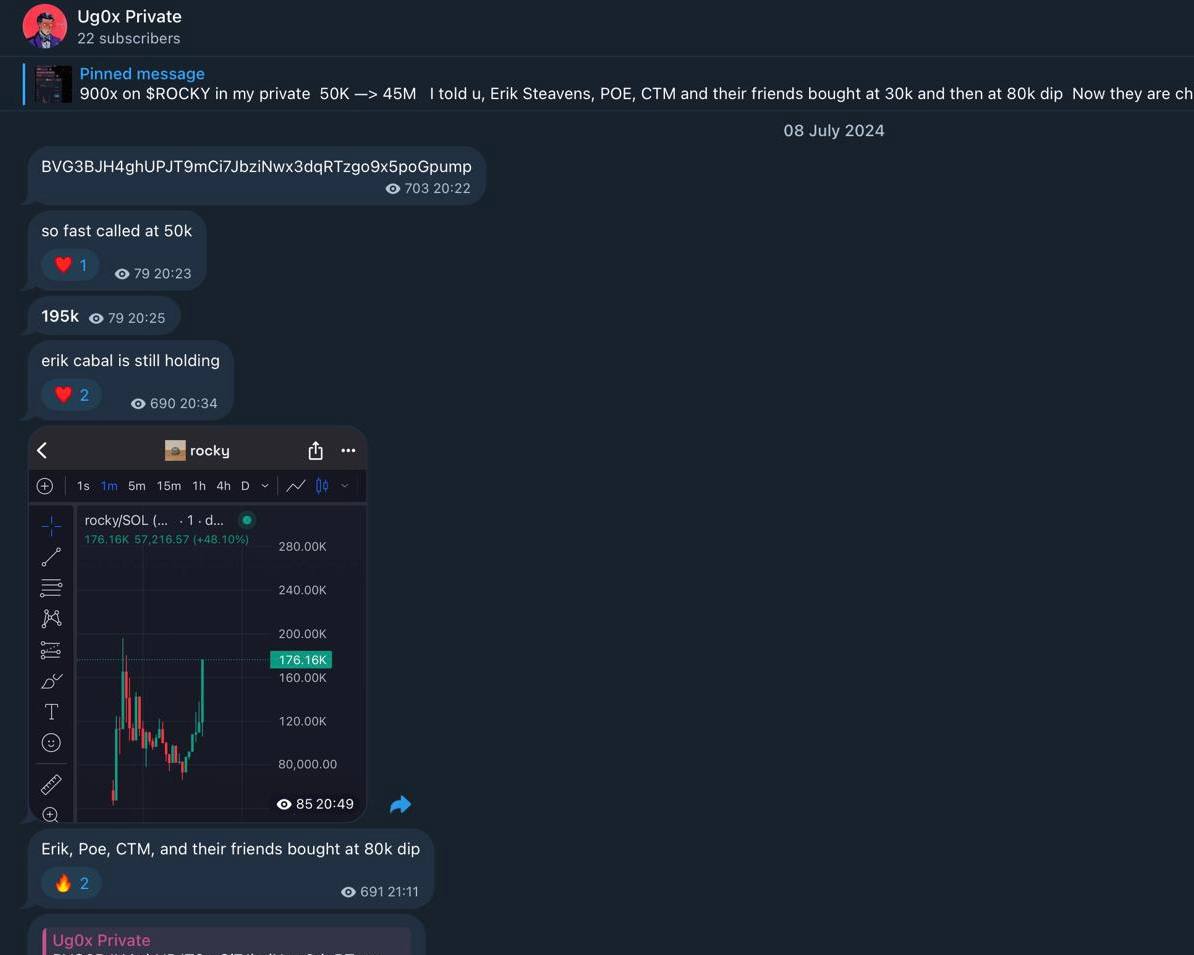
July 8, 2024, the operation around the $ROCKY token was a perfect case study. At that time, people like Erik Steavens, POE, DOGEN, and CTM were all quietly buying in the range of $10,000 to $80,000 market cap.

Seeing this signal, I knew it was no coincidence; they were definitely planning a pump.

I bought 2.8% of the circulating supply when the market cap was $40,000.

In the following days, this group of big shots联合发力 (joined forces) to pump the price, and the token's market cap soared to $45 million.

I took profits in batches between a $2 million and $10 million market cap, averaging an exit around $6 million.

In this trade, my entry capital increased 150 times. Although holding to the peak could have yielded 1100x, I strictly executed my exit plan. I was more than satisfied with making my first six-figure profit from this trade.
Tracking New Wallets, Project Wallets & Large Holding Wallets

By January 2025, the crypto market trading atmosphere was unprecedentedly hot, but wallet tracking was also becoming increasingly difficult. To continuously get first-hand insider information, I had to constantly optimize my methods and adapt.

The key to tracking these insiders' wallets was finding their new wallets that had just withdrawn funds from centralized exchanges like Binance. This meant accurately tracing fund transfer records and timestamps between multiple Binance addresses. This process was time-consuming but absolutely worth it.

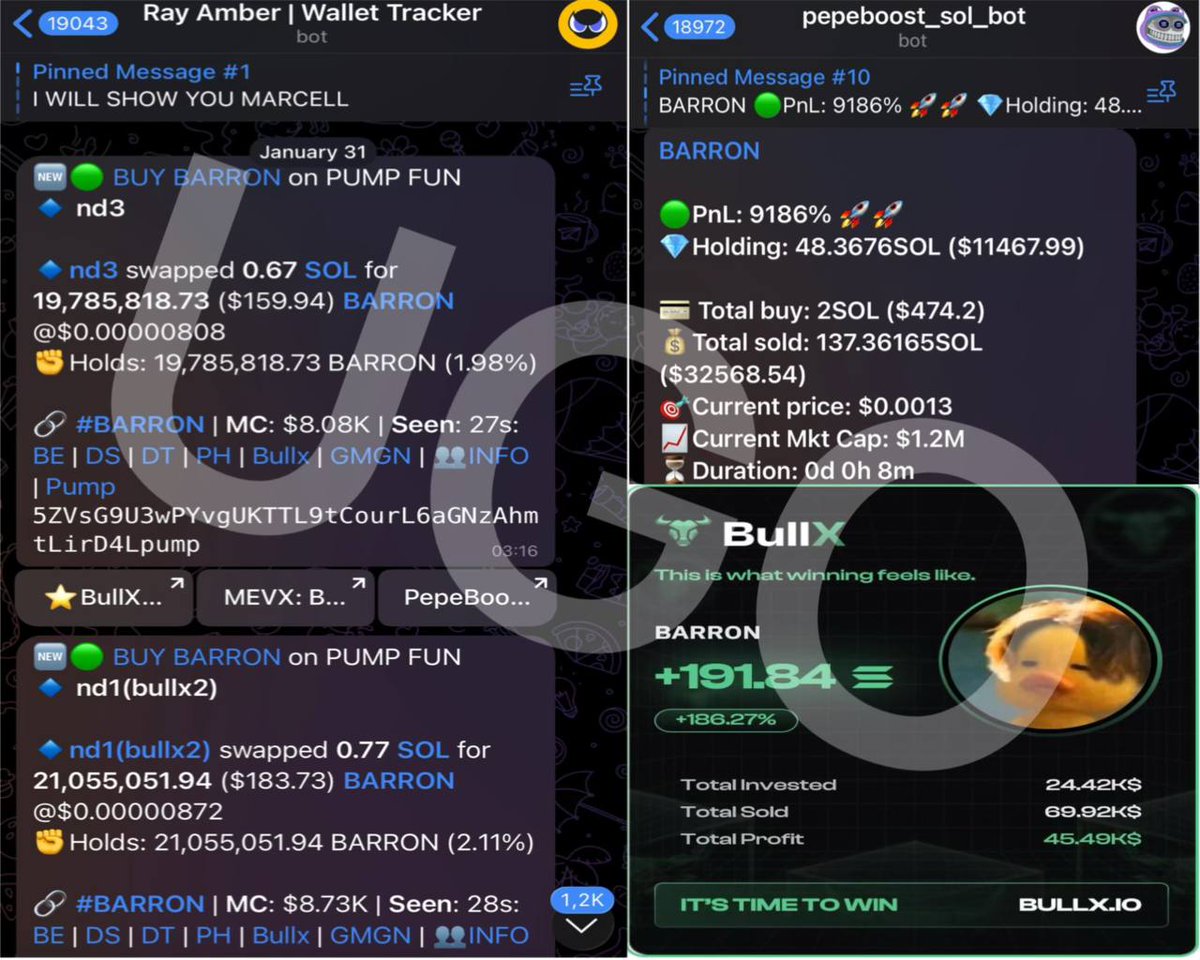
For example, I was closely tracking Marcell's wallet movements, so I could see his newly funded wallets every day. On January 31st, he personally launched and took a large position in the $BARRON token.

I built my position across 3 wallets in the market cap range of $15,000 to $25,000. About three minutes later, Marcell started posting to pump it. I quickly took profits and exited between a $1 million and $2.5 million market cap.

This was one of the fastest trades I ever executed: an initial investment of $1,300 eventually yielded over $110,000. (The trading platform BullX showed my buy amount as $24,000 because I later bought the dip in this wallet, maximizing the profit).
Tracking Market Maker Wallets

Market maker wallets are wallet addresses directly controlled by the token project team, primarily used to manipulate the token price for the benefit of the project team or the token itself.

Common manipulation tactics include: triggering stop-loss orders by placing big buy/sell orders, or dumping the price 30% in minutes to cause panic selling, allowing new investors to enter at low prices.

However, market makers often transfer tokens between wallets shortly after the token is launched. If these wallets aren't newly created or are easily identifiable, we can directly track the project team's movements and accurately capture every new token launch opportunity.

This is how I operated the $HOOD token trade on January 31, 2025.

This project team大概 (roughly) launches a new token every month. They completed their large position allocation when the market cap was pumped to around $2 million, and I bought in decisively at this level, getting in before the top KOLs started promoting it. A few hours later, I took profits between an $80 million and $120 million market cap, achieving roughly a 50x return on this trade.

Meanwhile, during the gap while managing the initial position profit-taking, I also used the market maker's large sell-offs to re-enter heavily, making 40% to 70%差价 (price difference/profit) in just a few minutes.

The total profit for this day was a whopping $152,000. Until the ASTER token trade in September of the same year, January 31st was my highest profit day.

My Ironclad Trading Rules

I always strictly adhere to capital management rules. For example, the capital投入 (input/allocated) to each trade never exceeds 5% of the total portfolio. I also flexibly adjust risk exposure based on the quality of the trading opportunity and my own level of confidence.

When trading with a wallet tracking strategy, you absolutely cannot use heavy leverage (or: take large positions). Once the target you are tracking discovers your presence, they can easily turn around and rug you.

You also need to learn to think from their perspective, understand their interests, operating habits, and rhythm control. This is how you minimize the risk of being rugged and achieve consistent, stable profits.

Of course, I strictly follow my own trading plan and never let emotions dictate decisions. I actually rarely have trouble with this because I started learning forex trading at age 14, and discipline is already deeply ingrained.

That said, I have also experienced several painful lessons of profit drawdowns. But these setbacks didn't crush me; instead, they became motivation for me to move forward. Driven by this unwillingness, I studied even harder, constantly refining my trading edge.

Finally

I am writing this article not to show off. On one hand, I want to use it as a diary to look back on my growth in 5 years. On the other hand, I also hope to inspire and help more people, letting everyone understand: as long as you are willing to主动求变 (actively seek change) and put in the effort, there is always a way to achieve your goals.

I must clarify one point: I never use these tracking techniques against friends or people around me. Everything I do is purely to understand the underlying logic of market operation and then go with the flow.

I am also very grateful to those I track, and to the project teams that truly work hard. I always trade with敬畏之心 (awe and respect), without any hostility. I am also sincerely grateful to all the friends I have met on this journey, they have given me so much help. Thank you all, and thank heaven's blessing.


Трендові криптовалюти

Пов'язані питання

QWhat was the key strategy the author used to turn $50 into over $1 million in less than a year?

AThe author used a wallet tracking strategy, focusing on following the money flow of 'smart money'—such as KOLs, insider groups, project teams, market makers, and large holders—instead of relying on social media hype or subjective judgments.

QWhat were the four main types of wallets the author tracked to identify profitable trading opportunities?

AThe author tracked four types of wallets: KOL wallets, conspiracy group (insider circle) wallets, new/project team/large holder wallets, and market maker wallets.

QHow did the author's approach to trading change after realizing the limitations of following social media hype?

AThe author stopped guessing market tops and bottoms, chasing narratives, or being influenced by social media trends. Instead, they focused solely on analyzing data and capital movements to execute trades based on the actions of informed investors.

QWhat was the author's strict rule regarding risk management in each trade?

AThe author never risked more than 5% of their total portfolio on a single trade and adjusted their risk exposure based on the quality of the opportunity and their confidence level.

QWhy did the author avoid using large positions when employing the wallet tracking strategy?

AThe author avoided large positions to prevent being noticed and targeted by the tracked entities, who could reverse their actions and exploit the follower's position.

Пов'язані матеріали

a16z: From Companies to DAOs, DUNA May Become the Next Generation Organizational Form

This article, "From Companies to DAOs: How DUNA Could Become the Next Organizational Form," traces the 500-year evolution of business collaboration. It begins with medieval structures like the *commenda* and Florentine *compagnia*, which exposed partners to personal risk. The modern corporation, exemplified by the Dutch East India Company (VOC), was a revolutionary leap, enabling large-scale, capital-intensive ventures by offering limited liability and reducing coordination costs. However, corporations introduced new challenges like principal-agent problems and bureaucratic overhead. The piece argues that software and internet-native protocols are now reducing these traditional overheads. Decentralized Autonomous Organizations (DAOs) emerged as a new model for coordination without centralized management. Yet, DAOs face a significant legal vacuum: they lack legal recognition, leaving members exposed to unlimited personal liability, and their tokens are vulnerable to being classified as securities under unclear regulations (e.g., the Howey Test). This has forced projects into suboptimal workarounds like offshore foundations. The article identifies the Decentralized Unincorporated Nonprofit Association (DUNA) as a potential solution. Recently legalized in states like Wyoming, the DUNA provides a legal wrapper for decentralized networks. It grants key protections—legal personality, limited liability, and perpetual existence—to a group without imposing a traditional hierarchical management structure. This allows token-holder communities to govern, hold assets, and contract as a single legal entity, aligning with their decentralized nature. While DUNA doesn't solve all governance challenges or magically resolve securities law questions, it represents a crucial step. It fills the legal recognition gap, offering a native legal form for internet-scale, decentralized collaboration and extending the separation of personal risk from organizational venture into a new domain.

marsbit8 хв тому

a16z: From Companies to DAOs, DUNA May Become the Next Generation Organizational Form

marsbit8 хв тому

2026 Mid-Year Report On-Chain RWA: Tokenized Stock Market Cap Doubles in a Year, But 90% of Rights Are Hollow Shells

The 2026 Mid-Year Report on On-Chain RWA highlights a significant growth in tokenized stock market capitalization, which nearly doubled from $951 million in March to $1.89 billion by July. However, the report reveals a fundamental contradiction in this "layer 2.5" ecosystem: products with the strongest legal foundation (like regulated U.S. infrastructure) lack liquidity and distribution, while freely tradable offshored wrapper products often lack substantive ownership rights. The increase is driven largely by a few products (SECZ, FGRS, STRCx) and platforms (Ondo, xStocks, Securitize collectively hold over 85% share). While distributed value across networks like Ethereum, Solana, and BNB Chain has grown, the market remains fragmented. Products referencing the same underlying asset (e.g., Apple stock) are distinct legal liabilities with different intermediaries and jurisdictional rules, offering varying degrees of legal claim. The report cautions that headline numbers are misleading, as they reflect changes in distributed token value—driven by issuance, conversions, and price movements—not pure investor inflows. True "canonical shares" with legal ownership, wide wallet distribution, institutional liquidity, and independent on-chain price discovery do not yet exist at scale. Tokenized treasuries show stronger product-market fit, and ETFs may be easier to scale than single stocks. The core takeaway is a trade-off: legal certainty versus liquidity and composability.

marsbit58 хв тому

2026 Mid-Year Report On-Chain RWA: Tokenized Stock Market Cap Doubles in a Year, But 90% of Rights Are Hollow Shells

marsbit58 хв тому

Coldcard Hardware Wallet Hacked: 594 Bitcoin Withdrawn in 25 Minutes

The Coldcard hardware wallet has been compromised, with hackers stealing approximately 594.5 Bitcoin (~$40 million) from 500 addresses in just 25 minutes. The root cause was a critical software bug, undetected for five years, which disabled the device's secure chip for generating true random numbers. This led to the creation of private keys based on predictable data like the processor's serial number, drastically reducing cryptographic security. The attackers exploited this offline by brute-forcing possible seed phrases, finding active addresses on the public ledger, and signing transactions. Initially, Coinkite (Coldcard's maker) claimed only older models were at risk but later admitted all devices running the compromised firmware were vulnerable. CEO Rodolphe Novak (NVK) apologized but ruled out financial compensation for affected users. To secure funds, owners must urgently update their firmware to specific safe versions, generate a completely new seed phrase on the updated device, and transfer all assets to new addresses created with that new seed. While a BIP-39 passphrase can help, it does not replace this migration process. Other Coinkite products like TAPSIGNER were not affected. This incident underscores that even specialized hardware requires rigorous, independent code audits, especially for cryptographic functions. It parallels past failures, like a 2006 OpenSSL bug in Debian, and raises questions about whether automated code analysis can ever fully replace human scrutiny in critical security areas.

cryptonews.ru3 год тому

Coldcard Hardware Wallet Hacked: 594 Bitcoin Withdrawn in 25 Minutes

cryptonews.ru3 год тому

Торгівля

Спот

Популярні статті

Як купити O

Ласкаво просимо до HTX.com! Ми зробили покупку O1 exchange (O) простою та зручною. Дотримуйтесь нашої покрокової інструкції, щоб розпочати свою криптовалютну подорож.Крок 1: Створіть обліковий запис на HTXВикористовуйте свою електронну пошту або номер телефону, щоб зареєструвати обліковий запис на HTX безплатно. Пройдіть безпроблемну реєстрацію й отримайте доступ до всіх функцій.ЗареєструватисьКрок 2: Перейдіть до розділу Купити крипту і виберіть спосіб оплатиКредитна/дебетова картка: використовуйте вашу картку Visa або Mastercard, щоб миттєво купити O1 exchange (O).Баланс: використовуйте кошти з балансу вашого рахунку HTX для безперешкодної торгівлі.Треті особи: ми додали популярні способи оплати, такі як Google Pay та Apple Pay, щоб підвищити зручність.P2P: Торгуйте безпосередньо з іншими користувачами на HTX.Позабіржова торгівля (OTC): ми пропонуємо індивідуальні послуги та конкурентні обмінні курси для трейдерів.Крок 3: Зберігайте свої O1 exchange (O)Після придбання O1 exchange (O) збережіть його у своєму обліковому записі на HTX. Крім того, ви можете відправити його в інше місце за допомогою блокчейн-переказу або використовувати його для торгівлі іншими криптовалютами.Крок 4: Торгівля O1 exchange (O)Легко торгуйте O1 exchange (O) на спотовому ринку HTX. Просто увійдіть до свого облікового запису, виберіть торгову пару, укладайте угоди та спостерігайте за ними в режимі реального часу. Ми пропонуємо зручний досвід як для початківців, так і для досвідчених трейдерів.

416 переглядів усьогоОпубліковано 2026.06.19Оновлено 2026.06.19

Як купити O

Як купити PROS

Ласкаво просимо до HTX.com! Ми зробили покупку Pharos (PROS) простою та зручною. Дотримуйтесь нашої покрокової інструкції, щоб розпочати свою криптовалютну подорож.Крок 1: Створіть обліковий запис на HTXВикористовуйте свою електронну пошту або номер телефону, щоб зареєструвати обліковий запис на HTX безплатно. Пройдіть безпроблемну реєстрацію й отримайте доступ до всіх функцій.ЗареєструватисьКрок 2: Перейдіть до розділу Купити крипту і виберіть спосіб оплатиКредитна/дебетова картка: використовуйте вашу картку Visa або Mastercard, щоб миттєво купити Pharos (PROS).Баланс: використовуйте кошти з балансу вашого рахунку HTX для безперешкодної торгівлі.Треті особи: ми додали популярні способи оплати, такі як Google Pay та Apple Pay, щоб підвищити зручність.P2P: Торгуйте безпосередньо з іншими користувачами на HTX.Позабіржова торгівля (OTC): ми пропонуємо індивідуальні послуги та конкурентні обмінні курси для трейдерів.Крок 3: Зберігайте свої Pharos (PROS)Після придбання Pharos (PROS) збережіть його у своєму обліковому записі на HTX. Крім того, ви можете відправити його в інше місце за допомогою блокчейн-переказу або використовувати його для торгівлі іншими криптовалютами.Крок 4: Торгівля Pharos (PROS)Легко торгуйте Pharos (PROS) на спотовому ринку HTX. Просто увійдіть до свого облікового запису, виберіть торгову пару, укладайте угоди та спостерігайте за ними в режимі реального часу. Ми пропонуємо зручний досвід як для початківців, так і для досвідчених трейдерів.

485 переглядів усьогоОпубліковано 2026.06.22Оновлено 2026.06.22

Як купити PROS

Що таке VERONA

I. Вступ до проекту VERONA - це блокчейн, створений для всіх, скрізь, через абстракцію ланцюга. Використовуючи свій загальний шар абстракції, VERONA вирізняється інтеграцією складних функцій блокчейну, таких як рахунки, підписи та взаємодія, безпосередньо на рівні протоколу. Цей підхід дозволяє взаємодіяти з блокчейн-додатками без необхідності розуміти основні технології.1) Основна інформація Назва: VERONA (VERONA)III. Пов'язані посилання Офіційне посилання на сайт: https://xion.burnt.com/ Біла книга: https://xion.burnt.com/whitepaper.pdf Експлорери: https://explorer.burnt.com/ Соціальні мережі: https://x.com/burnt_xion Примітка: Вступ до проекту взято з матеріалів, опублікованих або наданих офіційною командою проекту, які є лише для довідки і не є інвестиційною порадою. HTX не несе відповідальності за будь-які прямі або непрямі збитки, що виникають внаслідок цього.

343 переглядів усьогоОпубліковано 2026.06.22Оновлено 2026.06.22

Що таке VERONA

Обговорення

Ласкаво просимо до спільноти HTX. Тут ви можете бути в курсі останніх подій розвитку платформи та отримати доступ до професійної ринкової інформації. Нижче представлені думки користувачів щодо ціни A (A).

活动图片