Trump lauds Chris Waller as ‘great’ after Fed chair interview, will pick within weeks

cointelegraphОпубліковано о 2025-12-19Востаннє оновлено о 2025-12-19

Анотація

President Donald Trump praised Federal Reserve chair nominee Chris Waller as "great" and "fantastic," confirming he will announce his selection for the role within weeks. Waller, who has expressed crypto-friendly views, is among three or four candidates on the shortlist. According to prediction platform Polymarket, Waller currently has a 14% chance of selection, trailing crypto-supportive White House adviser Kevin Hassett (53%) and former Fed governor Kevin Warsh (28%). The crypto industry is closely monitoring the appointment due to the Fed's influence on interest rates, which significantly impact digital asset markets. Lower rates often drive investors toward higher-risk investments like cryptocurrencies.

United States President Donald Trump offered positive remarks about pro-crypto Fed chair nominee Chris Waller at a recent press conference, as speculation continues over his final choice.

“I think he’s great. I mean, he’s been a man who’s been there a long time. Somebody that I was very involved with and sense of his career, and he’s a fantastic man,” Trump said during a press conference on Thursday.

Waller has recently been perceived as relatively supportive of crypto, saying in an August speech at the Wyoming Blockchain Symposium 2025 that there is “nothing to be afraid of” about crypto payments operating outside the traditional banking system.

Trump says everyone on the shortlist “would be a good choice”

Waller currently has a 14% chance of being selected, according to crypto prediction platform Polymarket, making him the third most likely pick. Crypto-friendly White House economic adviser Kevin Hassett leads at 53%, followed by former Fed governor Kevin Warsh with 28% odds.
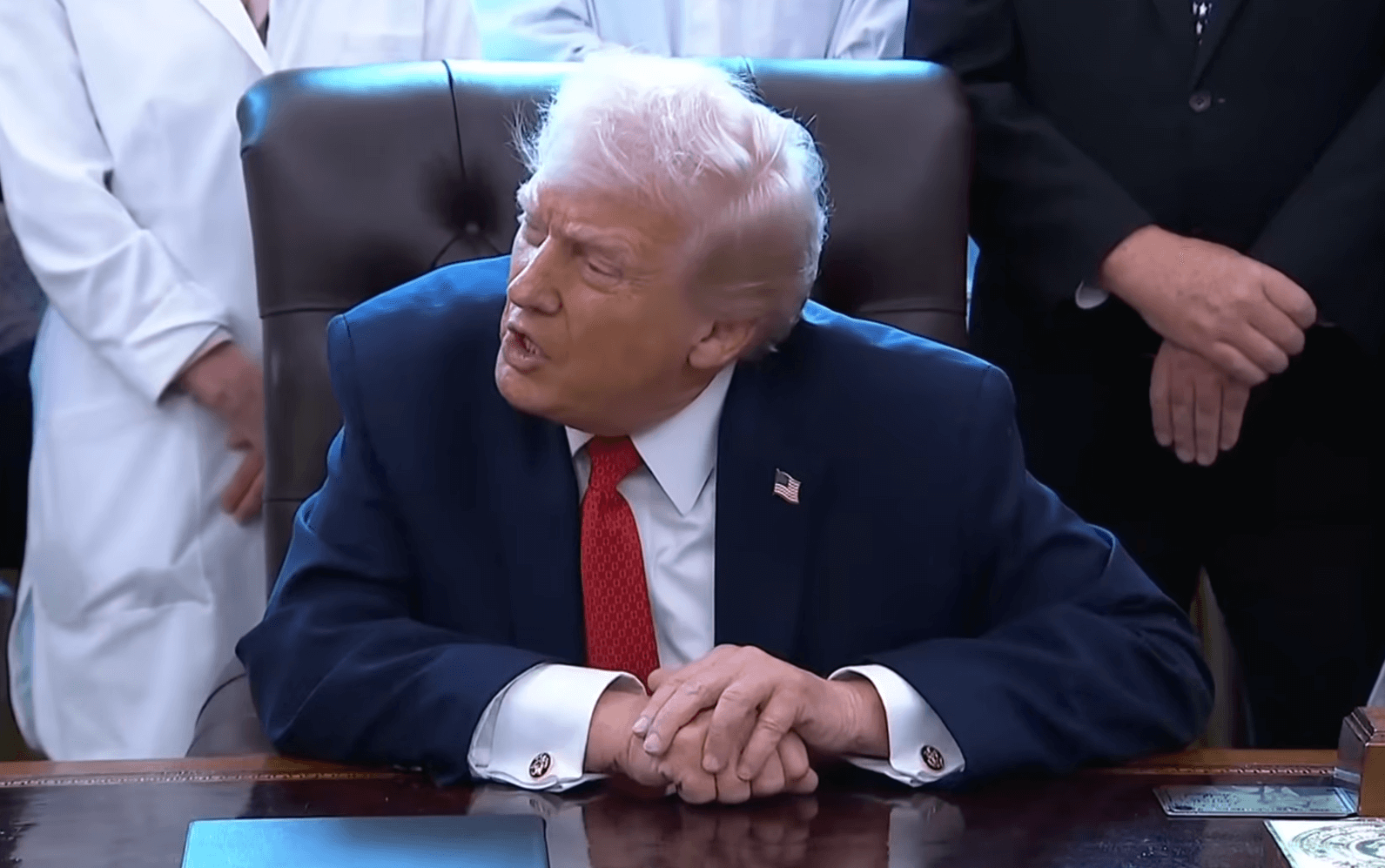
US President Donald Trump expects to make the Fed chair announcement in the next few weeks. Source: YouTube

Trump said that the list has been narrowed to three or four candidates. “I think every one of them would be a good choice, honestly,” he said.

When asked whether Fed governor Michelle Bowman was also on the shortlist, Trump did not directly answer the question, but described her as a “fantastic person.” Polymarket currently puts Bowman’s odds at 2%.

Trump said that he expects to make the announcement over the “next couple of weeks.” “I don’t know before the end of the year, but pretty soon,” Trump said.

Crypto industry has been keeping a close eye on Fed chair developments

The crypto industry has been paying close attention to developments surrounding Trump’s Fed chair nominee, with the discussion ramping up in recent months as the Fed’s role in monetary policy is often seen as affecting broader crypto market conditions.

Related: Global debt markets show dollar dominance moves in cycles, US Fed says

Interest rates, which are set by the Federal Reserve, are widely viewed as having a significant impact on the crypto market.

When rates are lowered, investors tend to seek higher-risk assets such as cryptocurrencies, as traditional investments like bonds and term deposits become less attractive.

Magazine: Big questions: Would Bitcoin survive a 10-year power outage?

Пов'язані питання

QWhat did President Trump say about Chris Waller at the press conference?

APresident Trump said, 'I think he’s great. I mean, he’s been a man who’s been there a long time. Somebody that I was very involved with and sense of his career, and he’s a fantastic man.'

QAccording to the crypto prediction platform Polymarket, what are the odds for the top three Fed chair candidates?

AAccording to Polymarket, crypto-friendly White House economic adviser Kevin Hassett leads at 53%, followed by former Fed governor Kevin Warsh with 28% odds, and Chris Waller is third with a 14% chance.

QWhat is Chris Waller's stance on cryptocurrency, as mentioned in the article?

AChris Waller is perceived as relatively supportive of crypto. In a speech, he stated there is 'nothing to be afraid of' about crypto payments operating outside the traditional banking system.

QWhen does President Trump expect to announce his choice for Fed chair?

APresident Trump said he expects to make the announcement in the 'next couple of weeks' and that it would be 'pretty soon,' though he was unsure if it would be before the end of the year.

QWhy is the crypto industry paying close attention to the Fed chair nomination?

AThe crypto industry is paying attention because the Fed’s role in monetary policy, particularly in setting interest rates, is widely viewed as having a significant impact on broader crypto market conditions.

Пов'язані матеріали

Can Generative Models Finally Be Trained End-to-End? The Core Is a For Loop

This article introduces a novel training paradigm for generative models called Explorative Modeling (XM), which enables true end-to-end training. Traditionally, powerful generative models like autoregressive and diffusion models are not trained end-to-end. They are trained to predict a single small step but require iterative multi-step sampling for inference. This "exposure bias" leads to error accumulation and limits performance. The core challenge XM addresses is "mode blurring." In generative tasks, a single input (e.g., "generate a dog") corresponds to many valid outputs (multiple modes). Standard training objectives like reconstruction loss force the model to average these modes, producing unrealistic, blurry outputs. To avoid this, existing models break generation into many small, almost deterministic steps, sacrificing end-to-end training. XM tackles this by restructuring the training loop itself. Its key insight is to amplify "generative expressivity." For each training input, instead of generating one sample, the model generates K candidate outputs. Only the candidate closest to the real data is used for computing the loss and updating the model via backpropagation. This simple "best-of-K" mechanism is implemented as a short for-loop. By exploring multiple possibilities, the model learns to distribute its guesses across different modes rather than collapsing to their uninformative average. The paper demonstrates that "exploration" acts as a new, powerful scaling axis. Gains from XM increase with model size, data scale, and compute. Experiments show improvements in FID scores for image generation and significant efficiency gains, sometimes outperforming larger models without exploration. When pushed to the limit, XM enables fully single-step, end-to-end generative models. In robotics tasks, an "Explorative Policy" matched the performance of a 100-step Diffusion Policy with a single forward pass, drastically improving inference speed. While the best-of-K concept is not entirely new, the authors' contribution lies in formally understanding it as a direct method to boost generative expressivity without fragmenting the generation process. This work suggests that as models scale, enhancing exploration during training may become crucial for overcoming fundamental performance bottlenecks.

marsbit23 хв тому

Can Generative Models Finally Be Trained End-to-End? The Core Is a For Loop

marsbit23 хв тому

Annual Salary of Millions Competing for Electricians, Meta Rushes to Open Its Own Technical School

The AI boom is facing an unexpected bottleneck: a severe shortage of skilled construction workers and electricians. As tech giants like Meta, OpenAI, and Alphabet race to build massive data centers—such as OpenAI's $16 billion "Stargate" project—they are hitting a critical labor wall. The U.S. needs an estimated 130,000 more electricians, 240,000 construction workers, and 150,000 supervisors by 2030 for AI infrastructure alone, but tens of thousands of electrician jobs go unfilled each year. While AI companies offer high premiums, with electricians earning up to $280,000 annually, worker scarcity still causes massive losses—delays on a single project can cost $14.2 million per month. The complexity of building AI data centers, which require immense power (equivalent to powering hundreds of thousands of homes), sophisticated electrical systems, and advanced liquid cooling solutions, demands highly skilled technicians who are in short supply. To combat this, companies are investing heavily in training. Meta has committed $115 million to a free training school offering tuition, housing, and stipends, targeting 5,000 new workers. OpenAI is partnering with unions to secure skilled labor. These efforts are paying off, with a significant rise in Gen Z interest in trade schools over college. However, the power demands are staggering. AI data centers are driving a rapid surge in electricity consumption, projected to account for up to 12% of U.S. power use by 2028 and raising costs for consumers. Furthermore, the construction boom is project-based, leading to a potential future glut of trained workers once building peaks, which could depress wages industry-wide. The race for AI supremacy now depends as much on skilled hands as on advanced chips.

marsbit2 год тому

Annual Salary of Millions Competing for Electricians, Meta Rushes to Open Its Own Technical School

marsbit2 год тому

Торгівля

Спот
活动图片