Trump Executed 3,600 Stock Trades in Q1, Bought Nvidia, Dell, Then Made a 'Stock Tip,' Sparking Conflict-of-Interest Controversy

marsbitОпубліковано о 2026-05-15Востаннє оновлено о 2026-05-15

Анотація

Former President Donald Trump executed 3,642 individual stock trades in Q1 2026, averaging about 60 trades per day, according to a recent OGE 278-T disclosure. This breaks from the modern presidential tradition of using blind trusts. The filings reveal Trump sold large positions in Amazon, Meta, and Microsoft while making significant new purchases in AI and semiconductor firms like NVIDIA, Broadcom, and Intel. Notably, he bought $1-5 million worth of Dell stock on February 10. Three months later, on May 8, he publicly urged Americans to "buy Dell" at a White House event; the stock has since risen 96%. His Intel purchases began in early March, after which the stock surged 150%. The U.S. government had taken a 9.9% stake in Intel in August 2025. These transactions, occurring close to related policy actions or public endorsements, have ignited significant controversy over potential conflicts of interest. While the White House maintains full compliance with the STOCK Act, critics highlight the unprecedented scale of trading and the timing coinciding with his official duties and donors' interests.

Author: Claude, Deep Chao TechFlow

Deep Chao Introduction: Trump's newly disclosed OGE 278-T form shows he executed 3,642 stock trades in Q1 2026, averaging about 60 trades per day, breaking the precedent of using a "blind trust" set by presidents since Lyndon Johnson.

The disclosure reveals that after buying $1 million to $5 million worth of Dell stock on February 10th, Trump publicly urged people on May 8th at the White House to "go buy Dell," following which the stock surged 96%. Multiple trades, including those in Nvidia and Intel, occurred ahead of related policy moves, rapidly fueling a conflict-of-interest controversy.

Trump's personal stock trading record is becoming one of the most contentious documents in Washington.

According to Benzinga, documents released this week by the Office of Government Ethics (OGE) show Trump executed 3,642 securities transactions in Q1 2026, averaging about 58 per day. The 113-page OGE 278-T form was signed by Trump on May 8th, delivered to the OGE on May 12th, and had "Filer paid late fee" handwritten on the cover page, indicating it exceeded the 30- to 45-day filing window stipulated by federal regulations.

This trading frequency breaks the nearly continuous blind trust arrangement precedent since Lyndon Johnson. Most former U.S. presidents placed personal assets in qualified blind trusts to limit conflicts of interest; Carter even liquidated his peanut farm, Obama held Treasury bonds and index funds, and Biden also employed a blind trust arrangement during his term.

Massively Sold Tech Giants, Heavily Bet on AI Chip Supply Chain

Disclosure documents show Trump significantly reduced holdings in Amazon, Meta, and Microsoft in Q1, all falling within the highest valuation bracket of $5 million to $25 million. However, while selling heavily, Trump maintained exposure to these three companies through smaller purchases.

More notably are the new positions. Trump established new positions in the $1 million to $5 million range in Nvidia (NVDA), Broadcom (AVGO), Synopsys (SNPS), Cadence Design Systems (CDNS), and Texas Instruments (TXN), covering almost every core segment of the U.S. AI chip supply chain. Large buys also appeared in Apple, Oracle, ServiceNow, Adobe, and Workday within the same range.
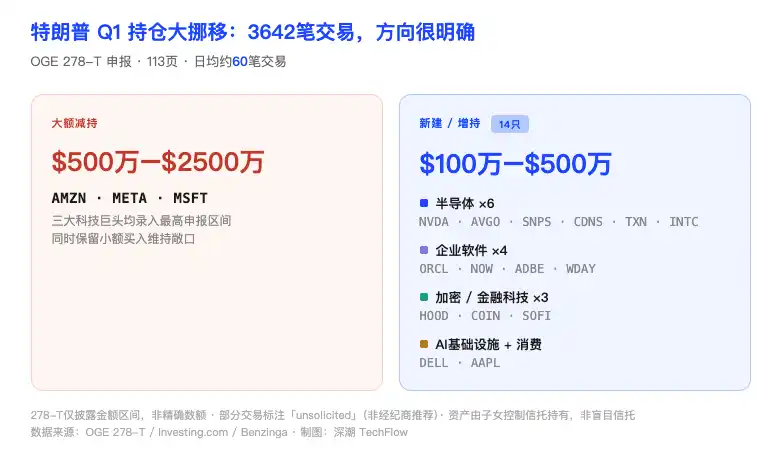
The semiconductor holdings closely align with the White House's policy direction of boosting domestic chip production capacity. According to Quiver Quantitative analysis, the purchase of Nvidia occurred before CEO Jensen Huang accompanied Trump on a visit to China, a trip expected to involve discussions on AI chip exports and semiconductor policy.

White House "Stock Tip" Three Months After Buying Dell, Stock Up 96%

The focus of the conflict-of-interest controversy centers on Dell.

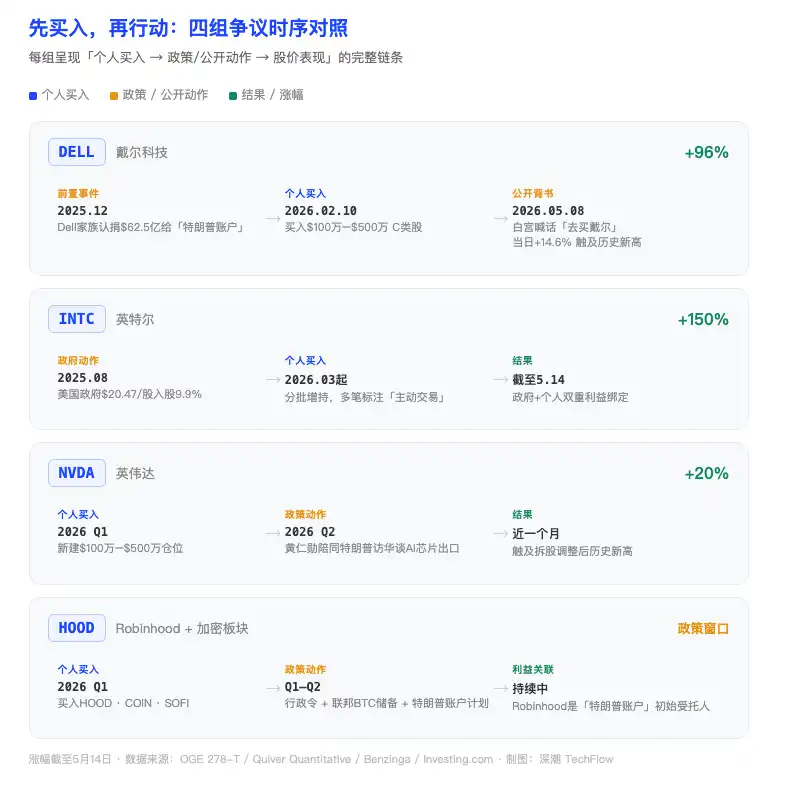
Documents show Trump bought $1 million to $5 million worth of Dell Technologies Class C stock on February 10, 2026. Three months later, at a Mother's Day event on May 8th, Trump thanked Michael Dell and Susan Dell by name at the White House and made the remark that sparked an uproar to those present—telling Americans to "go buy Dell."

That day, Dell's stock price surged as much as 14.6%, hitting a record high of $263.99. From Trump's purchase to the present, Dell's stock price has risen 96% cumulatively.

Another detail in the timeline intensified the controversy. On December 2, 2025, Michael Dell and Susan Dell pledged $6.25 billion to the "Trump Accounts," one of the largest private donations in recent years to a signature project of a sitting president. The White House has not responded to whether there was coordination between the President's public endorsement and the Dell family's donation.

Intel Shares Soar 150% After Purchase, Government Holds 9.9% Stake

Intel's trades are also worth examining.

Trump began buying Intel in batches starting in early March 2026, with several trades marked as "unsolicited," meaning not broker-recommended. Since the initial purchase on March 2nd, Intel's stock price has risen 150%.

Prior to this, the U.S. government purchased 433.3 million shares of Intel in August 2025 at $20.47 per share, giving it a 9.9% stake. In other words, Trump was buying Intel stock in the open market in his personal capacity while, in his presidential role, promoting government investment in Intel.

Additionally, purchases of Coinbase, Robinhood, and SoFi occurred during a period of active government promotion of crypto-friendly policies, including executive orders, a federal bitcoin reserve, and the "Trump Accounts" retirement plan. Robinhood is the initial trustee for that plan.
Non-Blind Trust Sparks Constitutional Debate, White House Claims Compliance

Critics view the alignment of these trading timelines as posing a conflict-of-interest risk. The White House argues that the filings fully comply with the STOCK Act's requirements.

Trump's assets are held in trusts controlled by his children, but the latest documents show numerous trades were executed by brokers acting as agents. The documents do not specify exactly which accounts hold the trading positions nor who gave the trading instructions.

An OGE spokesperson declined to comment on whether the trades reflect Trump's direct trading activity or operations through managed accounts, stating only that "the OGE is committed to transparency and citizen oversight of government."

According to Quiver Quantitative analysis, to their knowledge, this is the first time Trump has actively traded individual stocks while in office. The conservative, bond-heavy portfolio seen in previous 278-T filings has been completely overturned.


Пов'язані питання

QWhat is the primary controversy surrounding Donald Trump's stock trades in Q1 2026 as detailed in the article?

AThe primary controversy is the potential conflict of interest, as Trump conducted numerous personal stock trades (3642 in total) while in office, a break from the tradition of modern presidents using blind trusts. Specific concerns include his purchase of Dell stock followed by a public endorsement to "buy Dell" from the White House, and trades in companies like Nvidia and Intel that coincided with or preceded related government policy actions.

QHow did Donald Trump's investment activity in Dell become a focal point of the conflict-of-interest allegations?

ATrump purchased between $1 million and $5 million worth of Dell stock on February 10, 2026. Three months later, on May 8, he publicly told attendees at a White House event to "go buy Dell." Following this endorsement, Dell's stock price surged, having already risen 96% from his purchase date. This sequence created the appearance of using his presidential platform to influence a stock in which he held a significant personal financial stake.

QWhat significant change does the article note in Trump's investment strategy during his presidency compared to his previous disclosures?

AThe article notes a dramatic shift from a conservative, bond-heavy portfolio in his previous financial disclosures to an active trading strategy focused on individual stocks, particularly within the AI chip and technology sectors. This represents his first known period of active individual stock trading while in office.

QAccording to the article, what action did the US government take regarding Intel before Trump's personal stock purchases?

AIn August 2025, the US government purchased 433.3 million shares of Intel at $20.47 per share, acquiring a 9.9% stake in the company. Trump subsequently began personally buying Intel stock in March 2026.

QHow has the White House responded to criticism about the timing of Trump's stock trades?

AThe White House has defended the transactions, stating that the financial disclosures are fully compliant with the requirements of the STOCK Act. However, it has not commented on whether there was any coordination between the president's public endorsements and related stock trades or political donations.

Пов'язані матеріали

ByteDance Adopts Arm CPUs, Jensen Huang: So Sad I Didn't Buy Arm

**Summary:** At Computex 2026, Arm CEO Rene Haas announced that ByteDance and Oracle have adopted Arm's self-designed Arm AGI data center CPU. The company expects significant revenue growth from this product, projecting $20 billion in demand for the 2027/2028 fiscal years. Haas noted that restricting AI-capable CPUs from the US to China is nearly impossible due to their widespread applications. Arm's stock has surged dramatically this year, notably rising 16% after NVIDIA's Arm-based Vera CPU and RTX Spark announcements. A highlight was the informal, humorous on-stage conversation between Haas and NVIDIA CEO Jensen Huang. Huang joked about NVIDIA's failed attempt to acquire Arm and playfully lamented selling his Arm shares. Both executives showed a clear sense of camaraderie and shared regret over the missed merger. Key technical topics were discussed: 1. **AI PC Design:** Huang explained NVIDIA's RTX Spark superchip (with a 20-core Arm CPU) is designed for future AI agents that will autonomously run and use tools on PCs, blending local and cloud processing. 2. **Agent vs. OS:** Huang emphasized the operating system remains crucial, as AI agents rely on its APIs and tools to function. 3. **Growth Constraints:** He identified the shift to "useful AI" that generates profitable tokens as a primary driver for immense, almost limitless, computational demand. Haas outlined Arm's strategy across PC and data centers. For PCs, Arm collaborates with partners like NVIDIA and MediaTek, offering its compute subsystem (CSS) for custom SoCs. In data centers, its Arm AGI CPU (built on TSMC's 3nm process) has gained major partners including OpenAI, Meta, and now ByteDance and Oracle. Arm presented a multi-year roadmap for its in-house CPU line. The article concludes that while GPUs dominated the AI training race, the explosion of AI agents is shifting significant focus to CPUs for inference, state management, and tool orchestration. The industry is trending towards vertical integration, with companies like cloud providers designing chips and chip/IP firms offering full solutions, all competing to deliver more efficient computing per watt.

marsbit5 хв тому

ByteDance Adopts Arm CPUs, Jensen Huang: So Sad I Didn't Buy Arm

marsbit5 хв тому

New Wall Street Play: Yen Shorts Still Adding, But Japan Stocks Don't Rely on Carry Trade Unwinding

On June 3rd, USD/JPY hit 160.44, its highest level since July 2024, while the Nikkei 225 surged past 68,000 points. Contrary to popular narratives of an imminent "carry trade unwind" akin to August 2024, data reveals a more complex picture. Speculative net short positions in yen futures have actually increased, reaching -114,667 contracts by late May, suggesting traders are doubling down rather than retreating. Meanwhile, Japan's Finance Ministry conducted its largest-ever single-round FX intervention (11.73 trillion yen) in April-May but failed to hold the 160 yen line. The Nikkei's rally is not driven by carry trade dynamics. Foreign investors are aggressively buying Japanese stocks, with net purchases in 2026 running nearly 16 times higher than 2025 levels. This inflow is concentrated in AI and semiconductor-related stocks like SoftBank and Socionext, fueled by positive sector outlooks, rather than being a flight from unwinding yen shorts. Furthermore, the Nikkei has continued climbing despite the Bank of Japan's (BOJ) rate hikes to 0.75%. This disconnect exists because the current equity boom is fueled by AI-driven foreign investment, not reliant on cheap yen funding. However, this relationship remains fragile. Should the BOJ hike rates further (e.g., to 1.0%) while dollar weakness increases carry trade costs, the trajectories of the yen and Japanese stocks could reconverge, potentially triggering volatility.

marsbit9 хв тому

New Wall Street Play: Yen Shorts Still Adding, But Japan Stocks Don't Rely on Carry Trade Unwinding

marsbit9 хв тому

Broadcom's Q3 Guidance Misses Expectations by $12 Billion, After-Hours Trading Plummets Over 13%, AI Narrative "Cooling"?

On June 3, Broadcom released record Q2 FY26 results with revenue of $22.19B, up 48% YoY, and AI chip sales of $10.8B, up 143%. Adjusted EPS of $2.44 beat estimates. However, its Q3 AI semiconductor revenue guidance of $16B, while up over 200% YoY, fell roughly $1.2B (7%) short of analyst consensus expectations of $17.2B. This miss, coupled with slightly weaker-than-expected software revenue, triggered a severe market reaction. CEO Hock Tan maintained the FY26 AI revenue outlook of over $100B but did not raise it, disappointing investors who had priced in more robust growth. The stock plummeted over 13% in after-hours trading, erasing roughly $270B in market cap. The sell-off extended to peers like Marvell. A key concern for markets, particularly for Chinese optical module suppliers, was Tan's comment that the contribution of AI networking (e.g., Ethernet switches, optical interconnect chips) to AI revenue, currently near 40%, is expected to normalize to around 30% over time, signaling a potential peak in growth for that segment. Despite the guidance shortfall, Tan reiterated that AI demand remains "insatiable" and reaffirmed the long-term target of exceeding $100B in AI revenue by FY27. The reaction highlights the heightened sensitivity and premium valuation placed on AI-exposed stocks, where anything less than stellar guidance can prompt significant profit-taking. The broader question is whether this represents a cooling AI narrative or a correction in overstretched valuations.

marsbit9 хв тому

Broadcom's Q3 Guidance Misses Expectations by $12 Billion, After-Hours Trading Plummets Over 13%, AI Narrative "Cooling"?

marsbit9 хв тому

Торгівля

Спот
Ф'ючерси
活动图片