
Trading Time: Bitcoin Remains Under Pressure, Gold Price Falls Below Key Moving Average, Market Focus on Tonight's CPI

marsbitОпубліковано о 2026-06-10Востаннє оновлено о 2026-06-10

Анотація

**Market Overview: Risk Assets Under Pressure Ahead of Key US CPI Data** Major risk assets faced selling pressure on Tuesday, with heightened geopolitical tensions and caution ahead of pivotal US inflation data weighing on sentiment. The Nasdaq fell 0.97%, led lower by a sharp sell-off in major tech stocks like Apple. Oil prices (WTI) plunged over 3% to around $88.50. **Key Assets in Focus:** * **Gold:** Spot gold tumbled to the $4,200 level, breaking below its 200-day moving average. Analysts cited ETF outflows and higher real yields, with support now eyed near $4,100. * **Bitcoin:** Continued its decline, with ETFs seeing net outflows. Analysts warn a break below $60,000 could trigger a move toward $50,000. * **Stocks:** Tech and semiconductor stocks were hit hard. Super Micro Computer sank on dilution fears, while a bearish research report triggered a crash in optical communication stocks like AAOI and Coherent. **Tonight's Macro Catalyst: US CPI** All eyes are on the US May CPI report. Headline inflation is forecast to rise to multi-year highs (~4.3%), driven by energy, while core CPI is expected to show moderation. **Asia-Pacific Markets Tumble** Asian markets followed US tech losses. South Korea's KOSPI index crashed 6.46%, briefly triggering a trading halt, and Japan's Nikkei 225 fell 2.49%. Semiconductor stocks like Samsung Electronics and SK Hynix led declines. **Crypto Market Notes:** Ethereum shows weakness with declining open interest. Two tokens, SAHAR...

Daily market key data review and trend analysis, produced by PANews.

Macro Markets
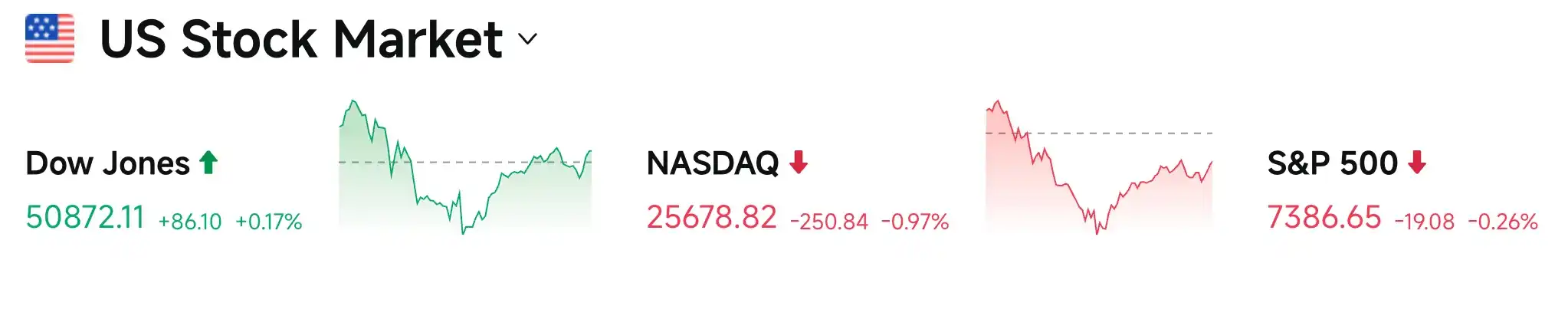
Tech stock selling caused sharp intraday volatility in US stocks on Tuesday, with the Nasdaq index at one point falling over 4%, closing down 0.97% below last Friday's low. The S&P 500 fell 0.26% to 7386.65 points, while the Dow Jones Industrial Average edged up 0.17% to 50872.11 points, supported by defensive sectors like consumer goods.

Geopolitical tensions escalated again. In response to the downing of a US military helicopter, US forces completed strikes on 20 targets within Iran. Iran subsequently retaliated against US bases in Jordan and Bahrain. Affected by this, the crude oil market saw intense volatility, with WTI crude oil briefly falling below $87, eventually closing sharply down over 3% near $88.50.

Gold prices were also impacted, with spot gold falling to the $4200 mark, hitting a nearly three-month low and already below the 200-day moving average. Analysts at Standard Chartered pointed out that as inflation rises and real yields climb, ETF funds are accelerating their outflow. The current ETP holdings structure is relatively fragile, potentially amplifying downward price pressure, with the next key technical support located near $4100. Notably, Citigroup analysts stated in a Monday report that if the Strait of Hormuz remains closed until late summer, gold prices could fall to $3500. Despite this, Ed Yardeni, founder of Yardeni Research, remains bullish, believing $4000 is a solid floor and sees potential up to $10,000.

US May inflation data will be released tonight at 8:30 PM. Wall Street institutions generally predict that, driven by surging energy prices, the May headline CPI year-on-year may rise to 4.2%~4.3%, hitting a nearly three-year high. However, the month-on-month core CPI is expected to be only 0.17%~0.22%, significantly below market consensus, with cooling in components like housing and auto insurance potentially being key to the slowdown in core inflation. The market is currently closely watching this data to gauge the policy stance of the new Federal Reserve Chairman, Kevin Warsh, at next week's interest rate meeting.

US Stock Dynamics
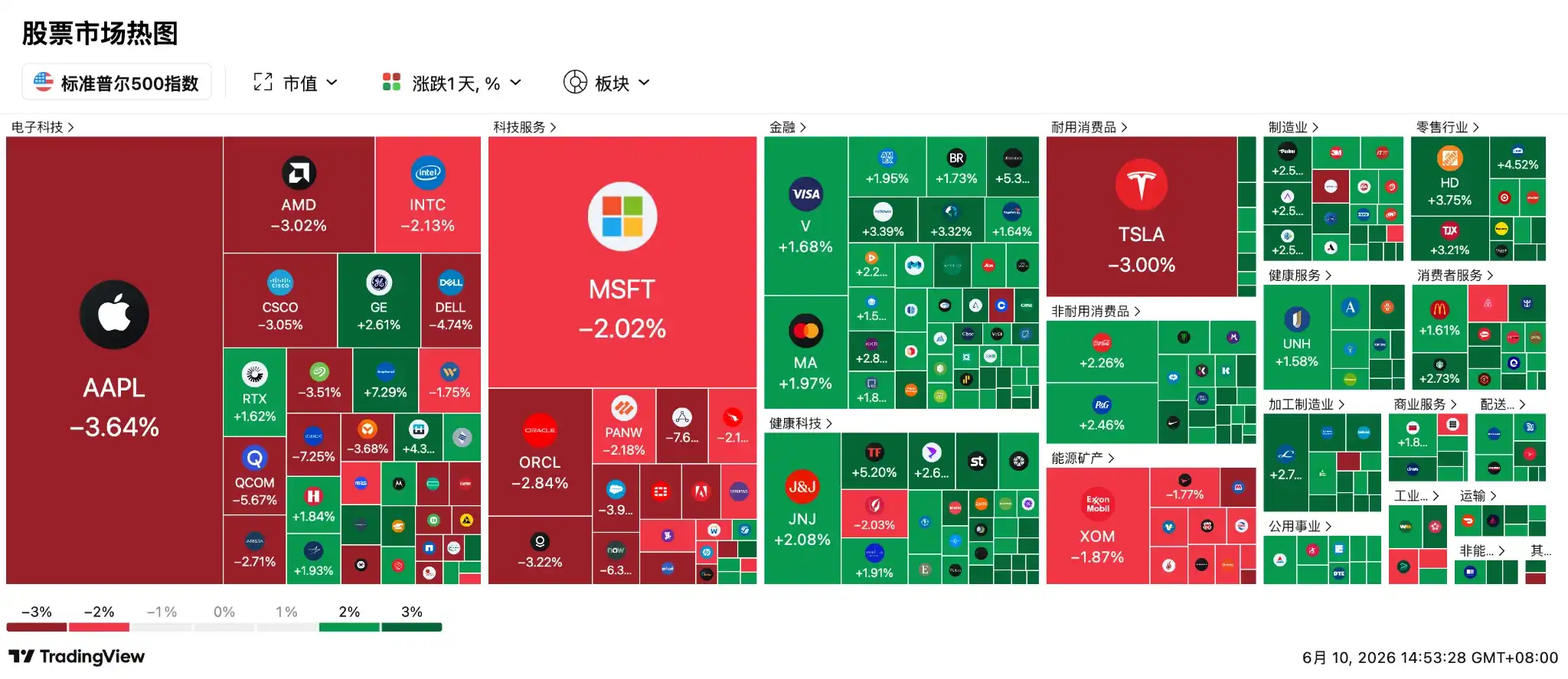
US stocks performed poorly after the AI frenzy subsided, with tech stocks experiencing heavy selling. The Philadelphia Semiconductor Index at one point plunged as much as 8.6%; ARM and Marvell Technology fell over 10% during the day; Micron Technology and Intel also fell up to 7% and 5% respectively. Apple, failing to deliver super-expected surprises at the WWDC conference, led the decline with its stock plummeting 3.64%. Super Micro Computer (SMCI) announced up to $7 billion in equity financing to purchase AI server components, with severe concerns about equity dilution causing its stock to crash over 10% in a single day, closing down 7.62%.

The optical communications sector experienced a "massacre" triggered by a research report. The prominent AI research firm SemiAnalysis released a report stating that NVIDIA's 800VDC power architecture and CPO (Co-Packaged Optics) large-scale production will be delayed until 2028. This expectation hammered the supply chain directly: Applied Optoelectronics (AAOI) plummeted 17% in a single day, Lumentum fell 8%, and chip giant COHERENT crashed 11.44%. Although NVIDIA Vice President Gilad Shainer strongly refuted this at the Computex exhibition, calling CPO "the most exciting technology today" and stating it would ramp up in the second half of the year, it failed to stop the spread of panic. The market began betting on NPO and traditional pluggable modules as transitional substitutes.

Meanwhile, Oracle is scheduled to release its earnings report after the US market close on Wednesday. The market generally expects revenue to reach $19.1 billion. TD Cowen and UBS have raised their price targets to $300 and $285 respectively, believing there is still room for acceleration in the cloud infrastructure business. Jefferies analyst Brent Thill stated that strong demand in the cloud infrastructure business will be a key factor driving the stock price. The options market indicates traders expect the company's stock price could swing up to 11% in a single week after the earnings release.

Cryptocurrency

Bitcoin continues to face pressure. Bitcoin ETFs saw a net outflow of $77.43 million yesterday, with total assets falling back to $775.8 billion, completely erasing the incremental funds since Trump's election victory.

The market remains cautious about the upcoming US CPI data. Analysts point out that if inflation remains high, it could further dampen the rationale for Bitcoin as a hedge tool. Bitwise research shows Bitcoin often reacts ahead of traditional markets, so its current trend may indicate a broader risk adjustment. Glassnode's MVRV model warns that once $60,000 is decisively lost, the deep value zone of $50,000 will become the next ruthless magnetic attraction point.

Ethereum is also weak. Options market data shows that ETH's open interest has fallen 25% since the May high, indicating weakening investor confidence in future price movements. Although institutions like Bitmine bought 75,000 ETH worth $122 million against the trend, analyst Ash Crypto warned that if it falls below $1500, Ethereum could head straight to $1000.

On-chain black swan events have intensified panic. Sahara AI saw its token halved by nearly 60% in a single day due to a rumor about a CCIP cross-chain bridge supplementing liquidity being misinterpreted as a sell-off. The Humanity project suffered a devastating blow, with hackers invading employee computers and wildly minting 1 billion H tokens. Currently, both H and SAHARA token prices have somewhat rebounded.

Today's Outlook:

  • Informed sources: SpaceX will determine the issuance price as early as June 11, with the stock listing on June 12.

  • Upbit 24-hour trading volume ranking: SAHARA, WLD, XRP, BTC, ETH.

  • Magic Eden (ME) will unlock approximately 172 million tokens worth about $10.4 million on June 11.

  • HOME (HOME) will unlock approximately 750 million tokens worth about $40.2 million.

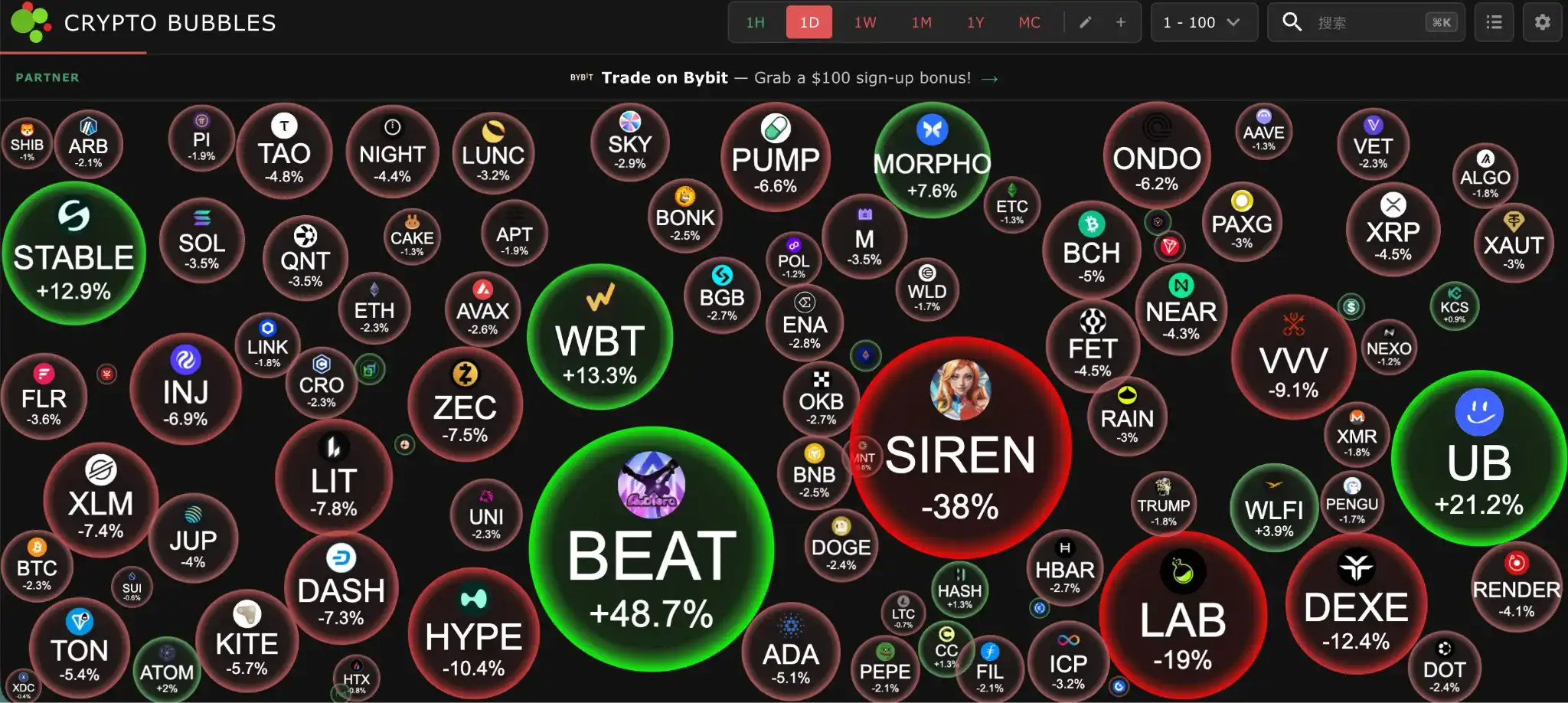
Top gainers among the top 100 cryptocurrencies by market cap today: BEAT up 48.7%, UB up 21.2%, WBT up 13.3%, STABLE up 12.9%, MORPHO up 7.6%.
Asia-Pacific Market

Asia-Pacific stock markets failed to stay immune. Under the dual pressure of Middle East conflict and the rout of US tech stocks, they experienced a major plunge.

The South Korean KOSPI index faced extremely severe selling, plummeting 6.46% and triggering circuit breakers at one point. The Japanese Nikkei 225 index also plunged over 1600 points, down 2.49%. Arjun Jayaraman, portfolio manager at Causeway Capital, pointed out that the proliferation of retail funds with high leverage and new ETFs in Japanese and Korean markets is amplifying this panic-driven volatility manifold.

Semiconductor giants became the epicenter of the selling wave in the Asia-Pacific market. Despite *The Korea Economic Daily* reporting the positive news that Samsung Electronics plans to build an advanced packaging plant in Gwangju, it seemed pale in the face of macro panic. Samsung Electronics stock plunged over 7%, and SK Hynix fell more than 8%. The Japanese chip contingent also retreated, with Advantest and Kioxia both falling nearly 4%. Not only that, even SoftBank Group saw its stock crash over 9% in a single day due to its attempt to use OpenAI shares as collateral for a $6 billion loan being blocked.

Amid the wailing, the A-share market walked its own independent logic due to strong data and World Cup expectations. China's May export data shone brightly, with a year-on-year surge of 19.4% in US dollar terms. Among them, integrated circuits skyrocketed 111%, and computer equipment surged 66%. Xing Zhaopeng, strategist at ANZ, remarked that the global AI hardware frenzy is substantively reshaping China's trade landscape. On the consumer side, with less than 48 hours until the US-Canada-Mexico World Cup opening, expectations for the "midnight viewing" late-night snack economy sparked by the time difference ignited the beer sector. Hui Quan Beer hit the daily limit up, while Zhujiang Beer and Yanjing Beer rose over 5%, becoming a rare bright spot in the gloomy market.


Пов'язані питання

QWhat are the key factors putting pressure on Bitcoin and gold prices according to the article?

ABitcoin is under pressure due to net outflows from Bitcoin ETFs and market caution ahead of the US CPI data. Gold fell below the key 200-day moving average to around $4200, pressured by rising inflation, higher real yields, ETF outflows, and geopolitical tensions.

QWhat major event is the market focused on tonight (the night the article was published), and what is the general forecast for the data?

AThe market is focused on the release of the US May CPI (Consumer Price Index) data. Forecasts suggest the headline CPI may rise to 4.2%~4.3% year-over-year, driven by energy prices, but core CPI month-over-month is expected to be significantly lower at 0.17%~0.22%.

QWhich sectors and specific companies in the US stock market experienced significant declines, and what were the main reasons?

AUS tech stocks, especially semiconductors and AI-related companies, saw significant declines. Key losers included Apple (down 3.64% post-WWDC), ARM, Marvell Technology, Micron, Intel, and Super Micro Computer (SMCI, down over 10% on dilution fears). The optical communications sector (e.g., AAOI, Lumentum, COHERENT) crashed due to a bearish analyst report delaying expectations for CPO technology adoption.

QWhat caused the severe sell-off in major Asian stock markets like South Korea's KOSPI and Japan's Nikkei 225?

AThe severe sell-off in Asian markets was caused by a combination of escalating geopolitical tensions in the Middle East and the sharp decline in US tech stocks. The panic was amplified by high levels of leveraged retail money and new ETFs in these markets.

QDespite the broader market downturn, which Chinese sectors showed strength and why?

AChina's A-shares showed relative strength, driven by robust export data (with integrated circuit exports surging 111%) linked to the global AI hardware boom, and positive expectations for the 'late-night snacking' economy ahead of the FIFA World Cup, which boosted beer stocks like HuiQuan Brewery.

Пов'язані матеріали

The Value Distribution of Stablecoins

**Summary: The Value Distribution of Stablecoins** The article argues that stablecoins are evolving from mere trading tools into broader channels for dollar access. It divides the stablecoin ecosystem into four layers to analyze how value is distributed: 1. **Issuance Layer:** Mints stablecoins, holds reserve assets, and captures the spread between reserve yield and user costs (e.g., Tether, Circle). This layer currently earns the largest profit margin. 2. **Infrastructure Layer:** Connects stablecoins to the traditional financial system, handling fiat on/off-ramps, banking integration, compliance (KYC/AML), and asset management (e.g., Bridge, BVNK). This is the "unglamorous" but critical work, building the essential bridges between crypto and real-world finance. 3. **Acquiring/Distribution Layer:** Integrates stablecoins into merchant systems, manages payment flows, and provides enterprise financial software (e.g., Stripe, Coinbase). They act as the access point for businesses. 4. **Application Layer:** The end-users and businesses that ultimately use stablecoins for payments, settlements, or as a store of value. They benefit from convenience but have little pricing power. The core thesis is that while the issuance layer currently dominates profits, the often-overlooked **infrastructure layer holds significant long-term potential**. The real challenge and barrier to mass adoption is not the on-chain transfer of stablecoins (which is simple), but the complex "last mile" integration into existing business workflows, banking systems, and regulatory frameworks across different countries. Companies in this layer are currently in a "land grab" phase, investing heavily to build networks, secure bank partnerships, and establish compliance pathways. While their position is currently pressured by the profitable issuers above and distribution platforms below, the article suggests that if stablecoins become a default financial rail for businesses, the infrastructure providers who have done the hard work of integration will ultimately gain strong pricing power and become entrenched, essential players.

marsbit1 год тому

The Value Distribution of Stablecoins

marsbit1 год тому

The Value Distribution of Stablecoins

The Value Distribution of Stablecoins The article argues that stablecoins are evolving from a mere trading tool into a broad "dollar channel." It analyzes the industry's value chain through four layers: 1. **Issuance Layer (e.g., Tether, Circle):** The top layer that mints stablecoins, holds reserve assets, and captures the thickest interest rate spread. 2. **Infrastructure Layer (e.g., Bridge, BVNK):** Connects stablecoins to the traditional financial system, handling critical but complex "dirty work" like fiat on/off-ramps, banking integration, compliance (KYC/AML), and cross-border settlement. 3. **Acquiring/Distribution Layer (e.g., Stripe, Coinbase):** Embeds stablecoins into merchant systems, manages payment flows, and integrates with enterprise software. 4. **Application Layer:** End-users and businesses that ultimately use stablecoins for payments, settlement, or storing value. The author posits that while the issuance layer currently captures the most profit, the most overlooked and potentially critical layer is infrastructure. The core challenge for stablecoin adoption isn't the on-chain transfer (which is simple), but bridging the gap between blockchain and the real-world financial system. This involves solving practical problems for businesses: fiat conversion, reconciliation, tax handling, and user onboarding. Infrastructure companies are currently in a difficult "land-grab" phase—building networks, securing banking relationships, and achieving compliance country-by-country. They face pressure from both the profitable issuance layer above and distribution platforms below. However, the author suggests this layer is building a crucial moat. Once stablecoins become a default business rail, the infrastructure players who have done the hard work of integration may gain significant, durable value and pricing power.

链捕手1 год тому

The Value Distribution of Stablecoins

链捕手1 год тому

How to Do Research Well: Deliberately Practice the Real Skills That Matter

No one truly teaches you how to do research. You're often given a desk, a pre-selected problem, and vague instructions to "create something new." Consequently, many people reverse-engineer the job based on visible outputs—papers, posts, announcements—learning only how to *appear* like a researcher rather than how to *become* one. True research capability is built from stacking small, trainable skills, nearly all of which can be developed through deliberate practice. **Pick Your Own Problem:** Most researchers absorb problems from advisors or trends, lacking the underlying reasoning. Choosing a problem you genuinely care about, as John Schulman advises, leads to original work. Develop "taste" like a muscle: predict experiment outcomes, guess paper results from methods, and track which findings remain important over time. **Upgrade Your Inputs:** Relying on shared reading lists (arXiv hot lists, filtered group chats) leads to unoriginal conclusions. Undervalued old literature often holds crucial insights (e.g., MoE, LSTM, backpropagation). Richard Sutton's "The Bitter Lesson" or Claude Shannon's 1952 talk on creative thinking are more predictive than lengthy modern surveys. Breadth matters as much as depth: draw from neuroscience, mechanism design, hardware knowledge, and honest statistics. Read papers directly, especially appendices and limitations sections. **Write Everything Down:** As Paul Graham noted, writing exposes flaws in seemingly mature ideas. Writing is the cheapest defense against self-deception. Following Feynman's principle, Darwin programmatically wrote down facts contradicting his theory to combat memory bias. Maintain a detailed log of hypotheses, setups, predictions, results, and updated understandings. Reviewing past logs fosters essential humility.

marsbit3 год тому

How to Do Research Well: Deliberately Practice the Real Skills That Matter

marsbit3 год тому

Торгівля

Спот
Ф'ючерси

Популярні статті

Що таке $S$

Розуміння SPERO: Комплексний огляд Вступ до SPERO Оскільки ландшафт інновацій продовжує еволюціонувати, виникнення технологій web3 та криптовалютних проектів відіграє ключову роль у формуванні цифрового майбутнього. Один з проектів, який привернув увагу в цій динамічній сфері, — це SPERO, позначений як SPERO,$$s$. Ця стаття має на меті зібрати та представити детальну інформацію про SPERO, щоб допомогти ентузіастам та інвесторам зрозуміти його основи, цілі та інновації в рамках web3 та крипто-сектору. Що таке SPERO,$$s$? SPERO,$$s$ — це унікальний проект у криптопросторі, який прагне використати принципи децентралізації та технології блокчейн для створення екосистеми, що сприяє залученню, корисності та фінансовій інклюзії. Проект розроблений для полегшення взаємодії між користувачами новими способами, надаючи їм інноваційні фінансові рішення та послуги. У своїй основі SPERO,$$s$ прагне надати можливості індивідам, забезпечуючи інструменти та платформи, які покращують користувацький досвід у криптовалютному просторі. Це включає в себе можливість більш гнучких методів транзакцій, сприяння ініціативам, що підтримуються спільнотою, та створення шляхів для фінансових можливостей через децентралізовані додатки (dApps). Основна концепція SPERO,$$s$ обертається навколо інклюзивності, прагнучи зменшити розриви в традиційній фінансовій системі, використовуючи переваги технології блокчейн. Хто є творцем SPERO,$$s$? Особистість творця SPERO,$$s$ залишається дещо невідомою, оскільки є обмежені публічно доступні ресурси, що надають детальну інформацію про його засновників. Ця відсутність прозорості може бути наслідком зобов'язання проекту до децентралізації — етики, яку багато проектів web3 поділяють, ставлячи колективні внески вище за індивідуальне визнання. Зосереджуючи обговорення навколо спільноти та її колективних цілей, SPERO,$$s$ втілює суть наділення без виділення конкретних осіб. Таким чином, розуміння етики та місії SPERO є більш важливим, ніж ідентифікація єдиного творця. Хто є інвесторами SPERO,$$s$? SPERO,$$s$ підтримується різноманітними інвесторами, починаючи від венчурних капіталістів до ангельських інвесторів, які прагнуть сприяти інноваціям у крипто-секторі. Зосередження цих інвесторів зазвичай узгоджується з місією SPERO — пріоритет надається проектам, які обіцяють технологічний прогрес у суспільстві, фінансову інклюзію та децентралізоване управління. Ці інвесторські фонди зазвичай зацікавлені в проектах, які не лише пропонують інноваційні продукти, але й позитивно впливають на спільноту блокчейн та її екосистеми. Підтримка з боку цих інвесторів підкріплює SPERO,$$s$ як значного конкурента в швидко змінюваній сфері крипто-проектів. Як працює SPERO,$$s$? SPERO,$$s$ використовує багатогранну структуру, яка відрізняє його від традиційних криптовалютних проектів. Ось деякі ключові особливості, які підкреслюють його унікальність та інноваційність: Децентралізоване управління: SPERO,$$s$ інтегрує моделі децентралізованого управління, надаючи користувачам можливість активно брати участь у процесах прийняття рішень щодо майбутнього проекту. Цей підхід сприяє відчуттю власності та відповідальності серед членів спільноти. Корисність токена: SPERO,$$s$ використовує свій власний криптовалютний токен, розроблений для виконання різних функцій в екосистемі. Ці токени дозволяють здійснювати транзакції, отримувати винагороди та полегшувати послуги, що пропонуються на платформі, підвищуючи загальну залученість та корисність. Шарова архітектура: Технічна архітектура SPERO,$$s$ підтримує модульність та масштабованість, що дозволяє безперешкодно інтегрувати додаткові функції та додатки в міру розвитку проекту. Ця адаптивність є надзвичайно важливою для збереження актуальності в постійно змінюваному крипто-ландшафті. Залучення спільноти: Проект підкреслює ініціативи, що підтримуються спільнотою, використовуючи механізми, які стимулюють співпрацю та зворотний зв'язок. Підтримуючи сильну спільноту, SPERO,$$s$ може краще задовольняти потреби користувачів та адаптуватися до ринкових тенденцій. Фокус на інклюзію: Пропонуючи низькі комісії за транзакції та зручні інтерфейси, SPERO,$$s$ прагне залучити різноманітну базу користувачів, включаючи осіб, які раніше не брали участі в крипто-просторі. Це зобов'язання до інклюзії узгоджується з його загальною місією наділення через доступність. Хронологія SPERO,$$s$ Розуміння історії проекту надає важливі уявлення про його розвиток та етапи. Нижче наведено пропоновану хронологію, що відображає значні події в еволюції SPERO,$$s$: Етап концептуалізації та ідеації: Початкові ідеї, що стали основою SPERO,$$s$, були сформовані, тісно пов'язані з принципами децентралізації та фокусом на спільноті в індустрії блокчейн. Запуск білого паперу проекту: Після концептуального етапу був випущений комплексний білий папір, що детально описує бачення, цілі та технологічну інфраструктуру SPERO,$$s$, щоб залучити інтерес та зворотний зв'язок від спільноти. Створення спільноти та ранні залучення: Активні зусилля були спрямовані на створення спільноти ранніх прихильників та потенційних інвесторів, що полегшило обговорення цілей проекту та отримання підтримки. Подія генерації токенів: SPERO,$$s$ провів подію генерації токенів (TGE) для розподілу своїх рідних токенів серед ранніх прихильників та встановлення початкової ліквідності в екосистемі. Запуск початкового dApp: Перший децентралізований додаток (dApp), пов'язаний з SPERO,$$s$, став доступним, дозволяючи користувачам взаємодіяти з основними функціями платформи. Постійний розвиток та партнерства: Безперервні оновлення та вдосконалення пропозицій проекту, включаючи стратегічні партнерства з іншими учасниками блокчейн-простору, сформували SPERO,$$s$ у конкурентоспроможного та еволюціонуючого гравця на крипто-ринку. Висновок SPERO,$$s$ є свідченням потенціалу web3 та криптовалют для революціонізації фінансових систем та наділення індивідів. Завдяки зобов'язанню до децентралізованого управління, залучення спільноти та інноваційно спроектованих функцій, він прокладає шлях до більш інклюзивного фінансового ландшафту. Як і з будь-якими інвестиціями в швидко змінюваному крипто-просторі, потенційним інвесторам та користувачам рекомендується ретельно досліджувати та обдумано взаємодіяти з поточними подіями в SPERO,$$s$. Проект демонструє інноваційний дух крипто-індустрії, запрошуючи до подальшого дослідження його численних можливостей. Хоча подорож SPERO,$$s$ ще триває, його основні принципи можуть справді вплинути на майбутнє того, як ми взаємодіємо з технологією, фінансами та один з одним у взаємопов'язаних цифрових екосистемах.

73 переглядів усьогоОпубліковано 2024.12.17Оновлено 2024.12.17

Що таке $S$

Що таке AGENT S

Агент S: Майбутнє автономної взаємодії в Web3 Вступ У постійно змінюваному ландшафті Web3 та криптовалюти інновації постійно переосмислюють, як люди взаємодіють з цифровими платформами. Один з таких новаторських проектів, Агент S, обіцяє революціонізувати взаємодію людини з комп'ютером через свою відкриту агентну структуру. Прокладаючи шлях для автономних взаємодій, Агент S прагне спростити складні завдання, пропонуючи трансформаційні застосування в штучному інтелекті (ШІ). Це детальне дослідження заглиблюється в складності проекту, його унікальні особливості та наслідки для сфери криптовалюти. Що таке Агент S? Агент S є революційною відкритою агентною структурою, спеціально розробленою для вирішення трьох основних викликів в автоматизації комп'ютерних завдань: Набуття специфічних знань у галузі: Структура інтелектуально навчається з різних зовнішніх джерел знань та внутрішнього досвіду. Цей подвійний підхід дозволяє їй створити багатий репозиторій специфічних знань у галузі, покращуючи її продуктивність у виконанні завдань. Планування на довгих горизонтах завдань: Агент S використовує планування з підкріпленням досвіду, стратегічний підхід, який полегшує ефективний розподіл та виконання складних завдань. Ця функція значно підвищує її здатність ефективно та результативно управляти кількома підзавданнями. Обробка динамічних, неоднорідних інтерфейсів: Проект представляє Інтерфейс Агент-Комп'ютер (ACI), інноваційне рішення, яке покращує взаємодію між агентами та користувачами. Використовуючи багатомодальні великі мовні моделі (MLLMs), Агент S може безперешкодно орієнтуватися та маніпулювати різноманітними графічними інтерфейсами користувача. Завдяки цим новаторським функціям Агент S надає надійну структуру, яка вирішує складнощі, пов'язані з автоматизацією людської взаємодії з машинами, прокладаючи шлях для численних застосувань у ШІ та за його межами. Хто є творцем Агент S? Хоча концепція Агент S є фундаментально новаторською, конкретна інформація про його творця залишається невідомою. Творець наразі невідомий, що підкреслює або початкову стадію проекту, або стратегічний вибір зберегти засновників у таємниці. Незважаючи на анонімність, акцент залишається на можливостях та потенціалі структури. Хто є інвесторами Агент S? Оскільки Агент S є відносно новим у криптографічній екосистемі, детальна інформація про його інвесторів та фінансових спонсорів не задокументована. Відсутність публічно доступних відомостей про інвестиційні фонди або організації, що підтримують проект, викликає питання щодо його фінансової структури та дорожньої карти розвитку. Розуміння підтримки є критично важливим для оцінки стійкості проекту та потенційного впливу на ринок. Як працює Агент S? В основі Агент S лежить передова технологія, яка дозволяє йому ефективно функціонувати в різних умовах. Його операційна модель побудована навколо кількох ключових функцій: Взаємодія з комп'ютером, подібна до людської: Структура пропонує розширене планування ШІ, прагнучи зробити взаємодії з комп'ютерами більш інтуїтивними. Імітуючи людську поведінку при виконанні завдань, вона обіцяє підвищити досвід користувачів. Наративна пам'ять: Використовується для використання високорівневого досвіду, Агент S використовує наративну пам'ять для відстеження історій завдань, тим самим покращуючи свої процеси прийняття рішень. Епізодична пам'ять: Ця функція надає користувачам покрокові інструкції, дозволяючи структурі пропонувати контекстуальну підтримку в міру виконання завдань. Підтримка OpenACI: Завдяки можливості працювати локально, Агент S дозволяє користувачам зберігати контроль над своїми взаємодіями та робочими процесами, узгоджуючи з децентралізованою етикою Web3. Легка інтеграція з зовнішніми API: Його універсальність і сумісність з різними платформами ШІ забезпечують те, що Агент S може безперешкодно вписатися в існуючі технологічні екосистеми, роблячи його привабливим вибором для розробників та організацій. Ці функціональні можливості колективно сприяють унікальному положенню Агент S у крипто-просторі, оскільки він автоматизує складні, багатоступеневі завдання з мінімальним втручанням людини. У міру розвитку проекту його потенційні застосування в Web3 можуть переосмислити, як відбуваються цифрові взаємодії. Хронологія Агент S Розробка та етапи Агент S можуть бути узагальнені в хронології, яка підкреслює його значні події: 27 вересня 2024 року: Концепція Агент S була представлена в комплексній науковій статті під назвою “Відкрита агентна структура, яка використовує комп'ютери як людина”, що демонструє основи проекту. 10 жовтня 2024 року: Наукова стаття була опублікована на arXiv, пропонуючи детальне дослідження структури та її оцінки продуктивності на основі бенчмарку OSWorld. 12 жовтня 2024 року: Було випущено відеопрезентацію, що надає візуальне уявлення про можливості та особливості Агент S, ще більше залучаючи потенційних користувачів та інвесторів. Ці маркери в хронології не лише ілюструють прогрес Агент S, але й вказують на його прихильність до прозорості та залучення громади. Ключові моменти про Агент S У міру розвитку структури Агент S кілька ключових характеристик виділяються, підкреслюючи її новаторський характер та потенціал: Інноваційна структура: Розроблена для забезпечення інтуїтивного використання комп'ютерів, подібного до людської взаємодії, Агент S пропонує новий підхід до автоматизації завдань. Автономна взаємодія: Здатність автономно взаємодіяти з комп'ютерами через GUI означає стрибок до більш інтелектуальних та ефективних обчислювальних рішень. Автоматизація складних завдань: Завдяки своїй надійній методології він може автоматизувати складні, багатоступеневі завдання, роблячи процеси швидшими та менш схильними до помилок. Безперервне вдосконалення: Механізми навчання дозволяють Агенту S покращуватися на основі минулого досвіду, постійно підвищуючи свою продуктивність та ефективність. Універсальність: Його адаптивність до різних операційних середовищ, таких як OSWorld та WindowsAgentArena, забезпечує його здатність служити широкому спектру застосувань. Оскільки Агент S займає своє місце в ландшафті Web3 та криптовалюти, його потенціал покращити можливості взаємодії та автоматизувати процеси означає значний прогрес у технологіях ШІ. Завдяки своїй інноваційній структурі Агент S є прикладом майбутнього цифрових взаємодій, обіцяючи більш безперешкодний та ефективний досвід для користувачів у різних галузях. Висновок Агент S представляє собою сміливий крок вперед у поєднанні ШІ та Web3, з можливістю переосмислити, як ми взаємодіємо з технологією. Хоча проект все ще на ранніх стадіях, можливості для його застосування є величезними та переконливими. Завдяки своїй комплексній структурі, що вирішує критичні виклики, Агент S прагне вивести автономні взаємодії на передній план цифрового досвіду. У міру того, як ми заглиблюємося в сфери криптовалюти та децентралізації, проекти, подібні до Агент S, безсумнівно, відіграватимуть ключову роль у формуванні майбутнього технологій та співпраці людини з комп'ютером.

699 переглядів усьогоОпубліковано 2025.01.14Оновлено 2025.01.14

Що таке AGENT S

Як купити S

Ласкаво просимо до HTX.com! Ми зробили покупку Sonic (S) простою та зручною. Дотримуйтесь нашої покрокової інструкції, щоб розпочати свою криптовалютну подорож.Крок 1: Створіть обліковий запис на HTXВикористовуйте свою електронну пошту або номер телефону, щоб зареєструвати обліковий запис на HTX безплатно. Пройдіть безпроблемну реєстрацію й отримайте доступ до всіх функцій.ЗареєструватисьКрок 2: Перейдіть до розділу Купити крипту і виберіть спосіб оплатиКредитна/дебетова картка: використовуйте вашу картку Visa або Mastercard, щоб миттєво купити Sonic (S).Баланс: використовуйте кошти з балансу вашого рахунку HTX для безперешкодної торгівлі.Треті особи: ми додали популярні способи оплати, такі як Google Pay та Apple Pay, щоб підвищити зручність.P2P: Торгуйте безпосередньо з іншими користувачами на HTX.Позабіржова торгівля (OTC): ми пропонуємо індивідуальні послуги та конкурентні обмінні курси для трейдерів.Крок 3: Зберігайте свої Sonic (S)Після придбання Sonic (S) збережіть його у своєму обліковому записі на HTX. Крім того, ви можете відправити його в інше місце за допомогою блокчейн-переказу або використовувати його для торгівлі іншими криптовалютами.Крок 4: Торгівля Sonic (S)Легко торгуйте Sonic (S) на спотовому ринку HTX. Просто увійдіть до свого облікового запису, виберіть торгову пару, укладайте угоди та спостерігайте за ними в режимі реального часу. Ми пропонуємо зручний досвід як для початківців, так і для досвідчених трейдерів.

1.5k переглядів усьогоОпубліковано 2025.01.15Оновлено 2026.06.02

Як купити S

Обговорення

Ласкаво просимо до спільноти HTX. Тут ви можете бути в курсі останніх подій розвитку платформи та отримати доступ до професійної ринкової інформації. Нижче представлені думки користувачів щодо ціни S (S).

活动图片













