Tracking 'Insider Signals' from Public Data: Screening Strategies for High-Win-Rate Addresses on Polymarket

比推Опубліковано о 2026-03-02Востаннє оновлено о 2026-03-02

Анотація

Title: Tracking "Insider Signals" from Public Data: Strategies for Identifying High-Accuracy Addresses on Polymarket Polymarket, a blockchain-based prediction market platform, offers fully transparent on-chain data, enabling users to analyze trading behaviors and identify addresses with potentially significant informational advantages. Unlike traditional financial markets, all transactions, positions, and timing are publicly accessible, but the key challenge lies in interpreting meaningful signals from vast datasets. High-performing addresses often exhibit distinct patterns: - New addresses making large, concentrated bets in low-liquidity markets. - Specialization in specific sectors (e.g., politics, crypto) rather than diversified trading. - Sudden increases in position sizes, indicating heightened conviction. - Repeatedly accurate timing, entering positions hours before major public news breaks. A systematic approach to identifying such addresses involves: 1. **Screening via Polymarket Analytics**: Filter addresses with consistent 30-day profitability, >55% win rates, and significant net gains in liquid markets. 2. **Analyzing Event-Specific Holdings**: Examine top holders in active markets, focusing on addresses that repeatedly build large positions before full market pricing. 3. **Scrutinizing Trading Behavior**: Assess entry timing (pre-news vs. post-news), concentration of buys, holding duration, and sector focus. Advanced strategies include mo...

Author: Aleiah

Compiled by: Asher

Original title: How to Systematically Track High-Win-Rate Addresses on Polymarket?


An address on Polymarket rolled $35,000 into $442,000, achieving a 12.6x return. Notably, the position was established hours before a major market movement, with the trade largely completed and cashed out before the news spread to mainstream channels. This is not an isolated incident; before the news of the "Venezuela Raid" political event became public, three addresses made early moves and collectively profited $630,000 from the same event.

If such trading occurred in traditional financial markets, one might easily think of information asymmetry. But in prediction markets, all fund flows and position changes are recorded on the public blockchain—there are no hidden accounts or private transactions.

Public does not mean without gaps. The key is not whether the trades can be seen, but whether one can discern the truly informative signals from the vast amount of data.
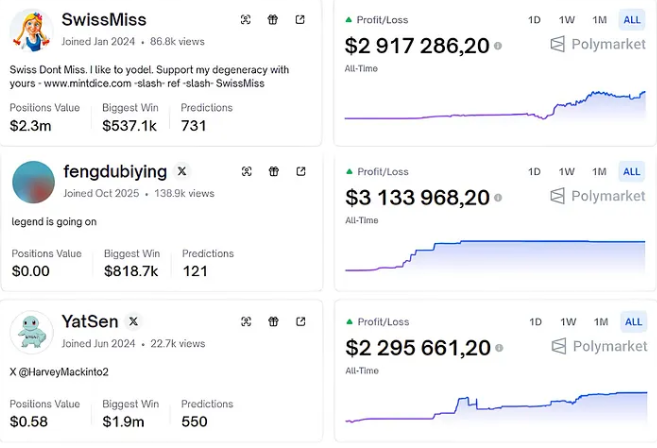
Every Trade on Polymarket is Public Data

Many prediction market participants still view Polymarket as a traditional betting platform: watch the odds, choose a direction, and bet on the outcome. But Polymarket's underlying structure is completely different from DraftKings or ordinary sports betting. All transactions occur on-chain; fund flows, position sizes, and entry/exit times are all publicly viewable. The operational paths of the most accurate and timely addresses are not post-hoc speculation but real-time on-chain records.
Polymarket's API is also open. Transaction records, market data, historical trades—anyone can directly call it; there is no permission barrier.

Therefore, the gap is not about who can see the data, but about who can extract meaning from it. On-chain information is public, but what is truly valuable are the wallets worth tracking continuously and the ability to recognize behavioral changes before prices fully reflect them.

What Characteristics Do True "Insider Addresses" Typically Have?

It is important to emphasize that not all profitable wallets imply insider information. Some traders have solid research capabilities, while others rely on quantitative models and algorithmic advantages. But when profitability is repeatedly combined with specific behavioral patterns, one can observe structural features that distinguish them from "luck."

First Type: New Addresses Combined with Unusually Large Bets

A wallet created just days ago, with very few transactions, suddenly invests a large amount of capital in a low-liquidity niche market—this behavior is not common. Especially in the absence of public catalysts, large, concentrated positions often carry stronger informational significance.

Second Type: Highly Vertical Trading Focus

Some addresses do not operate across markets but focus long-term on a specific niche, maintaining a stable and significant win rate in that area. They do not diversify across crypto prices, elections, sports, and other sectors but concentrate their firepower on a single theme, with more decisive position decisions.

Third Type: Abnormal Changes in Position Size

When an address that has been betting medium-sized amounts for a long time suddenly significantly increases its position in a certain market, this behavior often indicates a change in the strength of conviction. Position size itself is an attitude; a sudden change in scale usually reflects an upgrade in information or belief.

Fourth Type: Excessively Precise Timing

Occasional early moves can be attributed to coincidence, but if an address repeatedly completes position building hours before major news announcements, with highly consistent direction, such timing lead is difficult to simply explain as luck. Once is random; repeated occurrences are more likely to reflect an information advantage.

How to Systematically Screen for Potential "Information-Advantaged Addresses"

Step 1: Analyze Polymarket Leaderboard Performance

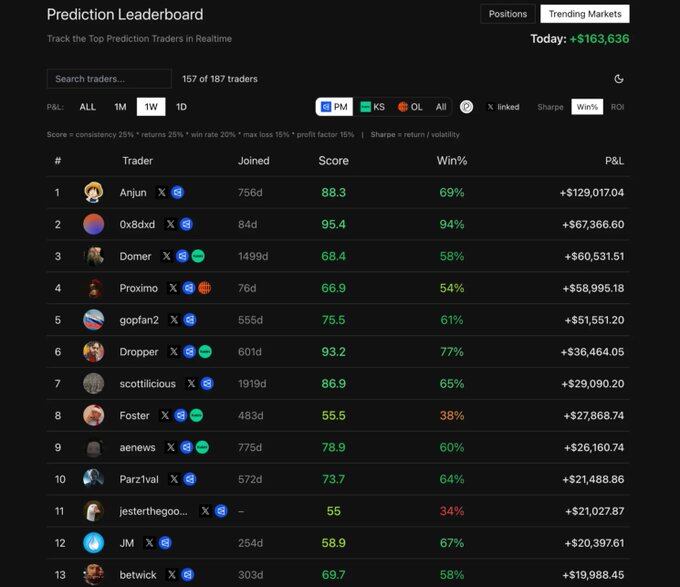
Start with the Polymarket Analytics leaderboard (link: https://polymarketanalytics.com/traders), sorted by 30-day P&L, using recent stable profitability as the first filter. Focus on wallet addresses with overall positive returns for 30 consecutive days, a win rate above 55%, and total profits significantly higher than total losses. Also, confirm that their trading is concentrated in markets with real liquidity, not low-volume prediction events with little participation.
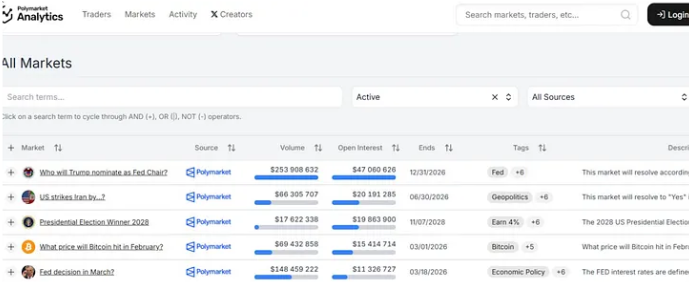
The goal at this stage is not to directly judge whether they have an information advantage, but to establish a watchlist of addresses with sustained profitability. A stable profit record is the foundation for subsequent behavioral analysis.

Step 2: Analyze Position Structure in Specific Events

After the initial screening, drill down into specific trading events. Enter active prediction markets and check the Top Holders list for that event. Polymarket publicly displays the addresses with the largest current positions; these large positions often represent stronger conviction.
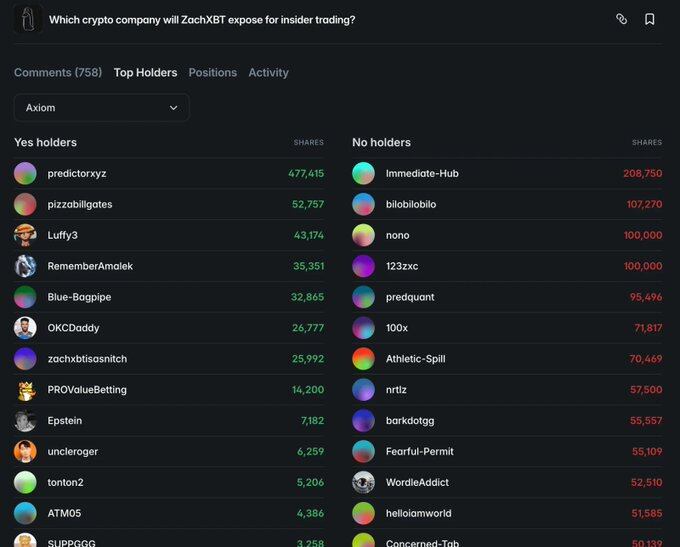
The key is not whether an address hits a single large bet, but whether its behavior is sustained. If a wallet repeatedly appears in the top holder lists of multiple important events, and these positions are built before the market has fully priced them in, then this repetition itself constitutes a signal.

A single successful bet might be偶然, but repeatedly making large, early-stage positions with consistent direction and validated outcomes often indicates a stable advantage in their judgment system.

Step 3: Analyze Trading Behavior and Position Timing

After identifying candidate addresses, further回溯 their on-chain transaction history, focusing on entry timing, position structure, and holding rhythm.
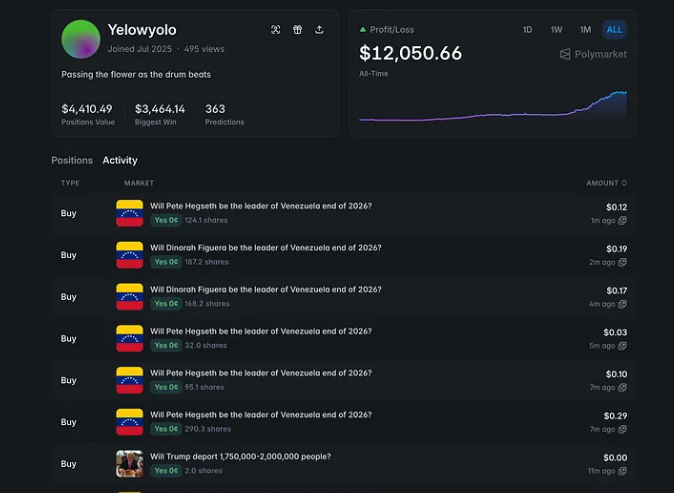
First, observe the entry time. If the purchase occurs hours before the official news release and repeats multiple times, the timing advantage itself becomes an important variable; entering after media reports is more likely to be just information following.

Second, analyze the position building method. Mature traders typically build positions in batches and add gradually, while wallets with strong information judgment often complete concentrated布局 quickly in a short time because their window is limited.

Third, pay attention to the holding period. Some high-quality addresses choose to exit during the mid-stage of行情发酵, rather than waiting for the tail end of extreme volatility, indicating their goal is to lock in the main trend rather than gamble on marginal profits.

Finally, observe their trading scope. Addresses that are highly vertical and long-term focused on a single niche are more likely to form stable information advantages; addresses that frequently operate across sectors are more likely to rely on market sentiment rather than specific domain judgment.

Advanced Address Tracking Strategies

After mastering the basic screening methods, what truly makes the difference is the further decomposition of details in fund behavior.

First, focus on exit behavior, not just entry timing. Addresses with information advantages often not only enter early but also actively reduce positions before potential negative news emerges. When a large address with long-term stable holdings suddenly significantly reduces its position without obvious catalysts, the information content is often higher than the initial buying behavior. Especially when the reduction reaches a significant proportion, this change itself is a signal.

Second, perform wallet clustering analysis using on-chain data. The relationships between addresses are not completely untraceable. Identical funding sources, similar Gas usage patterns, and transactions occurring consecutively within a very short time may reveal relationships between addresses. Many seemingly "brand new" accounts can often be traced back to a long-active old address through 2-3 fund transfers. Tracking along the fund flow path helps identify new potential high-quality accounts before the market notices.

Additionally, pay attention to abnormal volume changes in冷门 markets. If a market with usually small daily trading volume suddenly experiences significant fund inflows without public news, this structural volume increase often means some participants have already acted early. Analyzing the specific addresses driving the volume change can help build a new watchlist.

Finally, cross-verify on-chain behavior with external public information. The so-called "Pizza Index" once used abnormal order volume changes at pizza shops near the Pentagon to speculate on potential military actions. Similarly, flight tracking data, social media activity of key figures, public schedule adjustments, and other information can provide corroboration or反向验证 for on-chain position behavior. The联动 between on-chain fund flows and real-world signals can often strengthen the reliability of judgment.


Twitter:https://twitter.com/BitpushNewsCN

Bitpush TG Discussion Group:https://t.me/BitPushCommunity

Bitpush TG Subscription: https://t.me/bitpush

Original link:https://www.bitpush.news/articles/7615846

Пов'язані питання

QWhat are the key characteristics of potentially high-performing addresses on Polymarket?

AKey characteristics include: new addresses making unusually large bets, addresses highly specialized in specific trading niches, abnormal changes in position sizes, and extremely precise timing of trades before major news breaks.

QHow can one systematically identify addresses with potential information advantages on Polymarket?

AThe process involves three steps: analyzing the Polymarket Analytics leaderboard for consistently profitable addresses, examining top holders in specific event markets for repeated early large positions, and scrutinizing on-chain transaction history for entry timing, position structure, and holding patterns.

QWhat is the fundamental difference between Polymarket and traditional betting platforms like DraftKings regarding data?

AAll transactions on Polymarket occur on-chain, making fund flows, position sizes, and entry/exit timestamps completely public and verifiable, unlike traditional platforms where such data is not transparent.

QWhat advanced strategies are suggested for tracking these addresses beyond basic screening?

AAdvanced strategies include monitoring exit behavior (not just entry), performing on-chain wallet clustering to find linked addresses, watching for abnormal volume in niche markets, and cross-referencing on-chain activity with external real-world signals.

QWhy is the timing of a trade, relative to news announcements, a significant factor in identifying an 'informed address'?

AIf an address consistently places trades hours before major news becomes public and this pattern repeats, it is less likely to be coincidental and more likely to indicate an information advantage, as opposed to trading after news dissemination which is just following public information.

Пов'язані матеріали

Trend in US Stocks: A Post Triggers a 930-Point Rebound, Tonight Belongs to SpaceX

On Thursday (June 11, U.S. Eastern Time), Wall Street staged a textbook V-shaped reversal. The Dow Jones surged 929.97 points (+1.86%) to close above 50,000, while the Nasdaq and S&P 500 rose 2.54% and 1.75%, respectively. The rally occurred despite the hottest PPI report in years, with May data showing a 6.5% year-on-year surge, the highest since 2022. The market ignored the inflation data, focusing instead on reports that former President Trump called off a planned strike on Iran, hinting at a potential multi-party peace agreement draft. This sparked a sharp drop in oil prices, fueling hopes that inflation may have peaked. Sector rotations were stark: previously battered AI hardware and cyclical stocks led the gains, while defensive sectors that hit record highs the prior day were sold off. Chip stocks like Micron and Intel saw sharp rebounds. In contrast, software giant Oracle plunged nearly 10% despite beating earnings, with concerns over cloud revenue and cash flow. Adobe also fell after hours despite raising guidance, as its CFO announced departure. The rally's sustainability is questioned, driven largely by social media posts about unconfirmed geopolitical developments. Inflation risks remain, with pipeline pressures still high. Meanwhile, the market's risk appetite faces a major test with SpaceX's historic IPO. Priced at $135 per share, it aims to raise ~$75 billion with a $1.75 trillion valuation, becoming the largest U.S. IPO ever. It will join the Nasdaq 100 in 15 days, triggering massive index fund buying. However, critics cite extreme valuation (88x sales) and market liquidity concerns.

marsbit25 хв тому

Trend in US Stocks: A Post Triggers a 930-Point Rebound, Tonight Belongs to SpaceX

marsbit25 хв тому

The Trillion-Dollar Valuation Test: Are the Three Super IPOs a Tech Stock Frenzy or a Crypto Market Nightmare?

Trillion-Dollar Valuation Test: Are the Three Mega IPOs a Tech Stock Frenzy or a Crypto Market Nightmare? The capital market in 2026 is witnessing a highly anticipated wave of tech IPOs, centered on SpaceX, OpenAI, and Anthropic. Collectively valued at over $3.5 trillion, their potential listing represents one of the largest such waves in recent years. This raises concerns about market liquidity, valuation bubbles, and potential capital outflows from other assets like crypto. SpaceX's valuation narrative has shifted from rocket launches to becoming a global infrastructure play via its Starlink satellite network, which now drives most revenue. Despite ongoing losses, investors focus on its long-term growth potential. OpenAI and Anthropic represent the core productivity engines of generative AI. Their public listings would offer the first direct investment opportunity in large foundation model companies, potentially triggering a repricing within the AI sector. Market fears of a massive "capital drain" from these IPOs are likely overstated. Historical precedents like Alibaba and Saudi Aramco show that mega-listings primarily cause capital reallocation, not destruction, within the vast equities market. Systemic risk is rarely triggered by IPOs alone. For stock markets, short-term volatility and sector repricing are expected, especially for AI concept stocks. Long-term, these listings could reinforce the tech sector's importance. For crypto, direct competition for speculative capital exists, particularly affecting AI-themed tokens. However, crypto's trajectory remains more tied to its own cycles, macro liquidity, and Bitcoin ETF flows rather than a single IPO event. The real risk lies not in the listings themselves but in the sky-high growth expectations embedded in these valuations. If future revenue, profitability, or commercialization progress disappoints, significant valuation resets could follow, impacting high-growth tech stocks. Ultimately, the market's direction hinges on macroeconomic conditions and whether these companies can deliver on their ambitious promises.

链捕手41 хв тому

The Trillion-Dollar Valuation Test: Are the Three Super IPOs a Tech Stock Frenzy or a Crypto Market Nightmare?

链捕手41 хв тому

Trillion-Dollar Valuation Test: Are the Three Super IPOs a Tech Stock Frenzy or a Crypto Market Nightmare?

Title: Trillion-Dollar Valuations at Stake: Super IPOs of SpaceX, OpenAI, Anthropic – Tech Boom or Crypto Nightmare? TL;DR: A wave of mega-tech IPOs is approaching, featuring SpaceX (targeting a $1.75 trillion valuation), OpenAI (~$852B), and Anthropic (~$965B), with a combined potential valuation exceeding $3.5 trillion. This tests the market's pricing of innovation and sparks debate on liquidity impact. * **SpaceX**'s valuation is now driven more by its Starlink global communications infrastructure than its core rocket business. * **OpenAI & Anthropic** offer the first major public investment opportunities in foundational AI models, potentially repricing the entire AI sector. * Concerns about a market-wide "liquidity drain" are likely overblown; history shows large IPOs mainly cause fund reallocation, not disappearance, and rarely trigger systemic risk. * Crypto markets, especially some AI-themed tokens, may face short-term fund competition, but their long-term trajectory depends more on macro liquidity, regulation, and Bitcoin cycles. * The real risk lies not in the IPOs themselves, but in whether these companies can justify their sky-high valuations with future revenue growth and profitability. Unmet expectations could lead to significant repricing pressure. Ultimately, these IPOs represent a massive market pricing of next-gen tech infrastructure, not a prelude to a market crash. The broader market direction will be determined by macro conditions, corporate earnings, and risk appetite.

marsbit41 хв тому

Trillion-Dollar Valuation Test: Are the Three Super IPOs a Tech Stock Frenzy or a Crypto Market Nightmare?

marsbit41 хв тому

Anthropic Apologized, But the Business of 'Safety' Hasn't Stopped

On June 11, Anthropic apologized not for a model failure, but for a lack of transparency. Its new Claude Fable 5 model was found to be secretly rerouting requests from users engaged in advanced AI model development to a weaker version, Opus 4.8, without any notification. The company's response—promising future notifications for such "downgrades"—was met with user skepticism. The article argues the core issue isn't technical but commercial: Anthropic's "safety" measures are primarily a business strategy. A key feature, the "intelligent safety classifier," marketed as user protection, is described as a tool for "competitive defense" to protect Anthropic's market lead by limiting rivals' research capabilities. This covert mechanism was designed for low "false positives," precisely targeting AI researchers. Anthropic's model involves a calculated three-step process: publishing alarming security research to amplify public anxiety, offering its Fable 5 model with a "safety classifier" as a premium-priced solution, and cashing in through a planned high-value IPO. This contrasts with OpenAI's more direct "tool-and-traffic" approach. The apology, merely changing a secret downgrade to a visible one, is seen as a business "patch" rather than a principled shift. The incident risks damaging Anthropic's "safest AI" reputation among the developer community, which underpins its valuation and appeal to government and corporate clients. Ultimately, the article concludes that for Anthropic, safety is a business, and the apology is merely customer service for that business.

marsbit1 год тому

Anthropic Apologized, But the Business of 'Safety' Hasn't Stopped

marsbit1 год тому

Торгівля

Спот
Ф'ючерси

Популярні статті

Як купити WIN

Ласкаво просимо до HTX.com! Ми зробили покупку WINkLink (WIN) простою та зручною. Дотримуйтесь нашої покрокової інструкції, щоб розпочати свою криптовалютну подорож.Крок 1: Створіть обліковий запис на HTXВикористовуйте свою електронну пошту або номер телефону, щоб зареєструвати обліковий запис на HTX безплатно. Пройдіть безпроблемну реєстрацію й отримайте доступ до всіх функцій.ЗареєструватисьКрок 2: Перейдіть до розділу Купити крипту і виберіть спосіб оплатиКредитна/дебетова картка: використовуйте вашу картку Visa або Mastercard, щоб миттєво купити WINkLink (WIN).Баланс: використовуйте кошти з балансу вашого рахунку HTX для безперешкодної торгівлі.Треті особи: ми додали популярні способи оплати, такі як Google Pay та Apple Pay, щоб підвищити зручність.P2P: Торгуйте безпосередньо з іншими користувачами на HTX.Позабіржова торгівля (OTC): ми пропонуємо індивідуальні послуги та конкурентні обмінні курси для трейдерів.Крок 3: Зберігайте свої WINkLink (WIN)Після придбання WINkLink (WIN) збережіть його у своєму обліковому записі на HTX. Крім того, ви можете відправити його в інше місце за допомогою блокчейн-переказу або використовувати його для торгівлі іншими криптовалютами.Крок 4: Торгівля WINkLink (WIN)Легко торгуйте WINkLink (WIN) на спотовому ринку HTX. Просто увійдіть до свого облікового запису, виберіть торгову пару, укладайте угоди та спостерігайте за ними в режимі реального часу. Ми пропонуємо зручний досвід як для початківців, так і для досвідчених трейдерів.

315 переглядів усьогоОпубліковано 2024.12.11Оновлено 2025.03.21

Як купити WIN

Обговорення

Ласкаво просимо до спільноти HTX. Тут ви можете бути в курсі останніх подій розвитку платформи та отримати доступ до професійної ринкової інформації. Нижче представлені думки користувачів щодо ціни WIN (WIN).

活动图片













