Tiger Research: Realism is the Only Answer in the Cryptocurrency Downturn

marsbitОпубліковано о 2026-02-09Востаннє оновлено о 2026-02-09

Анотація

Tiger Research argues that during the prolonged crypto market downturn, only projects grounded in realism and practical problems are demonstrating resilience. The report highlights three key examples: Hyperliquid, which addresses immediate trading friction by building a performant perp DEX; Canton Network, which provides a privacy-focused, compliant infrastructure for institutional finance and real-world assets (RWA); and Kite AI, which is building payment infrastructure for a future AI agent economy. The common thread is a focus on solving real, existing market problems with structurally sound solutions. To assess a project's practical viability, the analysis should focus on three core questions: what specific problem it solves, how the solution is structured, and whether the team has the execution capability. Ultimately, the ability to deliver practical utility is the most powerful fundamental in a bear market.

This report is written by Tiger Research. The cryptocurrency market continues to be in a prolonged downturn. In this environment, the projects that can survive are those that demonstrate pragmatism and a realistic vision.

Core Points

  • Projects that solve real, specific problems can maintain resilience even during market downturns.
  • Hyperliquid, Canton, and Kite target different problem areas, but they share a common trait: providing practical and realistic solutions, rather than abstract narratives.
  • To assess this realism, analysis should focus on three factors: the problem the project aims to solve, the structure of the solution, and the team's ability to execute in practice.

1. Conditions for Survival in a Bear Market: Does it Work in Practice?
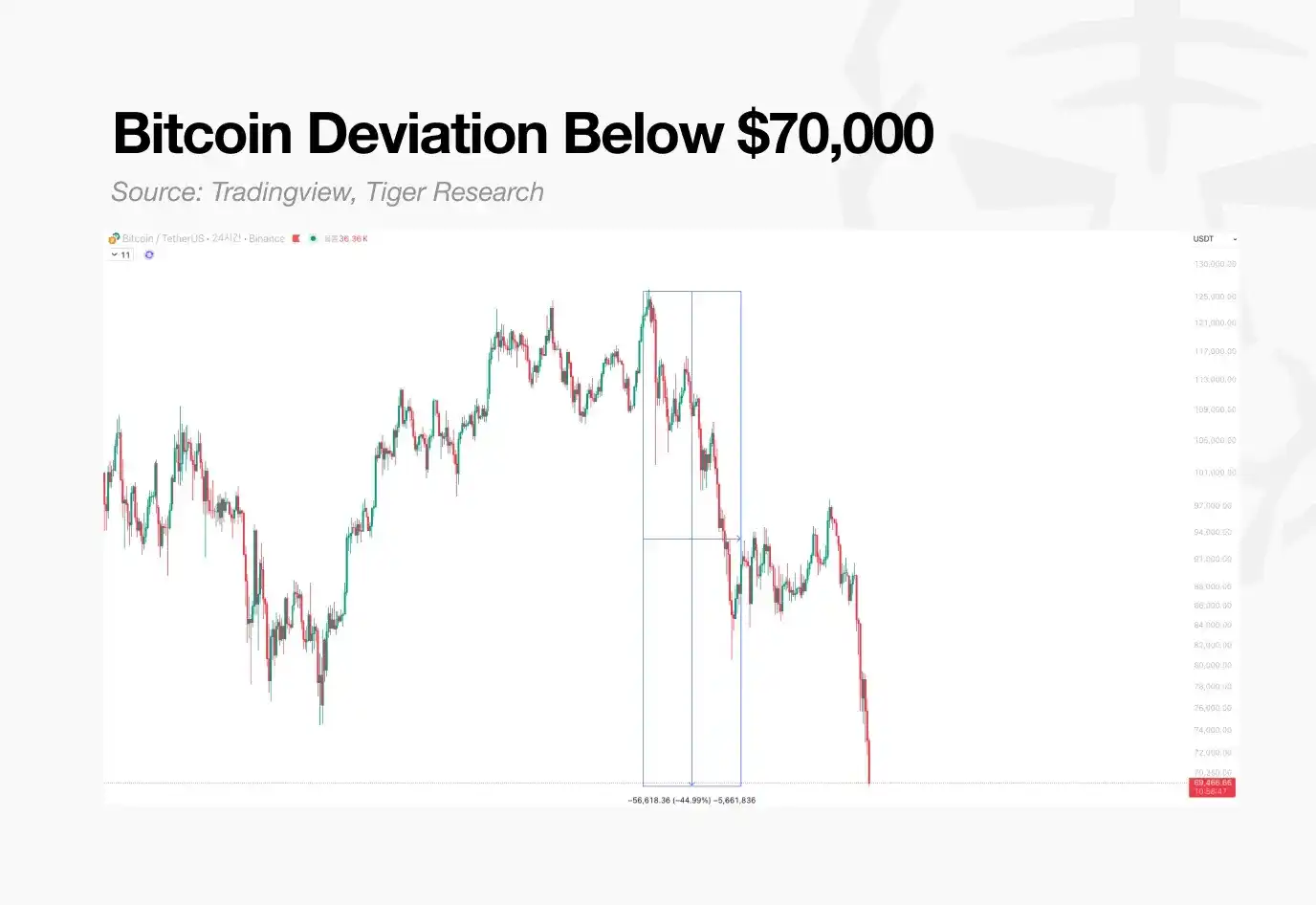
Source: Tiger Research

Bitcoin has fallen below $70,000. Among the top 100 cryptocurrencies by market cap, only 7 remain above their 200-day moving average. In contrast, 53 components of the Nasdaq 100 index are still trading above this threshold.

The market conditions are undeniable. Nevertheless, some crypto assets still manage to survive in the harshest environments.

Their resilience cannot be simply attributed to artificial market making or coincidental rebounds. A closer look at their development trajectory reveals a different explanation.

These projects no longer rely solely on vague visions or technical complexity. Instead, they share a common feature: solving core market problems with solutions rooted in practical reality. Their approach typically aligns with three directions:

  1. Do they solve a problem the market is currently facing?
  2. Are they ready for practical application in the near term?
  3. Are they building infrastructure that the industry will rely on long-term?

Ultimately, the ability to solve real problems in practice remains the most powerful fundamental.

2. Three Directions Chosen by the Market

Projects that can answer the above questions have successfully survived. Their approach is: 1) clearly identify a market problem; 2) propose a practical solution that matches a specific timing.

2.1. Hyperliquid: Solving Immediate Trading Friction

Centralized exchanges have traditionally been seen as responsible intermediaries. However, in practice, when problems arise, they often fail to align with investor interests. Decentralized exchanges emerged as an alternative, but poor user experience and performance have caused many investors to steer clear.
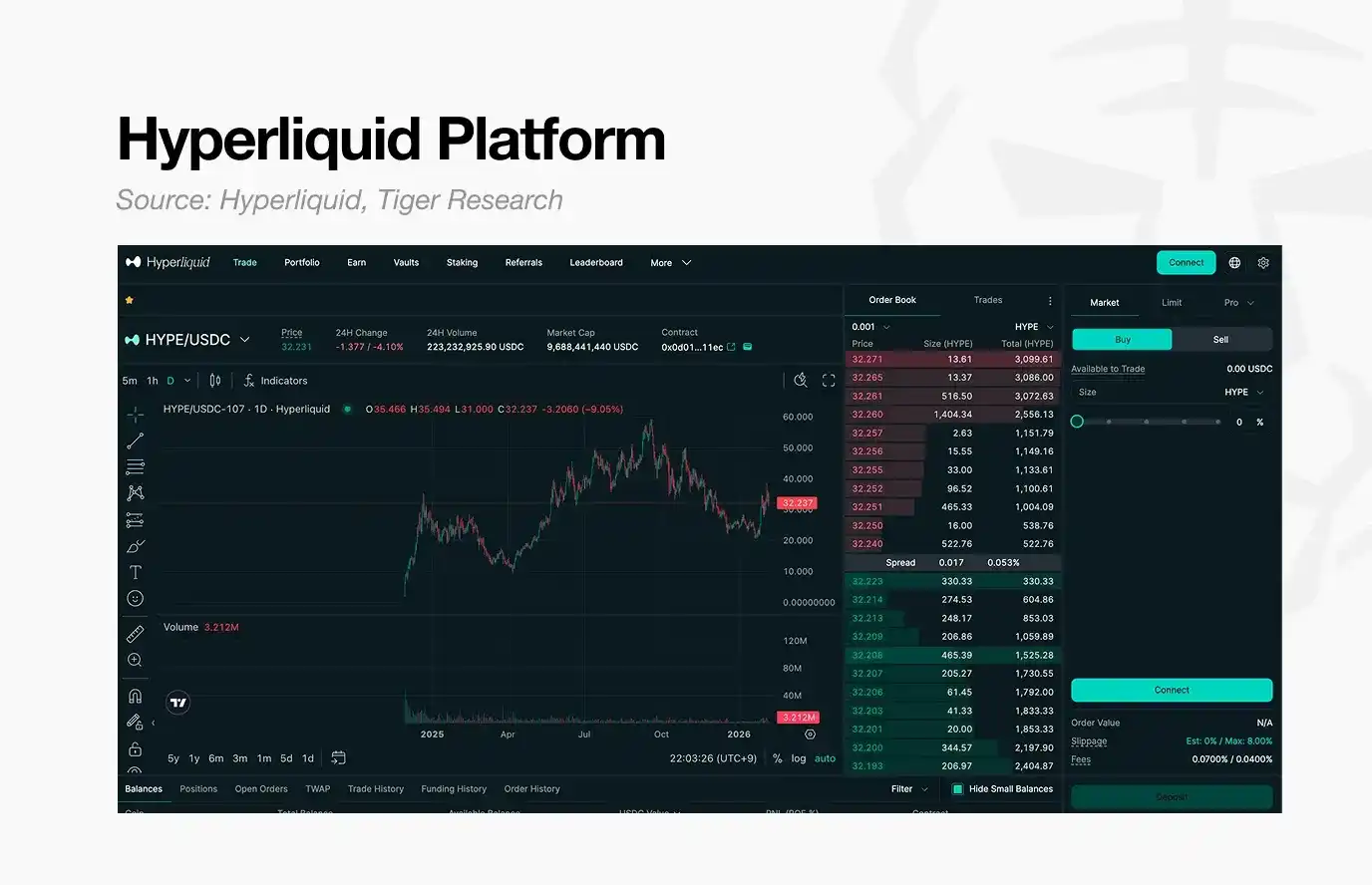
In this context, Hyperliquid introduced the concept of a perpetual contracts decentralized exchange (perp DEX). Through its HLP mechanism, it brings the features investors value in centralized exchanges—such as high leverage, fast execution, and stable liquidity—into an on-chain environment.

Early usage was partly driven by demand for the $HYPE token airdrop. However, continued engagement post-airdrop reflects user satisfaction with the platform's performance.

Ultimately, Hyperliquid's resilience stems from solving a persistent, real-world problem: dissatisfaction with centralized exchanges.

2.2. Canton Network: Preparing for the Era of Institutional Finance

Canton proposes a solution for the near future. As interest in real-world assets (RWA) continues to rise, institutions are beginning to see blockchain as financial infrastructure, not a public network. In this context, what institutions need is not complete data transparency, but a selective privacy model that supports regulatory compliance and confidentiality.

The Canton Network was born. Through DAML, Canton can provide configurable data disclosure for each participant.

This allows institutions to maintain transaction confidentiality while sharing information only to the necessary extent. Instead of imposing a provider-driven design, Canton builds infrastructure that aligns with institutional needs.
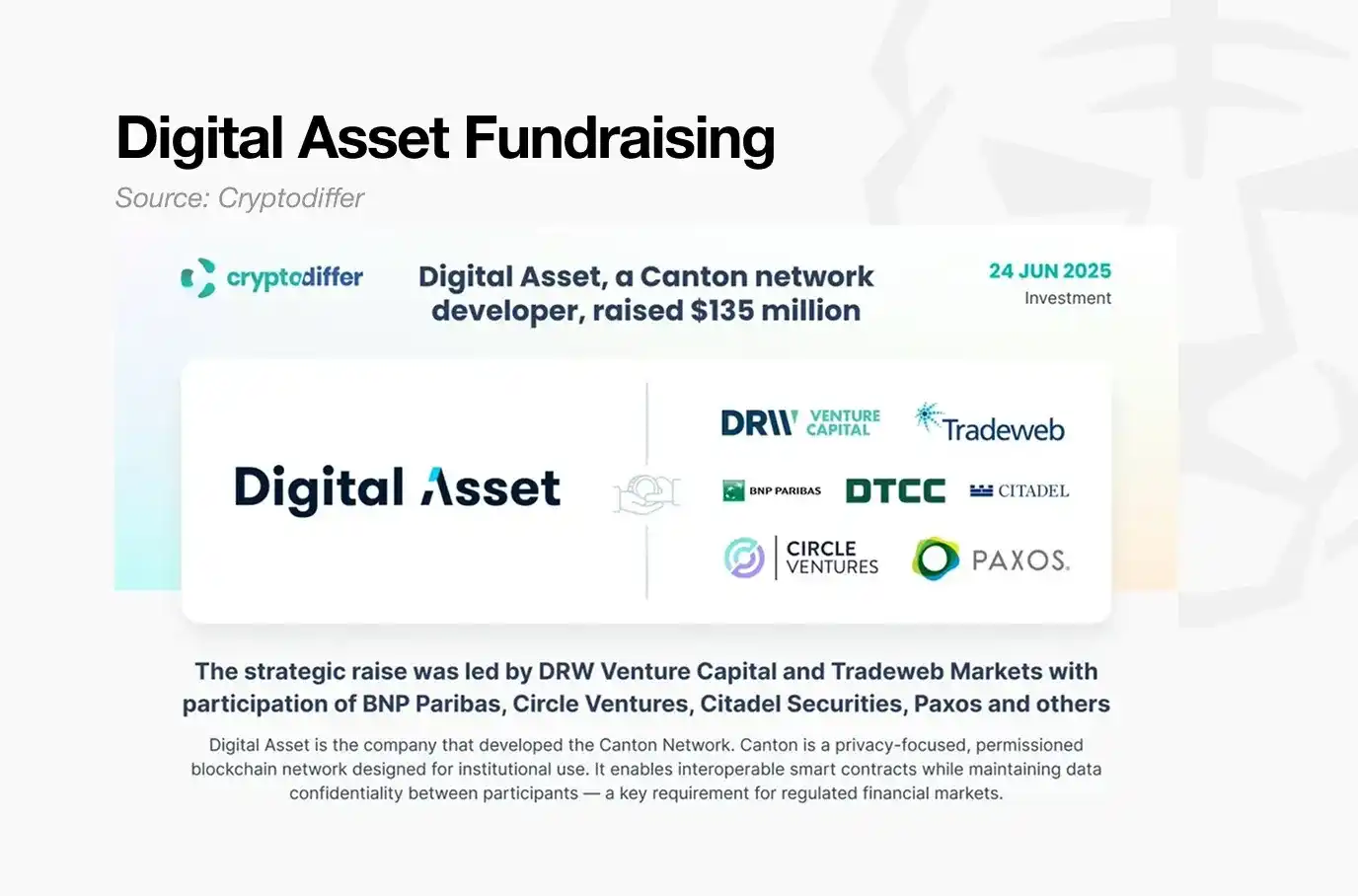
Another key factor is that Canton, from the outset, has focused on scaling its ecosystem with real-world deployments, supported by early partnerships with financial institutions.

Most notably, its partnership with DTCC establishes a pathway for assets managed by the traditional financial system to extend into a Canton-based environment. DTCC handles approximately $3.7 quadrillion in transactions annually, highlighting the practical feasibility of the Canton Network's approach.

Ultimately, the Canton Network provides a structural solution designed to meet three institutional requirements simultaneously: privacy protection, regulatory compliance, and integration with the existing financial system.

2.3. Kite AI: Building the AI Economy That Has Not Yet Arrived

Unlike the previous two examples, Kite AI currently has limited practical application. However, from the future perspective of AI agents operating as economic actors, its structural logic remains compelling.

There is broad consensus in both Web2 and Web3 about an agent-driven future. Few question scenarios where AI agents handle tasks like booking hotels or buying groceries on behalf of users.

However, such a future requires infrastructure that allows AI agents to independently initiate and execute payments. Existing transaction systems are designed for transfers between people, and for efficiency among human participants.

Therefore, for AI agents to operate as autonomous economic entities, new mechanisms are needed, including identity verification and automated payment frameworks.
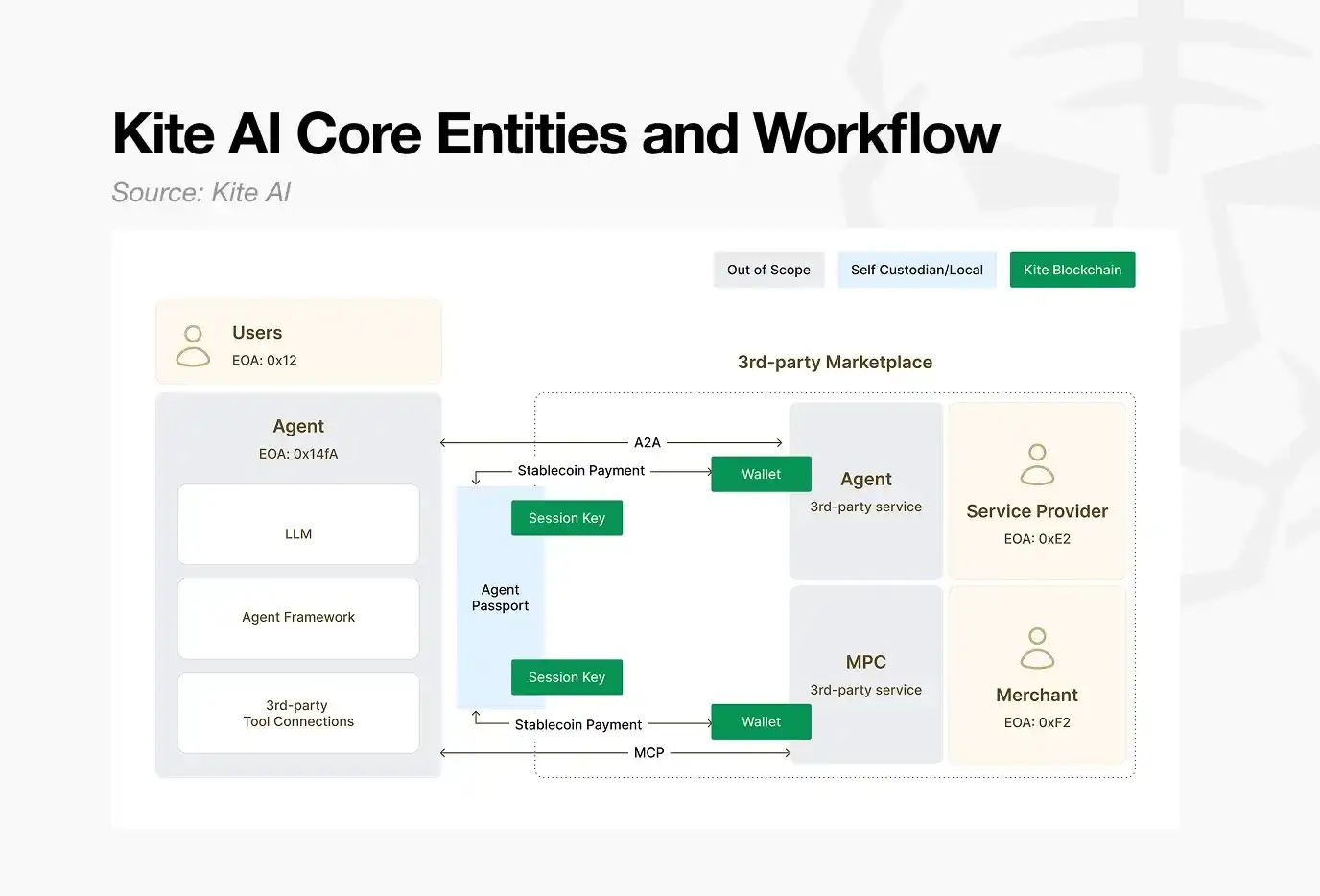
Kite AI is building payment infrastructure for this environment. Its core components include an "Agent Passport" for identity verification and the x402 protocol functionality for enabling automated payments.

The vision proposed by Kite AI cannot be deployed at scale currently, simply because the future it targets has not yet materialized.

Nonetheless, the project's realism stems from a broader premise: when this widely anticipated future arrives, the underlying technology it is developing will be necessary. This alignment with a widely accepted development trajectory gives the project structural credibility, despite its current limited use.

3. Three Key Questions for Assessing Practical Feasibility

Although these three projects have different timelines, they share a common characteristic: real-world feasibility.

Evaluations of the same project often diverge. Some believe it solves a real problem, while others see it as overhyped. To bridge this interpretation gap, at least three core questions must be asked:
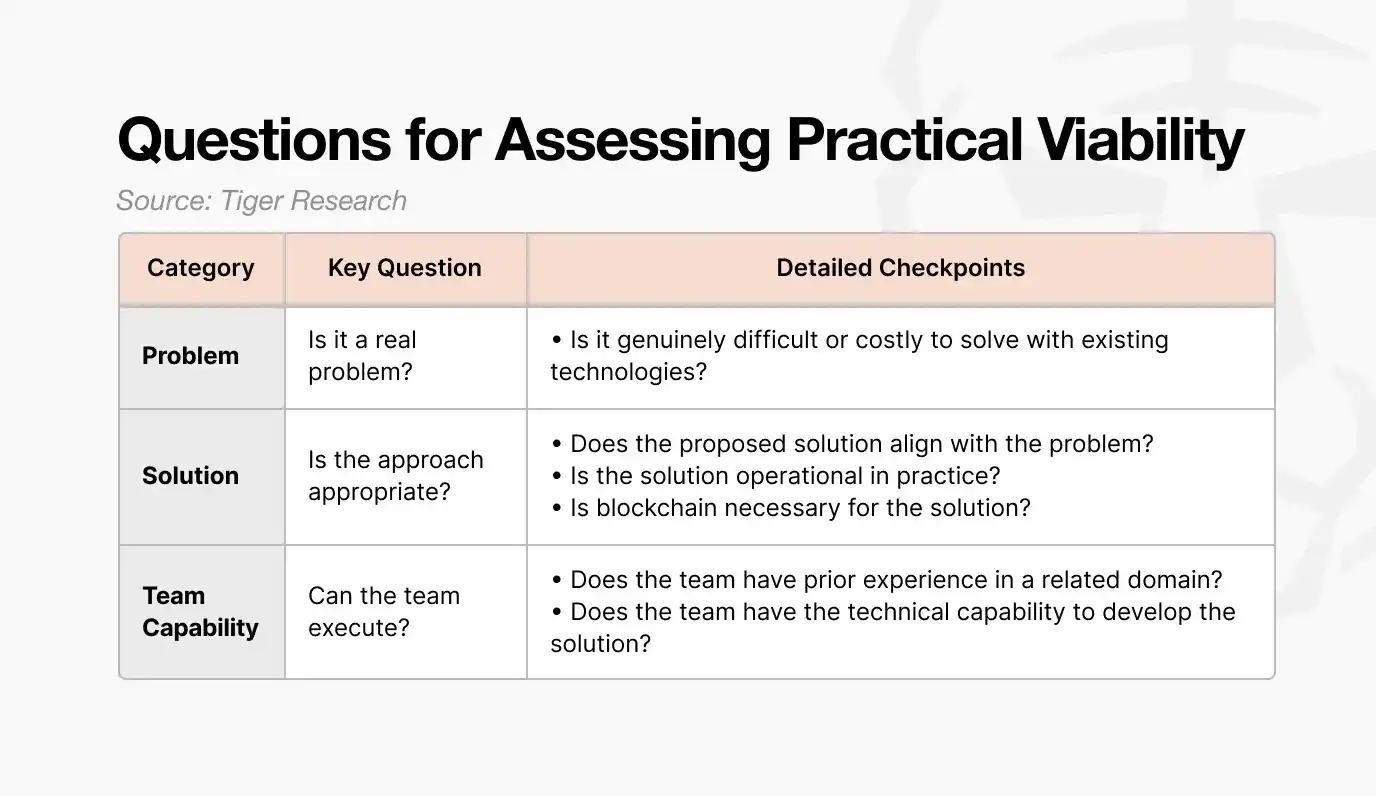
Source: Tiger Research

  1. What problem does it solve? Is the problem the project targets real and is there market demand for it?
  2. How does it solve it? Is the proposed solution structurally sound and executable?
  3. Who is executing it? Does the team have the capability and resources to turn the vision into reality?

Since most projects promote optimistic future narratives, answering these questions correctly requires time and effort. Filtering out misleading or incomplete information is not easy. Projects that cannot confidently answer these three questions may experience short-term price increases, but when the next downturn comes, they will likely disappear.

The current state of the cryptocurrency market is clearly unfavorable. But that doesn't mean it's all over. New experiments will continue, and the task is to assess what these efforts truly represent.

What matters most now is realism.

Пов'язані питання

QAccording to the Tiger Research article, what is the common characteristic of projects that survive in a prolonged crypto downturn?

AThe common characteristic is that they provide practical and realistic solutions to real, concrete problems, rather than relying on abstract narratives.

QWhat are the key factors to analyze when evaluating a project's realism, as outlined in the article?

AThe analysis should focus on three factors: the problem the project aims to solve, the structure of its proposed solution, and the team's ability to execute in practice.

QWhat specific market problem does Hyperliquid address, and how does it solve it?

AHyperliquid addresses the friction and lack of alignment with investor interests on centralized exchanges. It solves this by introducing a perpetual contracts decentralized exchange (perp DEX) that brings features like high leverage, fast execution, and stable liquidity on-chain through its HLP mechanism.

QHow does the Canton Network cater to the needs of institutional finance, as described in the report?

ACanton Network caters to institutional needs by providing a selective privacy model that supports regulatory compliance and confidentiality. It uses DAML language to allow configurable data disclosure for each participant, enabling institutions to share information only as necessary while maintaining transaction privacy and integrating with existing financial systems.

QWhat future infrastructure is Kite AI building, and why is it considered realistic even with limited current application?

AKite AI is building payment infrastructure for a future where AI agents act as autonomous economic entities. This includes an 'Agent Passport' for identity verification and the x402 protocol for automated payments. It is considered realistic because its vision aligns with the widely anticipated trajectory of AI development, making its underlying technology a necessary component for that future.

Пов'язані матеріали

380,000 Apps Exposed, 2,000+ Apps Leaked Secrets: AI Programming Turns 'Intranet' into Public Internet

Israeli cybersecurity firm RedAccess uncovered a severe data exposure trend linked to "vibe coding" or AI-powered software development tools. Their research found approximately 38,000 publicly accessible web applications built with platforms like Lovable, Base44, Netlify, and Replit. Of these, an estimated 2,000 apps exposed sensitive corporate and personal data, including medical records, financial information, internal strategic documents, and customer chat logs. In some cases, access even granted administrative privileges. The core issue stems from default privacy settings that make applications public by default, combined with a lack of built-in security controls (like authentication) in the AI-generated code. This allows employees without security expertise—"citizen developers"—to easily create and deploy applications that bypass standard corporate security reviews. The exposed apps, often indexed by search engines, are trivially discoverable. While some platform providers (Replit, Lovable, Wix/Base44) argue that security configuration is the user's responsibility and question the validity of some findings, security researchers confirm the widespread reality of such exposures. This pattern, also noted in prior studies, highlights a critical security gap as AI democratizes app creation, potentially leading to massive, unintentional data leaks.

marsbit46 хв тому

380,000 Apps Exposed, 2,000+ Apps Leaked Secrets: AI Programming Turns 'Intranet' into Public Internet

marsbit46 хв тому

Attracting Global Capital, Asia's New 'Super Cycle' Is Unfolding

Investors are turning to Asia as the next frontier for global equity growth, with a new "super cycle" unfolding across the region. Driven by the AI revolution, Asian markets, particularly South Korea, have seen significant rallies. According to Morgan Stanley analysis, the underlying drivers of Asia's industrial cycle are shifting from traditional sectors like real estate and manufacturing to massive investments in AI infrastructure, energy security and transition, and supply chain resilience. Fixed asset investment in Asia is projected to grow from around $11 trillion in 2025 to $16 trillion by 2030, with a 7% annual growth rate from 2026-2030. The AI wave is a primary catalyst, driving immense capital expenditure for chips, servers, data centers, and power systems. Asia is central to this hardware supply chain. In China, AI investment is focused on building a full-system domestic capability, with the local AI chip market potentially reaching $86 billion by 2030. Beyond AI, China's export story is expanding from EVs and batteries to robotics. The country already captures about half of new global industrial robot demand and over 90% of humanoid robot shipments. This growth phase mirrors the early stages of China's EV export boom. Simultaneously, energy security investments, spurred by AI's massive power needs, are rising, with China benefiting from its leadership in solar, batteries, and EVs. Regional defense spending is also increasing structurally, supporting demand for advanced manufacturing. The main beneficiaries are China, South Korea, and Japan, positioned in core supply chain areas. However, risks remain, including potential overcapacity, profit margin pressures from competition, persistent technological restrictions, geopolitical friction, and workforce displacement due to AI-driven automation. Market volatility is also expected to increase as investor expectations diverge on the realization of these capital investment and export themes.

marsbit46 хв тому

Attracting Global Capital, Asia's New 'Super Cycle' Is Unfolding

marsbit46 хв тому

Funding Weekly Report | 14 Public Funding Events, Kalshi Completes $10B New Funding Round at $220B Valuation Led by Coatue Management

Weekly Funding Roundup: 14 Deals and $10.49B+ in Total Funding, Led by Kalshi's $1B Round Last week (5.4-5.10) saw 14 notable funding events in the global blockchain ecosystem, raising over $10.49 billion in total. Key highlights include Kalshi, a prediction market platform, securing a $1 billion round led by Coatue Management, reaching a $22 billion valuation. The platform now boasts ~2 million MAUs and $178B in annualized trading volume. In DeFi, regulated on-chain reinsurer OnRe raised $5 million in Series A funding, and Bitcoin-backed credit protocol Saturn Credit completed a $2 million seed round. For Infrastructure & Tools, OpenTrade raised $17 million to expand its stablecoin yield infrastructure, and RWA platform Balcony secured $12.7 million to deploy its property settlement service in the US. Centralized Finance saw one deal: AI-driven trading platform Stockcoin.ai completed a seed round led by Amber Group. In the prediction market sector alongside Kalshi, AI-powered platform Elastics raised $2 million. Other notable deals include SC Ventures' strategic investment in crypto market maker GSR and Centrifuge securing a "seven-figure" investment from Coinbase to become a core RWA partner for Base. On the investor side, Haun Ventures raised a new $1 billion fund targeting crypto and AI, and Multi Investment raised ~$616 million to focus on blockchain and Web3 investments.

marsbit1 год тому

Funding Weekly Report | 14 Public Funding Events, Kalshi Completes $10B New Funding Round at $220B Valuation Led by Coatue Management

marsbit1 год тому

Торгівля

Спот
Ф'ючерси
活动图片





