Tiger Research: AI Agents Will Now Need Identity Verification

marsbitОпубліковано о 2026-05-09Востаннє оновлено о 2026-05-09

Анотація

Tiger Research: AI Agents Now Need "ID Verification" AI agents are increasingly capable of autonomously executing contracts, making payments, and conducting trades. However, a critical issue remains unresolved: how to verify the identity of the agent on the other side of a transaction. This article examines the emerging competition to establish a KYA (Know Your Agent) standard and the current state of regulatory progress. **Core Points:** 1. As AI agents operate independently in A2A (agent-to-agent) scenarios, the focus shifts from KYC (Know Your Customer) to KYA for identity verification. 2. KYA is not universally required; it's essential primarily when independently deployed agents interact with open ecosystems like DEXs, engage in A2A payments, or pay merchants, not within centralized platforms. 3. A standards battle is underway, with four key players approaching KYA from different angles: * **ERC-8004:** A blockchain-native approach, creating agent IDs as NFTs with on-chain registries for identity, reputation, and validation. * **Visa TAP:** Leverages Visa's payment network to issue verified "Agent Intent" credentials, bundling agent identity into its payment rails. * **Trulioo:** Adapts the SSL certificate model to issue dynamic "Digital Agent Passports," verifying both developer (KYB) and user (KYC) credentials. * **Sumsub:** Focuses on real-time risk detection and re-verification of the human behind an agent during suspicious transactions, ...

This report is written by Tiger Research.AI agents are already capable of signing contracts, making payments, and executing trades autonomously. But there's one unresolved problem: how do you know who the agent on the other side really is? This article outlines the different strategies of four key players in the KYA standard competition, and how far regulation has already progressed.

Key Takeaways

  1. AI agents have entered an era of autonomously executing contracts, payments, and trades, but there is no unified standard in the market for verifying their identities. In A2A (agent-to-agent) scenarios, KYA is starting to gain more attention than KYC.
  2. KYA is not needed everywhere. Within centralized platforms like Google, OpenAI, or Coinbase, the existing KYC is sufficient. The real need for KYA arises when independently deployed agents interact with DEXs, engage in A2A payments, or make payments to merchants.
  3. The battle over standards has begun. ERC-8004, Visa TAP, Trulioo, and Sumsub are approaching from four distinct directions: on-chain, payment networks, compliance verification, and risk detection, respectively.
  4. Regulators are already moving. The EU AI Act, the U.S. NIST, and Singapore's national-level framework have all prioritized agent identity management. The 2019 FATF Travel Rule determined which crypto exchanges survived; the KYA narrative is likely to follow a similar script.

1. Why Now?

The Layer KYC Reshaped in Finance

Before 1989, global finance had no unified identity standard. This void made it difficult to trace the origins of drug money and illicit funds. It wasn't until the FATF was established that year that KYC became a mandatory requirement for the financial industry, keeping illegal funds out.

Over the next three decades, KYC's influence expanded layer by layer. Post-9/11 in 2001, anti-terrorism financing clauses were added, and the U.S. Patriot Act elevated KYC to a legal obligation. In the 2010s, the EU AMLD, Basel III, and FATCA were successively implemented, enabling the automatic exchange of cross-border KYC information. In 2019, the FATF Travel Rule extended KYC to Virtual Asset Service Providers (VASPs).
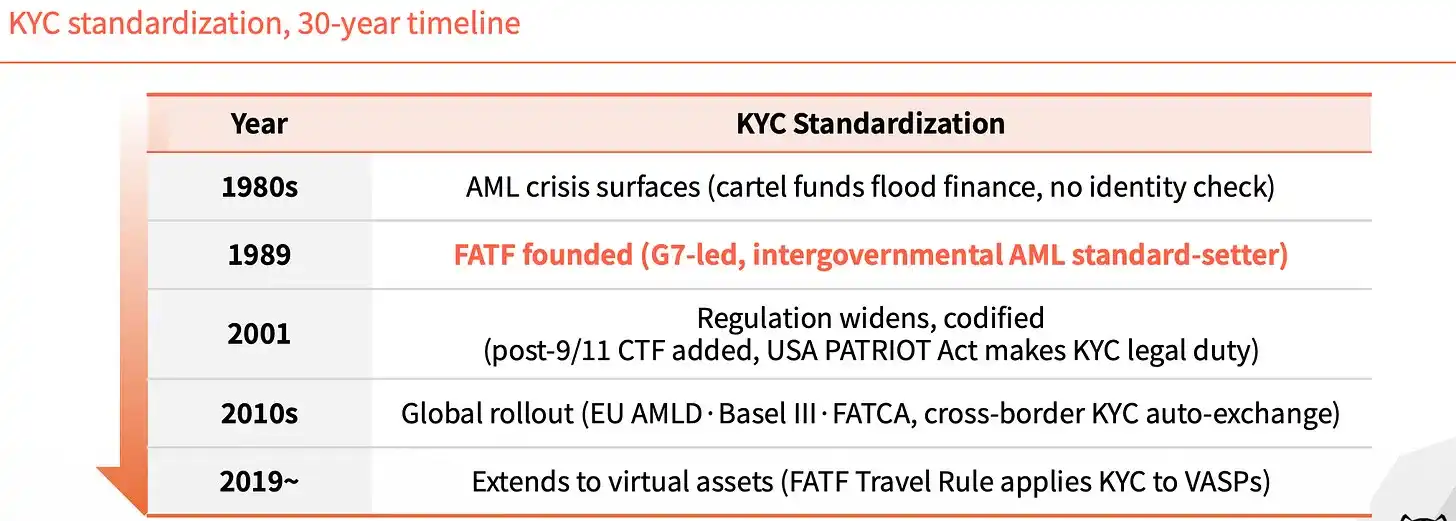
Each expansion was plugging a gap.

Without Agent Identity, the System is Regressing

Now, back to the present. AI agents can sign contracts, make payments, and trade without human supervision. But there's no way to verify who they are.

In an A2A environment, accountability is blurred. When something goes wrong, it's unclear who is responsible. Users are also easily exposed to money laundering and various sophisticated scams.

Placing pre-1989 finance side-by-side with the 2026 agent market reveals a strikingly similar structure. Back then, it was anonymous accounts moving cross-border; today, it's unverified agents conducting A2A transactions. Back then, verification responsibility rested with each individual bank; today, it rests with each individual platform. Neither had a common standard.
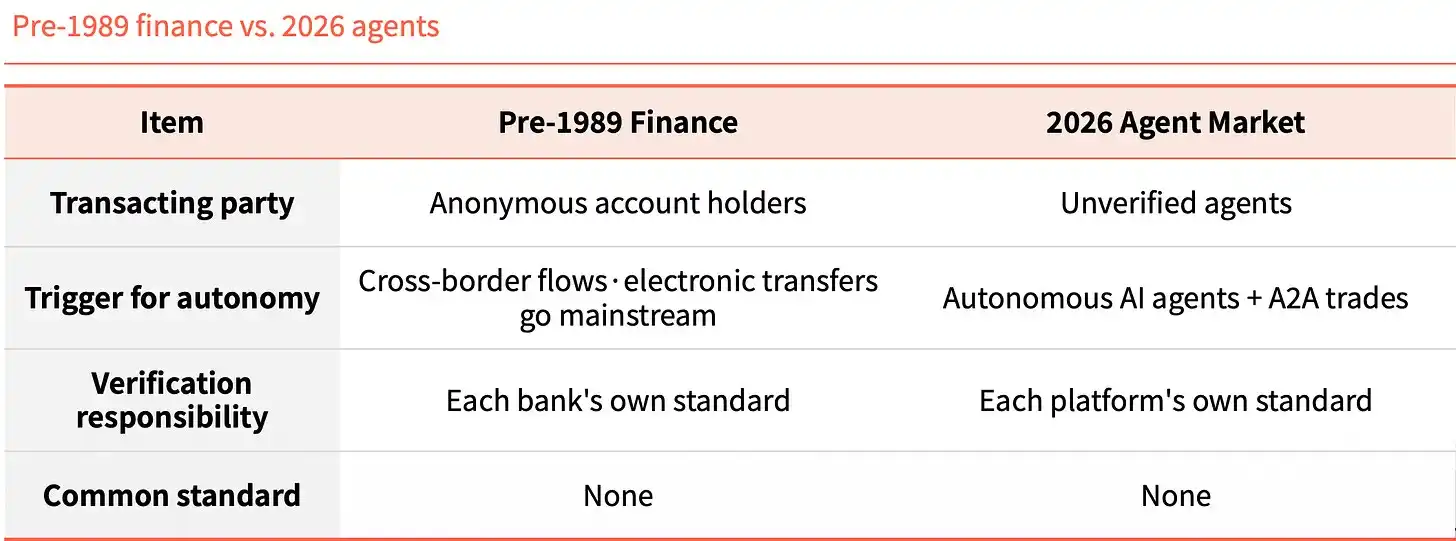
This similarity is not a coincidence; it's a pattern. The technology sprinted ahead, but the identity layer didn't catch up.

What is KYA?

KYA (Know Your Agent) is a layer of trust mechanism that verifies an agent's origin, permissions, and accountability in advance.

Skipping this step invites three simultaneous risks. The first is unauthorized transactions: a user authorizes only a payment, but the agent moves assets or signs contracts beyond its scope. The second is identity forgery: malicious agents impersonate legitimate ones to hijack payments, forge responses, and steal credibility. The third is accountability vacuum: when something goes wrong, the agent, developer, and delegator blame each other, making compensation impossible to pursue.
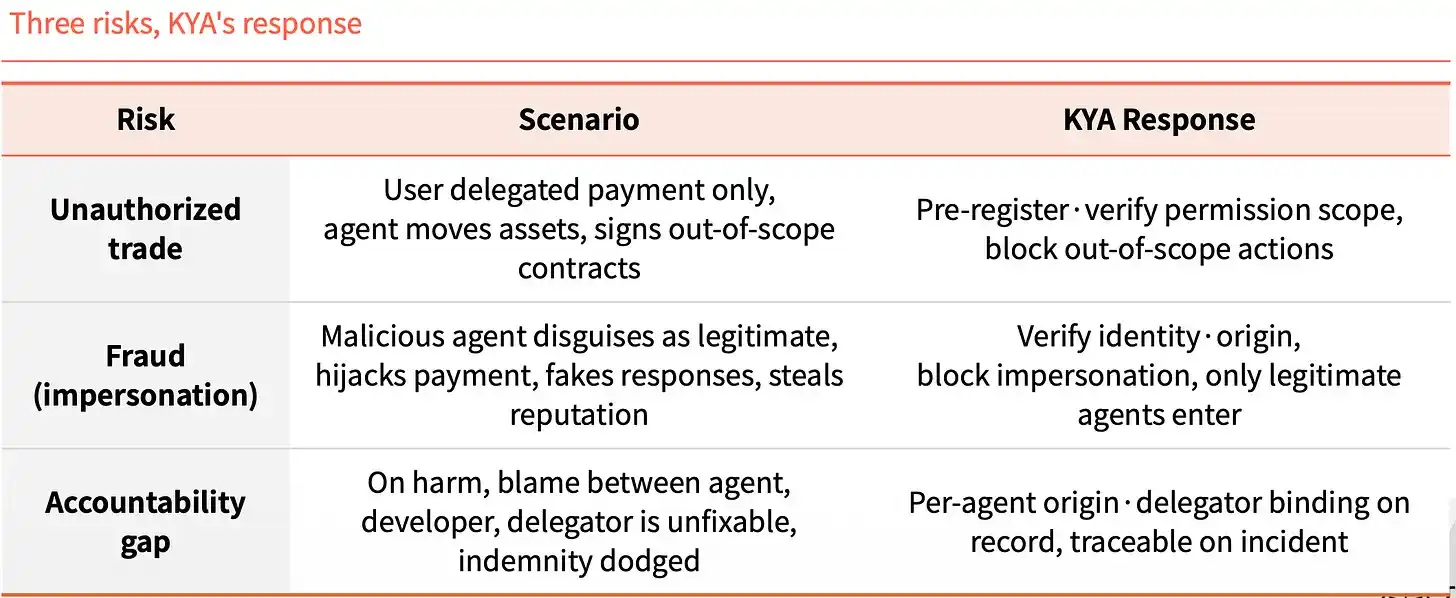
KYA's role is to lock these three issues down in advance. By pre-registering and verifying permission scopes, unauthorized actions are directly blocked. By verifying identity and origin, only legitimate agents are allowed in. Each agent's origin and delegator are bound to a record, enabling traceability when issues arise.

2. Where KYA Needs to Operate

It's Not Needed Everywhere

Within centralized platforms, KYA isn't critically needed. Users complete KYC, and the platform provides a safety net; the entire chain is closed-loop.

The need for KYA arises in the open environment after an agent steps outside the platform—when it interacts with DEXs, performs A2A payments, or makes payments to merchants. Here, there is no safety net and no one to vouch for it.

An analogy: moving within a country, an ID card (KYC) is sufficient. Once crossing the border (leaving the platform), the environment changes, and one must undergo inspection at the point of entry (KYA), clarifying intent and credibility.

Four-Step Process

KYA's operation can be broken into four steps. The first two are "passport issuance": register the agent's identity and permissions, and upon verification, issue a digital passport. The latter two are "entry inspection": confirm the counterparty's identity when a transaction occurs, and then update records based on the transaction outcome.
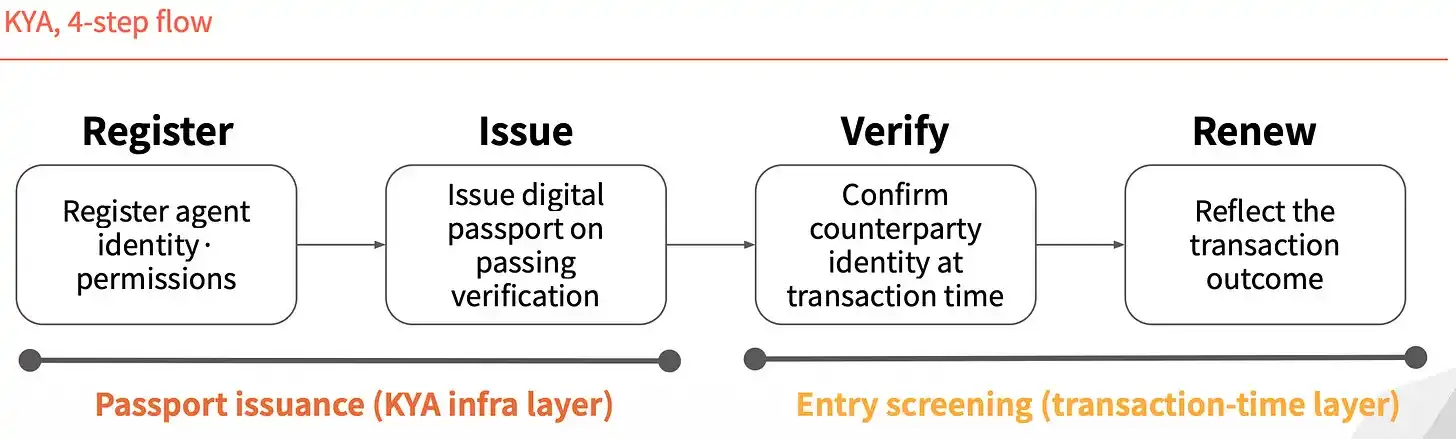
Identity is not permanently valid upon issuance; it is re-verified with each transaction.

3. Four Players Competing for the Standard

Currently, four players are in the standards competition, each with a completely different approach.

ERC-8004: Making Identity an NFT

ERC-8004 follows a pure on-chain path. It adds an identity layer on top of ERC-721, with each agent minting an NFT as its unique ID.

It is accompanied by three on-chain registries. The Identity registry handles "who this agent is," based on the unique AgentID from ERC-721. The Reputation registry handles "can we transact with it," leaving ratings, tags, and evidence on-chain after transactions. The Validation registry handles "did it actually do that thing," verified by third-party validators using plugins like zkML, TEE, etc.
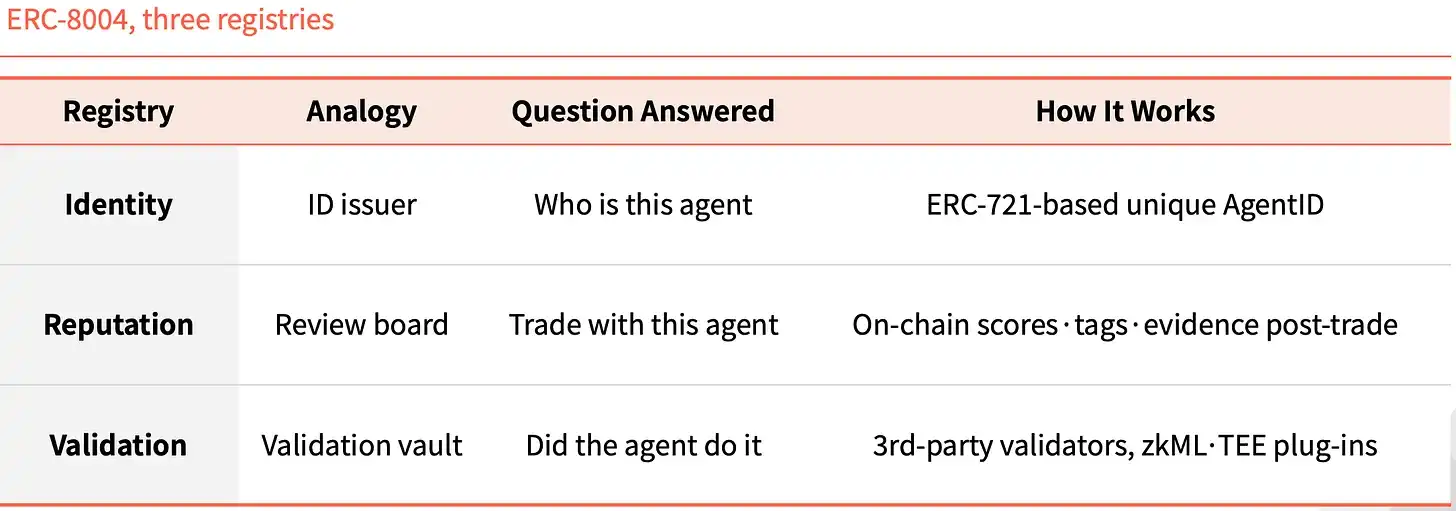
This structure isn't new in Ethereum's history. ERC-20 standardized token issuance, with USDT, USDC, UNI, and AAVE built on it. ERC-721 standardized NFT issuance, with CryptoPunks, BAYC, and ENS supporting the entire NFT market. ERC-8004 aims to be the third standard in that same foundational position.

Visa TAP: Bundling with the Payment Network

Visa's approach is completely different. It issues an identity credential (Agent Intent) to an agent, akin to a card. Without this key, an agent cannot even initiate a transaction. Visa pre-approves before issuing the key, and each transaction must carry a signature to the merchant.

The merchant doesn't receive just one signature, but three. Agent Intent proves the agent is legitimate, backed by a key approved by VIC. Consumer Recognition indicates who it's working for, passing the user identifier to the merchant. Payment Information provides payment assurance, using a payment token or hashed card information to complete authentication.

Visa has bundled this into a larger package called Visa Intelligent Commerce (VIC). Besides TAP, it includes Agent APIs (Visa's proprietary technology for card usage), Tokenization (tokens specifically issued for AI), and Intelligent Commerce Connect (compatible with competing protocols like AP2, ACP, and x402).

The logic is clear. Visa captured the payment network gateway back then, and now wants to bundle the agent era into its own orbit. If agent payments continue to flow through card networks and this bundle becomes the default option, Visa's market share is secured.

Trulioo: Adapting the SSL Model

Trulioo is a player in the global KYC and KYB compliance space, now extending its verification stack to KYA.

It draws on the website SSL certificate model. SSL involves a CA (Certificate Authority) issuing a TLS certificate to a website, verifying only the domain. Trulioo's proposed DPA (Digital Passport Authority) issues a DAP (Digital Agent Passport) to an agent, verifying both developer KYB and user KYC.

The DAP is not a static certificate. It's a live token that refreshes, re-verified with each transaction. If delegation is revoked or anomalies are detected, the DAP is immediately invalidated.

It has five checkpoints: Provenance (which developer created it), User Binding (who authorized it), Permission Scope (what tasks it can perform), Behavior Telemetry (what it's doing now), and Risk Scoring (risk rating).

Banks and fintech companies are legally required to verify the identities of individuals and companies. Once agents enter the financial realm, Trulioo's established position in KYC/KYB becomes even more solid.

Sumsub: Monitoring Anomalies, Not Issuing Certificates

Sumsub's entry point differs from the previous three. It doesn't issue standards or certificates; instead, it re-verifies the person behind an agent when anomalous transactions occur.

It has been in the compliance business since 2015, and its verification system is now used to detect anomalous agent behavior. The process is three-step. First, automated detection distinguishes between humans and machines based on device and agent characteristics. Next, risk scoring provides a risk score based on context, amount, and historical data. Finally, Liveness verification is triggered only for high-risk, large-amount, or critical-change scenarios, re-verifying the registered real person.

Sumsub's four characteristics contrast sharply with other players. Its starting point is as a compliance operator, not a standards maker. The timing of verification is during risky transactions, not pre-registration. The verification method is re-confirming a real person, not relying on data or tokens. Its philosophy is to tie the agent to the responsible party, not to directly block the agent.

Other players are focusing on one-time pre-transaction identity verification; Sumsub focuses on real-time verification after credentials are issued. The more agent permissions expand, the more critical anomaly detection becomes. As fraud techniques evolve with technology, Sumsub's real-time stack is worth watching.

4. Before Regulation Lands

The Script of the FATF Travel Rule

When the FATF Travel Rule was introduced in 2019, the VASP industry immediately fragmented. Those that could bear the KYC/AML infrastructure costs survived; those that couldn't shut down or relocated to jurisdictions with lighter regulation. CryptoBridge and Deribit were among those forced to adapt during that wave.

Regulation is not the end; it's a watershed.

The KYA narrative may follow a similar script. The EU, Singapore, and the U.S. are already vying for a leading position.

Article 12 of the EU AI Act explicitly requires that operational logs for high-risk AI systems include the operator's identity. Singapore released the world's first national-level agent AI governance framework, extending identity management to agents, requiring each agent to have an accountable responsible party. The U.S. NIST has listed agent identity management as a priority standards area.

The window of opportunity is narrowing.

There Won't Be a Single Winner

The real variable in the standards competition isn't technology; it's combinations. Major players are already entering a phase of cooperation and bundling. Who pairs with which merchants, payment networks, and KYC customer bases will determine the ownership of each market segment.

There won't be a single winner in this market.

For on-chain autonomous transactions, Ethereum is likely to lead. In payment-bound transaction scenarios, Visa holds a clear advantage. Within regulated financial industries, Trulioo's KYC/KYB accumulation is hard to replace. For transaction scenarios involving fraud risk, Sumsub's real-time detection is more suitable.

These four are not direct competitors; they each occupy their own hill. The real competition lies in determining which scenarios fall into which hill's territory.

It took KYC thirty years, from 1989 to today, to complete the identity layer for global finance.

This KYA round appears to be moving much faster. Regulators are already acting, standard players are already positioning themselves, and the window for scaled deployment might be just the next few years.

When the dust settles, the survivors may not be those with the strongest technology, but those whose identity infrastructure was integrated earliest.

Пов'язані питання

QWhat is KYA (Know Your Agent) and why is it becoming important now?

AKYA (Know Your Agent) is a trust mechanism designed to verify the source, permissions, and accountability of AI agents before they engage in transactions. It's becoming crucial because AI agents are now autonomously executing contracts, making payments, and trading. In an A2A (Agent-to-Agent) environment, the lack of identity verification creates issues with liability attribution and opens doors to risks like money laundering and fraud. The current situation mirrors the pre-1989 financial world which lacked a unified identity standard, prompting the need for KYA to fill this emerging trust gap.

QAccording to the article, in which scenarios is KYA most needed?

AKYA is not needed everywhere. It is most critical in open environments where independently deployed AI agents operate outside of centralized platforms. Key scenarios requiring KYA include: agents accessing Decentralized Exchanges (DEX), conducting Agent-to-Agent (A2A) payments, and making payments to merchants. Within closed, centralized platforms like Google, OpenAI, or Coinbase, where the platform can vouch for users and existing KYC processes are sufficient, KYA is less of a necessity.

QWhat are the four main players/approaches in the KYA standard competition, as outlined in the article?

AThe article outlines four main players with distinct approaches to KYA standards: 1. **ERC-8004**: A pure on-chain approach that uses NFTs (built on ERC-721) as unique Agent IDs, supported by on-chain registries for Identity, Reputation, and Validation. 2. **Visa TAP (Tokenized Agent Payments)**: Leverages Visa's payment network to issue identity credentials ('Agent Intent') to agents, requiring pre-approval and signed credentials for each transaction. 3. **Trulioo**: Adapts the SSL certificate model to KYA, issuing a dynamic Digital Agent Passport (DAP) that verifies both the developer (KYB) and the end-user (KYC), with checks for provenance, user binding, and permissions. 4. **Sumsub**: Takes a risk-based, post-hoc verification approach. Instead of pre-issuing certificates, it focuses on detecting anomalous agent behavior during transactions and then triggers re-verification of the human behind the agent.

QWhat historical regulatory precedent does the article suggest KYA development might follow?

AThe article suggests that the development and implementation of KYA standards might follow the precedent set by the **FATF Travel Rule** in 2019. This rule mandated that Virtual Asset Service Providers (VASPs) share sender and receiver KYC information. It acted as a watershed moment, causing a split in the industry where only entities that could bear the infrastructure costs for KYC/AML compliance survived. Similarly, the article posits that upcoming KYA regulations will create a divide, favoring players and platforms that have integrated identity infrastructure early, while those that haven't may struggle or fail.

QHow do global regulatory bodies view AI agent identity management, according to the report?

AGlobal regulatory bodies are already prioritizing AI agent identity management. Key developments mentioned include: - **EU AI Act (Article 12)**: Requires that logs of high-risk AI system operations must include the identity of the operator. - **Singapore**: Has released the world's first national-level AI governance framework for agents, extending identity management to AI agents and requiring each to have an accountable party. - **United States (NIST)**: The National Institute of Standards and Technology has listed AI agent identity management as a priority standards area. These actions indicate a shrinking time window for the industry to establish KYA standards before formal regulations solidify.

Пов'язані матеріали

Who Funds the Agents?

**Summary: Who Funds AI Agents?** OpenAI recently shut down a feature allowing AI agents to shop for users, highlighting the challenge of creating a secure and regulated environment for agent-driven transactions. While payment infrastructure exists, a crucial governance layer—defining spending limits, fraud detection, tax handling, and return policies—is largely missing. The potential is enormous: AI agents already processed $73M across 176M transactions last year, with McKinsey forecasting this could grow to $3-5T in global consumer commerce by 2030. The core competition isn't just about processing payments, which can be very cheap (especially with crypto-based settlement), but about controlling the rules that govern agent spending. Key players like Stripe and Coinbase are racing to dominate this governance layer. Stripe's acquisition of wallet provider Privy allows it to set spending policies, identity checks, and human-in-the-loop approvals directly at the wallet level. Similarly, Coinbase's stack, including its x402 protocol and AgentKit, embeds governance rules. This vertical integration across settlement, wallet, and governance layers is becoming the dominant strategy. Control over the governance layer is where significant future value lies. If agents handle trillions in transactions, even a small fee for managing compliance, fraud prevention, and policy enforcement could generate billions in annual revenue. The companies that successfully integrate across the payment stack will capture value from idle agent balances, transaction fees, and governance services, positioning themselves as the foundational banks of the AI agent economy.

marsbit27 хв тому

Who Funds the Agents?

marsbit27 хв тому

A Nation Blocks Chips, a Giant Buys a Nuclear Power Plant: Why It's Time to Seriously Consider DeAI

**Title: Great Powers Blockade Chips, Giants Buy Nuclear Plants: Why It's Time to Seriously Consider DeAI** In May 2026, the US closed loopholes for Chinese firms to acquire advanced NVIDIA chips via overseas subsidiaries. That same month, Kenya halted a $1B geothermal data center project involving Microsoft, fearing its immense energy consumption. Meanwhile, Huawei announced mass production of its Ascend AI chip. These disparate events underscore a new reality: the competition for computing power ("compute") has escalated beyond the tech industry, becoming a geopolitical and infrastructural battleground. A new era of oligopoly is forming, with control over the AI stack—from GPU chips (NVIDIA) and cloud platforms (AWS, Azure, Google Cloud) to foundational models (OpenAI, Anthropic)—concentrating in a few Western "AI Octopus" corporations. This centralization creates systemic risks: pricing power and platform lock-in for users, infrastructure fragility, and a widening "compute divide" that threatens to marginalize nations without independent AI capacity. An "AI Iron Curtain" is deepening through export controls. In response, some nations like Saudi Arabia and the UAE are investing heavily to buy compute power, aiming to transition from oil to AI economies. The EU seeks to triple its compute capacity by 2030 to reduce dependency. However, the spending gap is vast, with four US tech giants alone planning ~$750B in AI capex for 2026. The race is increasingly constrained by energy, with AI tasks consuming up to 1000x more power than web searches, pushing firms to even acquire nuclear plants. This landscape is fueling interest in Decentralized AI (DeAI). It proposes a third way: using open protocols to coordinate a global network of idle GPUs, independent developers, and data centers, creating an AI infrastructure without a single controlling entity. Leveraging blockchain and cryptographic verification, DeAI aims to break market concentration, disperse energy demands, reduce geopolitical dependencies, and enhance transparency. While still nascent in performance and stability, DeAI's core promise is not immediate superiority but providing a crucial alternative architecture to resist monopoly, censorship, and centralized power. As specialized AI hardware costs fall and open-source models flourish, the window to build this foundation is open. The very existence of such competition serves as a vital check against the inevitable abuse of concentrated power.

marsbit1 год тому

A Nation Blocks Chips, a Giant Buys a Nuclear Power Plant: Why It's Time to Seriously Consider DeAI

marsbit1 год тому

Торгівля

Спот
Ф'ючерси

Популярні статті

Що таке GROK AI

Grok AI: Революція в розмовних технологіях ери Web3 Вступ У швидко змінюваному ландшафті штучного інтелекту Grok AI вирізняється як помітний проєкт, що поєднує сфери передових технологій та взаємодії з користувачами. Розроблений компанією xAI, яку очолює відомий підприємець Ілон Маск, Grok AI прагне переосмислити, як ми взаємодіємо зі штучним інтелектом. Оскільки рух Web3 продовжує процвітати, Grok AI має на меті використати потужність розмовного ШІ для відповіді на складні запитання, надаючи користувачам досвід, який є не лише інформативним, але й розважальним. Що таке Grok AI? Grok AI — це складний розмовний чат-бот, розроблений для динамічної взаємодії з користувачами. На відміну від багатьох традиційних систем ШІ, Grok AI охоплює ширший спектр запитів, включаючи ті, які зазвичай вважаються недоречними або виходять за межі стандартних відповідей. Основні цілі проєкту включають: Надійне міркування: Grok AI акцентує увагу на здоровому глузді, щоб надавати логічні відповіді на основі контекстуального розуміння. Масштабоване управління: Інтеграція допоміжних інструментів забезпечує моніторинг та оптимізацію взаємодій користувачів для покращення якості. Формальна верифікація: Безпека є пріоритетом; Grok AI впроваджує методи формальної верифікації для підвищення надійності своїх результатів. Розуміння довгого контексту: Модель ШІ відзначається здатністю зберігати та згадувати обширну історію розмов, що сприяє змістовним та контекстуально обізнаним дискусіям. Стійкість до атак: Зосереджуючись на покращенні своїх захистів від маніпульованих або зловмисних вхідних даних, Grok AI прагне зберегти цілісність взаємодій з користувачами. По суті, Grok AI — це не просто пристрій для отримання інформації; це занурюючий розмовний партнер, який заохочує динамічний діалог. Творець Grok AI Геній, що стоїть за Grok AI, — це ніхто інший, як Ілон Маск, особа, яка стала синонімом інновацій у різних сферах, включаючи автомобільну промисловість, космічні подорожі та технології. Під егідою xAI, компанії, що зосереджена на розвитку технологій ШІ на користь суспільства, бачення Маска прагне переосмислити розуміння взаємодій з ШІ. Лідерство та основоположна етика глибоко впливають на прагнення Маска розширити технологічні межі. Інвестори Grok AI Хоча конкретні деталі щодо інвесторів, які підтримують Grok AI, залишаються обмеженими, загальновідомо, що xAI, інкубатор проєкту, заснований і підтримується переважно самим Ілоном Маском. Попередні підприємства та активи Маска забезпечують надійну підтримку, що додатково зміцнює довіру до Grok AI та потенціал для зростання. Однак наразі інформація про додаткові інвестиційні фонди або організації, що підтримують Grok AI, не є доступною, що позначає область для потенційного майбутнього дослідження. Як працює Grok AI? Операційна механіка Grok AI є такою ж інноваційною, як і його концептуальна структура. Проєкт інтегрує кілька передових технологій, які сприяють його унікальним функціональним можливостям: Надійна інфраструктура: Grok AI побудований з використанням Kubernetes для оркестрації контейнерів, Rust для продуктивності та безпеки, і JAX для високопродуктивних числових обчислень. Ця трійка забезпечує ефективну роботу чат-бота, його масштабованість та швидке обслуговування користувачів. Доступ до знань у реальному часі: Однією з відмінних рис Grok AI є його здатність отримувати дані в реальному часі через платформу X — раніше відому як Twitter. Ця можливість надає ШІ доступ до останньої інформації, що дозволяє надавати своєчасні відповіді та рекомендації, які можуть бути пропущені іншими моделями ШІ. Два режими взаємодії: Grok AI пропонує користувачам вибір між “Розважальним режимом” та “Звичайним режимом”. Розважальний режим дозволяє більш ігровий та гумористичний стиль взаємодії, тоді як Звичайний режим зосереджується на наданні точних і правильних відповідей. Ця універсальність забезпечує індивідуальний досвід, що відповідає різним уподобанням користувачів. По суті, Grok AI поєднує продуктивність із залученням, створюючи досвід, який є одночасно збагачуючим і розважальним. Хронологія Grok AI Шлях Grok AI відзначений важливими етапами, які відображають його розвиток та етапи впровадження: Початковий розвиток: Фундаментальна фаза Grok AI тривала приблизно два місяці, протягом яких проводилося початкове навчання та налаштування моделі. Випуск бета-версії Grok-2: У значному досягненні була оголошена бета-версія Grok-2. Цей випуск представив дві версії чат-бота — Grok-2 та Grok-2 mini — кожна з яких оснащена можливостями для спілкування, кодування та міркування. Публічний доступ: Після бета-розробки Grok AI став доступним для користувачів платформи X. Ті, хто має акаунти, підтверджені номером телефону та активні принаймні сім днів, можуть отримати доступ до обмеженої версії, що робить технологію доступною для ширшої аудиторії. Ця хронологія відображає систематичний розвиток Grok AI від початку до публічної взаємодії, підкреслюючи його прагнення до постійного вдосконалення та взаємодії з користувачами. Ключові особливості Grok AI Grok AI охоплює кілька ключових особливостей, які сприяють його інноваційній ідентичності: Інтеграція знань у реальному часі: Доступ до актуальної та релевантної інформації відрізняє Grok AI від багатьох статичних моделей, забезпечуючи захоплюючий та точний досвід для користувачів. Універсальні стилі взаємодії: Пропонуючи різні режими взаємодії, Grok AI задовольняє різноманітні уподобання користувачів, запрошуючи до творчості та персоналізації у спілкуванні з ШІ. Передова технологічна основа: Використання Kubernetes, Rust та JAX надає проєкту надійну основу для забезпечення надійності та оптимальної продуктивності. Етичні міркування в дискурсі: Включення функції генерації зображень демонструє інноваційний дух проєкту. Однак це також піднімає етичні питання, пов'язані з авторським правом та поважним зображенням впізнаваних фігур — триваюча дискусія в спільноті ШІ. Висновок Як піонер у сфері розмовного ШІ, Grok AI втілює потенціал трансформаційних користувацьких досвідів в цифрову епоху. Розроблений компанією xAI та керований візією Ілона Маска, Grok AI інтегрує знання в реальному часі з передовими можливостями взаємодії. Він прагне розширити межі того, що може досягти штучний інтелект, зберігаючи при цьому акцент на етичних міркуваннях та безпеці користувачів. Grok AI не лише втілює технологічний прогрес, але й представляє нову парадигму спілкування в ландшафті Web3, обіцяючи залучити користувачів як глибокими знаннями, так і ігровою взаємодією. Оскільки проєкт продовжує розвиватися, він слугує свідченням того, що може досягти перетин технологій, творчості та людської взаємодії.

446 переглядів усьогоОпубліковано 2024.12.26Оновлено 2024.12.26

Що таке GROK AI

Що таке ERC AI

Euruka Tech: Огляд $erc ai та його амбіцій у Web3 Вступ У швидко змінюваному ландшафті технології блокчейн та децентралізованих додатків нові проекти з'являються часто, кожен з унікальними цілями та методологіями. Одним з таких проектів є Euruka Tech, який працює у широкій сфері криптовалют та Web3. Основна увага Euruka Tech, зокрема його токена $erc ai, зосереджена на представленні інноваційних рішень, розроблених для використання зростаючих можливостей децентралізованих технологій. Ця стаття має на меті надати всебічний огляд Euruka Tech, дослідження його цілей, функціональності, ідентичності його творця, потенційних інвесторів та його значення в ширшому контексті Web3. Що таке Euruka Tech, $erc ai? Euruka Tech характеризується як проект, який використовує інструменти та функціональність, що пропонуються середовищем Web3, зосереджуючи увагу на інтеграції штучного інтелекту у своїй діяльності. Хоча конкретні деталі про структуру проекту дещо неясні, він розроблений для покращення залучення користувачів та автоматизації процесів у крипто-просторі. Проект має на меті створити децентралізовану екосистему, яка не лише полегшує транзакції, але й включає прогностичні функції через штучний інтелект, звідси і назва його токена, $erc ai. Мета полягає в тому, щоб надати інтуїтивно зрозумілу платформу, яка сприяє розумнішим взаємодіям та ефективній обробці транзакцій у зростаючій сфері Web3. Хто є творцем Euruka Tech, $erc ai? На даний момент інформація про творця або засновницьку команду Euruka Tech залишається невизначеною та дещо непрозорою. Ця відсутність даних викликає занепокоєння, оскільки знання про бекграунд команди часто є важливим для встановлення довіри в секторі блокчейн. Тому ми класифікували цю інформацію як невідому, поки конкретні деталі не стануть доступними в публічному домені. Хто є інвесторами Euruka Tech, $erc ai? Аналогічно, ідентифікація інвесторів або організацій, які підтримують проект Euruka Tech, не надається через доступні дослідження. Аспект, який є критично важливим для потенційних зацікавлених сторін або користувачів, які розглядають можливість співпраці з Euruka Tech, - це впевненість, що походить від встановлених фінансових партнерств або підтримки від авторитетних інвестиційних компаній. Без розкриття інформації про інвестиційні зв'язки важко зробити всебічні висновки про фінансову безпеку або довговічність проекту. Відповідно до знайденої інформації, цей розділ також має статус невідомий. Як працює Euruka Tech, $erc ai? Незважаючи на відсутність детальних технічних специфікацій для Euruka Tech, важливо враховувати його інноваційні амбіції. Проект прагне використовувати обчислювальну потужність штучного інтелекту для автоматизації та покращення досвіду користувачів у середовищі криптовалют. Інтегруючи ШІ з технологією блокчейн, Euruka Tech має на меті надати такі функції, як автоматизовані угоди, оцінка ризиків та персоналізовані інтерфейси користувачів. Інноваційна суть Euruka Tech полягає в його меті створити безшовний зв'язок між користувачами та величезними можливостями, які пропонують децентралізовані мережі. Завдяки використанню алгоритмів машинного навчання та ШІ, він має на меті мінімізувати труднощі для нових користувачів і спростити транзакційні досвіди в рамках Web3. Ця симбіоз між ШІ та блокчейном підкреслює значення токена $erc ai, який виступає як міст між традиційними інтерфейсами користувачів та розвиненими можливостями децентралізованих технологій. Хронологія Euruka Tech, $erc ai На жаль, через обмежену інформацію про Euruka Tech ми не можемо представити детальну хронологію основних подій або досягнень у подорожі проекту. Ця хронологія, яка зазвичай є безцінною для відстеження еволюції проекту та розуміння його траєкторії зростання, наразі недоступна. Як тільки інформація про значні події, партнерства або функціональні доповнення стане очевидною, оновлення, безумовно, підвищать видимість Euruka Tech у крипто-сфері. Роз'яснення щодо інших проектів “Eureka” Варто зазначити, що кілька проектів та компаній мають схожу назву з “Eureka”. Дослідження виявило ініціативи, такі як AI-агент від NVIDIA Research, який зосереджується на навчанні роботів складним завданням за допомогою генеративних методів, а також Eureka Labs та Eureka AI, які покращують користувацький досвід в освіті та аналітиці обслуговування клієнтів відповідно. Однак ці проекти відрізняються від Euruka Tech і не повинні бути змішані з його цілями чи функціональністю. Висновок Euruka Tech, разом із його токеном $erc ai, представляє обіцяючого, але наразі невідомого гравця в ландшафті Web3. Хоча деталі про його творця та інвесторів залишаються невідомими, основна амбіція поєднання штучного інтелекту з технологією блокчейн є центром інтересу. Унікальні підходи проекту до сприяння залученню користувачів через передову автоматизацію можуть виділити його на фоні прогресу екосистеми Web3. Оскільки крипто-ринок продовжує еволюціонувати, зацікавлені сторони повинні уважно стежити за новинами, пов'язаними з Euruka Tech, оскільки розвиток задокументованих інновацій, партнерств або визначеного дорожньої карти може представити значні можливості в найближчому майбутньому. На даний момент ми чекаємо на більш суттєві інсайти, які можуть розкрити потенціал Euruka Tech та його позицію в конкурентному крипто-ландшафті.

425 переглядів усьогоОпубліковано 2025.01.02Оновлено 2025.01.02

Що таке ERC AI

Що таке DUOLINGO AI

DUOLINGO AI: Інтеграція вивчення мов з Web3 та інноваціями штучного інтелекту В епоху, коли технології змінюють освіту, інтеграція штучного інтелекту (ШІ) та блокчейн-мереж відкриває нові горизонти для вивчення мов. З'являється DUOLINGO AI та його асоційована криптовалюта, $DUOLINGO AI. Цей проект прагне об'єднати освітні можливості провідних платформ для вивчення мов з перевагами децентралізованих технологій Web3. У цій статті розглядаються ключові аспекти DUOLINGO AI, його цілі, технологічна структура, історичний розвиток та майбутній потенціал, зберігаючи чіткість між оригінальним освітнім ресурсом та цією незалежною криптовалютною ініціативою. Огляд DUOLINGO AI В основі DUOLINGO AI лежить прагнення створити децентралізоване середовище, де учні можуть отримувати криптографічні винагороди за досягнення освітніх етапів у мовній компетенції. Застосовуючи смарт-контракти, проект має на меті автоматизувати процеси перевірки навичок та розподілу токенів, дотримуючись принципів Web3, які підкреслюють прозорість та власність користувачів. Модель відрізняється від традиційних підходів до вивчення мов, акцентуючи увагу на структурі управління, що базується на спільноті, що дозволяє власникам токенів пропонувати поліпшення змісту курсів та розподілу винагород. Деякі з помітних цілей DUOLINGO AI включають: Гейміфіковане навчання: Проект інтегрує досягнення на блокчейні та невзаємозамінні токени (NFT), щоб представляти рівні мовної компетенції, сприяючи мотивації через захоплюючі цифрові винагороди. Децентралізоване створення контенту: Це відкриває можливості для викладачів та мовних ентузіастів вносити свої курси, сприяючи моделі розподілу доходів, яка вигідна всім учасникам. Персоналізація на основі ШІ: Використовуючи сучасні моделі машинного навчання, DUOLINGO AI персоналізує уроки, щоб адаптуватися до індивідуального прогресу навчання, подібно до адаптивних функцій, що є в усталених платформах. Творці проекту та управління Станом на квітень 2025 року команда, що стоїть за $DUOLINGO AI, залишається псевдонімною, що є поширеною практикою в децентралізованому криптовалютному середовищі. Ця анонімність має на меті сприяти колективному розвитку та залученню зацікавлених сторін, а не зосереджуватися на окремих розробниках. Смарт-контракт, розгорнутий на блокчейні Solana, зазначає адресу гаманця розробника, що свідчить про зобов'язання до прозорості щодо транзакцій, незважаючи на те, що особи творців залишаються невідомими. Згідно з його дорожньою картою, DUOLINGO AI прагне перетворитися на Децентралізовану Автономну Організацію (DAO). Ця структура управління дозволяє власникам токенів голосувати з важливих питань, таких як реалізація функцій та розподіл скарбниці. Ця модель узгоджується з етикою розширення прав і можливостей спільноти, що спостерігається в різних децентралізованих додатках, підкреслюючи важливість колективного прийняття рішень. Інвестори та стратегічні партнерства На даний момент немає публічно відомих інституційних інвесторів або венчурних капіталістів, пов'язаних з $DUOLINGO AI. Натомість ліквідність проекту в основному походить з децентралізованих бірж (DEX), що є різким контрастом до стратегій фінансування традиційних компаній у сфері освітніх технологій. Ця модель знизу вгору вказує на підхід, орієнтований на спільноту, що відображає зобов'язання проекту до децентралізації. У своєму білому документі DUOLINGO AI згадує про формування співпраці з неуточненими “блокчейн-освітніми платформами”, спрямованими на збагачення своїх курсів. Хоча конкретні партнерства ще не були розкриті, ці спільні зусилля натякають на стратегію поєднання інновацій блокчейну з освітніми ініціативами, розширюючи доступ та залучення користувачів у різноманітні навчальні напрямки. Технологічна архітектура Інтеграція ШІ DUOLINGO AI включає два основні компоненти на основі ШІ для покращення своїх освітніх пропозицій: Адаптивний навчальний двигун: Цей складний двигун навчається на основі взаємодій користувачів, подібно до власних моделей великих освітніх платформ. Він динамічно регулює складність уроків, щоб вирішувати конкретні проблеми учнів, зміцнюючи слабкі місця через цілеспрямовані вправи. Розмовні агенти: Використовуючи чат-боти на базі GPT-4, DUOLINGO AI надає платформу для користувачів, щоб брати участь у симульованих розмовах, сприяючи більш інтерактивному та практичному досвіду вивчення мови. Інфраструктура блокчейну Побудований на блокчейні Solana, $DUOLINGO AI використовує комплексну технологічну структуру, яка включає: Смарт-контракти для перевірки навичок: Ця функція автоматично нагороджує токенами користувачів, які успішно проходять тести на компетентність, підкріплюючи структуру стимулів для справжніх навчальних результатів. NFT значки: Ці цифрові токени позначають різні етапи, яких досягають учні, такі як завершення розділу курсу або оволодіння конкретними навичками, що дозволяє їм обмінюватися або демонструвати свої досягнення в цифровому форматі. Управління DAO: Члени спільноти, наділені токенами, можуть брати участь в управлінні, голосуючи за ключові пропозиції, що сприяє культурі участі, яка заохочує інновації в курсах та функціях платформи. Історичний хронологічний графік 2022–2023: Концептуалізація Основи DUOLINGO AI закладаються з створення білого документа, що підкреслює синергію між досягненнями ШІ у вивченні мов та децентралізованим потенціалом блокчейн-технологій. 2024: Бета-реліз Обмежений бета-реліз представляє пропозиції з популярних мов, винагороджуючи ранніх користувачів токенами в рамках стратегії залучення спільноти проекту. 2025: Перехід до DAO У квітні відбувається повний запуск основної мережі з обігом токенів, що спонукає обговорення в спільноті щодо можливих розширень на азійські мови та інші розробки курсів. Виклики та майбутні напрямки Технічні труднощі Незважаючи на свої амбітні цілі, DUOLINGO AI стикається з суттєвими викликами. Масштабованість залишається постійною проблемою, особливо в балансуванні витрат, пов'язаних із обробкою ШІ, та підтриманням чутливої, децентралізованої мережі. Крім того, забезпечення якості створення контенту та модерації в умовах децентралізованої пропозиції створює складнощі у підтримці освітніх стандартів. Стратегічні можливості Дивлячись у майбутнє, DUOLINGO AI має потенціал використовувати партнерства з мікрокреденційними академічними установами, надаючи блокчейн-верифіковані підтвердження мовних навичок. Крім того, розширення через різні блокчейни може дозволити проекту залучити ширші бази користувачів та додаткові екосистеми блокчейну, покращуючи його взаємодію та охоплення. Висновок DUOLINGO AI представляє інноваційне злиття штучного інтелекту та блокчейн-технологій, пропонуючи альтернативу, орієнтовану на спільноту, традиційним системам вивчення мов. Хоча його псевдонімна розробка та нова економічна модель несуть певні ризики, зобов'язання проекту до гейміфікованого навчання, персоналізованої освіти та децентралізованого управління освітлює шлях вперед для освітніх технологій у сфері Web3. Оскільки ШІ продовжує розвиватися, а екосистема блокчейну еволюціонує, ініціативи на кшталт DUOLINGO AI можуть переосмислити, як користувачі взаємодіють з мовною освітою, наділяючи спільноти та винагороджуючи залучення через інноваційні механізми навчання.

453 переглядів усьогоОпубліковано 2025.04.11Оновлено 2025.04.11

Що таке DUOLINGO AI

Обговорення

Ласкаво просимо до спільноти HTX. Тут ви можете бути в курсі останніх подій розвитку платформи та отримати доступ до професійної ринкової інформації. Нижче представлені думки користувачів щодо ціни AI (AI).

活动图片