Those Who Hate Bitcoin Are 'Plundering' the World with Private Credit

marsbitОпубліковано о 2026-03-06Востаннє оновлено о 2026-03-06

Анотація

Author Jeff Park argues that private credit is the latest and most insidious financial innovation designed to conceal risk, ultimately socializing losses onto unsuspecting pensioners and insurance policyholders. Unlike past instruments like junk bonds or structured credit, private credit is structured to be opaque, with slow, smoothed valuations that hide problems until catastrophic, instantaneous write-downs occur (like BlackRock recently writing two loans to zero). The article posits that the 2008 crisis didn't eliminate risk but pushed it into a shadow banking system. The $2 trillion private credit market, now funding major AI projects, creates a perverse cycle: workers' retirement savings are used for automation that may eliminate their jobs. The core criticism is the flawed incentive structure: fund managers collect fees upfront while long lock-ups and a lack of transparency ensure that retirees and ordinary investors bear all the losses when the investments fail, making it a form of "theft of time" where profits are privatized and losses are socialized.

Written by: Jeff Park

Compiled by: Chopper, Foresight News

In the financial world, every generation invents a new tool to package its worst instincts into something that appears prudent.

The 1980s had junk bonds, cloaked in the guise of 'democratizing capital'; the 1990s had emerging market debt, packaged as a noble cause to help developing countries integrate into the global economy; the 2000s had structured credit, so complexly layered that even its designers couldn't understand it before it collapsed.

These 'innovations' share a common thread: they created artificial solutions (like liquidity transformation) for real problems (like insufficient growth), ultimately leading to disaster due to excess.

Private credit is the latest chapter in this story, and perhaps the most insidious one. Unlike its predecessors, it is designed from the outset to make the清算 (liquidation) before a risk explosion completely invisible. By the time it's discovered, the consequences are irreversible.

Recently, BlackRock directly wrote down the face value of two private credit loans from 100% to 0 in one go, one of them in less than a month. This doesn't look like a technical error in valuation methods; it looks more like a confession of flawed incentives.
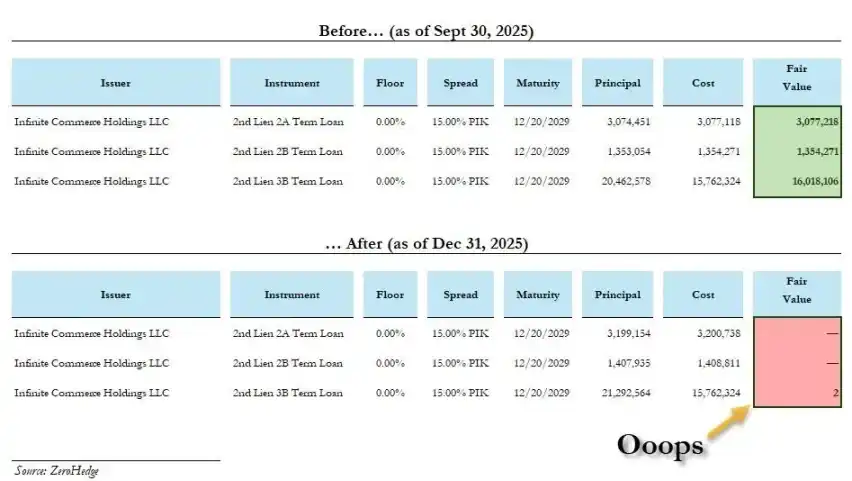
How did we get here?

The Crisis Isn't the Root Cause; Concealing the Truth Created It

The mainstream industry narrative goes like this: After the 2008 financial crisis, banks, constrained by Basel III, became afraid to lend. Non-bank institutions stepped in to fill the void, serving small and medium-sized enterprises. This was the market's inevitable choice.

The more truthful situation is that the post-2008 regulatory framework did not truly eliminate risk. Instead, it actively fostered a shadow system that bears the same underlying risks but evades the regulations originally designed to constrain them.

The private credit market has ballooned from $46 billion in 2000 to about $2 trillion today. This money didn't appear out of thin air, nor did it accidentally flow into pension funds and insurance companies. It was precisely channeled to institutions with large capital bases, long lock-up periods, and a willingness to accept opaque valuations.

Its structure is identical to that which precipitated the 2008 financial crisis, with one significant difference. When the subprime mortgage market collapsed in 2008, losses were concentrated in reckless borrowing households and the banks that lent to them. If private credit crashes, the losses have no boundaries; the money comes from life insurance policyholders and pension beneficiaries—ordinary people.

The socialization of losses that outraged the public in 2008 at least had a preceding period of private gains. With private credit: profits go into the pockets of fund managers, losses are socialized and flow to the retirement accounts of teachers, nurses, civil servants—people who never agreed to bear this risk.

Worse, the industry, not content with just harvesting institutions, is now targeting retail investors. Since 2025, private credit ETFs have become hugely popular, but the problem is even more severe: illiquid assets don't become liquid by being put into an ETF. It merely transfers the bomb of 'redemption runs hitting but assets being unsellable' from professional institutions to the brokerage accounts of ordinary investors.

This is the reality unfolding.

Asset Allocators Who Hate Bitcoin Expose Everything

Over the past few years, I've been recommending Bitcoin to institutions everywhere and discovered a startling pattern: those who reject Bitcoin are often fervent enthusiasts of private credit. This isn't just two different viewpoints on a topic; it's the same mentality.

Their objections to Bitcoin sound 'prudent': too volatile, drawdowns are inexplicable, no cash flow so it can't be valued.

But the subtext is: Bitcoin's price is too honest. Real-time, public, visible to all. If it makes a mistake, it's wrong, and it can't be hidden.

Private credit is the exact opposite:

  • Valuation changes are extremely slow, 'smoothed' quarterly by fund managers
  • There is no liquid market to puncture the lies
  • Lock-up periods are long enough for the decision-makers to get promoted, change jobs, or retire

The so-called 'proprietary deal flow' is just an excuse for a lack of effective pricing competition.

A true fiduciary seeks the truth. These allocators seek to avoid facing the truth. This isn't risk management; it's the opposite of risk management, yet it's cloaked in professionalism, completely disregarding the beneficiaries' interests.

The AI Boom Turns It Into a Systemic Risk

Morgan Stanley estimates that from 2025 to 2028, global data centers will require $2.9 trillion in capital expenditure, with about $800 billion of that to be solved by private credit. This has turned private credit from a lending market into the key infrastructure for the most important technological transformation of the coming decades.

A typical case: In October 2025, Meta and Blue Owl completed a $27 billion data center financing deal, the largest private credit transaction in history. The money came from PIMCO, BlackRock, and ultimately from pensions and insurance companies.

The cruelty of this cycle: the retirement savings of ordinary workers are used to fund automation and AI, which in turn replaces the very jobs of those workers. Private credit distorts the cost of capital and suppresses the value of labor. Now, nearly $50 billion in private credit floods into the AI sector every quarter.

The financialization of AI infrastructure and the displacement of the workforce that funds it form a closed loop: the left hand cuts the right hand.

Liquidity Transformation is Theft of Time

I'm not saying credit itself is sinful, nor that all private credit firms are bad. Credit has always been a game of probabilities; bad debts and mismatches exist in every era.

The key difference is: who truly bears the loss?

  • If a bank makes a bad loan, it's on their balance sheet, regulated, faces bank runs and equity wipeouts—there is real money at risk;
  • Private credit managers earn performance fees, incentives that 'encourage you to place bets,' not incentives that 'encourage you to win responsibly.'

By the time the loan goes to zero, the manager has already made enough money.

Every financial engineering endeavor ultimately points to one question: who bears the costs nobody wants?

The 'brilliance' of private credit is how 'elegantly' it answers this question:

Profits flow upward and backward: to the older, already retired beneficiaries of long-term capital

Costs flow downward and forward: suppressing wages, freezing hiring, delaying investment, distorting the entire economy's cost of capital

Private credit is the theft of time.

This is the age-old liquidity transformation in finance, just stripped of its disguise.

They bear risks they shouldn't have to bear, through tools they cannot choose, at prices they cannot foresee.

Lock-up periods ensure they cannot exit. The lack of public valuation ensures they cannot protest. And the quarterly valuation smoothing mechanism ensures that when the final bill comes, those responsible are long gone.

It doesn't look like plunder; it looks like 'steady returns.' The two are almost indistinguishable until the moment of collapse. While this story is age-old, the novelty lies in its sheer scale, its profound lack of transparency, and the astounding success of an asset class built on this illusion of safety, which has managed to convince the world's most cautious capital managers.

There is no asset class in the world that can be valued at 100% for three consecutive months and then written down to zero overnight.

If this isn't theft, then I don't know what is.

Пов'язані питання

QWhat is the main argument the author makes about private credit?

AThe author argues that private credit is the latest and most insidious financial innovation that artificially solves real problems like lack of growth, but is designed to hide risks until it's too late. It socializes losses onto ordinary people while managers privatize gains, making it a form of 'theft of time'.

QAccording to the author, what is a key difference between the 2008 subprime crisis and a potential private credit crash?

AIn the 2008 subprime crisis, losses were primarily concentrated on reckless households and lending banks, with a period of private gain before losses were socialized. In a private credit crash, losses would flow directly to pensioners, teachers, nurses, and public servants—ordinary people who never agreed to bear the risk—while the gains have already been pocketed by fund managers.

QWhy does the author believe that asset allocators who reject Bitcoin often favor private credit?

AThe author contends that these allocators reject Bitcoin because its price is 'too honest'—it is real-time, public, and cannot hide mistakes. In contrast, they favor private credit because its valuations are smoothed, lack a liquid market to expose lies, and have long lock-up periods that allow decision-makers to avoid accountability by the time losses occur.

QHow is the AI boom exacerbating the systemic risks of private credit?

AThe AI boom is creating massive capital expenditure needs for data centers, with an estimated $800 billion expected to be funded through private credit. This transforms private credit from a lending market into critical infrastructure for a major technological shift. It creates a perverse cycle where workers' pension funds are used to finance AI and automation that may ultimately replace their own jobs.

QWhat does the author mean by 'private credit is theft of time'?

AThe author means that private credit 'steals time' through its structure: profits flow upward and backward to older, retired beneficiaries of long-term capital, while the costs (lower wages, hiring freezes, delayed investment) are pushed downward and forward onto future generations. The long lock-ups and lack of transparency ensure that by the time the bill comes due, those responsible are no longer accountable, and the true risk-takers (ordinary people) cannot protest or exit.

Пов'язані матеріали

How Many Tokens Away Is Yang Zhilin from the 'Moon Chasing the Light'?

The article explores the intense competition between two leading Chinese AI companies, DeepSeek and Kimi (Moon Dark Side), and the mounting pressure on Yang Zhilin, the founder of Kimi. While DeepSeek re-emerged after 15 months of silence with its powerful V4 model—boasting 1.6 trillion parameters and low-cost, long-context capabilities—Kimi has been focusing on long-context processing and multi-agent systems with its K2.6 model. Yang faces a threefold challenge: technological rivalry, commercialization pressure, and investor expectations. Despite Kimi’s high valuation (reaching $18 billion), its revenue heavily relies on a single product with low paid conversion rates, while DeepSeek’s strategic silence and open-source influence have strengthened its market position and valuation prospects, now targeting over $20 billion. Both companies reflect broader trends in China’s AI ecosystem: Kimi aims for global influence through open-source contributions and agent-based advancements, while DeepSeek prioritizes foundational innovation and hardware independence, notably shifting to Huawei’s chips. Their competition is seen as vital for China’s AI progress, with the gap between top Chinese and U.S. models narrowing to just 2.7% on the Elo rating scale. Ultimately, the article argues that this rivalry, though anxiety-inducing for leaders like Zhilin, is essential for driving innovation and solidifying China’s role in the global AI landscape.

marsbit2 год тому

How Many Tokens Away Is Yang Zhilin from the 'Moon Chasing the Light'?

marsbit2 год тому

TechFlow Intelligence Bureau: ChatGPT Helps Amateur Mathematician Crack 60-Year-Old Problem, CFTC Sues New York Regulator Over Coinbase and Gemini

An amateur mathematician, with the assistance of ChatGPT, has solved a combinatorial mathematics puzzle originally proposed by Hungarian mathematician Paul Erdős in the 1960s. This marks another milestone in AI-aided mathematical research, demonstrating the evolving capabilities of large language models in formal reasoning. In other AI developments, OpenAI introduced a new privacy filter tool for enterprise API usage, automatically screening sensitive data. Meanwhile, the Qwen3.6-27B model achieved 100 tokens per second on a single RTX 5090 GPU using quantization, significantly lowering the cost barrier for local AI deployment. In crypto and Web3, the U.S. CFTC sued New York’s financial regulator, challenging its oversight of Coinbase and Gemini—a first-of-its-kind federal-state regulatory clash. Following a vulnerability, KelpDAO and major DeFi protocols established a recovery fund. Tether froze $344 million in assets linked to Iran’s central bank upon U.S. Treasury request, highlighting the centralized control risks in stablecoins. Separately, Litecoin underwent a 3-hour chain reorganization to undo a privacy-layer exploit. In the U.S., former President Trump invoked the Defense Production Act to address power grid bottlenecks affecting AI data centers and dismissed the entire National Science Board, raising concerns over research independence. A retail trader gained 250% on a $600k Intel options bet amid AI-related speculation. Xiaomi announced its first performance electric vehicle, targeting rivals like Tesla. Meanwhile, iPhone users reported devices automatically reinstalling a hidden app daily, suspected to be MDM-related. A Chinese securities report noted that A-share institutional crowding has reached its second-longest streak since 2007, signaling high valuations and potential style rotation. The day’s developments reflect a dual narrative: AI is enabling unprecedented individual breakthroughs, while centralized power structures—whether governmental or corporate—are becoming more assertive, underscoring that decentralization is as much a political-economic challenge as a technical one.

marsbit3 год тому

TechFlow Intelligence Bureau: ChatGPT Helps Amateur Mathematician Crack 60-Year-Old Problem, CFTC Sues New York Regulator Over Coinbase and Gemini

marsbit3 год тому

Торгівля

Спот
Ф'ючерси

Популярні статті

Що таке BITCOIN

Розуміння HarryPotterObamaSonic10Inu (ERC-20) та його позиції у крипто-просторі Останніми роками ринок криптовалют спостерігав за зростанням популярності мем-коінів, які привертають інтерес не тільки трейдерів, але й тих, хто шукає спілкування та розважальну цінність. Серед цих унікальних токенів є HarryPotterObamaSonic10Inu (ERC-20), інтригуючий проект, що поєднує культурні посилання з тканинами криптовалюти. Ця стаття досліджує ключові аспекти HarryPotterObamaSonic10Inu, вивчаючи його механізми, спільноту та його взаємодію з ширшим крипто-ландшафтом. Що таке HarryPotterObamaSonic10Inu (ERC-20)? Як випливає з його назви, HarryPotterObamaSonic10Inu є мем-коіном, побудованим на блокчейні Ethereum, класифікованим за стандартом ERC-20. На відміну від традиційних криптовалют, які можуть підкреслювати практичну корисність або інвестиційний потенціал, цей токен процвітає завдяки розважальній цінності та силі своєї спільноти. Проект спрямований на створення середовища, де зацікавлені користувачі можуть об'єднуватися, ділитися ідеями та брати участь у заходах, натхненних різноманітними культурними явищами. Однією з примітних особливостей HarryPotterObamaSonic10Inu є нульовий податок на транзакції. Цей привабливий елемент має на меті заохочувати торгівлю та участь у спільноті, позбавлену додаткових витрат, які можуть відлякувати дрібних трейдерів. Загальна пропозиція монет становить один мільярд токенів, що позначає намір підтримувати суттєву циркуляцію в межах спільноти. Творець HarryPotterObamaSonic10Inu (ERC-20) Походження HarryPotterObamaSonic10Inu дещо окутане таємницею; деталі про творця залишаються невідомими. Розвиток цього токена позбавлений впізнаваної команди або чіткої стратегії, що не є рідкістю в секторі мем-коінів. Натомість проект виник органічно, а його розвиток значною мірою залежить від ентузіазму та участі його спільноти. Інвестори HarryPotterObamaSonic10Inu (ERC-20) Щодо зовнішніх інвестицій та підтримки, HarryPotterObamaSonic10Inu також залишається невизначеним. Токен не зазначає жодних відомих інвестиційних фондів або значної організаційної підтримки. Натомість життєва сила проекту полягає в його базовій спільноті, яка інформує про його зростання та стійкість через колективні дії та залученість у крипто-просторі. Як працює HarryPotterObamaSonic10Inu (ERC-20)? Як мем-коін, HarryPotterObamaSonic10Inu функціонує передусім поза традиційними рамками, що часто регулюють вартість активів. Є кілька відмінних аспектів, що визначають, як працює проект: Транзакції без податку: Завдяки відсутності податкових зборів на транзакції, користувачі можуть вільно купувати та продавати токен, не турбуючись про приховані витрати. Залучення спільноти: Проект процвітає завдяки взаємодії спільноти, використовуючи соціальні медіа для створення шуму та сприяння залученню. Обговорення, обмін контентом та залученість є ключовими елементами, що допомагають розширити його охоплення та зміцнити лояльність серед прихильників. Відсутність практичної корисності: Слід зазначити, що HarryPotterObamaSonic10Inu не пропонує конкретної корисності в рамках фінансової екосистеми. Натомість він класифікується як токен, що призначений в основному для розваги та спільнотних активностей. Культурне посилання: Токен кмітливо вплітає елементи популярної культури, щоб привернути інтерес, зв'язуючи з ентузіастами мемів та крипто-стежками. HarryPotterObamaSonic10Inu ілюструє, як мем-коіни функціонують інакше, ніж традиційні криптовалютні проекти, увійшовши на ринок як інноваційні соціальні конструкти, а не утилітарні активи. Хронологія HarryPotterObamaSonic10Inu (ERC-20) Історія HarryPotterObamaSonic10Inu відзначена кількома значними етапами: Створення: Токен виник з вірусного мему, захопивши уяву багатьох крипто-ентузіастів. Конкретні дати створення недоступні, що підкреслює його органічний розвиток. Лістинг на біржах: HarryPotterObamaSonic10Inu з'явився на різних біржах, дозволяючи зручніший доступ і торгівлю спільноти. Ініціативи залучення спільноти: Ведення діяльності, спрямованої на покращення взаємодії спільноти, включаючи конкурси, кампанії в соціальних мережах та створення контенту від фанатів та прихильників. Плани на майбутнє: Дорожня карта проекту включає запуск колекції NFT, мерчандайзинг та електронну комерцію, пов'язану з його культурними темами, що далі залучає спільноту та намагається додати більше вимірів до його екосистеми. Ключові моменти про HarryPotterObamaSonic10Inu (ERC-20) Спільнотний підхід: Проект надає пріоритет колективному внеску та креативності, забезпечуючи, щоб участь користувачів була в центрі його розвитку. Класифікація як мем-коін: Це є його епігенез розважальної криптовалюти, що відрізняється від традиційних інвестиційних інструментів. Жодного прямого відношення до Bitcoin: Незважаючи на схожість у назві, HarryPotterObamaSonic10Inu є відмінним і не має жодного зв’язку з Bitcoin або іншими усталеними криптовалютами. Зосередженість на співпраці: HarryPotterObamaSonic10Inu створено для того, щоб надати простір для співпраці та обміну історіями серед його власників, забезпечуючи шлях для творчості та спільного зв'язку. Перспективи на майбутнє: Амбіція розширитися за межі початкової концепції в NFT та мерчандайз відкриває шлях для проекту потенційно потрапити в більш мейнстрімні сфери цифрової культури. Оскільки мем-коіни продовжують захоплювати уяву спільноти криптовалют, HarryPotterObamaSonic10Inu (ERC-20) вирізняється своїми культурними зв'язками та орієнтованим на спільноту підходом. Хоча він може не відповідати типовій моделі утилітарного токена, його суть полягає в радощах і товариськості, що підтримуються серед його прихильників, підкреслюючи еволюційну природу криптовалют в усе більш цифрову епоху. Оскільки проект продовжує розвиватися, важливо спостерігати за тим, як динаміка спільноти вплине на його траєкторію в постійно змінюваному ландшафті технології блокчейн.

1.7k переглядів усьогоОпубліковано 2024.04.01Оновлено 2024.12.03

Що таке BITCOIN

Як купити BTC

Ласкаво просимо до HTX.com! Ми зробили покупку Bitcoin (BTC) простою та зручною. Дотримуйтесь нашої покрокової інструкції, щоб розпочати свою криптовалютну подорож.Крок 1: Створіть обліковий запис на HTXВикористовуйте свою електронну пошту або номер телефону, щоб зареєструвати обліковий запис на HTX безплатно. Пройдіть безпроблемну реєстрацію й отримайте доступ до всіх функцій.ЗареєструватисьКрок 2: Перейдіть до розділу Купити крипту і виберіть спосіб оплатиКредитна/дебетова картка: використовуйте вашу картку Visa або Mastercard, щоб миттєво купити Bitcoin (BTC).Баланс: використовуйте кошти з балансу вашого рахунку HTX для безперешкодної торгівлі.Треті особи: ми додали популярні способи оплати, такі як Google Pay та Apple Pay, щоб підвищити зручність.P2P: Торгуйте безпосередньо з іншими користувачами на HTX.Позабіржова торгівля (OTC): ми пропонуємо індивідуальні послуги та конкурентні обмінні курси для трейдерів.Крок 3: Зберігайте свої Bitcoin (BTC)Після придбання Bitcoin (BTC) збережіть його у своєму обліковому записі на HTX. Крім того, ви можете відправити його в інше місце за допомогою блокчейн-переказу або використовувати його для торгівлі іншими криптовалютами.Крок 4: Торгівля Bitcoin (BTC)Легко торгуйте Bitcoin (BTC) на спотовому ринку HTX. Просто увійдіть до свого облікового запису, виберіть торгову пару, укладайте угоди та спостерігайте за ними в режимі реального часу. Ми пропонуємо зручний досвід як для початківців, так і для досвідчених трейдерів.

4.3k переглядів усьогоОпубліковано 2024.12.12Оновлено 2025.03.21

Як купити BTC

Що таке $BITCOIN

ЦИФРОВЕ ЗОЛОТО ($BITCOIN): Комплексний аналіз Вступ до ЦИФРОВОГО ЗОЛОТА ($BITCOIN) ЦИФРОВЕ ЗОЛОТО ($BITCOIN) — це проект на основі блокчейну, що працює в мережі Solana, який має на меті поєднати характеристики традиційних дорогоцінних металів з інноваціями децентралізованих технологій. Хоча він має таку ж назву, як і Bitcoin, який часто називають “цифровим золотом” через його сприйняття як засобу збереження вартості, ЦИФРОВЕ ЗОЛОТО є окремим токеном, розробленим для створення унікальної екосистеми в ландшафті Web3. Його мета — позиціонувати себе як життєздатний альтернативний цифровий актив, хоча деталі щодо його застосувань і функціональностей все ще розробляються. Що таке ЦИФРОВЕ ЗОЛОТО ($BITCOIN)? ЦИФРОВЕ ЗОЛОТО ($BITCOIN) — це токен криптовалюти, спеціально розроблений для використання в блокчейні Solana. На відміну від Bitcoin, який виконує широко визнану роль зберігання вартості, цей токен, здається, зосереджується на більш широких застосуваннях і характеристиках. Помітні аспекти включають: Інфраструктура блокчейну: Токен побудований на блокчейні Solana, відомому своєю здатністю обробляти швидкі та низьковартісні транзакції. Динаміка постачання: ЦИФРОВЕ ЗОЛОТО має максимальне постачання, обмежене 100 квадрильйонами токенів (100P $BITCOIN), хоча деталі щодо його обігового постачання наразі не розголошуються. Утиліта: Хоча точні функціональності не викладені, є вказівки на те, що токен може бути використаний для різних застосувань, потенційно пов'язаних з децентралізованими додатками (dApps) або стратегіями токенізації активів. Хто є творцем ЦИФРОВОГО ЗОЛОТА ($BITCOIN)? На даний момент особа творців і команди розробників, що стоять за ЦИФРОВИМ ЗОЛОТОМ ($BITCOIN), залишається невідомою. Ця ситуація є типовою для багатьох інноваційних проектів у сфері блокчейну, особливо тих, що пов'язані з децентралізованими фінансами та феноменом мем-коінів. Хоча така анонімність може сприяти культурі, орієнтованій на спільноту, вона посилює занепокоєння щодо управління та підзвітності. Хто є інвесторами ЦИФРОВОГО ЗОЛОТА ($BITCOIN)? Доступна інформація вказує на те, що ЦИФРОВЕ ЗОЛОТО ($BITCOIN) не має жодних відомих інституційних спонсорів або помітних венчурних капіталовкладень. Проект, здається, працює за моделлю “рівний до рівного”, зосереджуючись на підтримці та прийнятті спільноти, а не на традиційних шляхах фінансування. Його активність і ліквідність переважно розташовані на децентралізованих біржах (DEX), таких як PumpSwap, а не на встановлених централізованих торгових платформах, що ще більше підкреслює його підхід знизу вгору. Як працює ЦИФРОВЕ ЗОЛОТО ($BITCOIN) Операційні механізми ЦИФРОВОГО ЗОЛОТА ($BITCOIN) можна детальніше розглянути на основі його дизайну блокчейну та характеристик мережі: Механізм консенсусу: Використовуючи унікальний proof-of-history (PoH) Solana в поєднанні з моделлю proof-of-stake (PoS), проект забезпечує ефективну валідацію транзакцій, що сприяє високій продуктивності мережі. Токеноміка: Хоча конкретні дефляційні механізми не були детально описані, велике максимальне постачання токенів вказує на те, що воно може задовольняти мікротранзакції або нішеві випадки використання, які ще потрібно визначити. Інтероперабельність: Існує потенціал для інтеграції з більш широкою екосистемою Solana, включаючи різні платформи децентралізованих фінансів (DeFi). Однак деталі щодо конкретних інтеграцій залишаються невизначеними. Хронологія ключових подій Ось хронологія, яка підкреслює значні віхи, пов'язані з ЦИФРОВИМ ЗОЛОТОМ ($BITCOIN): 2023: Початкове розгортання токена відбувається на блокчейні Solana, позначене його адресою контракту. 2024: ЦИФРОВЕ ЗОЛОТО набуває видимості, оскільки стає доступним для торгівлі на децентралізованих біржах, таких як PumpSwap, що дозволяє користувачам торгувати ним проти SOL. 2025: Проект спостерігає спорадичну торгову активність і потенційний інтерес до ініціатив, очолюваних спільнотою, хоча на даний момент не зафіксовано жодних значних партнерств або технічних досягнень. Критичний аналіз Сильні сторони Масштабованість: Основна інфраструктура Solana підтримує високі обсяги транзакцій, що може підвищити утиліту $BITCOIN у різних сценаріях транзакцій. Доступність: Потенційно низька торгова ціна за токен може привабити роздрібних інвесторів, сприяючи більш широкій участі завдяки можливостям дробового володіння. Ризики Відсутність прозорості: Відсутність публічно відомих спонсорів, розробників або процесу аудиту може викликати скептицизм щодо стійкості та надійності проекту. Волатильність ринку: Торгова активність сильно залежить від спекулятивної поведінки, що може призвести до значної волатильності цін і невизначеності для інвесторів. Висновок ЦИФРОВЕ ЗОЛОТО ($BITCOIN) постає як цікавій, але неоднозначний проект у швидко розвиваючійся екосистемі Solana. Хоча він намагається використати наратив “цифрового золота”, його відхід від встановленої ролі Bitcoin як засобу збереження вартості підкреслює необхідність чіткішого розмежування його передбачуваної утиліти та структури управління. Майбутнє прийняття та адаптація, ймовірно, залежатиме від вирішення поточної непрозорості та більш чіткого визначення його операційних та економічних стратегій. Примітка: Цей звіт охоплює синтезовану інформацію, доступну станом на жовтень 2023 року, і можуть відбутися події, що виходять за межі дослідницького періоду.

75 переглядів усьогоОпубліковано 2025.05.13Оновлено 2025.05.13

Що таке $BITCOIN

Обговорення

Ласкаво просимо до спільноти HTX. Тут ви можете бути в курсі останніх подій розвитку платформи та отримати доступ до професійної ринкової інформації. Нижче представлені думки користувачів щодо ціни BTC (BTC).

活动图片














