Those Pre-Bitcoin PoW Protocols Have Recently Been Reimplemented

marsbitОпубліковано о 2026-05-11Востаннє оновлено о 2026-05-11

Анотація

This article details a recent surge in replicating pre-Bitcoin Proof-of-Work (PoW) protocols, specifically focusing on Hal Finney's 2004 RPOW (Reusable Proofs of Work). Within five days in May 2026, multiple independent builders in the Bitcoin/cypherpunk community launched projects inspired by this early electronic cash proposal. The initiative began with Fred Krueger's `rpow2.com`, a centralized but auditable system that replaced RPOW's original IBM 4758 hardware with Ed25519 signatures. Initially a faithful replica, it later adopted Bitcoin-like features (21M supply cap, difficulty adjustment) and a controversial 5.24% founder allocation. This sparked rapid forks, including `rpow4.com` which incorporated full Bitcoin parameters, a prediction market (`rpowmarket.com`), and a DEX (`rpow2swap.com`). Concurrently, Mike In Space created a prototype of Wei Dai's 1998 b-money proposal (`b-money.replit.app`), pushing the historical exploration even further back. The article contrasts these centralized, server-dependent experiments with Bitcoin's core innovation of decentralized, trustless consensus. It also highlights a parallel development: the `HASH` project on Ethereum, which uses smart contract hooks to enable a purely fair-launch, browser-mineable PoW token with 0% allocations to team or VCs. The collective activity is framed as a meme-driven, educational exploration of cypherpunk history rather than a serious financial movement, with all projects heavily disclaiming any inv...

Author: 798.eth

Preface:

Yesterday, I posted an article about a PoW protocol fork. Today, the browser mining project on the Ethereum mainnet is also here, using v4 hooks to guard the entrance to liquidity pool creation.

Previously seen projects used hooks for economic engine design. UPEG uses hooks to stitch ERC-20 and NFT together. SATO uses hooks to take over pricing curves. SLOP uses hooks to automatically use swap fees to buy floor NFTs for burning. These all design hooks as economic engines.

Today, I looked at one called HASH. Its logic is completely different. It's essentially a PoW token with a 21M cap, difficulty adjustment, halving—copying the whole BTC set. Mining runs keccak256 in the browser. Hooks are not involved in the mining logic; they only do two things. First, guard the entrance to pool creation: only after the genesis sale is complete is anyone allowed to call seedPool to trigger pool creation, and the parameters must match. Second, each swap charges 1% in both directions to the protocol treasury.

In other words, hooks in this project are infrastructure. Not an economic engine, but a gatekeeper at the moment of launch, plus a layer of protocol fee channel beyond LP fees.

0% team, 0% VC, 0% airdrop—all supply goes through public sale plus PoW. The reason they can achieve such a thorough fair launch is that hooks move the pool creation step from the dev's hands into the contract.

Not financial advice.

Only looking for innovative aspects.

Below is the original article:
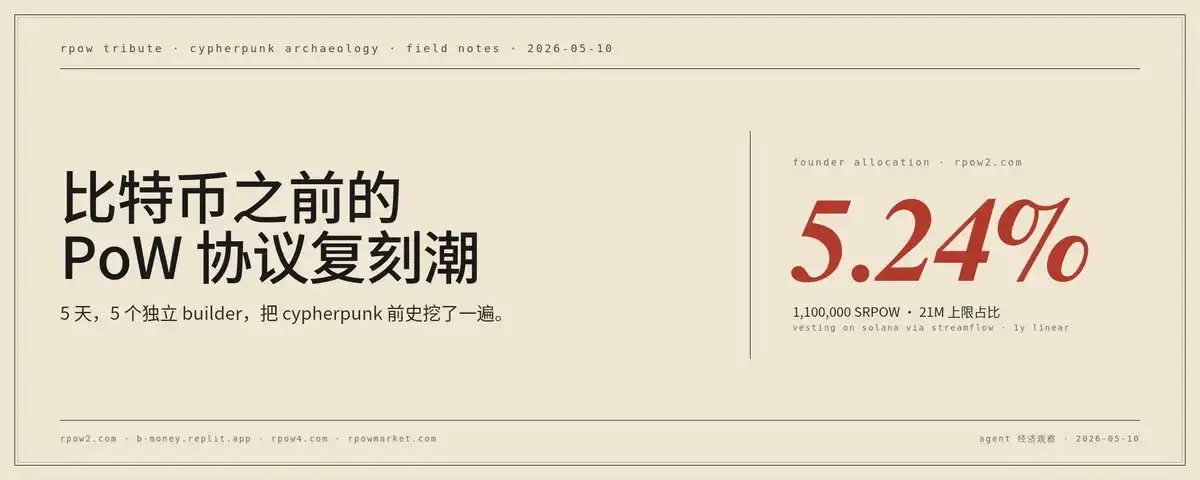
5 days, 5 independent builders dug through cypherpunk prehistory. The first one is RPOW.

Bitcoin did not appear out of thin air.

It has a cypherpunk lineage: Adam Back's Hashcash in 1997, Wei Dai's b-money and Nick Szabo's Bit Gold in 1998, Hal Finney's RPOW in 2004. These proposals each solved part of the problem of "using PoW as electronic cash." Hashcash provided primitives, b-money gave a blueprint for decentralized settlement, Bit Gold gave a blueprint for transferable value, RPOW made PoW tokens reusable. Satoshi strung this lineage together in 2008, writing the Bitcoin whitepaper.

22 years later, in early May 2026, over 5 days, this lineage was collectively reimplemented by a group of people on X and GitHub. The first protocol to be forked was RPOW.

What is RPOW

In 2004, Finney published RPOW on the cypherpunk mailing list—the first electronic currency based on PoW. It was centralized, running on a single server. But this server was connected to an IBM 4758, a FIPS 140-certified hardware cryptographic coprocessor capable of hashing its own internal code and signing a remote attestation. Any user could use this attestation to verify that the server was running Finney's published source code, unaltered—centralized but auditable. This was the real problem RPOW's entire design solved.

In 2009, Bitcoin launched, offering a different answer to the same problem: decentralized consensus. It cut off the trusted hardware path, requiring no trust in any single machine. Finney was the first person to receive a transfer from Satoshi and passed away in 2014 from ALS.

Jump to May 7, 2026

That day, Fred Krueger registered rpow2.com and deployed it.

A brief background on Krueger. He was a Wall Street trader at Salomon Brothers and RBS Greenwich Capital from the 1980s to 1990s. From the 1990s to 2000s, he successively founded TagWorld, iWin, Traffic Marketplace, and Adconion Media Group, with nine exits totaling $500 million according to his own 2018 statement. He entered crypto in 2017 with WorkCoin. In 2022, he initiated Libre Chain, claiming to be Bitcoin's first decentralized lending market. In 2025, he co-authored The Big Bitcoin Book and Bitcoin One Million with Ben Sigman, and in the same year initiated 2718.fund, a Bitcoin fund generating 10% APY cash flow through BTC-collateralized stablecoin loans, with 2718 derived from Euler's number e. He has 244K followers on X, is a Bitcoin maximalist, anti-Ethereum, and has publicly predicted a BTC terminal value of $4.5M to $10M.

I retrieved the webpage from May 7th. It was written like this:

No IBM 4758 — Ed25519 signatures, magic-link auth, Postgres ledger. Still centralized. Still no supply cap. Still no difficulty adjustment. Faithful by design.

No Bitcoin features. At that time, Krueger chose to faithfully replicate Finney, replacing the IBM 4758 with Ed25519 and Postgres, keeping the rest as is.

Within the next 48 hours

On May 8th, developer cryptonaut420 (Nick Rathman) registered rpow4.com, directly copying Bitcoin's full parameters: halving every 210,000 blocks, initial reward of 50 RPOW, transaction fees, treasury—everything included.

On May 9th, GitHub user ImMike launched rpowmarket.com, creating a Polymarket-style BTC price prediction market, integrating rpow2/3/4 as betting tokens.

On May 10th, EmblemVault CSO Adam McBride built rpow2swap.com.

5 days, 3 forks plus a prediction market plus a DEX.

Krueger didn't sit idle

Between May 9th and 10th, he changed the about page of rpow2:

Still centralized — but Bitcoin-flavored where it counts: a fixed 21,000,000 supply cap, and a stepped difficulty adjustment that adds one trailing-zero bit for every 1,000,000 coins minted.

The line "Faithful by design" was gone.

The next paragraph is more telling:

Founder allocation: 1,100,000 SRPOW (5.24% of the 21M cap) was allocated at launch as a "satoshi" tribute, vested linearly over one year via the Streamflow protocol on Solana.

He added a 21M cap, difficulty adjustment, and conveniently reserved 1.1 million tokens as a founder pre-mine. Linear vesting over one year via the Streamflow protocol on Solana, named "satoshi tribute."

Satoshi's most iconic feature was no pre-mine. Anyone who wanted BTC had to mine it themselves. Calling a 5.24% founder pre-mine a "satoshi tribute" is somewhat ironic.

Back to the most crucial line on the webpage.

No IBM 4758 — Ed25519 signatures.

Ed25519 can prove the party holding the private key signed the transaction; it cannot prove what code the party holding the key is running. This misses the entirety of Finney's engineering contribution.

Krueger copied the parts of Bitcoin that look like Bitcoin: 21M cap, halving, scarcity narrative, the word "satoshi." He didn't copy the parts that make Bitcoin Bitcoin: decentralized consensus, the trustless alternative to remote attestation, fair launch.

The story overflows beyond RPOW

On the morning of May 10th, around UTC 06:30, Mike In Space hosted b-money.replit.app on Replit, paying homage to Wei Dai's 1998 electronic cash proposal.

The scale is tiny: 5 accounts, 107.5 total supply, 16 transactions. The code has an `activeContracts` field, corresponding to the `contracts` concept in Wei Dai's original paper.

Mike In Space is not a random person. He is the founder of the Bitcoin Stamps protocol, author of the SRC-20 protocol, and a contributor to Bitcoin Magazine. One of the core figures in the current wave of Bitcoin on-chain inscription.

Wei Dai's b-money predates Hal Finney's RPOW by 6 years. It was never truly implemented because Wei Dai himself stated in his proposal, "I'm not sure if this can work." Mike's version is also clearly a prototype, but it pushes the cypherpunk replication effort to an origin even earlier than RPOW.

The next logical stops would be Bit Gold (Nick Szabo 1998), then DigiCash or Chaum's ecash from the 1980s. This archaeological path is already laid out.

This wave of collective action

5 independent builders: Krueger, cryptonaut420, ImMike, Adam McBride, Mike In Space.

There is overlap at the community level. They all belong to the Bitcoin old-timers / Counterparty / Ordinals / NFT archaeology lineage. Mike In Space's Bitcoin Stamps protocol is exactly the asset type Adam McBride wraps at EmblemVault. This isn't five unrelated people independently forking; it's the same subculture collectively responding to the same meme within 5 days.

Currently, on rpow2swap, rpow FDV is 0.68M. Let's see how it develops later. Essentially, rpow is centralized; if the server is shut down, everything is gone.

But this replication lineage is still quite interesting.

Disclaimer

This article is solely for event documentation and engineering analysis and does not constitute any form of investment advice. All projects mentioned are explicitly labeled by their respective authors as experimental, homage, or for entertainment purposes.

rpow2's webpage clearly states:

this IS a centralized system. The ledger lives in a Postgres database operated by one person on rented infrastructure. If that server is breached, lost, or seized, your tokens may be lost with it. No warranty, no recovery guarantees.

rpowmarket's disclaimer reads: parody · no value · for fun.

b-money.replit.app is a free-hosted prototype.

Not financial advice.

Трендові криптовалюти

Пов'язані питання

QWhat is the main innovation of the HASH project mentioned in the article regarding its use of 'hooks'?

AIn the HASH project, hooks are not used as an economic engine but as infrastructure. Their primary function is twofold: 1) To guard the launch of the liquidity pool by only allowing the pool creation after the genesis sale is complete and only with correct parameters. 2) To levy a 1% protocol fee on both sides of every swap into a treasury. This allows for a completely fair launch with 0% for the team, VC, or airdrops, as the hook removes the pool creation step from the developer's control and places it within the smart contract.

QAccording to the article, what key Bitcoin-like feature did Fred Krueger add to his RPOW2 project after other forks emerged, and what controversial decision did he make?

AAfter other forks of RPOW appeared, Fred Krueger updated his RPOW2 project to include key Bitcoin-like features: a fixed 21,000,000 supply cap and a stepped difficulty adjustment. However, he controversially allocated 1,100,000 SRPOW (5.24% of the total supply) as a "founder allocation" or "satoshi tribute" for himself, vested linearly over one year via the Streamflow protocol on Solana. This pre-mine contradicts Satoshi Nakamoto's principle of a fair, no-pre-mine launch for Bitcoin.

QWhat fundamental difference exists between Hal Finney's original 2004 RPOW design and Fred Krueger's 2026 RPOW2 implementation in terms of achieving trust?

AHal Finney's original RPOW used an IBM 4758 hardware security module to provide remote attestation, proving the server was running his exact, unaltered public source code. Fred Krueger's RPOW2 implementation replaced this with Ed25519 signatures and a Postgres ledger. While Ed25519 can prove a transaction was signed by a private key holder, it cannot prove what code the key holder is running, thus losing the core trust mechanism of Finney's design and remaining fundamentally centralized.

QWho implemented a version of Wei Dai's 'b-money' proposal, and what is the significance of this act within the context of the article?

AMike In Space (creator of Bitcoin Stamps) implemented a prototype of Wei Dai's 1998 "b-money" proposal at b-money.replit.app. This action is significant because it pushed the wave of cypherpunk protocol recreations to an even earlier origin point than the RPOW forks. b-money was a seminal, yet unimplemented, precursor to Bitcoin that proposed decentralized settlement. Mike's prototype, though simple, represents a direct homage to this foundational idea in the cypherpunk lineage.

QWhat common characteristic do the five builders mentioned in the article (Krueger, cryptonaut420, ImMike, Adam McBride, Mike In Space) share, according to the author's analysis?

AThe five builders are not random individuals but belong to the same interconnected subculture or community. They are part of the "Bitcoin old-timer / Counterparty / Ordinals / NFT archaeology" lineage. For example, Mike In Space's Bitcoin Stamps protocol is a type of asset that Adam McBride's project, EmblemVault, wraps. Their collective action over five days represents a coordinated response within this specific community to the same 'meme' or idea of recreating historical cypherpunk protocols.

Пов'язані матеріали

Dialogue with Jia Hang | Looking Back at Two Decades of Chinese Payment Going Global

**Summary: A Conversation with Jia Hang on Two Decades of China's Payment Globalization** Jia Hang, a veteran with over twenty years in payments, reflects on China's attempts to build a global payment network through three key phases: UnionPay (card networks), Alipay+ (digital wallets), and now, stablecoins. His journey began at UnionPay International, aiming to establish China's card network abroad. While successful in following Chinese tourists ("where Chinese go, UnionPay goes"), it struggled to achieve true global scale. The core lesson: card networks like Visa/Mastercard's unassailable advantage isn't just technical standards, but their deeply entrenched **governance and profit-sharing models** that create powerful network effects. Competing as the "same species" is nearly impossible. At Ant Group, he led Alipay+, a strategy to bypass card networks by interconnecting local e-wallets worldwide. While innovative, it faced a similar ceiling. Mobile QR payments and card swipes were essentially **the same species competing for the same pie**, lacking a disruptive value proposition for users or a sustainable new incentive model to replace the card networks' established flywheel. Today, at Singapore's DCS, Jia focuses on stablecoin-based payments. He argues stablecoins represent a fundamental shift. They are not competing with Visa for consumer payments but challenging the **traditional banking and account system for value movement**. Products like "U Cards" (stablecoin-linked payment cards) are transitional, leveraging existing card networks for acceptance while building new rails. The real potential lies in stablecoins enabling seamless, low-cost global value transfer, potentially reorganizing the financial infrastructure around **accounts rather than cards**. Jia believes stablecoin adoption for local retail payments, cross-border transactions, and as high-yield savings vehicles is becoming irreversible. This could gradually reduce reliance on traditional fiat channels, especially in regions with weak currencies or capital controls. The quest for the "next global payment network" continues, now centered on whether stablecoins can successfully bridge Web2 and Web3, establish new governance, and create compelling user value beyond mere cost reduction.

marsbit3 хв тому

Dialogue with Jia Hang | Looking Back at Two Decades of Chinese Payment Going Global

marsbit3 хв тому

Circle's Stock Price Plunges 76%, Hong Kong Dollar Stablecoin Set to Launch Within Two Weeks

Circle's stock price has plunged approximately 76% from its 2023 peak, reflecting a major market revaluation. Despite this, Circle President Heath Tarbert emphasized the company's focus on long-term execution and its dominant position with USDC's $73 billion circulation across 34 blockchains. The competitive landscape is intensifying. A new consortium-backed stablecoin, Open USD, is attempting to challenge incumbents by sharing reserve yields with partners. More significantly, Visa's new stablecoin platform, initially supporting Open USD while also being compatible with USDC, could erode Circle's network effects. In response, Circle is expanding into real-world payments through partnerships like the one with Japan's JCB. Separately, Tether (USDT) faces a two-year compliance window under new U.S. regulations, requiring it to adjust its reserve composition away from assets like Bitcoin and loans towards cash and U.S. Treasuries. Meanwhile, in Hong Kong, Standard Chartered-backed fintech firm Dian Dian is poised to launch a licensed HKD-pegged stablecoin (HKDAP), moving the industry into a phase where the real test is integrating licensed stablecoins into actual payment flows and corporate treasury systems. The sharp decline in Circle's stock underscores a broader shift: the stablecoin market is moving from a winner-takes-all dynamic to a multi-player competitive arena where execution, compliance, and real-world utility are becoming paramount.

marsbit3 хв тому

Circle's Stock Price Plunges 76%, Hong Kong Dollar Stablecoin Set to Launch Within Two Weeks

marsbit3 хв тому

Amidst Capital's Encirclement, Decentralization is the Sole Defense for Public Blockchains

In a landscape dominated by power and profit motives, the author argues that decentralization is not merely one desirable feature among many in blockchain design—it is the singular, non-negotiable defense against corporate and capital capture. The article adopts a Machiavellian, realist perspective on human institutions, positing that businesses will inevitably attempt to co-opt any valuable network to protect their profits and dominance. While external attacks like 51% forks are often discussed, the greater existential risk is internal capture—the gradual erosion of a protocol’s neutrality by vested interests, as seen historically with platforms like Visa and Google. The piece critiques permissioned chains, highly centralized “permissionless” layer-1s, and layer-2s without sufficient decentralization (e.g., single sequencers) as inherently vulnerable. These compromised systems, promoted by established financial players, are framed as delaying tactics to stifle truly open networks that threaten existing high-fee, inefficient business models. Real-world examples, such as closed enterprise consortiums that exclude competitors, illustrate how such systems cement oligopolies rather than foster innovation. The author concludes that while decentralized protocols like Ethereum are imperfect and costly to operate, they represent the only viable long-term equilibrium. In a market where value naturally flows to the most secure and neutral settlement layer, only maximally decentralized public blockchains can resist being subsumed by capital and powerful incumbents.

Foresight News14 хв тому

Amidst Capital's Encirclement, Decentralization is the Sole Defense for Public Blockchains

Foresight News14 хв тому

Who Decides the Rules of Bitcoin? BIP-110 Ignites Governance Debate

Bitcoin's governance is once again at the center of a heated debate, this time ignited by BIP-110, the "Reduced Data Temporary Softfork." This proposal aims to curb non-monetary data (like inscriptions and Runes) by introducing seven new consensus-layer restrictions over a year, such as limiting new output scripts to 34 bytes and restoring the OP_RETURN cap to 83 bytes. The controversy stems from BIP-110's fundamental shift: it moves the battle against "spam" from node relay and miner policies to the consensus layer, rendering currently valid transactions invalid. Supporters, arguing that default policy governance has failed (highlighted by Bitcoin Core v30's relaxation of OP_RETURN limits), see this as necessary to protect node resources and Bitcoin's monetary focus. Opponents, led by figures like Michael Saylor and Adam Back, warn it dangerously centralizes governance. Saylor listed 110 reasons against it, criticizing its low 55% miner activation threshold and potential for chain splits. Back emphasized Bitcoin's "permissionless" ethos, arguing no single group should impose value judgments via consensus rules. Further complicating matters, technical critiques suggest BIP-110 may be technically circumventable, and a "BlockSlop" vulnerability in its upgrade path poses a consensus risk. The debate has drawn in diverse stakeholders: miners (with pools like Ocean signaling support and Foundry polling clients), node operators (like Bitcoin Knots), and new players like corporate treasury holder MicroStrategy (Saylor), whose market influence adds a novel dimension. Ultimately, BIP-110 acts as a governance stress test, exposing the unresolved question: who decides Bitcoin's rules? It pits the authority of miners, node operators, developers, and capital holders against each other, with each side claiming to defend Bitcoin's core principles of neutrality and security.

marsbit30 хв тому

Who Decides the Rules of Bitcoin? BIP-110 Ignites Governance Debate

marsbit30 хв тому

Who Decides Bitcoin's Rules? BIP-110 Ignites Governance Debate

Title: Who Decides Bitcoin's Rules? BIP-110 Ignites Governance Debate A new technical proposal, BIP-110 (Reduced Data Temporary Softfork), has sparked a fundamental governance debate within the Bitcoin community. It aims to impose new consensus rules for one year to limit non-financial data (like inscriptions and Runes) on-chain, moving beyond simple node and miner policy filters to invalidate currently valid transactions. Supporters argue that default policies have failed due to workarounds, necessitating consensus-layer changes to protect Bitcoin's core monetary function from data spam. Critics, including Michael Saylor and Adam Back, contend this dangerously centralizes judgment, undermines permissionlessness, and sets a risky governance precedent. They advocate for market-based solutions like fees or Layer 2s instead. The debate exposes deeper tensions: miners are divided on activation; node operators assert their sovereignty; Bitcoin Core developers influence defaults without direct accountability; and large corporate holders like MicroStrategy now wield narrative influence. Technically, BIP-110 may not fully block data and carries a disclosed consensus bug risk. Ultimately, BIP-110 acts as a stress test, forcing the community to confront the unresolved question: who legitimately decides what Bitcoin is and how it evolves, amidst competing claims from miners, nodes, developers, and capital holders.

链捕手42 хв тому

Who Decides Bitcoin's Rules? BIP-110 Ignites Governance Debate

链捕手42 хв тому

Торгівля

Спот

Популярні статті

Що таке BITCOIN

Розуміння HarryPotterObamaSonic10Inu (ERC-20) та його позиції у крипто-просторі Останніми роками ринок криптовалют спостерігав за зростанням популярності мем-коінів, які привертають інтерес не тільки трейдерів, але й тих, хто шукає спілкування та розважальну цінність. Серед цих унікальних токенів є HarryPotterObamaSonic10Inu (ERC-20), інтригуючий проект, що поєднує культурні посилання з тканинами криптовалюти. Ця стаття досліджує ключові аспекти HarryPotterObamaSonic10Inu, вивчаючи його механізми, спільноту та його взаємодію з ширшим крипто-ландшафтом. Що таке HarryPotterObamaSonic10Inu (ERC-20)? Як випливає з його назви, HarryPotterObamaSonic10Inu є мем-коіном, побудованим на блокчейні Ethereum, класифікованим за стандартом ERC-20. На відміну від традиційних криптовалют, які можуть підкреслювати практичну корисність або інвестиційний потенціал, цей токен процвітає завдяки розважальній цінності та силі своєї спільноти. Проект спрямований на створення середовища, де зацікавлені користувачі можуть об'єднуватися, ділитися ідеями та брати участь у заходах, натхненних різноманітними культурними явищами. Однією з примітних особливостей HarryPotterObamaSonic10Inu є нульовий податок на транзакції. Цей привабливий елемент має на меті заохочувати торгівлю та участь у спільноті, позбавлену додаткових витрат, які можуть відлякувати дрібних трейдерів. Загальна пропозиція монет становить один мільярд токенів, що позначає намір підтримувати суттєву циркуляцію в межах спільноти. Творець HarryPotterObamaSonic10Inu (ERC-20) Походження HarryPotterObamaSonic10Inu дещо окутане таємницею; деталі про творця залишаються невідомими. Розвиток цього токена позбавлений впізнаваної команди або чіткої стратегії, що не є рідкістю в секторі мем-коінів. Натомість проект виник органічно, а його розвиток значною мірою залежить від ентузіазму та участі його спільноти. Інвестори HarryPotterObamaSonic10Inu (ERC-20) Щодо зовнішніх інвестицій та підтримки, HarryPotterObamaSonic10Inu також залишається невизначеним. Токен не зазначає жодних відомих інвестиційних фондів або значної організаційної підтримки. Натомість життєва сила проекту полягає в його базовій спільноті, яка інформує про його зростання та стійкість через колективні дії та залученість у крипто-просторі. Як працює HarryPotterObamaSonic10Inu (ERC-20)? Як мем-коін, HarryPotterObamaSonic10Inu функціонує передусім поза традиційними рамками, що часто регулюють вартість активів. Є кілька відмінних аспектів, що визначають, як працює проект: Транзакції без податку: Завдяки відсутності податкових зборів на транзакції, користувачі можуть вільно купувати та продавати токен, не турбуючись про приховані витрати. Залучення спільноти: Проект процвітає завдяки взаємодії спільноти, використовуючи соціальні медіа для створення шуму та сприяння залученню. Обговорення, обмін контентом та залученість є ключовими елементами, що допомагають розширити його охоплення та зміцнити лояльність серед прихильників. Відсутність практичної корисності: Слід зазначити, що HarryPotterObamaSonic10Inu не пропонує конкретної корисності в рамках фінансової екосистеми. Натомість він класифікується як токен, що призначений в основному для розваги та спільнотних активностей. Культурне посилання: Токен кмітливо вплітає елементи популярної культури, щоб привернути інтерес, зв'язуючи з ентузіастами мемів та крипто-стежками. HarryPotterObamaSonic10Inu ілюструє, як мем-коіни функціонують інакше, ніж традиційні криптовалютні проекти, увійшовши на ринок як інноваційні соціальні конструкти, а не утилітарні активи. Хронологія HarryPotterObamaSonic10Inu (ERC-20) Історія HarryPotterObamaSonic10Inu відзначена кількома значними етапами: Створення: Токен виник з вірусного мему, захопивши уяву багатьох крипто-ентузіастів. Конкретні дати створення недоступні, що підкреслює його органічний розвиток. Лістинг на біржах: HarryPotterObamaSonic10Inu з'явився на різних біржах, дозволяючи зручніший доступ і торгівлю спільноти. Ініціативи залучення спільноти: Ведення діяльності, спрямованої на покращення взаємодії спільноти, включаючи конкурси, кампанії в соціальних мережах та створення контенту від фанатів та прихильників. Плани на майбутнє: Дорожня карта проекту включає запуск колекції NFT, мерчандайзинг та електронну комерцію, пов'язану з його культурними темами, що далі залучає спільноту та намагається додати більше вимірів до його екосистеми. Ключові моменти про HarryPotterObamaSonic10Inu (ERC-20) Спільнотний підхід: Проект надає пріоритет колективному внеску та креативності, забезпечуючи, щоб участь користувачів була в центрі його розвитку. Класифікація як мем-коін: Це є його епігенез розважальної криптовалюти, що відрізняється від традиційних інвестиційних інструментів. Жодного прямого відношення до Bitcoin: Незважаючи на схожість у назві, HarryPotterObamaSonic10Inu є відмінним і не має жодного зв’язку з Bitcoin або іншими усталеними криптовалютами. Зосередженість на співпраці: HarryPotterObamaSonic10Inu створено для того, щоб надати простір для співпраці та обміну історіями серед його власників, забезпечуючи шлях для творчості та спільного зв'язку. Перспективи на майбутнє: Амбіція розширитися за межі початкової концепції в NFT та мерчандайз відкриває шлях для проекту потенційно потрапити в більш мейнстрімні сфери цифрової культури. Оскільки мем-коіни продовжують захоплювати уяву спільноти криптовалют, HarryPotterObamaSonic10Inu (ERC-20) вирізняється своїми культурними зв'язками та орієнтованим на спільноту підходом. Хоча він може не відповідати типовій моделі утилітарного токена, його суть полягає в радощах і товариськості, що підтримуються серед його прихильників, підкреслюючи еволюційну природу криптовалют в усе більш цифрову епоху. Оскільки проект продовжує розвиватися, важливо спостерігати за тим, як динаміка спільноти вплине на його траєкторію в постійно змінюваному ландшафті технології блокчейн.

2.2k переглядів усьогоОпубліковано 2024.04.01Оновлено 2024.12.03

Що таке BITCOIN

Як купити BTC

Ласкаво просимо до HTX.com! Ми зробили покупку Bitcoin (BTC) простою та зручною. Дотримуйтесь нашої покрокової інструкції, щоб розпочати свою криптовалютну подорож.Крок 1: Створіть обліковий запис на HTXВикористовуйте свою електронну пошту або номер телефону, щоб зареєструвати обліковий запис на HTX безплатно. Пройдіть безпроблемну реєстрацію й отримайте доступ до всіх функцій.ЗареєструватисьКрок 2: Перейдіть до розділу Купити крипту і виберіть спосіб оплатиКредитна/дебетова картка: використовуйте вашу картку Visa або Mastercard, щоб миттєво купити Bitcoin (BTC).Баланс: використовуйте кошти з балансу вашого рахунку HTX для безперешкодної торгівлі.Треті особи: ми додали популярні способи оплати, такі як Google Pay та Apple Pay, щоб підвищити зручність.P2P: Торгуйте безпосередньо з іншими користувачами на HTX.Позабіржова торгівля (OTC): ми пропонуємо індивідуальні послуги та конкурентні обмінні курси для трейдерів.Крок 3: Зберігайте свої Bitcoin (BTC)Після придбання Bitcoin (BTC) збережіть його у своєму обліковому записі на HTX. Крім того, ви можете відправити його в інше місце за допомогою блокчейн-переказу або використовувати його для торгівлі іншими криптовалютами.Крок 4: Торгівля Bitcoin (BTC)Легко торгуйте Bitcoin (BTC) на спотовому ринку HTX. Просто увійдіть до свого облікового запису, виберіть торгову пару, укладайте угоди та спостерігайте за ними в режимі реального часу. Ми пропонуємо зручний досвід як для початківців, так і для досвідчених трейдерів.

5.0k переглядів усьогоОпубліковано 2024.12.12Оновлено 2026.06.02

Як купити BTC

Що таке $BITCOIN

ЦИФРОВЕ ЗОЛОТО ($BITCOIN): Комплексний аналіз Вступ до ЦИФРОВОГО ЗОЛОТА ($BITCOIN) ЦИФРОВЕ ЗОЛОТО ($BITCOIN) — це проект на основі блокчейну, що працює в мережі Solana, який має на меті поєднати характеристики традиційних дорогоцінних металів з інноваціями децентралізованих технологій. Хоча він має таку ж назву, як і Bitcoin, який часто називають “цифровим золотом” через його сприйняття як засобу збереження вартості, ЦИФРОВЕ ЗОЛОТО є окремим токеном, розробленим для створення унікальної екосистеми в ландшафті Web3. Його мета — позиціонувати себе як життєздатний альтернативний цифровий актив, хоча деталі щодо його застосувань і функціональностей все ще розробляються. Що таке ЦИФРОВЕ ЗОЛОТО ($BITCOIN)? ЦИФРОВЕ ЗОЛОТО ($BITCOIN) — це токен криптовалюти, спеціально розроблений для використання в блокчейні Solana. На відміну від Bitcoin, який виконує широко визнану роль зберігання вартості, цей токен, здається, зосереджується на більш широких застосуваннях і характеристиках. Помітні аспекти включають: Інфраструктура блокчейну: Токен побудований на блокчейні Solana, відомому своєю здатністю обробляти швидкі та низьковартісні транзакції. Динаміка постачання: ЦИФРОВЕ ЗОЛОТО має максимальне постачання, обмежене 100 квадрильйонами токенів (100P $BITCOIN), хоча деталі щодо його обігового постачання наразі не розголошуються. Утиліта: Хоча точні функціональності не викладені, є вказівки на те, що токен може бути використаний для різних застосувань, потенційно пов'язаних з децентралізованими додатками (dApps) або стратегіями токенізації активів. Хто є творцем ЦИФРОВОГО ЗОЛОТА ($BITCOIN)? На даний момент особа творців і команди розробників, що стоять за ЦИФРОВИМ ЗОЛОТОМ ($BITCOIN), залишається невідомою. Ця ситуація є типовою для багатьох інноваційних проектів у сфері блокчейну, особливо тих, що пов'язані з децентралізованими фінансами та феноменом мем-коінів. Хоча така анонімність може сприяти культурі, орієнтованій на спільноту, вона посилює занепокоєння щодо управління та підзвітності. Хто є інвесторами ЦИФРОВОГО ЗОЛОТА ($BITCOIN)? Доступна інформація вказує на те, що ЦИФРОВЕ ЗОЛОТО ($BITCOIN) не має жодних відомих інституційних спонсорів або помітних венчурних капіталовкладень. Проект, здається, працює за моделлю “рівний до рівного”, зосереджуючись на підтримці та прийнятті спільноти, а не на традиційних шляхах фінансування. Його активність і ліквідність переважно розташовані на децентралізованих біржах (DEX), таких як PumpSwap, а не на встановлених централізованих торгових платформах, що ще більше підкреслює його підхід знизу вгору. Як працює ЦИФРОВЕ ЗОЛОТО ($BITCOIN) Операційні механізми ЦИФРОВОГО ЗОЛОТА ($BITCOIN) можна детальніше розглянути на основі його дизайну блокчейну та характеристик мережі: Механізм консенсусу: Використовуючи унікальний proof-of-history (PoH) Solana в поєднанні з моделлю proof-of-stake (PoS), проект забезпечує ефективну валідацію транзакцій, що сприяє високій продуктивності мережі. Токеноміка: Хоча конкретні дефляційні механізми не були детально описані, велике максимальне постачання токенів вказує на те, що воно може задовольняти мікротранзакції або нішеві випадки використання, які ще потрібно визначити. Інтероперабельність: Існує потенціал для інтеграції з більш широкою екосистемою Solana, включаючи різні платформи децентралізованих фінансів (DeFi). Однак деталі щодо конкретних інтеграцій залишаються невизначеними. Хронологія ключових подій Ось хронологія, яка підкреслює значні віхи, пов'язані з ЦИФРОВИМ ЗОЛОТОМ ($BITCOIN): 2023: Початкове розгортання токена відбувається на блокчейні Solana, позначене його адресою контракту. 2024: ЦИФРОВЕ ЗОЛОТО набуває видимості, оскільки стає доступним для торгівлі на децентралізованих біржах, таких як PumpSwap, що дозволяє користувачам торгувати ним проти SOL. 2025: Проект спостерігає спорадичну торгову активність і потенційний інтерес до ініціатив, очолюваних спільнотою, хоча на даний момент не зафіксовано жодних значних партнерств або технічних досягнень. Критичний аналіз Сильні сторони Масштабованість: Основна інфраструктура Solana підтримує високі обсяги транзакцій, що може підвищити утиліту $BITCOIN у різних сценаріях транзакцій. Доступність: Потенційно низька торгова ціна за токен може привабити роздрібних інвесторів, сприяючи більш широкій участі завдяки можливостям дробового володіння. Ризики Відсутність прозорості: Відсутність публічно відомих спонсорів, розробників або процесу аудиту може викликати скептицизм щодо стійкості та надійності проекту. Волатильність ринку: Торгова активність сильно залежить від спекулятивної поведінки, що може призвести до значної волатильності цін і невизначеності для інвесторів. Висновок ЦИФРОВЕ ЗОЛОТО ($BITCOIN) постає як цікавій, але неоднозначний проект у швидко розвиваючійся екосистемі Solana. Хоча він намагається використати наратив “цифрового золота”, його відхід від встановленої ролі Bitcoin як засобу збереження вартості підкреслює необхідність чіткішого розмежування його передбачуваної утиліти та структури управління. Майбутнє прийняття та адаптація, ймовірно, залежатиме від вирішення поточної непрозорості та більш чіткого визначення його операційних та економічних стратегій. Примітка: Цей звіт охоплює синтезовану інформацію, доступну станом на жовтень 2023 року, і можуть відбутися події, що виходять за межі дослідницького періоду.

157 переглядів усьогоОпубліковано 2025.05.13Оновлено 2025.05.13

Що таке $BITCOIN

Обговорення

Ласкаво просимо до спільноти HTX. Тут ви можете бути в курсі останніх подій розвитку платформи та отримати доступ до професійної ринкової інформації. Нижче представлені думки користувачів щодо ціни BTC (BTC).

活动图片