The World of Gold, the Dollar, and Debt: A Revaluation of the Balance Sheet

marsbitОпубліковано о 2026-02-02Востаннє оновлено о 2026-02-02

Анотація

The article "The World of Gold, the Dollar, and Debt: A Revaluation of the Balance Sheet" argues that the fundamental, often hidden mechanism organizing modern society is not money itself, but the continuous extension of debtor-creditor relationships. Nations, communities, and individuals essentially trade the future for the present. Economic growth and consumption are fueled by an institutionalized consensus that the future can be allocated in advance, with debt being the technical instrument of this system. From this perspective, the core question becomes: who has the power to discount the future into the present and define that future? Money creation and contraction are merely expressions of this debt-based world. The true "magic" of finance is the intertemporal exchange of resources. The roles of the US dollar and gold are clarified through this lens. The dollar is not merely currency; it is the primary tool for coordinating and denominating global debt. The system functions as a massive intertemporal trade: the US provides future promises, while the world provides present productive capacity to承接 (undertake) that debt. Gold is unique as the only major financial asset with no corresponding liability; it is the ultimate settlement that requires no counterparty's promise. It is therefore often seen as inefficient in a healthy debt system but gains value when the future兑现 (fulfillment) of promises is doubted. The author posits that true避险 (risk aversion) is not about find...

Author: Iron Pillar Brother in CRYPTO

The most fundamental, yet most hidden, organizational coordination mechanism in modern society is not currency itself, but the continuous extension of the debtor-creditor relationship.

Whether it's a country, a community, an organization, or an individual, the essential action being repeated is: trading the future for the present.

The economic growth and consumer prosperity we take for granted do not stem from wealth appearing out of thin air, but from a highly institutionalized consensus: the future can be allocated in advance. Debt is the technical implementation of this consensus.

Understanding the world from this perspective reveals a more fundamental core: who has a greater ability to discount the future into the present, and who has the power to define the future.

In this sense, the creation and contraction of money are merely expressions of the world of debt. The magic of finance really boils down to one thing: the intertemporal exchange of resources.

I. Understanding Gold and the Dollar from a Debt Perspective

If you place debt at the center of how the world operates, the roles of gold and the dollar immediately become clear. The dollar is not money; it is a tool for coordinating and denominating debt.

U.S. Treasury debt is not simply a liability of the United States itself. Placed within the global balance sheet, the dollar system is: the U.S. outputs promises about the future, and the world provides present productive capacity to承接 (undertake) the debt. Using the dollar as a contract, the two parties have reached the largest intertemporal transaction in human history.

The uniqueness of gold lies in the fact that it is the only financial asset that does not correspond to any liability. It requires no one's endorsement, no one's promise; it is the final settlement in itself. On the balance sheet, gold is the only asset without a counterparty.

Precisely because of this, gold often appears inefficient, unyielding, and lacking imagination when the debt system is functioning well. But when people begin to doubt whether the future can be smoothly兑现 (honored/cashed in), the value of gold is re-understood.

Some say gold hedges against geopolitical risk. But if you continue to deconstruct this using the balance sheet, this statement is incomplete. Geopolitics does not directly destroy wealth; what it truly disrupts is the stability of debt relationships.

II. Hedging is About Finding a Healthy Balance Sheet

Understanding the logic above, it becomes clear that if you understand the world as an ever-expanding balance sheet, then so-called hedging is not about finding a certain asset that is forever safe, but rather, at different stages, finding balance sheet structures that are still healthy and sustainable. The most fundamental risk is not volatility, but an imbalance in the debt structure.

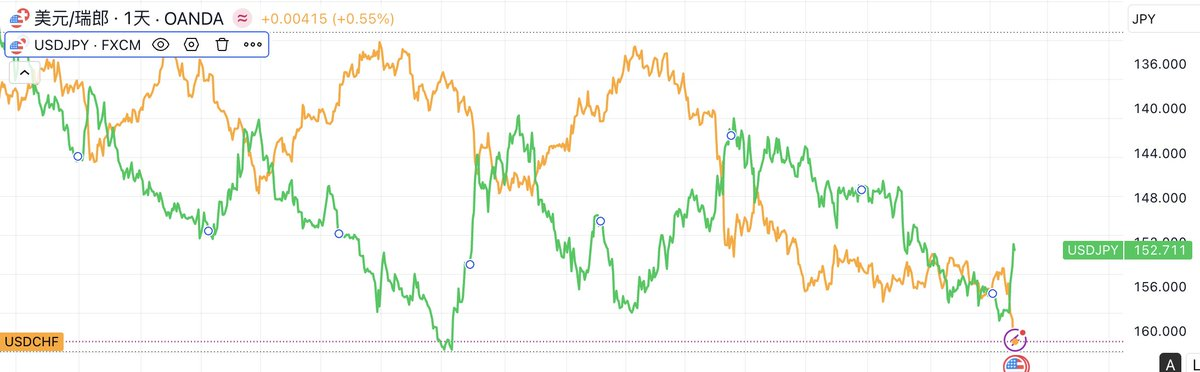
Therefore, if observing recent market trends, the depreciation of the dollar and the huge fluctuations of the yen are accompanied by the rapid appreciation of the fiat currency of countries with relatively healthy balance sheets, like Switzerland.
If we extend this view further, why is silver rising? Why are more commodities rising? Looking at it from a broader macro perspective, there is currently only one fundamental variable affecting the debtor-creditor relationship: AI.

AI is not merely an industry; in my view, its fundamentality lies in its ability to reshape the balance sheet. On one end, it infinitely drives down human efficiency costs exponentially—software becomes cheaper, labor is replaced, information processing approaches zero cost. On the other end, however, it creates an unprecedented rigid capital demand in the real world—computing power, electricity, land, energy, and minerals have become the most powerful real-world constraints.

These two forces are simultaneously acting on the global balance sheet: the efficiency side is becoming lighter, while the capital side is becoming heavier. This is fundamental to the current reshaping of the debt system.

In other words: any work that can be digitized, logicalized, or automated is seeing its cost approach zero. Software, copywriting, design, basic code—these once expensive intellectual assets are becoming as cheap as tap water. But everything has its cost. Correspondingly, the generation of every Token is背后 (backed by) the burning of computing chips, the consumption of electricity, and the transmission through copper cables. The smarter AI becomes, the more贪婪 (rapaciously) it demands from the physical world.

Over the past few decades, global growth relied more on financial engineering—credit expansion, leverage rolling, expectation management. The future could be continuously discounted, making debt seem light and controllable. But when growth becomes re-bound to variables that cannot be虚构 (fabricated/fictionalized), like computing power, electricity, resources, and productive capacity, debt is no longer just a numbers game. From this angle, when you look at silver and commodities, what the market is pricing is the提前定价 (pre-pricing) of future production capacity constraints.

Thus, when growth is locked in by physical constraints, the magic of debt fails. Because no matter how much currency you inject, if there isn't enough copper to build power grids, enough silver to make panels, AI's computing power cannot run.

III. Has the End Times for the Dollar Arrived?

Nothing is eternal, including gold. Understanding the operating logic of the debt world means one must also accept a less pleasing conclusion: gold is not the eternal answer either. Its current rise is merely due to the scarcity of being an asset without a counterparty. However, gold cannot generate cash flow, cannot improve production efficiency, and cannot replace real capital formation. From a balance sheet perspective, it's roughly equivalent to temporarily freezing risk.

Returning to the dollar, why is it still used for pricing even though the market has long been singing its demise? It's because you need the world's deepest asset pool for collateral, settlement, and hedging; you hold U.S. debt not just because you believe in the U.S., but because you need an asset recognized by the global financial system that can be used for抵押融资 (collateralized financing) at any time.

The strength of the dollar lies not in its financial correctness, but in the irreplaceability of its network effects. It is currently the only container in human civilization capable of承载 (bearing/carrying) the extension of tens of trillions in debt.

Over the past few decades, the core capability of the dollar system has been: discounting the future into the present. The U.S. issues debt, the world buys it; the U.S. consumes, the world supplies. This is essentially the global redistribution of time value.

But as the U.S. fiscal path relies increasingly on持续扩表 (continuous balance sheet expansion) and debt rolling, the credit of the dollar undergoes a subtle change: it remains the best choice, but it is no longer a free choice; the opportunity cost has risen significantly.

But the fatal blow is not this. It is that when growth relies increasingly on electricity, computing power, resources, and productive capacity, the financial system's expertise in using expectations, leverage, and discount rates to凭空 (out of thin air) bring the future to the present will encounter the hard constraints of the physical world.

The so-called Greenland (likely referring to resource acquisition/control), tariffs, and manufacturing reshoring are essentially games围绕 (revolving around) these hard constraints. In other words, the U.S. must率先 (take the lead in) completing the reshaping of AI infrastructure, turning the dollar into the sole voucher for purchasing the world's strongest computing power and most efficient productive capacity. This is the necessary condition for the dollar's王者归来 (return of the king).

Otherwise, against the backdrop of physical constraints and AI redefining global division of labor, the dollar system will gradually lose its ability to discount the future, slowly moving towards its末法时代 (end times/dharma-ending age). A slow but irreversible relative decline, until a monetary anchor that better represents real productive capacity and technological dominance emerges to replace it.


Пов'язані питання

QWhat is the core organizational mechanism of modern society according to the article, and how is it implemented?

AThe article states that the most fundamental and implicit organizational coordination mechanism of modern society is not currency itself, but the continuous extension of debt-credit relationships. It is implemented through a highly institutionalized consensus that the future can be allocated in advance, with debt being the technical method for realizing this consensus.

QHow does the article define the unique role of gold in the financial system from a balance sheet perspective?

AFrom a balance sheet perspective, the article defines gold as the only financial asset that does not correspond to any liability. It is the ultimate form of payment that requires no one's endorsement or promise, making it an asset with no counterparty risk on the balance sheet.

QWhat does the article suggest 'risk aversion' truly means in the context of a global balance sheet?

AThe article suggests that 'risk aversion' is not about finding a perpetually safe asset, but rather about identifying balance sheet structures that are still healthy and sustainable at different stages. The fundamental risk is not volatility, but an imbalance in the debt structure.

QAccording to the author, what is the fundamental impact of AI on the global balance sheet and the existing debt system?

AThe author argues that AI's fundamental impact lies in its ability to reshape the balance sheet. It drastically reduces the cost of human efficiency on one end (making software, labor, and information processing cheaper), while simultaneously creating unprecedented rigid capital demands for compute power, electricity, land, energy, and minerals on the other. This creates a tension where the 'efficiency' side becomes lighter and the 'capital' side becomes heavier, fundamentally challenging the existing debt system.

QWhat is the necessary condition for the US dollar to maintain its dominance ('return of the king'), as per the article's analysis?

AThe necessary condition for the US dollar to maintain its dominance, according to the article, is for the United States to lead in reshaping AI infrastructure, making the dollar the sole credential for purchasing the world's strongest computing power and most efficient productive capacity. Without this, the dollar system could gradually lose its ability to discount the future and enter a period of relative decline.

Пов'язані матеріали

As Consensus Accelerates, What Are Young Investors Betting On?

Title: As Consensus Forms Faster, What Are Young Investors Betting On? In the rapid evolution of tech investment, a new generation of young investors is navigating a landscape where AI, robotics, commercial aerospace, and quantum computing are advancing simultaneously. Traditional investment logic based on financial models is giving way to a need for deep technical understanding and the ability to act before industry consensus forms. An analysis of trends from the "WAIC FUTURE TECH" list of young investment leaders reveals key shifts in focus. The first major trend is the movement of AI from the digital screen into the physical world. Investment is shifting from large language models and chatbots towards embodied AI, robotics, AI hardware, and edge computing. While demonstrations generate excitement, the real challenge lies in achieving scalable, reliable, and cost-effective delivery in complex real-world environments like factories and logistics. Success depends not just on algorithms but on the integration of sensors, actuators, and control systems. Second, the competitive focus for large models is moving beyond raw capability toward building an "intelligence flywheel." The goal is to create self-reinforcing systems where user interaction generates data, improving the model, which in turn enhances the user experience and attracts more engagement. Companies that successfully embed AI into workflows to create these closed-loop systems can build lasting value that isn't easily erased by the next model upgrade. Third, facing a potential bottleneck in high-quality human-generated data, investors are looking at new underlying technologies. Reinforcement learning and self-play, as demonstrated by AlphaGo Zero, offer paths for AI to generate its own experience. Scientific foundation models, which aim to build general AI capabilities for fields like life sciences and materials discovery, represent a non-consensus direction that could unlock new frontiers of knowledge and data. Finally, in deep-tech areas like quantum computing, commercial aerospace, and space-based infrastructure, patient capital is essential. These fields have long, uncertain development and validation cycles involving complex engineering, supply chains, and regulations. Investment here requires a long-term view, focusing on foundational team capabilities and the eventual emergence of market demand, even if commercial returns are distant. Collectively, these trends illustrate how young investors are adapting to a new era. They are learning to make earlier, technically-informed judgments, balance hype with real-world viability, and provide the patient capital needed to build the deep-tech foundations of the future.

marsbit29 хв тому

As Consensus Accelerates, What Are Young Investors Betting On?

marsbit29 хв тому

Can Japan Buy Growth with AI? Will the Bond Market Believe It?

Japan's cabinet has introduced the 2026 Basic Policy on Economic and Fiscal Management and Reform, shifting its primary fiscal target. The new framework moves away from the traditional annual primary balance goal and instead prioritizes a stable reduction of the debt-to-GDP ratio. This change is tied to a strategy of increased "responsible proactive fiscal" spending, aiming to boost long-term growth through investments in strategic sectors like AI, semiconductors, energy, and robotics. The government estimates total public and private investment in 62 key technologies could exceed 370 trillion yen by 2040. The market reaction has been mixed and cautious. While equity markets may respond to policy signals, bond markets are focused on fiscal credibility. Concerns center on whether the weakening of the clear primary balance anchor could lead to looser fiscal discipline. If investors doubt that these strategic investments will generate sufficient productivity gains, tax revenue, and nominal growth to outpace rising interest costs, they may demand higher yields on Japanese Government Bonds (JGBs). Recent volatility in the yen and JGB yields, with the 10-year yield briefly reaching 2.9%, reflects this skepticism. The success of this new framework hinges on two factors: whether Japan can achieve a nominal growth rate consistently higher than its long-term interest rates, and whether future budgets demonstrate disciplined control over bond issuance. The government's narrative is that strategic investment is essential to break Japan's cycle of low growth, aging, and labor shortages. However, the bond market will continuously assess the credibility of this plan, pricing the risk that it may represent fiscal expansion rather than a viable growth strategy.

marsbit1 год тому

Can Japan Buy Growth with AI? Will the Bond Market Believe It?

marsbit1 год тому

Misjudged A-Shares: Resilience, Expectations, and Confidence

China's A-share market recently faced selling pressure, especially in tech sectors, initially triggered by a global tech sell-off that began in South Korea. However, the article argues this is a case of "mistaken injury" and highlights the market's underlying resilience. This resilience stems from three main pillars: **1) Tech Sector Fundamentals:** Unlike Korea's market dominated by a few memory chip stocks, China's tech sector is diversified across computing, communications, electronics, and semiconductors, supported by dual narratives of global AI supply chains and domestic substitution. Core areas like optical modules and fiber optics continue to show strong earnings growth. **2) "National Team" Support:** State-backed institutions and large corporations have made significant market purchases and announced buybacks, providing liquidity and signaling confidence. This is seen as a stabilizing policy signal, often associated with market bottoms. **3) Broader Market Pillars:** Other major sectors are showing endogenous recovery momentum. Consumer stocks benefit from stabilizing CPI and signs of sector recovery (e.g., liquor price hikes). Cyclical sectors like aluminum have high earnings, potential price increases due to tight supply, and low valuations. The financial sector offers stable dividends and low valuations. The conclusion is that the sell-off was driven by external contagion, not a collapse in fundamentals. With strong policy support and recovering momentum across key sectors, the A-share market possesses the toughness to regain stability.

marsbit1 год тому

Misjudged A-Shares: Resilience, Expectations, and Confidence

marsbit1 год тому

Торгівля

Спот
活动图片




