The Standard-Bearer of a Trillion-Dollar Industry Falls on the Eve of Victory

marsbitОпубліковано о 2026-05-26Востаннє оновлено о 2026-05-26

Анотація

Ondo Finance CEO Nathan Allman, a key figure in the RWA (Real World Assets) sector, has passed away unexpectedly. The company announced on May 26, 2026, that longtime president Ian De Bode will succeed him as CEO. Allman, a former Goldman Sachs digital assets executive, founded Ondo Finance in 2021. The company became a leader in tokenizing securities, starting with U.S. Treasury funds (OUSG/USDY) and expanding to a platform for tokenized U.S. stocks and ETFs (Ondo Global Markets). Its total value locked (TVL) surpassed $4 billion, capturing about 58% of the tokenized stock market. A major focus for Allman was navigating regulatory challenges. He personally led engagements with the SEC, which later closed a confidential investigation into Ondo without charges. Recently, Ondo achieved significant milestones: obtaining an SEC no-action letter for tokenized securities on Ethereum, partnering with DTCC in its tokenization initiative alongside BlackRock and Goldman Sachs, and completing a pilot for near-instant cross-border redemption of tokenized Treasuries with J.P. Morgan, Mastercard, and Ripple. The company emphasized that De Bode, a former McKinsey digital assets lead who has overseen strategy and operations for over two years, has the full support of the management team to continue Allman's vision. The ONDO token saw a relatively muted market reaction, dropping approximately 6% following the news.

Original Author: ChandlerZ, Foresight News

On May 26, 2026, Ondo Finance announced via its official Twitter account that its founder and CEO, Nathan Allman, had passed away unexpectedly. The company appointed its long-serving President, Ian De Bode, as the new CEO. The announcement stated that Allman's family and loved ones would receive the company's full support, but no further details regarding the cause of death were disclosed.

The announcement also emphasized that Allman had built a management team capable of independent operation. Ian De Bode had been effectively responsible for the company's strategy, products, and daily operations for over two years and had received the full backing of the management team. The company made clear its intention to continue in the direction Allman had set.
From Goldman Sachs to the Regulatory Negotiation Table for Tokenized Securities

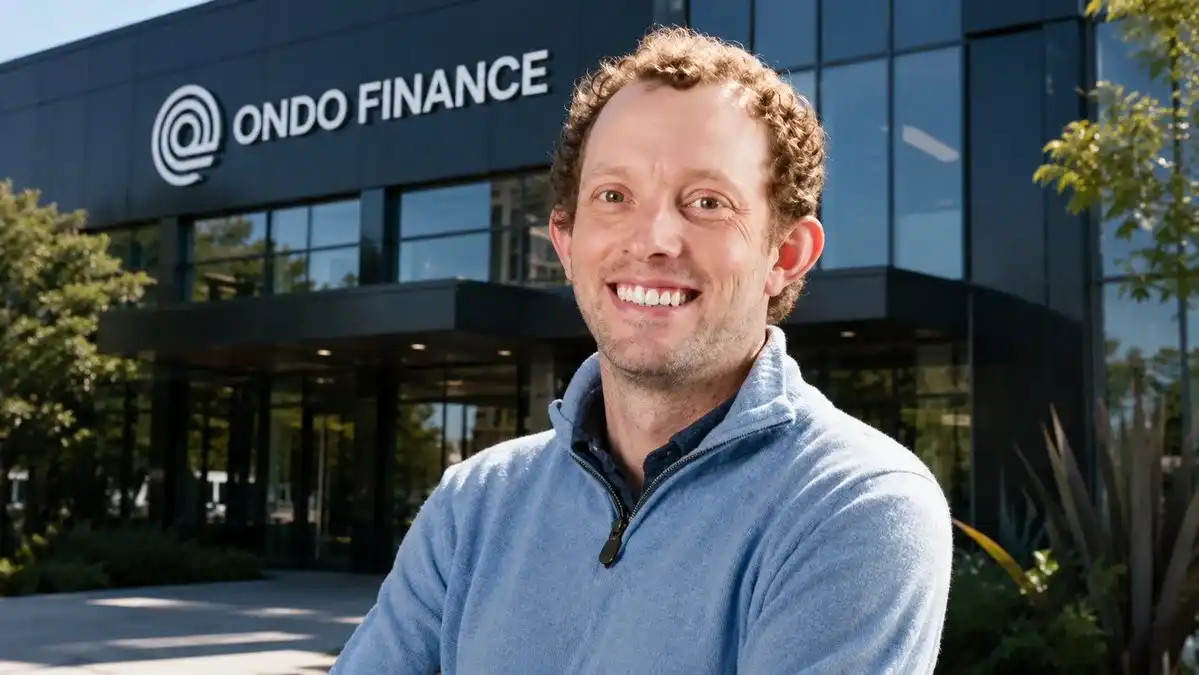
Nathan Allman was widely recognized as a core driving force in the RWA (Real World Assets) sector. He earned his bachelor's degree from Brown University, majoring in Economics and Biology, before pursuing an MBA at Stanford Graduate School of Business.

In 2018, he ran his own crypto hedge fund, ChainStreet Capital. In 2019, he joined Goldman Sachs' Digital Asset business within the Global Markets Division, focusing on building cryptocurrency market services for institutional investors and using blockchain infrastructure to transform the issuance and trading processes of traditional securities. This experience provided a direct methodological foundation for his later product designs. Two years later, he left Goldman Sachs to found Ondo Finance.
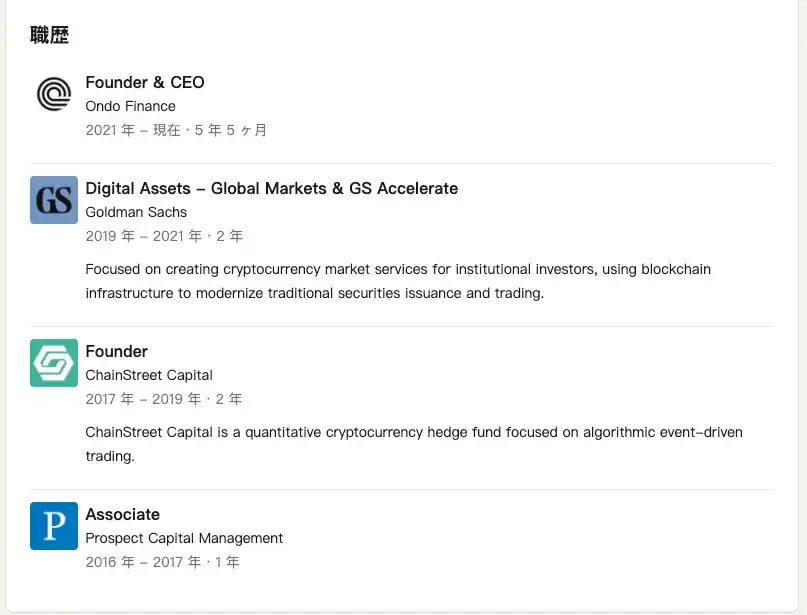
In 2021, Allman founded Ondo Finance, clearly positioning the project as a "compliant channel connecting traditional finance and on-chain infrastructure." Ondo's core product lines were developed along this path.

Initially, Ondo focused on DeFi structured yield products. In 2023, it pivoted towards tokenizing real-world assets. Its first product after this shift was OUSG (Ondo Short-Term US Treasuries Fund). Users could deposit stablecoins like USDC, which Ondo would then use to purchase short-term U.S. Treasury bonds, distributing the returns to holders in token form. USDY, another product, packaged the yields from short-term Treasuries into a perpetual token, made available to non-U.S. accredited investors.

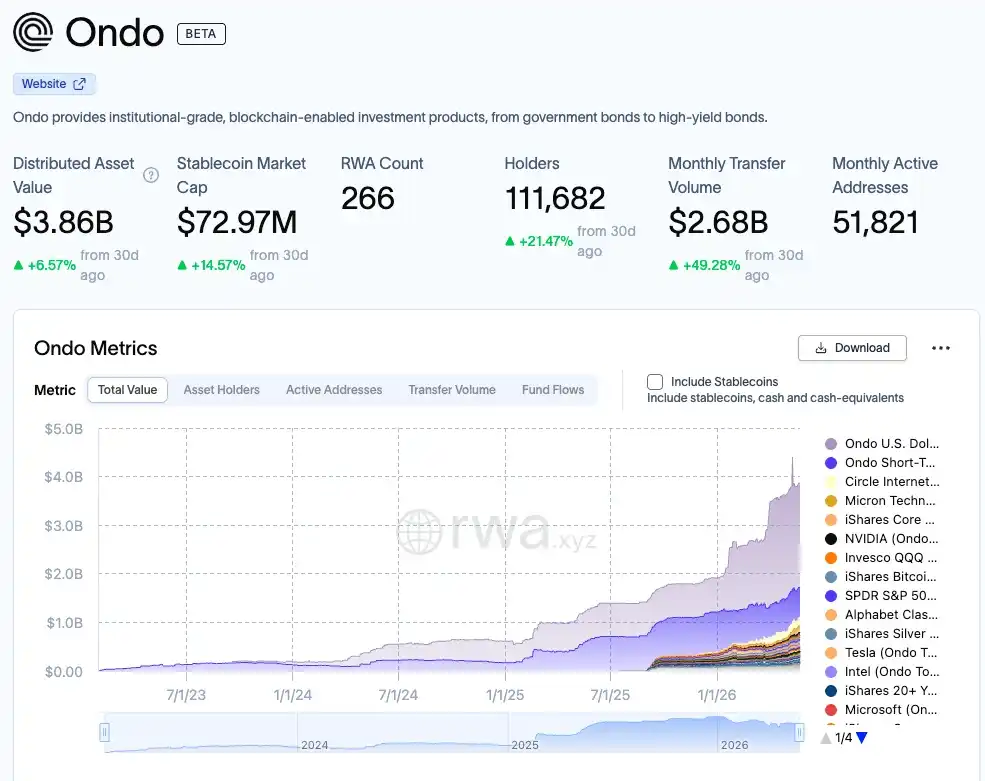
At the time, the largest tokenized Treasury product on the market was BlackRock's BUIDL fund, which had a minimum investment of $5 million—far out of reach for ordinary investors. In early 2024, Allman made a key decision to integrate BUIDL into OUSG's underlying assets. This allowed Ondo users to indirectly hold Treasuries managed by BlackRock through OUSG, while lowering the investment threshold from $5 million to $100,000 and enabling 24/7 subscriptions and redemptions. This move solidified Ondo's position in the RWA space. Throughout 2024, Ondo's Total Value Locked (TVL) grew from $40 million to $534 million, a 13-fold increase.

Following Treasuries came stocks. In September 2025, Allman launched Ondo Global Markets, expanding the tokenized assets from U.S. Treasuries to U.S. stocks and ETFs. The logic behind this product was that a large number of global investors were unable to directly invest in U.S. stocks due to geographical restrictions, account opening barriers, or trading time zone differences. Ondo created on-chain tokens representing over 260 U.S. securities, including Apple, NVIDIA, and S&P 500 ETFs, enabling non-U.S. users to trade these tokenized versions 24/7 on Solana, Ethereum, and BNB Chain. In an interview with CNBC, Allman stated that much of the demand came from crypto users who hadn't yet ventured into traditional asset investing, with ETFs being their easiest entry point.

Ondo Global Markets saw its TVL exceed $240 million within 48 hours of launch, and it surpassed $1 billion within eight months, becoming the first tokenized stock platform to reach that scale. Combined with OUSG and USDY, the platform's total TVL at one point exceeded $4 billion, capturing about 58% of the tokenized stock market.
However, the biggest obstacle for tokenized securities was never technology, but regulation. In the United States, the issuance and trading of securities are strictly regulated by the SEC, and turning stocks into on-chain tokens operates in a legal gray area. Allman's chosen path was direct engagement.

In April 2025, he led a team to meet with the SEC's Crypto Working Group to discuss a compliant framework for tokenized U.S. securities. In December of the same year, Ondo submitted a tokenized securities roadmap to the SEC, with a core request for the SEC to formally recognize the legal status of public blockchains in the tokenized securities market, thereby opening channels for retail investors. That same month, the SEC quietly closed its confidential investigation into Ondo's tokenized U.S. Treasuries and the ONDO token without bringing any charges. For a crypto company operating in a regulatory gray area, this amounted to receiving a tacit approval.

In terms of funding, Ondo raised a total of $46 million. Founders Fund and Pantera Capital jointly led the Series A round, with Coinbase Ventures, Tiger Global, and Wintermute participating. In July 2025, Allman and Pantera jointly established the $250 million Ondo Catalyst Fund, dedicated to investing in RWA infrastructure projects.

The Final Pieces of the Puzzle Left by Allman

In December 2025, Ondo Finance announced that it had submitted its tokenized securities roadmap to the U.S. Securities and Exchange Commission (SEC). Ondo stated that direct registration, beneficial ownership, and wrapped/associated security ownership models all coexist in today's financial markets and play important roles on-chain. In the letter, Ondo urged the SEC to allow these three models by: 1. Supporting both direct and intermediary ownership models; 2. Accepting permissioned, permissionless, and hybrid blockchains; 3. Providing targeted regulatory clarity for tokenization based on transfer agents; 4. Allowing broader tokenization of securities deposited at DTC.

In the weeks preceding Allman's passing, Ondo successively accomplished several industry-first feats.

On May 6, Ondo Finance's official blog disclosed that it, in collaboration with Kinexys by J.P. Morgan, Mastercard, and Ripple, had completed the first near real-time cross-border, cross-bank redemption of a tokenized U.S. Treasury fund. Traditional cross-border security redemption processes typically take several days, involving investors submitting redemption requests, custodian banks confirming holdings, initiating fund transfers via interbank networks like SWIFT, and multiple intermediaries confirming step-by-step.

In this pilot project, Ripple redeemed its holdings of Ondo Short-Term US Government Bonds (OUSG) on the XRP Ledger. After processing the redemption, Ondo sent fiat payment instructions via the Mastercard Multi-Token Network. Kinexys by J.P. Morgan's blockchain infrastructure executed the fund settlement and delivered USD funds to Ripple's bank account in Singapore through its correspondent banking network.

Concurrently, Ondo received a No-Action Letter from the SEC, clearing the compliance path for issuing tokenized securities on Ethereum. Ondo officially stated that the scope of this application was limited, with the OGM product's positioning unchanged—it remains tokenized notes providing non-U.S. investors with exposure to U.S. stocks and ETFs. The underlying securities and official book records are maintained within the existing custody system, held by custodian BitGo. The core change is that, under limited circumstances, the relevant security interests can be synchronously recorded in tokenized form on the Ethereum mainnet to optimize collateral monitoring, subscription/redemption processes, and reconciliation operations.

On May 5, The Depository Trust & Clearing Corporation (DTCC) announced that its DTC Tokenization Service was collaborating with over 50 financial institutions, including Ondo, in a tokenized securities alliance alongside BlackRock and Goldman Sachs. The service will support the tokenization of RWAs held at DTC, providing exactly the same rights and investor protections as traditional forms. DTCC plans to initiate the first limited production transactions in July 2026 and formally launch the service in October.

A crypto-native team founded just five years prior now has a partner list featuring J.P. Morgan, BlackRock, Goldman Sachs, DTCC, and Mastercard. While many projects in the RWA space are involved in tokenization, only Ondo has managed to simultaneously sit at both the SEC's negotiation table and within DTCC's alliance. The establishment of these partnerships was inseparable from Allman's personal efforts.

The Successor Has Been in Place for Two Years

In its announcement, Ondo stated that Allman had helped them build a durable organization. The concrete meaning of this statement points to the successor, Ian De Bode.

Before joining Ondo, De Bode was the Global Head of Digital Assets at McKinsey & Company, having spent over a decade in consulting on institutional digital transformation. He also holds an MBA from Stanford. He joined Ondo as Chief Strategy Officer at the end of 2023, was promoted to President in November 2025, and had been leading the company's strategy, products, and daily operations for over two years. Ondo's announcement specifically emphasized that De Bode had the "full trust" of the management team.
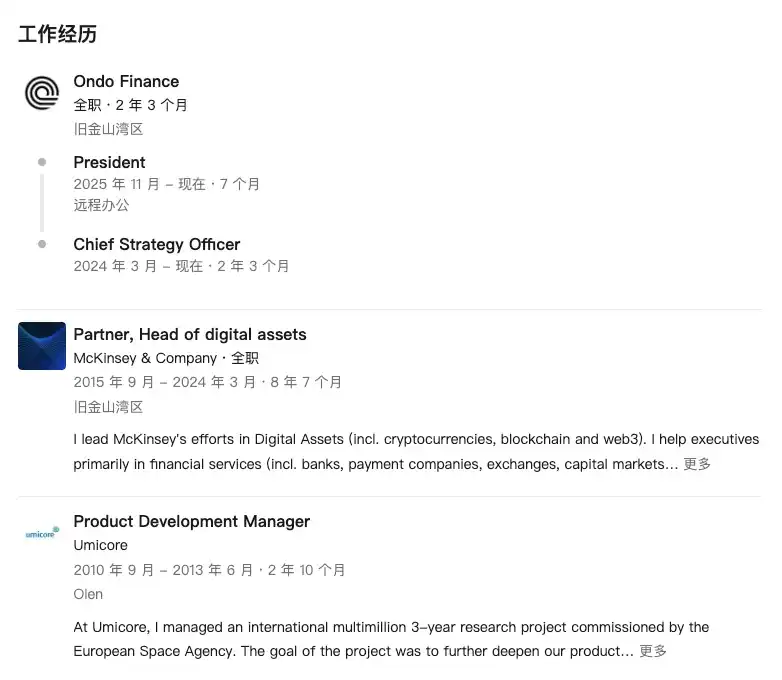
For a crypto company, it is extremely rare to have a successor who has been in place for over two years, is familiar with all aspects of the business, and can take over immediately upon the founder's unexpected death. Crypto projects are often highly reliant on the founder's personal influence and community appeal; the departure of a founder typically signals directional risks and a crisis of trust. However, the test left by Allman is also clear. He personally led the team in negotiations with the SEC last April. The personal relationship networks he accumulated with regulators and Wall Street institutions are something De Bode will need to prove he can inherit.

The ONDO token fell approximately 6% following the announcement and is currently trading around $0.413. The market reaction has been relatively restrained, with no signs of panic selling.

There were no publicly recorded health issues for Allman at the time of his death. Ondo's announcement used the term "unexpected passing" and did not disclose specific reasons. The DTCC tokenized securities pilot scheduled for July was a new milestone he had planned, but he will not see it go live.

Пов'язані питання

QWho was Nathan Allman and what was his role in the cryptocurrency industry?

ANathan Allman was the founder and CEO of Ondo Finance, a company in the Real-World Asset (RWA) tokenization space. He was a core driver in the RWA sector, bridging traditional finance with on-chain infrastructure through compliant channels.

QWhat were the key products developed by Ondo Finance under Nathan Allman's leadership?

AUnder Nathan Allman's leadership, Ondo Finance developed key products including OUSG (tokenized short-term US Treasuries fund), USDY (perpetual token for US Treasury yield), and Ondo Global Markets, which tokenized US stocks and ETFs for global non-US investors.

QWhat significant regulatory milestone did Ondo Finance achieve shortly before Nathan Allman's passing?

AShortly before his passing, Ondo Finance received a No-Action Letter from the U.S. Securities and Exchange Commission (SEC), which cleared a key compliance hurdle for issuing tokenized securities on the Ethereum blockchain.

QWho has been appointed as the new CEO of Ondo Finance, and what is his background?

AIan De Bode, who had been President of the company, has been appointed as the new CEO. He previously served as the Global Head of Digital Assets at McKinsey & Company and has a Stanford MBA. He had been leading Ondo's strategy, product, and daily operations for over two years prior to his appointment.

QWhat was the significance of Ondo Finance's involvement with the DTCC's tokenized securities service?

AOndo Finance was included in the Depository Trust & Clearing Corporation's (DTCC) Tokenized Securities Service alliance, alongside major institutions like BlackRock and Goldman Sachs. This service will support tokenizing real-world assets held at the DTC, marking a significant step in legitimizing and integrating tokenized securities into the mainstream financial infrastructure.

Пов'язані матеріали

BTC Thrice Rejected at $80,000 Threshold, HYPE Reaches New Highs Signaling Opportunity | Guest Analysis

**Bitcoin (BTC) Struggles at $80k; HYPE Reaches New Highs | Key Analysis & Strategy** Bitcoin faces continued resistance in the $78.5k - $79.5k zone after failing to sustain a break above its daily chart rising channel. It has retreated to the channel's midline. A failure to hold here could see a test of the $73.5k - $75k support area. The 4-hour chart shows a complex corrective structure. The strategy is neutral for mid-term positions. For short-term trading, two scenarios are outlined: **A)** Selling on a failed rally into the $78.5k-$79.5k resistance, and **B)** Selling on a confirmed breakdown below the $73.5k-$75k support, both with tight risk management. Meanwhile, **HYPE** has posted consecutive highs. The 4-hour chart indicates its current uptrend may be weakening near $65, with models showing potential bearish divergence. The view is that a short-term top could be forming. The strategy advises against chasing the rally and instead looking for a potential long entry on a pullback to the $47.5 - $50 support zone, provided clear reversal signals appear. Last week, a disciplined short BTC trade based on model signals yielded a 2.78% profit. The article emphasizes that all analysis is for informational purposes only and not investment advice, highlighting the importance of strict stop-loss discipline and dynamic position management in a volatile market. *(Note: The text references proprietary models like the "Price Difference Trading Model" and "Momentum Quantification Model" for generating trade signals.)*

marsbit46 хв тому

BTC Thrice Rejected at $80,000 Threshold, HYPE Reaches New Highs Signaling Opportunity | Guest Analysis

marsbit46 хв тому

Tether's New Business: Helping Small Countries Issue Stablecoins

Tether has announced a partnership with the Georgian government to issue GEL₮, a Lari-pegged stablecoin, aiming to reduce costs, accelerate settlements, and promote cross-border payments. This move is part of Tether's broader strategy to establish a replicable, standardized business of issuing sovereign currency-backed stablecoins for smaller nations, alongside its flagship USDT and other regional offerings like MXNT (Mexican Peso) and CNHT (Offshore Yuan). Georgia represents an ideal test case due to its high reliance on remittances (~15% of GDP), established digital asset regulatory framework aligned with U.S. standards, and prior engagement with Tether. The country gains accelerated internationalization of its currency by accessing Tether's global distribution network and liquidity pools, where GEL₮ can be swapped directly with assets like USDT. For Tether, the immediate financial gain from Georgia's small market is minimal. The true value lies in creating a template. Successfully navigating the compliance, reserve, and redemption processes for GEL₮ allows Tether to replicate this model swiftly for other nations with similar profiles, such as Azerbaijan or Nigeria. The deeper strategy involves subtly integrating these national currencies into an informal USDT-anchored dollar system, positioning Tether as the essential routing infrastructure. This partnership highlights a potential new model: the outsourcing of sovereign currency globalization to private stablecoin issuers. It offers smaller states a faster path to digital currency integration than developing a Central Bank Digital Currency (CBDC). However, it raises significant questions about monetary sovereignty, financial stability risks, and increased dependency on a private entity. If more countries adopt this model in the coming year, Tether could evolve from a stablecoin issuer into a unique, cross-sovereign financial infrastructure service provider.

marsbit51 хв тому

Tether's New Business: Helping Small Countries Issue Stablecoins

marsbit51 хв тому

Notion CEO: AI companies should be a 'Jazz Band,' and I am a 'Refounder'

Notion CEO Ivan Zhao, in a recent podcast, shared his journey of twice rebuilding the company from near-collapse and now applying the same "Refounder" mindset to reshape the 1000-person organization in the AI era. He argues that AI has commoditized technical capability (Capability). True talent now hinges on Taste (judgment/values) and Agency (proactive drive), necessitating a shift in hiring—e.g., hiring more juniors for curiosity and having sales candidates demonstrate work upfront. Zhao envisions the company as a "Jazz Band"—agile and improvisational—versus a rigid "Marching Band." This is reflected in an engineering "dumbbell" structure (super juniors + top-tier seniors, with middle layers compressed), dissolving the CMO role to let teams operate directly, and integrating entrepreneurs via acquisitions to lead their expertise areas. Notion has abandoned traditional long-term product roadmaps, planning only conservatively for finances while adopting a week-by-week, improvisational approach to product strategy, as longer plans proved futile during rapid AI shifts. He concludes that while human nature and roles remain constants, companies must rewrite their approaches to hiring (valuing Taste/Agency over Capability), organizational design (reducing roles focused on coordination/execution), and planning (embracing flexibility). Modern knowledge work, being only ~150 years old, is ripe for reinvention.

marsbit51 хв тому

Notion CEO: AI companies should be a 'Jazz Band,' and I am a 'Refounder'

marsbit51 хв тому

BTC Faces Triple Resistance at $80,000 Milestone, HYPE Hits New Highs Signaling Potential | Invited Analysis

This weekly analysis maintains a structured framework, focusing on Bitcoin (BTC) and HYPE, dissecting their multi-timeframe price action to identify key support and resistance zones and formulate actionable trading plans. The previous week's short position on BTC yielded a 2.78% gain, reinforcing the "signal-driven, disciplined" approach. For Bitcoin, the core scenario revolves around the battle between the 78,500–79,500 USD resistance zone and the 73,500–75,000 USD support area. The daily chart shows BTC within a rising channel; a failure to hold support at the channel's midline could lead to a test of the lower boundary. The 4-hour chart details an 8-segment corrective structure from the 82,850 USD high. Two short-term strategies are proposed: (A) Selling on a failed rally into the 78.5k-79.5k zone, with a stop above 80,600, or (B) Selling a confirmed breakdown below the 73.5k-75k support, with a stop above 76,500. Medium-term positioning remains neutral. For HYPE, the 4-hour chart indicates a five-wave advance from the May 14th low, now showing potential exhaustion and a top warning signal near 65 USD. The core view is to watch for a potential short-term peak formation. The recommended strategy is to avoid chasing the rally and instead look for a long setup upon a pullback to the 47.5–50 USD support zone, provided clear stabilization and model confirmation signals appear. The report concludes with a detailed review of the prior BTC short trade, executed based on model signals and candlestick patterns, and reiterates strict risk management rules, including immediate stop-loss placement and trailing stops to protect profits. All analysis is presented as a personal trading log, not investment advice.

Odaily星球日报1 год тому

BTC Faces Triple Resistance at $80,000 Milestone, HYPE Hits New Highs Signaling Potential | Invited Analysis

Odaily星球日报1 год тому

Торгівля

Спот
Ф'ючерси
活动图片