Monkey-Selling Lifeline Finally Turns Fortunes: Machi Big Brother Turns $150k Into $12.72 Million In Three Days

marsbitОпубліковано о 2026-08-25Востаннє оновлено о 2026-08-25

Анотація

Machi Big Brother, a prominent crypto whale, has staged a dramatic comeback. After ten months of significant losses, he turned a $150,000 capital into $12.72 million in just three days during last week's market rally. This 84x gain was achieved through aggressive "rolling" strategies on the Hyperliquid platform, where unrealized profits are continuously used as collateral to increase leveraged long positions. His current portfolio holds $100.7 million in assets backing $123.72 million in open long positions, primarily in ETH, with an overall leverage of approximately 13.1x. However, this massive position is highly precarious; a roughly 10% drop in ETH's price to $2,229 would trigger automatic liquidation, wiping out his recent profits. His trading history is marked by high leverage, frequent liquidations, and poor risk management, having been liquidated 71 times in a single month in 2025. To fund these risky trades and meet margin calls in recent months, he has been selling his NFT holdings, including Bored Ape Yacht Club (BAYC) assets, at substantial losses—a move the community dubbed "selling monkeys to stay alive." Despite the recent windfall, his cumulative losses remain high, and his high-risk strategy leaves him vulnerable to sudden market reversals.

As the tide of market recovery rolls in, the undercurrents on-chain have long churned up stormy seas. Machi Big Brother has once again become the protagonist in the on-chain arena of public opinion.

Over the past ten months, this crypto whale has been repeatedly submerged by each wave surge, with a persistent record of losses like a heavy report card. But in last week's one-sided market movement, starting with $150,000 in capital, he rolled a leveraged long position into $12.72 million within three days, netting a single-trade profit of $12.5 million, an 84x return on his principal.

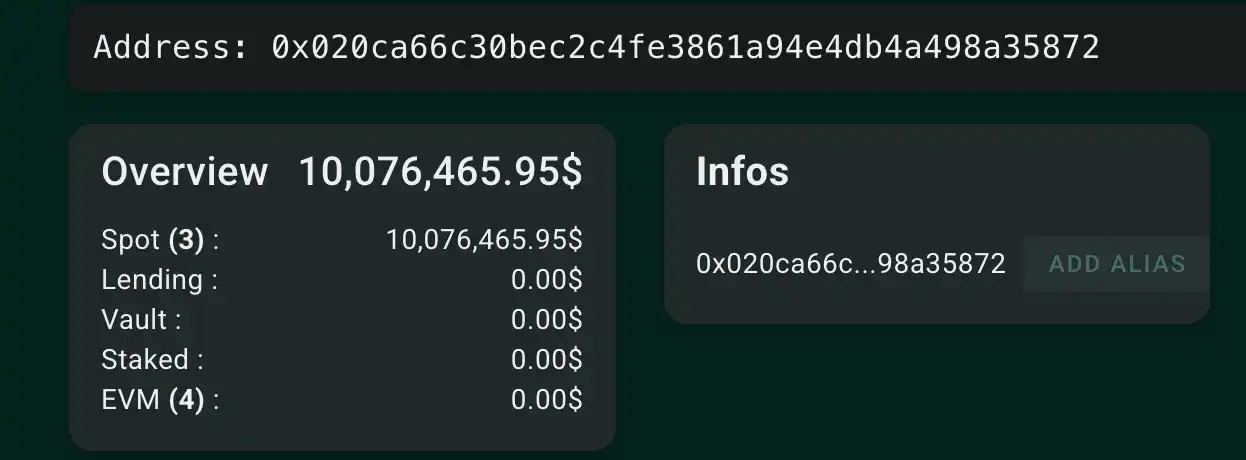
As of 18:00 on August 24th, the total assets in the Hyperliquid account machibigbrother.eth stood at $10.07 million, supporting a massive long position worth $124 million. Leverage hangs by a thread, positions weigh like a heavy hammer—the paper gains and losses of this single individual are precisely a concentrated snapshot of current market sentiment, liquidity battles, and risk appetite. On-chain numbers do not lie, inscribing both frenzy and calm within the holdings data.
Current Positions: $10 Million Supporting $133 Million

Analysts differ slightly in their accounts. According to analyst Yu Jin's data, Machi Big Brother had accumulated losses of $35 million from long ETH positions over the past 10 months, which narrowed to approximately $24 million after this profitable trade.

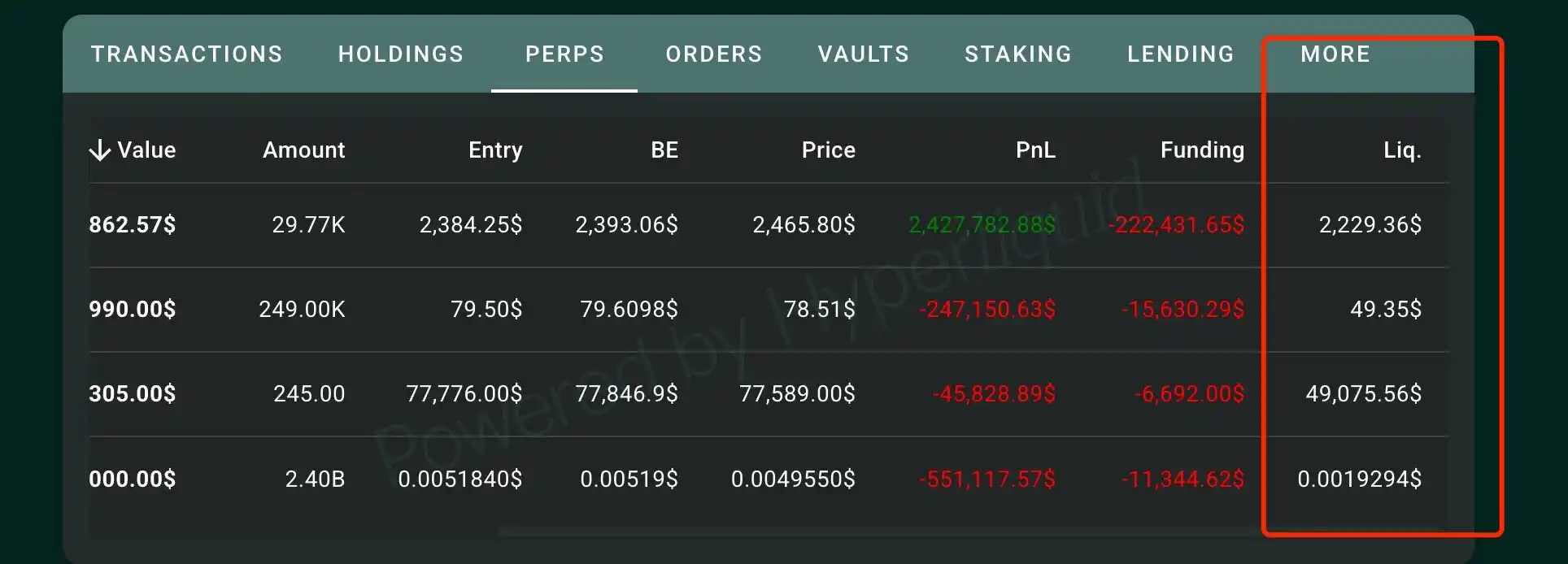
A clearer picture of his current position composition can be seen from HypurrScan's real-time on-chain data (data retrieved at 18:00, August 24th, 2026):

__IMG_1__

The four positions total $123.72 million, showing an overall unrealized profit of approximately $1.435 million at current prices. But breaking it down: the HYPE, BTC, and PUMP positions are all below their break-even prices. Only the ETH position remains 2.9% above its break-even price. Essentially, all profits are being propped up by the single ETH trade (unrealized profit ~$2.36 million), while the other three combined show an unrealized loss of $920,000.

Furthermore, to maintain these four long positions, he has already paid cumulative funding fees of approximately $256,000—this is the holding cost for perpetual contracts, deducted every hour regardless of price movement; the longer the position is held, the more is deducted.

The most critical factor is the 'liquidation price.' Once the price hits this level, the system will automatically sell his position to stop losses without his consent. The tightest among the four is ETH—$2,229, roughly 10% below the current price. And the ETH position alone constitutes 59% of his total portfolio, making it the entire account's line of death.

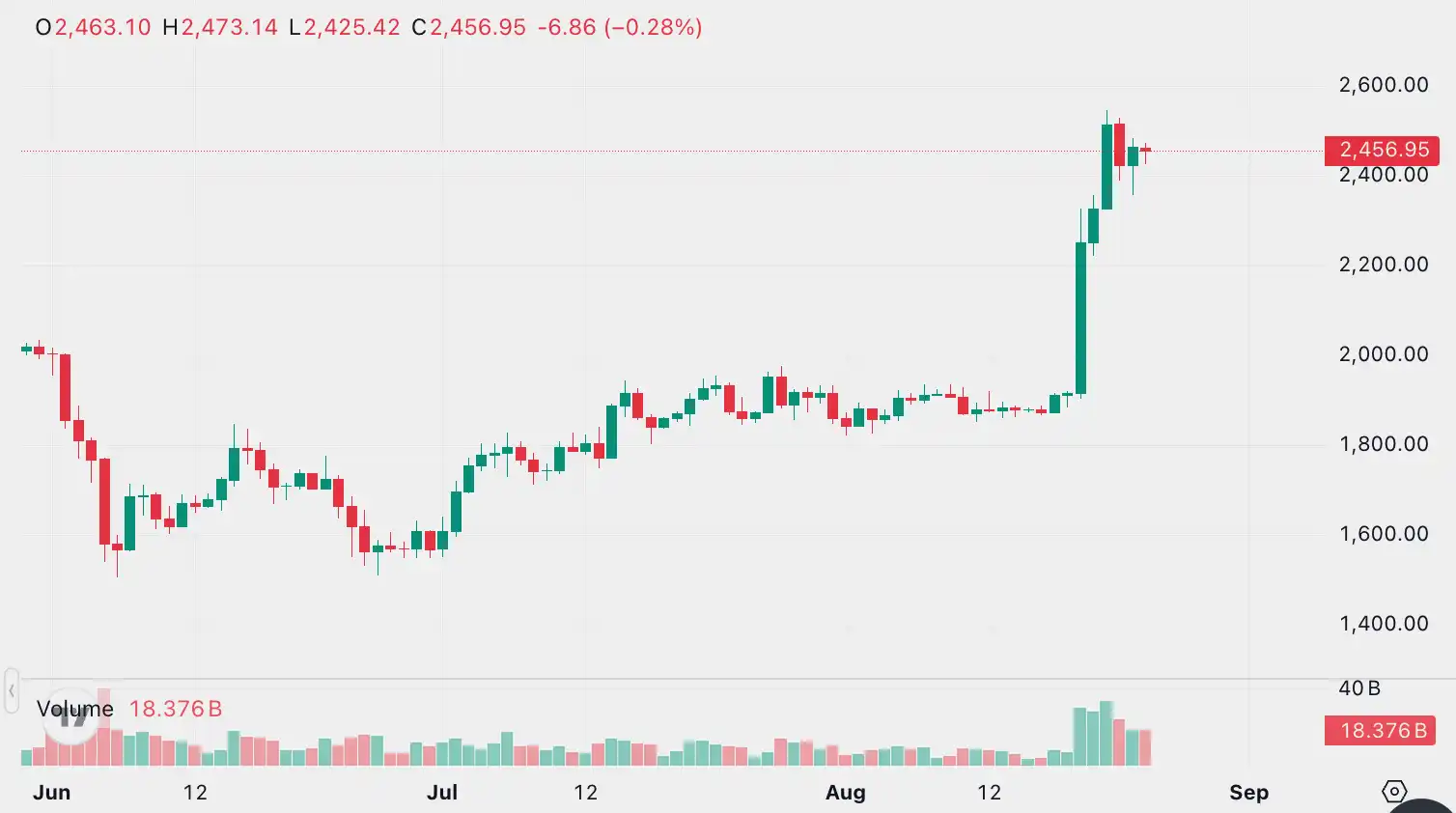
In terms of leverage ratio: $9.44 million in equity is supporting a $123.72 million position, resulting in an overall leverage of approximately 13.1x. This means if ETH drops from $2,463 to $2,229, a $234 decline, the $12.5 million profit made over these 3 days, along with the initial capital, would be wiped out.
Strategy Unchanged, Risks Persist

It is important to note that Machi Big Brother's profit this time was achieved through continuous 'position rolling.' 'Rolling a position' refers to opening a leveraged position and, instead of withdrawing unrealized profits, using those profits directly as additional margin to automatically support a larger position; if the price rises further, the position expands again, compounding in this manner.

Its mathematical characteristic is exponential gains when winning, but a total loss when losing. Because each increase in position size is built upon the unrealized profits of the previous one, a market reversal doesn't just erase the principal but simultaneously wipes out all the rolled-up profits. Turning $150k into $11.15 million requires getting it right several times in a row; turning $11.15 million back to $150k, theoretically, requires only one wrong move.

Last week's ETH rebound from the bottom provided the ideal environment for this structure: one-sided, continuous, and without pullbacks.
Although this operation resulted in $11 million in unrealized profits, one must not forget that as the 'on-chain liquidation champion,' Machi Big Brother has repeatedly seen massive profits rapidly turn into huge losses. In mid-September 2025, his account value peaked near $60 million (unrealized profit over $44–45 million). Subsequently, during the market crash on October 11th, multiple long positions including XPL and ETH were liquidated, turning a profit of approximately $15 million into a loss exceeding $11 million—profits evaporated swiftly.

His trading style is characterized by high leverage (often 25x–40x), extreme bullish bias, high win rate but extremely poor risk/reward ratio, and adding margin/averaging down instead of cutting losses during downturns. This leads to 'small wins, huge losses' and frequent liquidations.

In November 2025, Lookonchain monitored him being forcibly liquidated 71 times in a single month on Hyperliquid, ranking first across the network.

Currently, he still carries significant cumulative historical losses, and his fundamental issues with trading discipline remain unchanged. On-chain data is public and transparent, but volatility is intense.

The Two Weeks of Selling Apes to Add Margin

A highlight of this story is the halo effect Machi Big Brother himself carries, while another highlight is the narrative of a small capital base gambling for a massive position. But rewinding two weeks prior, he was selling off Bored Ape Yacht Club (BAYC) NFTs one by one:

August 5th: Sold BAYC #5670 for 9 ETH—the purchase cost over three years ago was 84.99 ETH, resulting in an 89.4% loss.

August 13th: Sold BAYC #5715 for 8.3 ETH, approximately $15,500; the original cost was 34.17 ETH, around $64,600, resulting in a 75.7% loss.

This was his routine for the first half of August.

The fire sale of BAYCs can be traced back even earlier. According to another Lookonchain statistic, he sold 34 BAYCs at a loss in June, obtaining about 326 ETH, but incurring an overall loss of approximately 399 ETH. The primary purpose was to add margin for his high-leverage ETH long positions on Hyperliquid, to avoid or delay liquidation. This led the community to joke that he was 'using monkeys for a lifeline.'

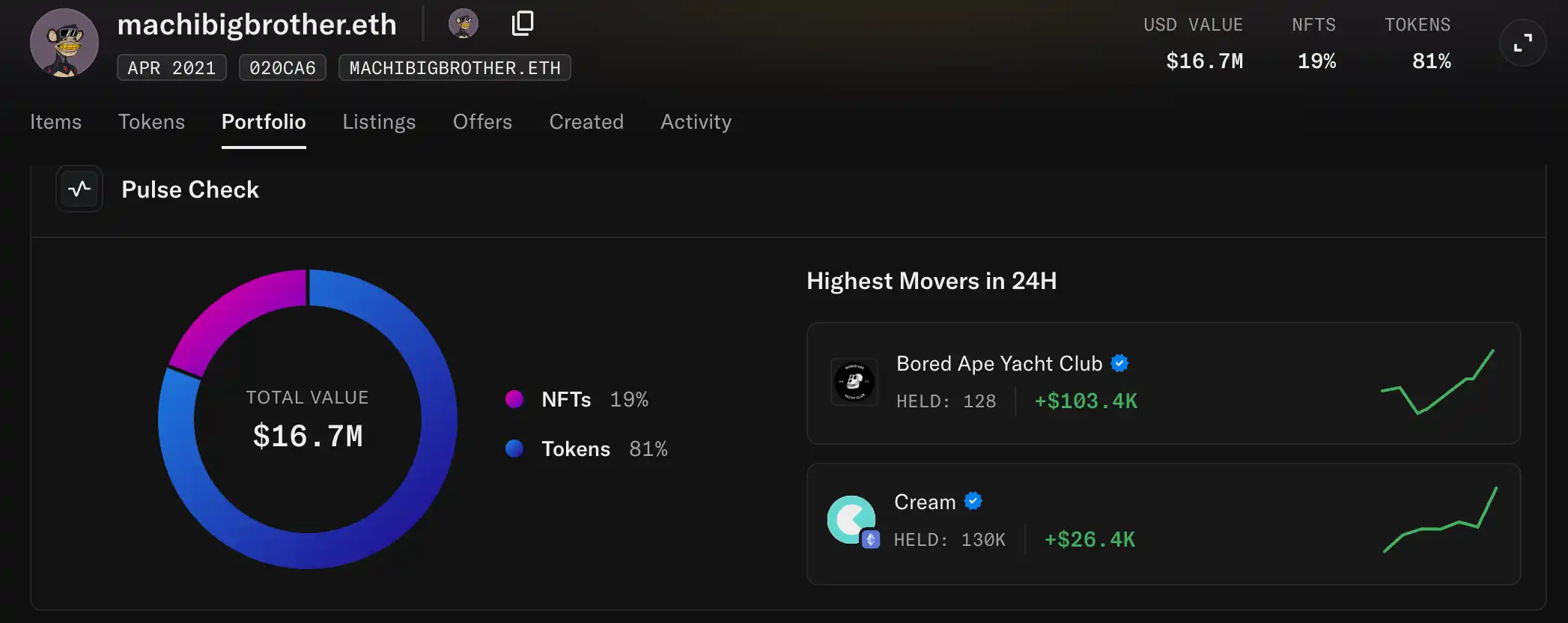
As of writing, according to OpenSea data, his NFT portfolio consists of 4,357 items, but the NFT portion's value has dwindled to only $3.17 million. This includes 128 BAYCs (~$2.5 million) and 102 MAYCs (~$288,000). In contrast, at his peak, he held a heavy position of over three hundred BAYCs.
Пов'язані питання

QWho is the main subject of the article, and what is his notable recent financial achievement?

AThe main subject is Machi Big Brother, a crypto whale. His notable recent achievement is turning a $150,000 principal into $12.72 million within three days through extreme leverage trading, an 84x return.

QWhat is the current situation of Machi Big Brother's portfolio on Hyperliquid as described in the article?

AAs of the snapshot, his account held about $10.07 million in total assets, but it was supporting a massive long position of $124 million. His overall leverage was approximately 13.1x. His main risk is the ETH position, which constitutes 59% of his total holdings and has a liquidation price around $2,229, about 10% below the current price.

QWhat is the trading strategy that Machi Big Brother used to achieve the recent $12.5 million profit, and what are its key risks?

AHe used a 'rolling' strategy. This means he didn't withdraw profits but used them as added margin to increase his position size, creating a compounding effect. The key risk is that while profits can grow exponentially during a sustained trend, the entire accumulated profit and principal can be wiped out in a single market reversal.

QWhy did Machi Big Brother sell a significant number of his Bored Ape Yacht Club (BAYC) NFTs in the months leading up to his recent trade?

AHe sold his BAYC NFTs at a loss to raise capital. The primary purpose was to add margin to his highly leveraged long positions on ETH on Hyperliquid, aiming to avoid or delay liquidation (forced selling) of those positions.

QAccording to the article, what is a characteristic pattern of Machi Big Brother's long-term trading history despite his recent success?

AHis long-term trading history is characterized by high leverage, consistent bias towards long positions, high frequency of winning trades but poor risk-to-reward ratio, and a pattern of adding more funds during losses instead of cutting losses. This has led to him being frequently liquidated and accumulating significant overall losses over time, earning him titles like 'on-chain liquidation champion'.

Пов'язані матеріали

Zcash's ETF Gilding: How a Privacy Coin Was Packaged by Wall Street into a Compliant Asset

The article traces the decade-long path of Zcash (ZEC), a privacy-focused cryptocurrency, to its potential launch as the first privacy coin spot ETF, with Grayscale's ZCSH filing in August 2026. It argues ZEC's suitability stemmed not from regulatory acceptance of its privacy technology, but from its centralized, institutional structure from inception—a commercial company (ECC) with venture capital backing and a Founder's Reward—making it easier to package than decentralized alternatives. Three key institutions, intertwined in a network, drove the process: Grayscale (owned by DCG, an early ZEC investor), which had held ZEC in a trust since 2017; Coinbase, providing custody, prime brokerage, derivatives, and venture investment; and ZODL, a new for-profit entity formed in 2026 when ECC's core development team split from the non-profit foundation. The major regulatory hurdle was SEC scrutiny (2023-2026) over ZEC's historical structure, which resembled an unregistered investment contract due to automatic block rewards to ECC and the Foundation. This was resolved through governance changes (NU6 upgrade in 2024) that ended direct funding and shifted control to community voting, coinciding with a broader shift in SEC enforcement policy. Notably, the law firm Davis Polk represented both the Zcash Foundation in its SEC defense and Grayscale in the ETF filing. The push is also driven by DCG's dire financial needs amid Genesis bankruptcy lawsuits, seeking high-fee products (the ZEC ETF charges 2.5%). Concurrently, major mining operations by entities like Cypherpunk Technologies (backed by Winklevoss Capital) and DCG's Fortitude Mining expanded, motivated by profitability and aiming to influence the network. The article concludes with irony: to become a compliant ETF asset, ZEC must shed its core privacy feature for the fund's holdings, which will be held in transparent, auditable addresses. Wall Street is not adopting privacy technology but packaging the *concept* of privacy into a tradable, fee-generating financial product. The transformation was not a single master plan but the result of a network of aligned interests capitalizing on regulatory, governance, and market shifts over ten years.

marsbit8 хв тому

Zcash's ETF Gilding: How a Privacy Coin Was Packaged by Wall Street into a Compliant Asset

marsbit8 хв тому

Bitcoin Core Developer Warns That Bitcoin Payments Are Disappearing at 'Bitcoin Beach'

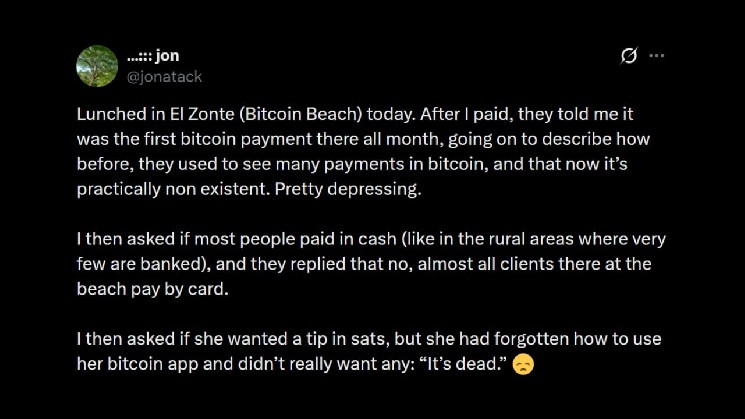
A Bitcoin Core developer, John Atack, who has lived in El Salvador since 2022, shared a concerning anecdote about Bitcoin adoption in the country. While dining at El Zonte, a region known as "Bitcoin Beach," he paid with Bitcoin and was told it was the first such payment the establishment had received in a month. Staff explained Bitcoin payments, once common, have now virtually disappeared, with nearly all customers using cards. An employee even declined a Bitcoin tip, stating she had forgotten how to use her wallet and declaring "It's already dead." Atack emphasized this was a single observation but noted the employee had witnessed the payment evolution over three years. His comments sparked mixed reactions. Some disputed his experience, with one user confirming successful Bitcoin payments in the same area. However, Bitcoin reporter Juan Galt acknowledged an underlying "economic problem," arguing that expecting price appreciation makes using Bitcoin for everyday transactions counterintuitive to economic incentives needed for a circular crypto economy. Despite the concerning report, Atack also reflected that El Salvador remains a global leader in cryptocurrency adoption and progressive legislation, sometimes causing locals to take these advancements for granted. The story highlights the ongoing challenges of mainstream Bitcoin adoption for daily commerce, even in pioneering nations.

cryptonews.ru11 хв тому

Bitcoin Core Developer Warns That Bitcoin Payments Are Disappearing at 'Bitcoin Beach'

cryptonews.ru11 хв тому

A Huge 'Sleeping' Wave of New Bitcoin Buyers Has Not Even Bought Bitcoin Yet

A recent study by the Federal Reserve Bank of Cleveland, titled "Do You Even Crypto, Bro? Cryptocurrencies in Household Finance," reveals that Bitcoin and other crypto assets are less understood than other financial assets in US households. The primary reasons for not owning crypto are a lack of knowledge and the perception that it is a poor investment. Even among owners, the main motivations are profit-seeking and portfolio diversification rather than an understanding of the underlying technology's benefits, such as independence from banks. The research found that showing respondents Bitcoin's past 12-month performance increased their desired portfolio allocation by about 47%, indicating investment decisions are driven more by recent returns than fundamental comprehension. Crypto gains are often treated like lottery winnings, leading to one-off luxury purchases rather than sustained increases in spending. While non-owners largely view crypto as high-risk, owners are somewhat less likely to do so, though they exhibit greater uncertainty about future returns compared to traditional assets like stocks or gold. This ambiguity about Bitcoin's nature and valuation contributes directly to its price volatility. The study concludes that this volatility will persist, but education efforts combined with price appreciation could convert today's uninformed non-owners into future Bitcoin holders.

cryptonews.ru13 хв тому

A Huge 'Sleeping' Wave of New Bitcoin Buyers Has Not Even Bought Bitcoin Yet

cryptonews.ru13 хв тому

Grain Prices Haven't Taken Off Yet, So Why Have Fertilizer Prices Risen First?

Fertilizer prices are rising ahead of a potential global food price surge, driven primarily by supply-side constraints rather than current agricultural demand. While a strong El Niño is forecast for late 2026, its impact is expected to be initially limited to specific crops like palm oil and rubber, not leading to immediate, broad-based grain shortages. The fertilizer market is currently propelled by its own dynamics: **Urea** faces domestic oversupply in China, with its price reliant on the potential to export to higher-priced international markets. **Phosphate fertilizers** are experiencing a rare "supply-led" cycle due to global sulfur shortages, shipping disruptions, and production cuts overseas, placing Chinese producers with integrated resources and export channels in a key position. **Potash** supply is tightening due to planned maintenance and production cuts at major global producers, underpinning its long-term resource scarcity narrative. Looking ahead to 2027, a prolonged El Niño could shift the market into a second phase of "demand-supply resonance." If extreme weather significantly impacts crop yields and global grain inventories, rising food prices and farmer income would boost fertilizer application demand. This potential demand surge, layered onto the existing supply constraints, could amplify the price cycle. The overarching theme is that **food security is redefining the strategic value of fertilizers**, particularly for resource-constrained phosphate and potash. Policy priorities balancing domestic supply guarantees with export opportunities, coupled with resource ownership and global supply chain access, are becoming critical determinants of profitability beyond short-term weather cycles.

marsbit16 хв тому

Grain Prices Haven't Taken Off Yet, So Why Have Fertilizer Prices Risen First?

marsbit16 хв тому

Торгівля

Спот
活动图片