The Scythe of Bitcoin's Leading Figure: A Record of a Nasdaq Robbery

marsbitОпубліковано о 2026-02-18Востаннє оновлено о 2026-02-18

Анотація

This investigation details a sophisticated financial scheme orchestrated by David Bailey, CEO of Nakamoto Holdings ($NAKA). Through a reverse merger with a shell company, NAKA's stock skyrocketed from $2 to over $30, luring retail investors while early PIPE investors entered at just $1.12 per share. The stock then collapsed by 99% to $0.29. Amid the crash, Bailey engaged in desperate debt refinancing, accruing massive losses. He then used the crippled public company to acquire his own private firms, BTC Inc and UTXO Management, at a fixed share price of $1.12—nearly four times the market rate. This acquisition, approved by shareholders during the stock's peak without their full understanding, resulted in massive dilution for existing investors. The entire operation, while technically compliant, transferred wealth from retail investors to insiders. Bailey, who compared himself to historical financial dynasties, ultimately used the wreckage of the public company to enrich himself and his private empire, showcasing a brutal intersection of influencer culture and public markets.

Editor's Note: This article provides an in-depth analysis of the astonishing capital operations behind David Bailey and the Nakamoto Holdings ($NAKA) he controls. From the frenzied surge during the backdoor listing to the 99% crash after retail investors entered the market, and then using the devastated listed company to acquire his private assets at a high premium, it is a meticulously designed wealth transfer leveraging information asymmetry and regulatory loopholes.

This is a brutal investigation into greed, compliance games, and influencer capitalism. It serves as a warning that when belief is packaged as a financial product, and when the slogan of decentralization meets centralized greed, retail investors are often the last exit liquidity. Understanding this story might give you more clarity and less blind following the next time a big name promotes an investment.

Below is the full content:

This morning, David Bailey used a listed company whose market value has evaporated by 99% to acquire two private companies he founded at a premium four times the current stock price—all without requiring a shareholder vote.

What's most shocking? This asset transfer drama was locked in long before retail investors bought their first share.

To understand how this was done, we must start from the beginning.

In May 2025, a zombie company named KindlyMD announced a merger with Nakamoto Holdings, a Bitcoin reserve tool founded by David Bailey.

The stock price soared from $2 to over $30 within days, attracting a flood of retail investors. Bitcoin influencers celebrated, and Bailey even compared himself to the Morgans, the Medicis, and the Rothschilds.
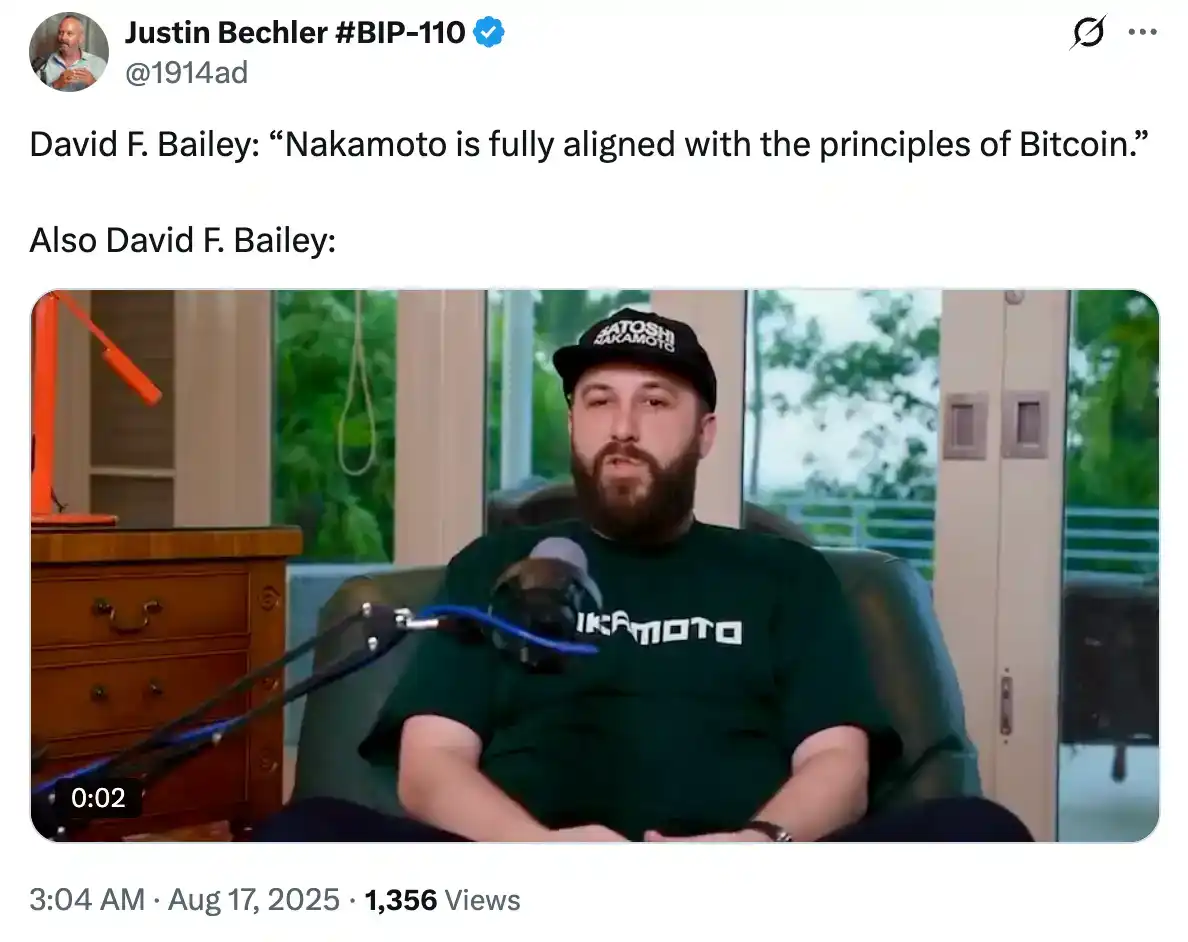
Nine months later, the stock price fell to 29 cents, and Bailey just used this stock to buy his own companies.

The Pump

The mechanism was quite ingeniously designed.

KindlyMD was originally an unnoticed micro-cap stock on Nasdaq. Nakamoto Holdings went public through a reverse merger, backed by $510 million in PIPE (Private Investment in Public Equity) financing and $200 million in convertible bonds.

On paper, it seemed like the birth of a Bitcoin reserve giant, with a new generation of Bitcoin influencers rushing to tell you why to buy $NAKA (of course, the reason was to own more Bitcoin).

Within days, NAKA's price-to-NAV ratio reached an astonishing 23x, meaning speculators paid $23 for every $1 of Bitcoin held by the company.

Michael Saylor's MicroStrategy never reached such a premium. The difference is that MicroStrategy has years of operational history, a software business generating actual revenue, and a CEO who didn't manipulate the transaction structure to enrich himself on the backend.

Insiders knew secrets that retail investors didn't. The PIPE investors—including the notorious BIP-110 opponents Udi Wertheimer, Jameson Lopp, and Adam Back—got in at $1.12 per share. Retail investors bought at $28, $30, $31, and even higher.

This information asymmetry was built into the structure from day one.

In June, Bailey completed another $51.5 million PIPE financing at $5.00 per share. Although the second batch of investors got in at a much lower cost than retail, it was still far above the $1.12 floor price, and they were ultimately harvested too.

Bailey celebrated the financing, saying it took less than 72 hours and investor demand was extremely strong.

Let's take a closer look at this strategy.

The Dump

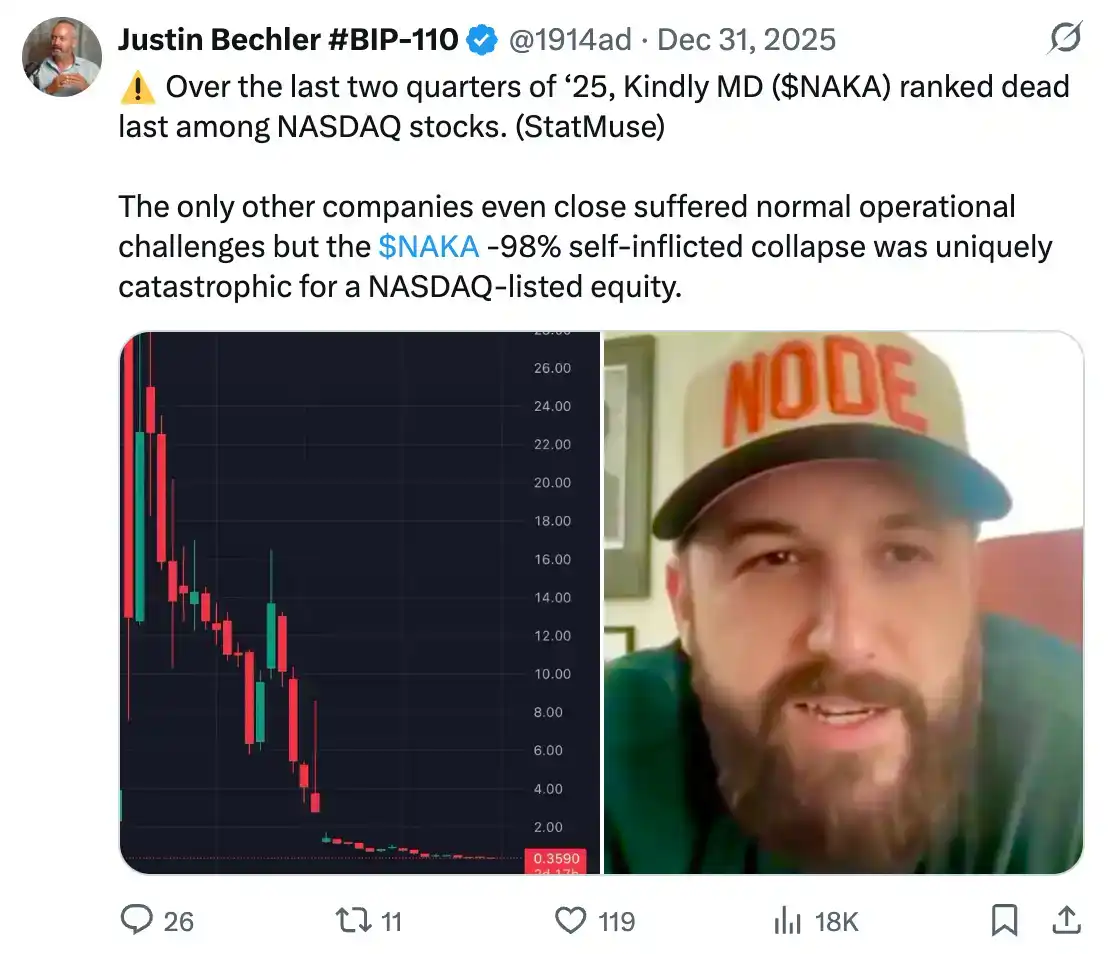
By September, NAKA had plummeted by 96%.

The early PIPE investors who obtained shares at $1.12 could finally cash out after the merger was completed in August, and they did so.

Bailey's response was quite bizarre for a public company CEO; he told shareholders who were just there for a quick trade to leave.

So they left.

The stock price continued to fall. Below $1. Below 50 cents. Below 30 cents. A company holding about 5,765 Bitcoins (worth over $500 million) now had a market cap of less than $300 million.

The market valued Nakamoto even lower than the Bitcoin on its balance sheet, which says a lot about how investors view the management team and corporate structure wrapped around these Bitcoins.
Debt Spiral

As the stock price crashed, Bailey changed lenders frequently, like a gambler borrowing money on the casino floor.

The initial capital structure included $200 million in convertible bonds from Yorkville Advisors, with a conversion price of $2.80. As NAKA's stock price fell below this level, the convertible bonds became debt that could devour equity. So, on October 3, Nakamoto took out a $203 million term loan from Two Prime Lending to redeem Yorkville's notes and interest.

Four days later, on October 7, they borrowed $206 million in USDT from Antalpha at 7% interest to repay Two Prime. Antalpha's loan had a term of only 30 days (with an option to extend for another 30 days). They replaced the term loan with a 30-day bridge loan within a week.

The plan was to convert this bridge loan into a $250 million 5-year secured convertible bond from Antalpha. Use the new convertible to repay the bridge loan, the bridge loan to repay the term loan, and the term loan to repay the old convertible.

But that $250 million convertible never materialized on Antalpha's terms.

On December 16, Nakamoto borrowed $210 million in USDT from Kraken at 8% interest, over-collateralized by 150% with Bitcoin from its treasury.
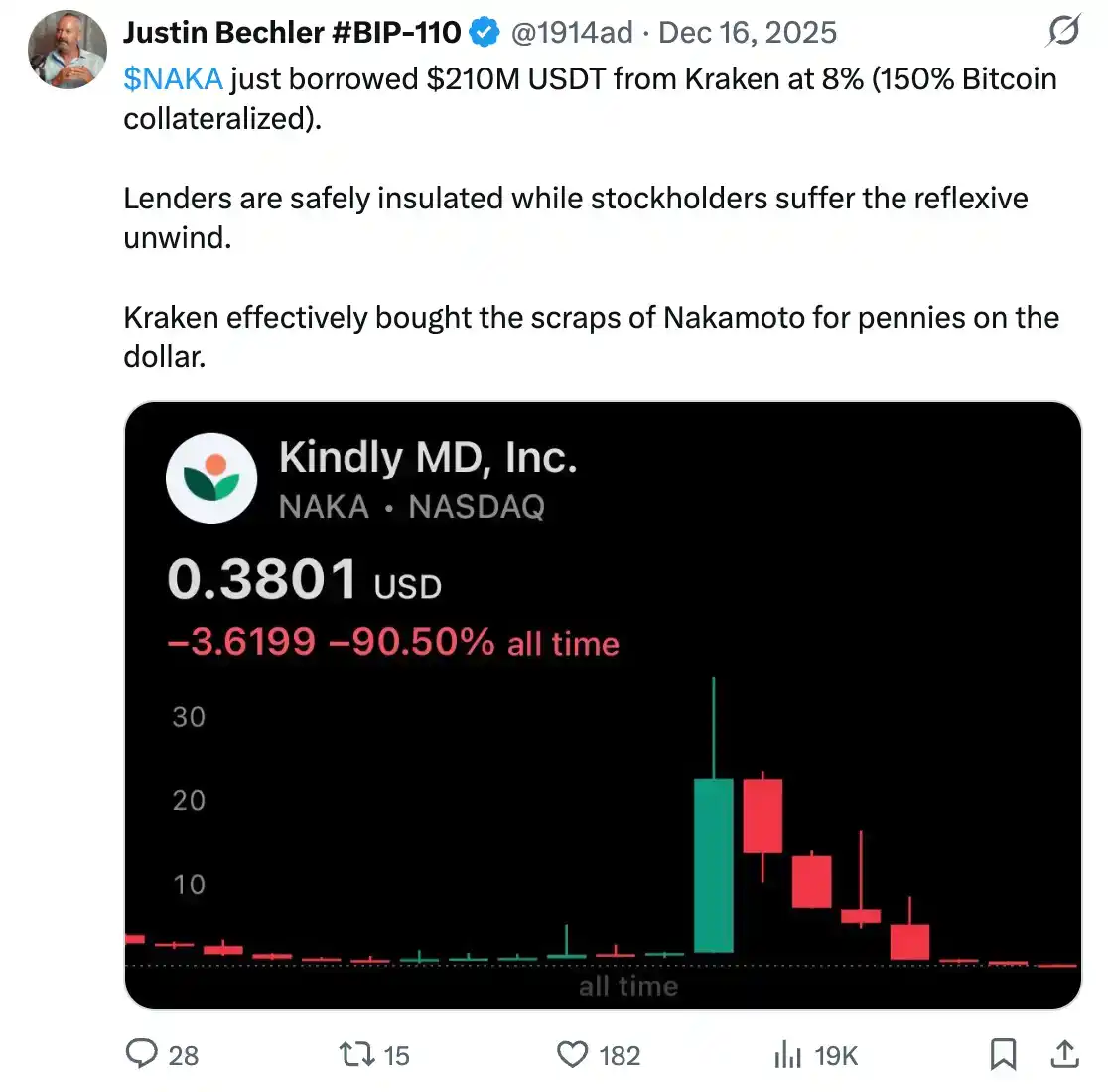
Do the math: The lender has $315 million worth of Bitcoin as collateral for a $210 million loan. If NAKA's stock goes to zero, Kraken takes the collateral. If Bitcoin drops 33%, Kraken remains unscathed. At every stage of this drama, the lenders were tightly protected, while common shareholders bore the full brunt of the reflexive crash.

Each new loan tightened the noose.

Countdown

On December 10, Nasdaq notified Nakamoto that it faced delisting risk because its stock price had been below $1 for 30 consecutive business days. The company must regain compliance by June 8, 2026, meaning the closing price must be above $1 for 10 consecutive trading days.

The current stock price is 29 cents.
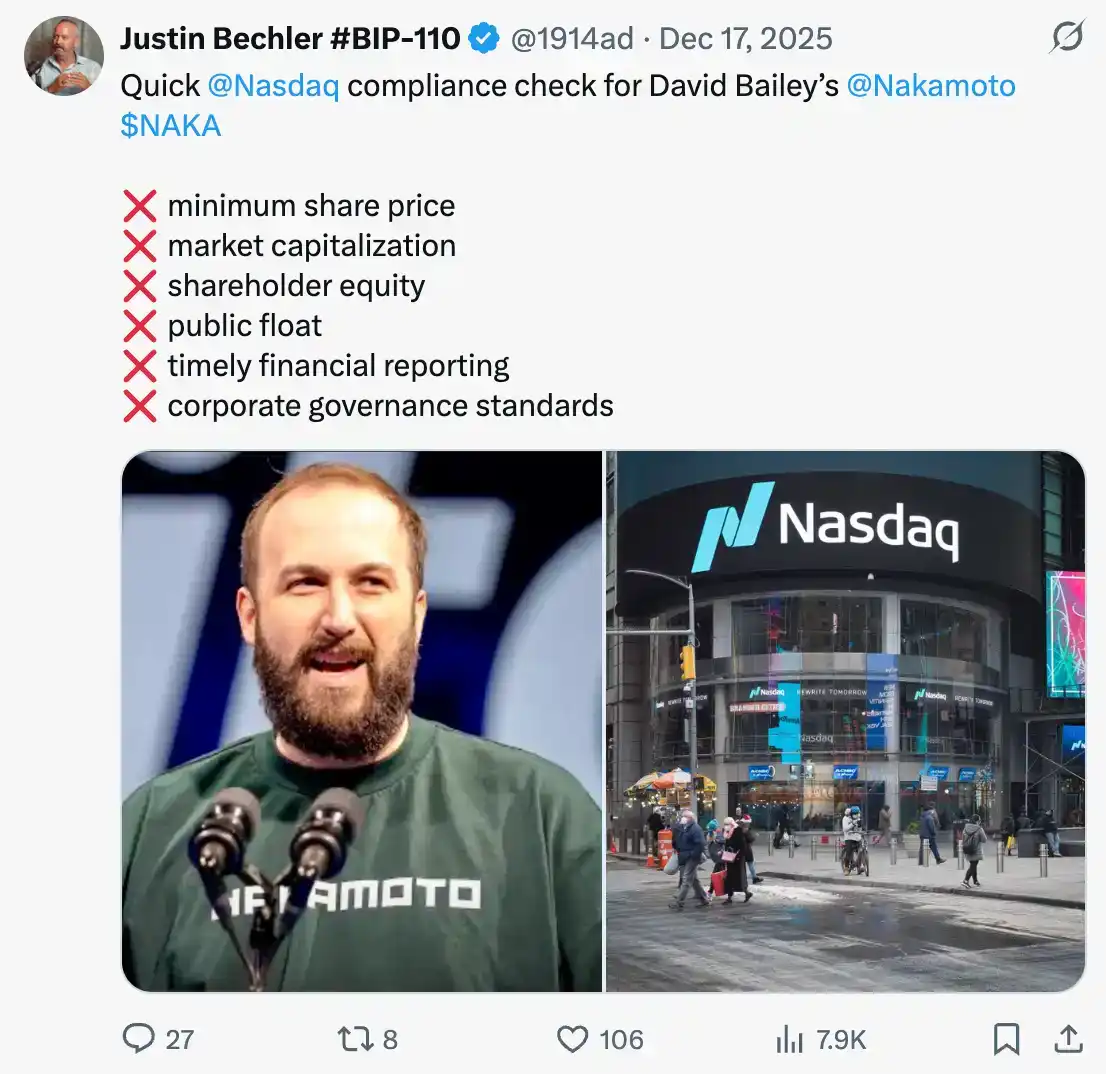
If delisted, Nakamoto would be unable to conduct ATM (at-the-Market) offerings, issue convertible bonds, or use stock as acquisition currency. Everything Bailey assembled in this shell relies on a Nasdaq listing that currently cannot be maintained.

Accounting Disaster

In November, Nakamoto filed a Form 12b-25 with the SEC, admitting it could not submit its quarterly financial report on time due to accounting complexities from the merger. Preliminary data revealed the truth:

The Nakamoto acquisition resulted in a $59.75 million loss (payment price higher than net asset value)

$22.07 million unrealized loss on digital assets

$1.41 million realized loss from selling Bitcoin

$14.45 million loss on debt extinguishment from refinancing rotations

A quarterly loss of approximately $97 million, partially offset by a $21.8 million accounting gain from contingent liabilities. This company, which was supposed to be the perfect Bitcoin reserve tool, couldn't even submit its books on time.

The Heist

This brings us back to this morning.

Nakamoto announced signing a definitive merger agreement to acquire BTC Inc and UTXO Management. BTC Inc owns Bitcoin Magazine and operates the Bitcoin Conference. UTXO manages a Bitcoin-focused hedge fund.

Bailey is the Chairman and CEO of the buyer, Nakamoto.

He is also the founder of the sellers, BTC Inc and UTXO.

He is the buyer, the seller, and the CEO approving the terms.

But weeks before the acquisition, he quietly handed the CEO title to Brandon Greene, creating a paper-thin separation between himself and the entities he was about to buy with shareholder equity.

This morning's deal was entirely financed with Nakamoto stock, priced at $1.12 per share based on a call option embedded in the original marketing services agreement. And $NAKA is still struggling to climb back to $0.29.

Bailey's companies received a stock valuation nearly four times the current market price. Security holders of BTC Inc and UTXO will receive 363.6 million shares, valuing the deal at $107.3 million at market prices.

But these shares were issued at $1.12, meaning the deal was structured when NAKA's stock was flying high, and the terms were never adjusted when the stock crashed.

Forget the fictional pricing on the contract. What really matters is that 363.6 million new shares just entered the float. Regardless of whether the documents say $1.12 or $0.29, existing shareholders were diluted by this quantity. The $1.12 label is a courtesy to the seller, but the dilution is real.

No additional shareholder approval was needed because the call option was already embedded in the original merger documents, and shareholders voted to approve them when NAKA's stock was still at $20, $30.

The retail investors who approved these terms had no idea they were authorizing the future acquisition of Bailey's private business at a locked-in high premium while their own shares were turning to dust.

Architecture of Self-Dealing

Stepping back, the entire architecture is breathtakingly elegant.
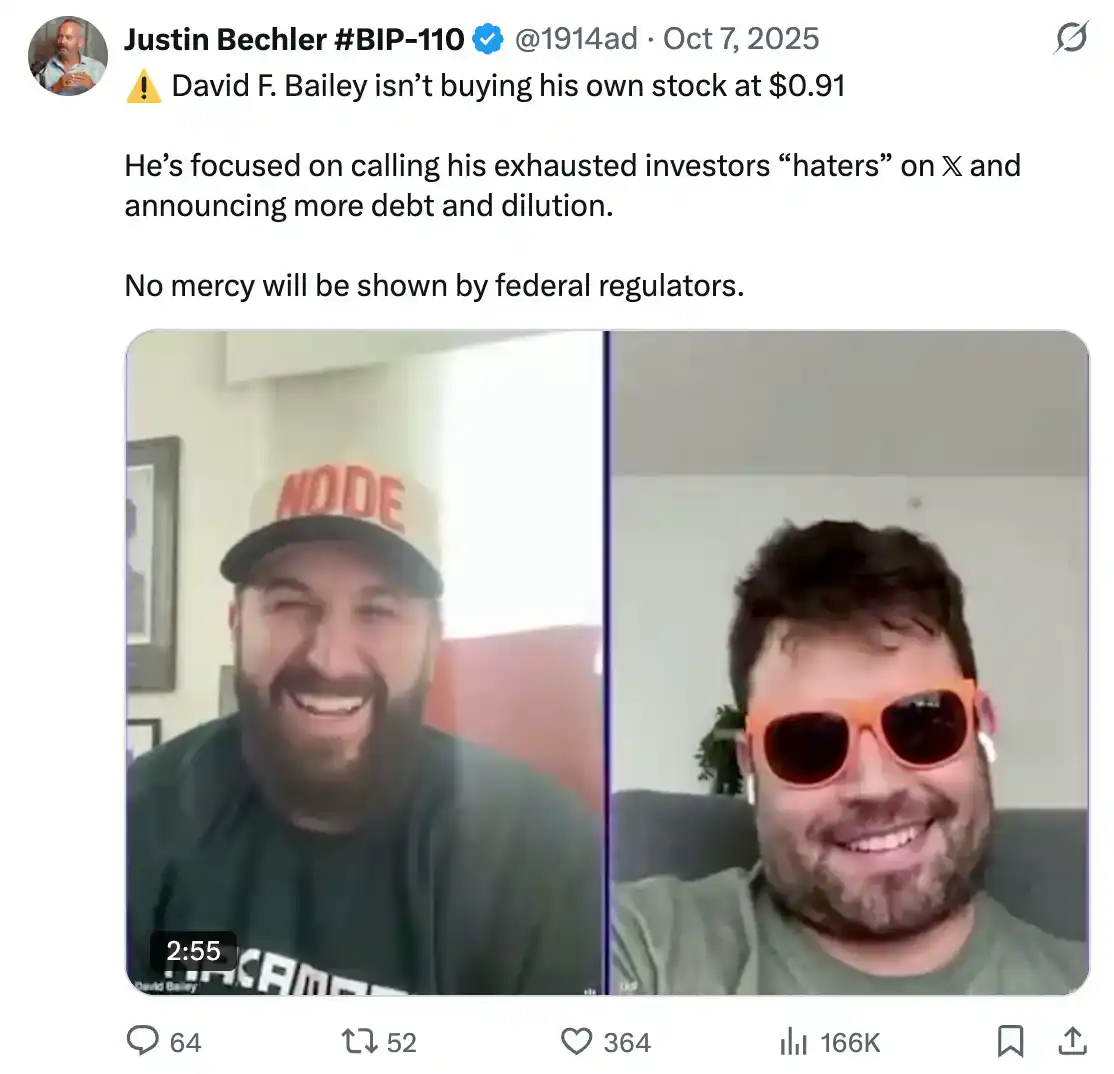
Bailey created Nakamoto Holdings. Merged it into a public shell company via KindlyMD, raising $710 million in the process. Driven by retail enthusiasm, the stock was pumped to 23x NAV. PIPE investors got in at $1.12, while the public paid 20 to 30 times that. The stock then crashed 99%.

During this time, the company changed lenders three times in a week, trying to manage $200 million in debt that was structured to convert to equity when the stock price was much higher.

Now, with the shattered stock price below 30 cents, Bailey is using this hollowed-out tool to swallow his private empire at terms agreed upon when the stock was a hundred times higher. The initial KindlyMD merger was the Trojan horse, and the acquisition of BTC Inc was the real payload.

Bailey told us from the start. In the initial press release, he said Nakamoto would acquire BTC Inc, subject to audit and call option exercise. The MSA was publicly filed, and the option terms were disclosed. Everything was legally compliant and fully transparent—just like all complex financial engineering, the truth was buried in piles of documents no one would read.

The person who operates Bitcoin Magazine, organizes the world's largest Bitcoin conference, and positions himself as a leader of the Bitcoin movement, built a public company, destroyed 99% of shareholder value, and is now using it to acquire his own businesses at a premium.

He once compared himself to the Medicis. At least the Medicis created value for Florence before taking their cut.

Nakamoto is the freak show that happens when influencer culture meets the public stock market.

Exit Liquidity

David Bailey raised $710 million from over 200 investors across six continents. He promised them a future like the Morgans, Medicis, and Rothschilds, a financial dynasty built on Bitcoin. He told them Nakamoto would bring Bitcoin to the center of global capital markets. He said their names would echo through history.

But he delivered a 99% loss.

He priced the PIPE at $1.12 while retail bought at $28. He embedded call options to acquire his own companies into the filings without shareholders understanding what they were authorizing. He rotated three lenders in a week to prevent $200 million in debt from crushing equity, accumulating $14 million in debt extinguishment losses along the way. He sold Bitcoin at a loss from the treasury that was supposed to only accumulate, not sell. He couldn't even submit quarterly financial reports on time. And when the stock price finally fell to 29 cents...

When the rubble was cleared and the retail investors who trusted him were wiped out, he exercised that call option, using the wreckage of their investment to buy his private empire at four times the market price.

Bailey holds 11 million shares at a cost of $1.12. Adam Back holds nearly 9 million shares. Balaji, Lopp, Yusko, Salinas, Jihan Wu—they all got in at a price that teachers, truck drivers, or first-time investors could never access. These are the people who shape the Bitcoin narrative. They run conferences, publish magazines, manage funds, post tweets. They are the supply chain of belief, turning skeptics into believers and believers into bag holders.

Now, Bailey owns Bitcoin Magazine, the Bitcoin Conference, and a hedge fund, all packed into a public company with a market cap only a fraction of its Bitcoin holdings, all acquired with stock priced four times the market value, all approved before a single cent from retail entered.

And he's not done.

Nakamoto has already filed with the SEC for a $5 billion ATM (At-the-Market) stock offering. Bailey now controls the media division, the conference division, the hedge fund, and a shelf registration that allows him to keep issuing stock collateralized by the Bitcoin treasury until the last bit of value is squeezed out.

When exactly did the Bitcoin community hand the keys to conference promoters and influencer capitalists? And why is anyone surprised when they drive away with the car?


Пов'язані питання

QWhat was the key mechanism David Bailey used to acquire his private companies at a premium using the struggling Nakamoto Holdings stock?

AHe utilized a call option embedded in the original marketing services agreement, which was approved by shareholders when the stock price was high, allowing the acquisition at $1.12 per share despite the market price collapsing to $0.29.

QHow did the PIPE investors benefit from the retail investors in the Nakamoto Holdings deal?

APIPE investors, including prominent Bitcoin figures, acquired shares at $1.12, while retail investors bought in at prices 20 to 30 times higher, around $28 to $31, creating a massive information asymmetry from the start.

QWhat was the consequences of Nakamoto's stock price falling below $1 for an extended period?

AThe company received a delisting notice from Nasdaq, threatening its ability to conduct ATM offerings, issue convertible notes, or use its stock as acquisition currency, which was crucial for Bailey's plans.

QWhat financial maneuvers did Nakamoto employ to manage its $200 million debt as the stock price collapsed?

AThe company rapidly cycled through lenders, first replacing a convertible note with a term loan, then a 30-day bridge loan, and finally a loan from Kraken secured by 150% over-collateralization of its Bitcoin treasury, accruing significant losses in the process.

QHow did David Bailey structure the acquisition to avoid additional shareholder approval for buying his own companies?

AThe call option for the acquisition was pre-approved by shareholders in the initial merger documents when the stock was highly valued, so no further vote was required when the deal was executed after the price crash.

Пов'язані матеріали

$30 Billion DeFi Capital Exodus: LayerZero Stumbles, Chainlink Feasts

Following the major DeFi security incident involving Kelp DAO, a significant migration of funds is underway from the cross-chain protocol LayerZero to Chainlink's CCIP (Cross-Chain Interoperability Protocol). Over $30 billion in Total Value Locked (TVL) from protocols like Kelp DAO, Solv Protocol, Re, and Tydro has moved to Chainlink in the past week, driven by security concerns. LayerZero is facing a severe trust crisis after the attack. Initially denying responsibility, LayerZero Labs has now issued a public apology, acknowledging management oversights. These include a vulnerable "1/1" single-node configuration for its Decentralized Verification Network (DVN) and past misuse of a multi-signature wallet by a team member. The protocol's weekly bridge volume has slumped to near-historic lows of around $470 million. In contrast, Chainlink is experiencing a surge in adoption and activity. Its independent active addresses recently hit multi-month highs, and whales have been accumulating LINK tokens. Beyond DeFi, Chainlink is securing partnerships with traditional finance giants like DTCC, European stock exchange operator SIX Group, and asset manager Amundi. While LayerZero has announced security upgrades—such as migrating to stronger multi-signature configurations and developing a second DVN client—and contributed to a rescue fund, the event underscores that security is becoming a decisive competitive factor as DeFi matures.

marsbit6 хв тому

$30 Billion DeFi Capital Exodus: LayerZero Stumbles, Chainlink Feasts

marsbit6 хв тому

The $13 Trillion Repo Market Is Quietly Being Rewritten by Blockchain

The $13 trillion repurchase agreement (repo) market, a crucial artery for global short-term funding, is experiencing a significant transformation through blockchain technology. After years of limited impact in finance, blockchain is finding substantial adoption in repo transactions. Major institutions like JPMorgan Chase, HSBC, and Broadridge are deploying tokenized repo platforms, with daily volumes already reaching tens of billions of dollars. Traditional repo markets operate with fixed hours, rely on intermediaries, and involve manual, time-consuming processes. Tokenized repos, by contrast, use blockchain to create digital tokens representing cash and securities collateral. This enables near-instantaneous settlement, 24/7 trading, automated execution, and enhanced auditability. The key drivers for adoption include maturing technology, more receptive regulators, and growing client recognition of tangible benefits like reduced operational friction and capital efficiency. Analyses, such as one from Broadridge, indicate that moving a portion of repo activity onto blockchain can significantly reduce a bank's required liquidity buffers, potentially freeing up billions in capital. The infrastructure is also seen as foundational for a future of round-the-clock trading for traditional assets. Challenges remain, including the existence of fragmented blockchain networks, the need for stress testing under extreme market conditions, and the loss of operational flexibility compared to manual processes. However, the industry consensus is that these are implementation hurdles. Tokenized repo has moved beyond pilot stages to become one of blockchain's most concrete and impactful applications in traditional finance, marking a pivotal shift in how a core market functions.

marsbit6 хв тому

The $13 Trillion Repo Market Is Quietly Being Rewritten by Blockchain

marsbit6 хв тому

From Gas Limit to 'Keyed Nonces', How to Understand the Next Step in Ethereum Scalability?

Ethereum’s scalability efforts are shifting toward a user-centric approach—focusing not only on higher TPS, but on translating technical upgrades into lower costs, smoother operations, and better wallet experiences. Two recent developments highlight this direction: - **Raising the Gas Limit to 200 million**: Following the Fusaka upgrade that increased it to 60 million, a consensus has formed around a potential future increase to 200 million. This would boost Ethereum’s execution capacity, but it is planned alongside other upgrades—such as ePBS, Block-Level Access Lists (BAL), and EIP-8037—to manage state growth and keep node operation viable for average participants. - **Keyed Nonces (EIP-8250)**: This proposal aims to improve how transactions are queued. Instead of a single linear nonce per account, it introduces multiple independent nonce domains. This prevents different types of transactions—such as private payments, session keys, or batch operations—from blocking each other. Vitalik Buterin views this as a foundational step toward better privacy support and more flexible state scalability. Together, these upgrades are part of a broader move to push complexity from wallets, DApps, and relays back into the protocol layer. For everyday users, this means future Ethereum interactions could become less congested, more intuitive, and safer—especially as core improvements in account abstraction, cross-L2 interoperability, and node decentralization continue to progress. Ultimately, Ethereum is evolving to handle not just more transactions, but more varied and complex on-chain use cases while preserving its decentralized foundation.

marsbit29 хв тому

From Gas Limit to 'Keyed Nonces', How to Understand the Next Step in Ethereum Scalability?

marsbit29 хв тому

Leaving OpenAI, How Much Has Their Net Worth Increased?

Former OpenAI employees have collectively accrued near-trillion dollar valuations through ventures and investments, charting AI's future. The article highlights two main paths: founding high-value companies like Anthropic and Perplexity, or applying insider insights as investors. Leopold Aschenbrenner exemplifies the investor path. After being fired from OpenAI, he leveraged firsthand knowledge of AI's massive energy demands to make hugely successful public market bets on nuclear and fuel cell companies, practicing "cross-industry cognitive arbitrage." Other alumni, like the Zero Shot VC fund founders, use their technical foresight for early-stage investing. Their key advantage lies not just in picking winners, but in knowing which technical approaches are likely dead ends—a "veto list" derived from internal OpenAI experience. Angel investing within the network, as seen with Mira Murati and Sam Altman, operates on deep, pre-existing understanding of a founder's capabilities, reducing due diligence to near zero. This creates an ecosystem bound by a shared belief in AGI's imminent arrival, differing from networks like the "PayPal Mafia" which were built on shared past struggles. The shift of these builders to investors signals a profound conviction: their situational awareness of the AI landscape is now so clear that deploying capital based on that judgment is more efficient than building themselves. They are allocating bets on the future they helped shape from the inside.

marsbit40 хв тому

Leaving OpenAI, How Much Has Their Net Worth Increased?

marsbit40 хв тому

Торгівля

Спот
Ф'ючерси

Популярні статті

Що таке BITCOIN

Розуміння HarryPotterObamaSonic10Inu (ERC-20) та його позиції у крипто-просторі Останніми роками ринок криптовалют спостерігав за зростанням популярності мем-коінів, які привертають інтерес не тільки трейдерів, але й тих, хто шукає спілкування та розважальну цінність. Серед цих унікальних токенів є HarryPotterObamaSonic10Inu (ERC-20), інтригуючий проект, що поєднує культурні посилання з тканинами криптовалюти. Ця стаття досліджує ключові аспекти HarryPotterObamaSonic10Inu, вивчаючи його механізми, спільноту та його взаємодію з ширшим крипто-ландшафтом. Що таке HarryPotterObamaSonic10Inu (ERC-20)? Як випливає з його назви, HarryPotterObamaSonic10Inu є мем-коіном, побудованим на блокчейні Ethereum, класифікованим за стандартом ERC-20. На відміну від традиційних криптовалют, які можуть підкреслювати практичну корисність або інвестиційний потенціал, цей токен процвітає завдяки розважальній цінності та силі своєї спільноти. Проект спрямований на створення середовища, де зацікавлені користувачі можуть об'єднуватися, ділитися ідеями та брати участь у заходах, натхненних різноманітними культурними явищами. Однією з примітних особливостей HarryPotterObamaSonic10Inu є нульовий податок на транзакції. Цей привабливий елемент має на меті заохочувати торгівлю та участь у спільноті, позбавлену додаткових витрат, які можуть відлякувати дрібних трейдерів. Загальна пропозиція монет становить один мільярд токенів, що позначає намір підтримувати суттєву циркуляцію в межах спільноти. Творець HarryPotterObamaSonic10Inu (ERC-20) Походження HarryPotterObamaSonic10Inu дещо окутане таємницею; деталі про творця залишаються невідомими. Розвиток цього токена позбавлений впізнаваної команди або чіткої стратегії, що не є рідкістю в секторі мем-коінів. Натомість проект виник органічно, а його розвиток значною мірою залежить від ентузіазму та участі його спільноти. Інвестори HarryPotterObamaSonic10Inu (ERC-20) Щодо зовнішніх інвестицій та підтримки, HarryPotterObamaSonic10Inu також залишається невизначеним. Токен не зазначає жодних відомих інвестиційних фондів або значної організаційної підтримки. Натомість життєва сила проекту полягає в його базовій спільноті, яка інформує про його зростання та стійкість через колективні дії та залученість у крипто-просторі. Як працює HarryPotterObamaSonic10Inu (ERC-20)? Як мем-коін, HarryPotterObamaSonic10Inu функціонує передусім поза традиційними рамками, що часто регулюють вартість активів. Є кілька відмінних аспектів, що визначають, як працює проект: Транзакції без податку: Завдяки відсутності податкових зборів на транзакції, користувачі можуть вільно купувати та продавати токен, не турбуючись про приховані витрати. Залучення спільноти: Проект процвітає завдяки взаємодії спільноти, використовуючи соціальні медіа для створення шуму та сприяння залученню. Обговорення, обмін контентом та залученість є ключовими елементами, що допомагають розширити його охоплення та зміцнити лояльність серед прихильників. Відсутність практичної корисності: Слід зазначити, що HarryPotterObamaSonic10Inu не пропонує конкретної корисності в рамках фінансової екосистеми. Натомість він класифікується як токен, що призначений в основному для розваги та спільнотних активностей. Культурне посилання: Токен кмітливо вплітає елементи популярної культури, щоб привернути інтерес, зв'язуючи з ентузіастами мемів та крипто-стежками. HarryPotterObamaSonic10Inu ілюструє, як мем-коіни функціонують інакше, ніж традиційні криптовалютні проекти, увійшовши на ринок як інноваційні соціальні конструкти, а не утилітарні активи. Хронологія HarryPotterObamaSonic10Inu (ERC-20) Історія HarryPotterObamaSonic10Inu відзначена кількома значними етапами: Створення: Токен виник з вірусного мему, захопивши уяву багатьох крипто-ентузіастів. Конкретні дати створення недоступні, що підкреслює його органічний розвиток. Лістинг на біржах: HarryPotterObamaSonic10Inu з'явився на різних біржах, дозволяючи зручніший доступ і торгівлю спільноти. Ініціативи залучення спільноти: Ведення діяльності, спрямованої на покращення взаємодії спільноти, включаючи конкурси, кампанії в соціальних мережах та створення контенту від фанатів та прихильників. Плани на майбутнє: Дорожня карта проекту включає запуск колекції NFT, мерчандайзинг та електронну комерцію, пов'язану з його культурними темами, що далі залучає спільноту та намагається додати більше вимірів до його екосистеми. Ключові моменти про HarryPotterObamaSonic10Inu (ERC-20) Спільнотний підхід: Проект надає пріоритет колективному внеску та креативності, забезпечуючи, щоб участь користувачів була в центрі його розвитку. Класифікація як мем-коін: Це є його епігенез розважальної криптовалюти, що відрізняється від традиційних інвестиційних інструментів. Жодного прямого відношення до Bitcoin: Незважаючи на схожість у назві, HarryPotterObamaSonic10Inu є відмінним і не має жодного зв’язку з Bitcoin або іншими усталеними криптовалютами. Зосередженість на співпраці: HarryPotterObamaSonic10Inu створено для того, щоб надати простір для співпраці та обміну історіями серед його власників, забезпечуючи шлях для творчості та спільного зв'язку. Перспективи на майбутнє: Амбіція розширитися за межі початкової концепції в NFT та мерчандайз відкриває шлях для проекту потенційно потрапити в більш мейнстрімні сфери цифрової культури. Оскільки мем-коіни продовжують захоплювати уяву спільноти криптовалют, HarryPotterObamaSonic10Inu (ERC-20) вирізняється своїми культурними зв'язками та орієнтованим на спільноту підходом. Хоча він може не відповідати типовій моделі утилітарного токена, його суть полягає в радощах і товариськості, що підтримуються серед його прихильників, підкреслюючи еволюційну природу криптовалют в усе більш цифрову епоху. Оскільки проект продовжує розвиватися, важливо спостерігати за тим, як динаміка спільноти вплине на його траєкторію в постійно змінюваному ландшафті технології блокчейн.

1.9k переглядів усьогоОпубліковано 2024.04.01Оновлено 2024.12.03

Що таке BITCOIN

Як купити BTC

Ласкаво просимо до HTX.com! Ми зробили покупку Bitcoin (BTC) простою та зручною. Дотримуйтесь нашої покрокової інструкції, щоб розпочати свою криптовалютну подорож.Крок 1: Створіть обліковий запис на HTXВикористовуйте свою електронну пошту або номер телефону, щоб зареєструвати обліковий запис на HTX безплатно. Пройдіть безпроблемну реєстрацію й отримайте доступ до всіх функцій.ЗареєструватисьКрок 2: Перейдіть до розділу Купити крипту і виберіть спосіб оплатиКредитна/дебетова картка: використовуйте вашу картку Visa або Mastercard, щоб миттєво купити Bitcoin (BTC).Баланс: використовуйте кошти з балансу вашого рахунку HTX для безперешкодної торгівлі.Треті особи: ми додали популярні способи оплати, такі як Google Pay та Apple Pay, щоб підвищити зручність.P2P: Торгуйте безпосередньо з іншими користувачами на HTX.Позабіржова торгівля (OTC): ми пропонуємо індивідуальні послуги та конкурентні обмінні курси для трейдерів.Крок 3: Зберігайте свої Bitcoin (BTC)Після придбання Bitcoin (BTC) збережіть його у своєму обліковому записі на HTX. Крім того, ви можете відправити його в інше місце за допомогою блокчейн-переказу або використовувати його для торгівлі іншими криптовалютами.Крок 4: Торгівля Bitcoin (BTC)Легко торгуйте Bitcoin (BTC) на спотовому ринку HTX. Просто увійдіть до свого облікового запису, виберіть торгову пару, укладайте угоди та спостерігайте за ними в режимі реального часу. Ми пропонуємо зручний досвід як для початківців, так і для досвідчених трейдерів.

4.5k переглядів усьогоОпубліковано 2024.12.12Оновлено 2025.03.21

Як купити BTC

Що таке $BITCOIN

ЦИФРОВЕ ЗОЛОТО ($BITCOIN): Комплексний аналіз Вступ до ЦИФРОВОГО ЗОЛОТА ($BITCOIN) ЦИФРОВЕ ЗОЛОТО ($BITCOIN) — це проект на основі блокчейну, що працює в мережі Solana, який має на меті поєднати характеристики традиційних дорогоцінних металів з інноваціями децентралізованих технологій. Хоча він має таку ж назву, як і Bitcoin, який часто називають “цифровим золотом” через його сприйняття як засобу збереження вартості, ЦИФРОВЕ ЗОЛОТО є окремим токеном, розробленим для створення унікальної екосистеми в ландшафті Web3. Його мета — позиціонувати себе як життєздатний альтернативний цифровий актив, хоча деталі щодо його застосувань і функціональностей все ще розробляються. Що таке ЦИФРОВЕ ЗОЛОТО ($BITCOIN)? ЦИФРОВЕ ЗОЛОТО ($BITCOIN) — це токен криптовалюти, спеціально розроблений для використання в блокчейні Solana. На відміну від Bitcoin, який виконує широко визнану роль зберігання вартості, цей токен, здається, зосереджується на більш широких застосуваннях і характеристиках. Помітні аспекти включають: Інфраструктура блокчейну: Токен побудований на блокчейні Solana, відомому своєю здатністю обробляти швидкі та низьковартісні транзакції. Динаміка постачання: ЦИФРОВЕ ЗОЛОТО має максимальне постачання, обмежене 100 квадрильйонами токенів (100P $BITCOIN), хоча деталі щодо його обігового постачання наразі не розголошуються. Утиліта: Хоча точні функціональності не викладені, є вказівки на те, що токен може бути використаний для різних застосувань, потенційно пов'язаних з децентралізованими додатками (dApps) або стратегіями токенізації активів. Хто є творцем ЦИФРОВОГО ЗОЛОТА ($BITCOIN)? На даний момент особа творців і команди розробників, що стоять за ЦИФРОВИМ ЗОЛОТОМ ($BITCOIN), залишається невідомою. Ця ситуація є типовою для багатьох інноваційних проектів у сфері блокчейну, особливо тих, що пов'язані з децентралізованими фінансами та феноменом мем-коінів. Хоча така анонімність може сприяти культурі, орієнтованій на спільноту, вона посилює занепокоєння щодо управління та підзвітності. Хто є інвесторами ЦИФРОВОГО ЗОЛОТА ($BITCOIN)? Доступна інформація вказує на те, що ЦИФРОВЕ ЗОЛОТО ($BITCOIN) не має жодних відомих інституційних спонсорів або помітних венчурних капіталовкладень. Проект, здається, працює за моделлю “рівний до рівного”, зосереджуючись на підтримці та прийнятті спільноти, а не на традиційних шляхах фінансування. Його активність і ліквідність переважно розташовані на децентралізованих біржах (DEX), таких як PumpSwap, а не на встановлених централізованих торгових платформах, що ще більше підкреслює його підхід знизу вгору. Як працює ЦИФРОВЕ ЗОЛОТО ($BITCOIN) Операційні механізми ЦИФРОВОГО ЗОЛОТА ($BITCOIN) можна детальніше розглянути на основі його дизайну блокчейну та характеристик мережі: Механізм консенсусу: Використовуючи унікальний proof-of-history (PoH) Solana в поєднанні з моделлю proof-of-stake (PoS), проект забезпечує ефективну валідацію транзакцій, що сприяє високій продуктивності мережі. Токеноміка: Хоча конкретні дефляційні механізми не були детально описані, велике максимальне постачання токенів вказує на те, що воно може задовольняти мікротранзакції або нішеві випадки використання, які ще потрібно визначити. Інтероперабельність: Існує потенціал для інтеграції з більш широкою екосистемою Solana, включаючи різні платформи децентралізованих фінансів (DeFi). Однак деталі щодо конкретних інтеграцій залишаються невизначеними. Хронологія ключових подій Ось хронологія, яка підкреслює значні віхи, пов'язані з ЦИФРОВИМ ЗОЛОТОМ ($BITCOIN): 2023: Початкове розгортання токена відбувається на блокчейні Solana, позначене його адресою контракту. 2024: ЦИФРОВЕ ЗОЛОТО набуває видимості, оскільки стає доступним для торгівлі на децентралізованих біржах, таких як PumpSwap, що дозволяє користувачам торгувати ним проти SOL. 2025: Проект спостерігає спорадичну торгову активність і потенційний інтерес до ініціатив, очолюваних спільнотою, хоча на даний момент не зафіксовано жодних значних партнерств або технічних досягнень. Критичний аналіз Сильні сторони Масштабованість: Основна інфраструктура Solana підтримує високі обсяги транзакцій, що може підвищити утиліту $BITCOIN у різних сценаріях транзакцій. Доступність: Потенційно низька торгова ціна за токен може привабити роздрібних інвесторів, сприяючи більш широкій участі завдяки можливостям дробового володіння. Ризики Відсутність прозорості: Відсутність публічно відомих спонсорів, розробників або процесу аудиту може викликати скептицизм щодо стійкості та надійності проекту. Волатильність ринку: Торгова активність сильно залежить від спекулятивної поведінки, що може призвести до значної волатильності цін і невизначеності для інвесторів. Висновок ЦИФРОВЕ ЗОЛОТО ($BITCOIN) постає як цікавій, але неоднозначний проект у швидко розвиваючійся екосистемі Solana. Хоча він намагається використати наратив “цифрового золота”, його відхід від встановленої ролі Bitcoin як засобу збереження вартості підкреслює необхідність чіткішого розмежування його передбачуваної утиліти та структури управління. Майбутнє прийняття та адаптація, ймовірно, залежатиме від вирішення поточної непрозорості та більш чіткого визначення його операційних та економічних стратегій. Примітка: Цей звіт охоплює синтезовану інформацію, доступну станом на жовтень 2023 року, і можуть відбутися події, що виходять за межі дослідницького періоду.

75 переглядів усьогоОпубліковано 2025.05.13Оновлено 2025.05.13

Що таке $BITCOIN

Обговорення

Ласкаво просимо до спільноти HTX. Тут ви можете бути в курсі останніх подій розвитку платформи та отримати доступ до професійної ринкової інформації. Нижче представлені думки користувачів щодо ціни BTC (BTC).

活动图片











