The Revelation from the Raydium Theft Incident: New DeFi Vulnerabilities Lurking in Forgotten Old Contracts

Foresight NewsОпубліковано о 2026-06-13Востаннє оновлено о 2026-06-13

Анотація

**Raydium Exploit Reveals DeFi's Hidden Risk: Forgotten "Zombie" Contracts** A recent attack on Raydium's deprecated V3 AMM pools resulted in a loss of approximately $1.34 million. The hacker exploited pools that were no longer supported by Raydium's current UI or SDK but remained fully functional and accessible on-chain. This incident highlights a critical, often overlooked category of risk in DeFi: inactive or legacy smart contracts that projects fail to properly decommission. Since March 2025, there have been at least 8 publicly reported attacks targeting such abandoned contracts, with total losses around $10.8 million. Including older pools and deprecated features, the count rises to 10 incidents with roughly $22.5 million in losses. These "zombie contracts" represent a lifecycle management failure rather than a code vulnerability, yet they are typically misclassified under general "code bug" categories in security reports, masking the true scale of the problem. The root cause is that projects often merely document a contract as "deprecated" without taking essential technical steps to secure it: withdrawing remaining assets, disabling external call functions, and implementing ongoing monitoring. These forgotten, under-monitored components become prime targets for attackers. To address this, the industry needs to recognize "zombie contracts" as a distinct risk category and establish standardized decommissioning protocols. Essential steps should include: 1) a formal ret...


Author: Gino Matos

Compiler: Luffy, Foresight News


TL;DR:


  • Hackers stole approximately $1.34 million in assets by exploiting Raydium's long-discontinued V3 Automated Market Maker liquidity pools.
  • This incident exposes a widespread issue: Old contracts decommissioned by DeFi projects are still operational on-chain. These forgotten underlying infrastructures have become easily overlooked attack targets.
  • Public reports indicate that since March 2025, there have been at least 8 similar theft incidents targeting old contracts within the industry, suggesting that a vast amount of unattended legacy code remains externally callable.


Recently, a vulnerability in Raydium's AMM V3 resulted in a loss of $1.34 million. This incident involved five liquidity pools outside the project's current product ecosystem. These pools were unsupported by Raydium's UI or SDK and inaccessible to ordinary users, yet they were ultimately exploited by hackers.


This attack targeted the neglected old contracts and underlying infrastructures within the industry, revealing major flaws in the full lifecycle management of smart contracts. This type of problem is not unique to this one Solana-based decentralized exchange.


The Overlooked Risk Category


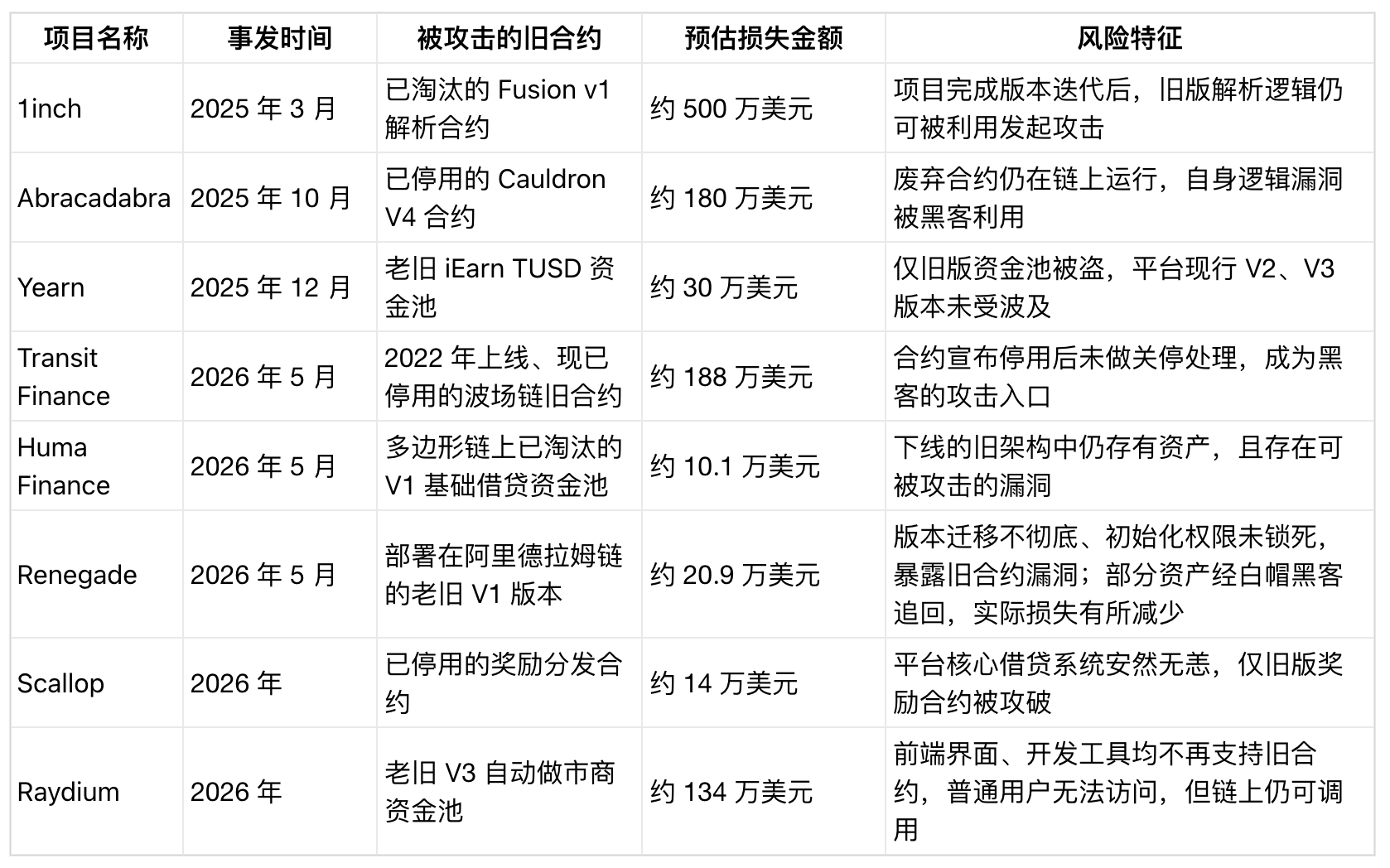
According to publicly available security incident reports, from March 2025 to the present, there have been at least 8 confirmed attack cases explicitly due to abandoned, phased-out, or old contracts, with cumulative losses of approximately $10.8 million.


If attacks involving old liquidity pools and outdated supporting products are included in the statistics, the number of related incidents reaches 10 (including this Raydium theft), with total losses amounting to about $22.5 million.


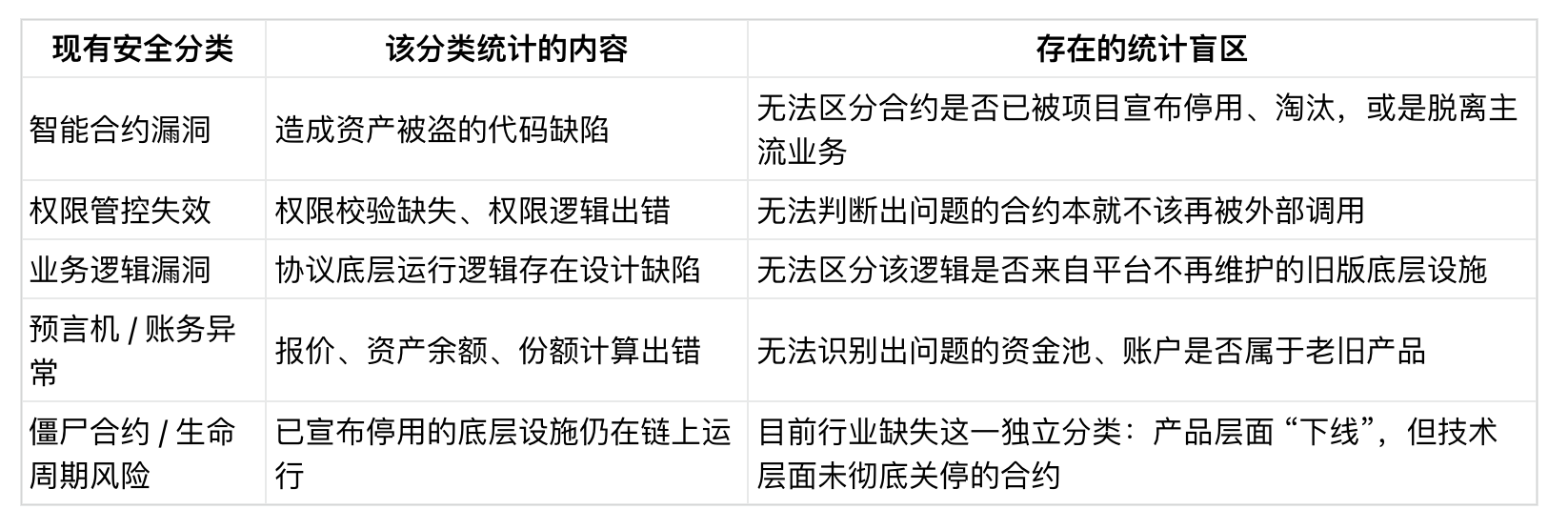
Most current industry security incident tracking platforms categorize attack types based on technical causes. Common classifications include: smart contract code vulnerabilities, permission control failures, oracle manipulation, private key leakage, cross-chain bridge defects, etc.


Zombie contracts (i.e., old contracts declared discontinued by projects but still normally callable on-chain) belong to a completely different risk dimension. They are security incidents caused by failures in contract lifecycle management, yet they have always been buried within the statistical entries of various conventional vulnerabilities and have not been classified separately.


The reason Raydium's V3 AMM liquidity pools were abandoned stems from the formal shutdown of the Serum project they relied on, rendering this set of old contracts completely non-functional. The corresponding liquidity assets have been idle on-chain ever since.


Raydium's currently used new version of the contract performs dual verification of two key pieces of information: first, it checks asset proportions through a total supply verification mechanism; second, it verifies the minting address of liquidity tokens and various associated account information.


However, this outdated V3 contract completely omitted these two verification processes. Hackers exploited this vulnerability by forging new liquidity tokens and impersonating legitimate certificates, directly bypassing all risk control rules.


In this incident, a total of approximately 150,177 RAY, 5,603 SOL, and 893,700 USDC were stolen. These assets had been stored in the platform's old liquidity pools for a long time. Although detached from mainstream operations, their on-chain call permissions were never deactivated.


Eight Cases Reveal Common Problems


Since 2025, several well-known DeFi projects have stumbled over old contracts. All incidents share the same characteristics: the project team claimed that the current version of the product and active users were unaffected, but because the old contracts were not completely shut down, the project treasury ultimately bore the full losses.


Why Old Contract Risks Are Overlooked


Currently, the vast majority of industry security incident classification systems focus on attack methods, tampering targets, and code failure points, representing an analytical perspective "starting from technical vulnerabilities." This also leads to the masking of zombie contract incidents. The core of such problems is never coding errors, but the failure of projects to execute the necessary complete shutdown of old contracts.


A 2025 industry research paper analyzed 50 major global crypto security incidents between 2022 and 2025, with cumulative losses exceeding $1 billion. The study pointed out that high-harm on-chain attacks are often the result of chain risk superposition, simultaneously involving human operations, daily maintenance, economic models, contract lifecycle management, community governance, and other levels.


The paper proposed a four-layer root cause analysis framework, clearly classifying contract lifecycle management vulnerabilities and community governance vulnerabilities as independent risk categories separate from code writing vulnerabilities. The zombie contract problem is a typical lifecycle management vulnerability. However, in existing security statistics systems, such incidents are uniformly categorized as "code vulnerabilities," and the corresponding loss data is concealed under other classifications, failing to attract sufficient industry attention.


Beware the "Contract Graveyard": Old Infrastructure Becomes a New Attack Hotspot


If DeFi projects continue to treat "contract shutdown" as an optional, trivial matter—merely annotating "this contract is discontinued" in product documentation without transferring idle assets, disabling call functions, or continuously monitoring status—then hackers will persistently target this "contract graveyard."


Every large DeFi project's historical deployment records have now become attack targets that hackers can search and exploit. The currently counted $22.5 million in losses is merely the value from publicly exposed cases; the real risk is far higher.


Those old liquidity pools holding assets but detached from mainstream user workflows, historical authorization interfaces, and early partnership integration modules receive far less operational monitoring than current business systems, making them precisely the preferred targets for hackers.


To change the status quo, "zombie contracts" must first be listed as an independent risk category with separate incident statistics. Secondly, the contract decommissioning process must be incorporated into standardized security procedures, placed on equal footing with code audits. Only by implementing full lifecycle operations and maintenance can the attack surface be effectively reduced.


Currently, the industry's handling methods are largely similar. Raydium used its project treasury to cover the $1.34 million loss. Transit Finance and Huma Finance also bore user losses through the project side.


This also means that contract decommissioning is no longer just a documentation annotation task; it is an essential security control link.


Seven Security Control Standards for Contract Decommissioning


For the shutdown of old contracts, the industry can establish standardized control processes. The specific requirements and their functions are as follows:
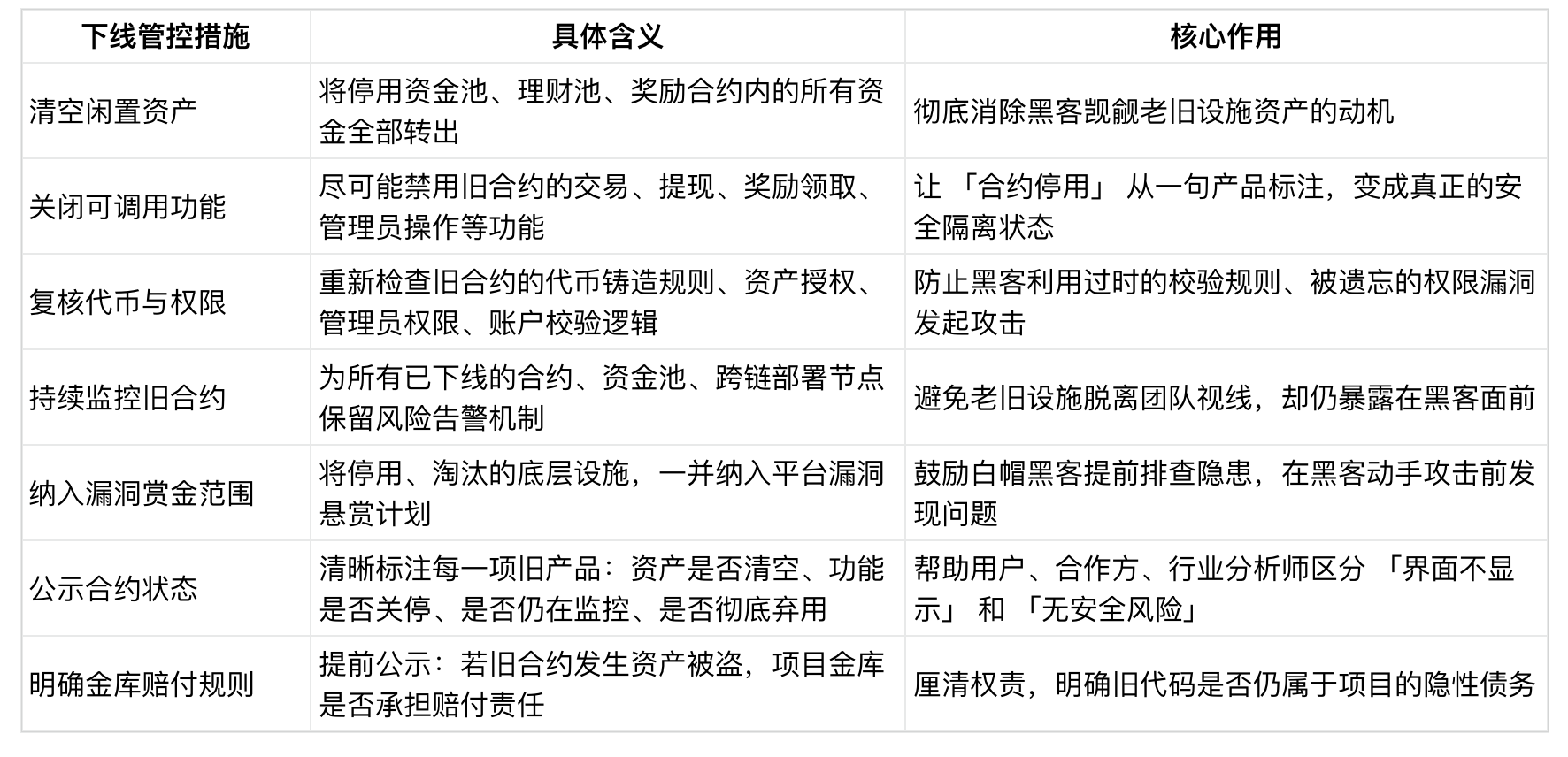


Simply annotating "contract discontinued" in documentation merely shifts the security risk to the project treasury, while the attack vulnerability remains. Announcing a shutdown only at the product level without a complete technical deactivation leaves old contracts perpetually callable: project teams neglect oversight, while hackers watch closely at all times.


The value of a DeFi project is not only reflected in its current total value locked (TVL) but also in the historical code and underlying architectures accumulated along its journey. And this forgotten history has now become a new security突破口 (breakthrough point).


Пов'язані питання

QWhat is the main vulnerability exploited in the recent Raydium hack, and what was the estimated loss?

AThe main vulnerability was in Raydium's deprecated V3 Automated Market Maker (AMM) liquidity pools. Hackers exploited these old, inactive contracts to steal approximately $1.34 million worth of assets.

QAccording to the article, what new risk category does the Raydium incident and similar attacks highlight for the DeFi industry?

AThe incident highlights the risk category of 'zombie contracts' or outdated smart contracts that have been deprecated but remain operational and callable on the blockchain, becoming overlooked attack surfaces.

QHow many similar attacks targeting outdated or deprecated contracts have been reported since March 2025, and what is the total estimated loss mentioned?

ASince March 2025, there have been at least 8 reported attacks specifically targeting deprecated or old contracts, with a cumulative loss of about $10.8 million. Including older liquidity pools and related products, the total is 10 incidents with losses around $22.5 million.

QWhy are these 'zombie contract' risks often overlooked in current security incident classifications?

ACurrent security classifications focus on technical vulnerabilities (like code bugs, oracle manipulations). 'Zombie contract' issues stem from lifecycle management failures—contracts not being properly decommissioned—and are therefore often mis-categorized under general 'code vulnerability' labels, obscuring their specific nature.

QWhat does the article suggest as a key action to properly address the risk of outdated contracts?

AThe article suggests establishing standardized security control processes for contract decommissioning. This includes measures like withdrawing all idle assets, permanently disabling key functions, revoking permissions, and continuous monitoring, treating contract sunsetting as a critical security task on par with code auditing.

Пов'язані матеріали

As Consensus Accelerates, What Are Young Investors Betting On?

Title: As Consensus Forms Faster, What Are Young Investors Betting On? In the rapid evolution of tech investment, a new generation of young investors is navigating a landscape where AI, robotics, commercial aerospace, and quantum computing are advancing simultaneously. Traditional investment logic based on financial models is giving way to a need for deep technical understanding and the ability to act before industry consensus forms. An analysis of trends from the "WAIC FUTURE TECH" list of young investment leaders reveals key shifts in focus. The first major trend is the movement of AI from the digital screen into the physical world. Investment is shifting from large language models and chatbots towards embodied AI, robotics, AI hardware, and edge computing. While demonstrations generate excitement, the real challenge lies in achieving scalable, reliable, and cost-effective delivery in complex real-world environments like factories and logistics. Success depends not just on algorithms but on the integration of sensors, actuators, and control systems. Second, the competitive focus for large models is moving beyond raw capability toward building an "intelligence flywheel." The goal is to create self-reinforcing systems where user interaction generates data, improving the model, which in turn enhances the user experience and attracts more engagement. Companies that successfully embed AI into workflows to create these closed-loop systems can build lasting value that isn't easily erased by the next model upgrade. Third, facing a potential bottleneck in high-quality human-generated data, investors are looking at new underlying technologies. Reinforcement learning and self-play, as demonstrated by AlphaGo Zero, offer paths for AI to generate its own experience. Scientific foundation models, which aim to build general AI capabilities for fields like life sciences and materials discovery, represent a non-consensus direction that could unlock new frontiers of knowledge and data. Finally, in deep-tech areas like quantum computing, commercial aerospace, and space-based infrastructure, patient capital is essential. These fields have long, uncertain development and validation cycles involving complex engineering, supply chains, and regulations. Investment here requires a long-term view, focusing on foundational team capabilities and the eventual emergence of market demand, even if commercial returns are distant. Collectively, these trends illustrate how young investors are adapting to a new era. They are learning to make earlier, technically-informed judgments, balance hype with real-world viability, and provide the patient capital needed to build the deep-tech foundations of the future.

marsbit6 хв тому

As Consensus Accelerates, What Are Young Investors Betting On?

marsbit6 хв тому

Can Japan Buy Growth with AI? Will the Bond Market Believe It?

Japan's cabinet has introduced the 2026 Basic Policy on Economic and Fiscal Management and Reform, shifting its primary fiscal target. The new framework moves away from the traditional annual primary balance goal and instead prioritizes a stable reduction of the debt-to-GDP ratio. This change is tied to a strategy of increased "responsible proactive fiscal" spending, aiming to boost long-term growth through investments in strategic sectors like AI, semiconductors, energy, and robotics. The government estimates total public and private investment in 62 key technologies could exceed 370 trillion yen by 2040. The market reaction has been mixed and cautious. While equity markets may respond to policy signals, bond markets are focused on fiscal credibility. Concerns center on whether the weakening of the clear primary balance anchor could lead to looser fiscal discipline. If investors doubt that these strategic investments will generate sufficient productivity gains, tax revenue, and nominal growth to outpace rising interest costs, they may demand higher yields on Japanese Government Bonds (JGBs). Recent volatility in the yen and JGB yields, with the 10-year yield briefly reaching 2.9%, reflects this skepticism. The success of this new framework hinges on two factors: whether Japan can achieve a nominal growth rate consistently higher than its long-term interest rates, and whether future budgets demonstrate disciplined control over bond issuance. The government's narrative is that strategic investment is essential to break Japan's cycle of low growth, aging, and labor shortages. However, the bond market will continuously assess the credibility of this plan, pricing the risk that it may represent fiscal expansion rather than a viable growth strategy.

marsbit43 хв тому

Can Japan Buy Growth with AI? Will the Bond Market Believe It?

marsbit43 хв тому

Misjudged A-Shares: Resilience, Expectations, and Confidence

China's A-share market recently faced selling pressure, especially in tech sectors, initially triggered by a global tech sell-off that began in South Korea. However, the article argues this is a case of "mistaken injury" and highlights the market's underlying resilience. This resilience stems from three main pillars: **1) Tech Sector Fundamentals:** Unlike Korea's market dominated by a few memory chip stocks, China's tech sector is diversified across computing, communications, electronics, and semiconductors, supported by dual narratives of global AI supply chains and domestic substitution. Core areas like optical modules and fiber optics continue to show strong earnings growth. **2) "National Team" Support:** State-backed institutions and large corporations have made significant market purchases and announced buybacks, providing liquidity and signaling confidence. This is seen as a stabilizing policy signal, often associated with market bottoms. **3) Broader Market Pillars:** Other major sectors are showing endogenous recovery momentum. Consumer stocks benefit from stabilizing CPI and signs of sector recovery (e.g., liquor price hikes). Cyclical sectors like aluminum have high earnings, potential price increases due to tight supply, and low valuations. The financial sector offers stable dividends and low valuations. The conclusion is that the sell-off was driven by external contagion, not a collapse in fundamentals. With strong policy support and recovering momentum across key sectors, the A-share market possesses the toughness to regain stability.

marsbit1 год тому

Misjudged A-Shares: Resilience, Expectations, and Confidence

marsbit1 год тому

Торгівля

Спот
活动图片




