A cryptocurrency company operated by billionaire brothers the Winklevosses once faced a severe federal lawsuit, but after Donald Trump returned to the White House, the U.S. Securities and Exchange Commission (SEC) decided to suspend the case. Previously, the SEC had also filed a lawsuit against the world's largest cryptocurrency exchange, Binance, yet after the new administration took office, the lawsuit was completely dismissed. Additionally, after years of legal disputes with Ripple Labs, the new SEC attempted to reduce the penalties imposed by the court on this cryptocurrency company.
An investigation by The New York Times found that the SEC's retreat in these cases reflects a comprehensive shift in the federal government's attitude toward the cryptocurrency industry after Trump began his second term. No regulatory agency has ever withdrawn multiple lawsuits against the same industry on such a large scale, yet The New York Times discovered that when Trump took office again, over 60% of the cryptocurrency-related cases being pursued by the SEC saw relaxed handling—either suspending proceedings, reducing penalties, or outright dismissing cases.
The investigation also pointed out that the move to dismiss cryptocurrency cases is particularly unusual. During Trump's administration, the proportion of dismissed cases related to cryptocurrency companies far exceeded the dismissal rate for cases in other industries. Although the specifics of these cryptocurrency lawsuits vary, many of the involved companies share a commonality: financial dealings with Trump, who calls himself the "crypto president."
As the top federal agency overseeing financial market violations, the SEC is no longer actively pursuing any company known to be associated with Trump. For all companies that have cooperated with the Trump family's cryptocurrency business or funded his political activities, the SEC has dismissed related lawsuits. The only remaining cryptocurrency-related cases now involve obscure entities with no apparent connection to Trump.
· The SEC dismissed 7 cryptocurrency cases, 5 of which involved companies with known ties to Trump;
· Another 7 cryptocurrency cases were suspended, with favorable settlement plans or concessions made, 3 of which involved companies with known ties to Trump;
· Only 9 cases remain without dismissal, and none of these involve parties with known connections to Trump.
The SEC stated in a declaration that there was no political favoritism in handling cryptocurrency enforcement cases, and this adjustment in enforcement direction was based on legal and policy considerations, including doubts about its own authority to regulate the cryptocurrency industry. The SEC also emphasized that long before Trump supported the cryptocurrency industry, current Republican commissioners fundamentally opposed filing most cryptocurrency-related lawsuits, while stressing that the SEC "places great importance on securities fraud issues and earnestly safeguards investor rights."
There is currently no evidence that the president pressured the SEC to show leniency toward specific cryptocurrency companies. The New York Times also found no indication that these companies influenced the cases by providing political donations or engaging in business collaborations with Trump; some financial dealings and business collaborations even occurred after the SEC adjusted its case handling approach.
But the core issue is that Trump is both a participant in the cryptocurrency industry and its top policymaker. As president, the policies he promotes, if highly aligned with his personal interests, create conflicts of interest. The fact that many cryptocurrency companies sued by the SEC are connected to him highlights this very conflict.
At the start of Trump's second term, the White House publicly declared that the president would "halt those aggressive enforcement actions and excessive regulatory measures that hinder cryptocurrency innovation." Although the SEC's dismissal of individual cryptocurrency cases had already attracted public attention, The New York Times, through analyzing thousands of court records and conducting dozens of interviews, found that the scale of the SEC's relaxation of cryptocurrency regulation this year far exceeds previous instances, and Trump's allies in the cryptocurrency industry have reaped significant benefits, details that had not been fully exposed before.
All defendants involved in this investigation denied any violations, with many claiming they were only accused of procedural violations. Additionally, some cases where the SEC relaxed its handling involved companies with no apparent connection to the president.
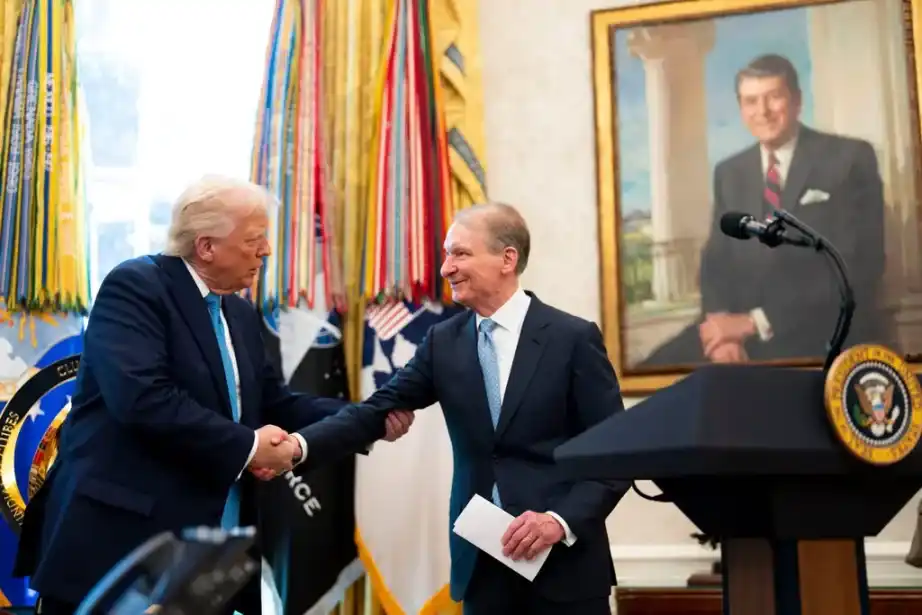
White House Press Secretary Karoline Leavitt dismissed claims that Trump and his family have conflicts of interest, stating that the related policies Trump is promoting "fulfill the president's promise to advance innovation, create economic opportunities for all Americans, and help the U.S. become a global cryptocurrency hub."
The Trump administration has comprehensively relaxed regulation of the cryptocurrency industry, with the U.S. Department of Justice even disbanding its cryptocurrency enforcement unit. The SEC's policy shift this year can be described as a 180-degree turn.
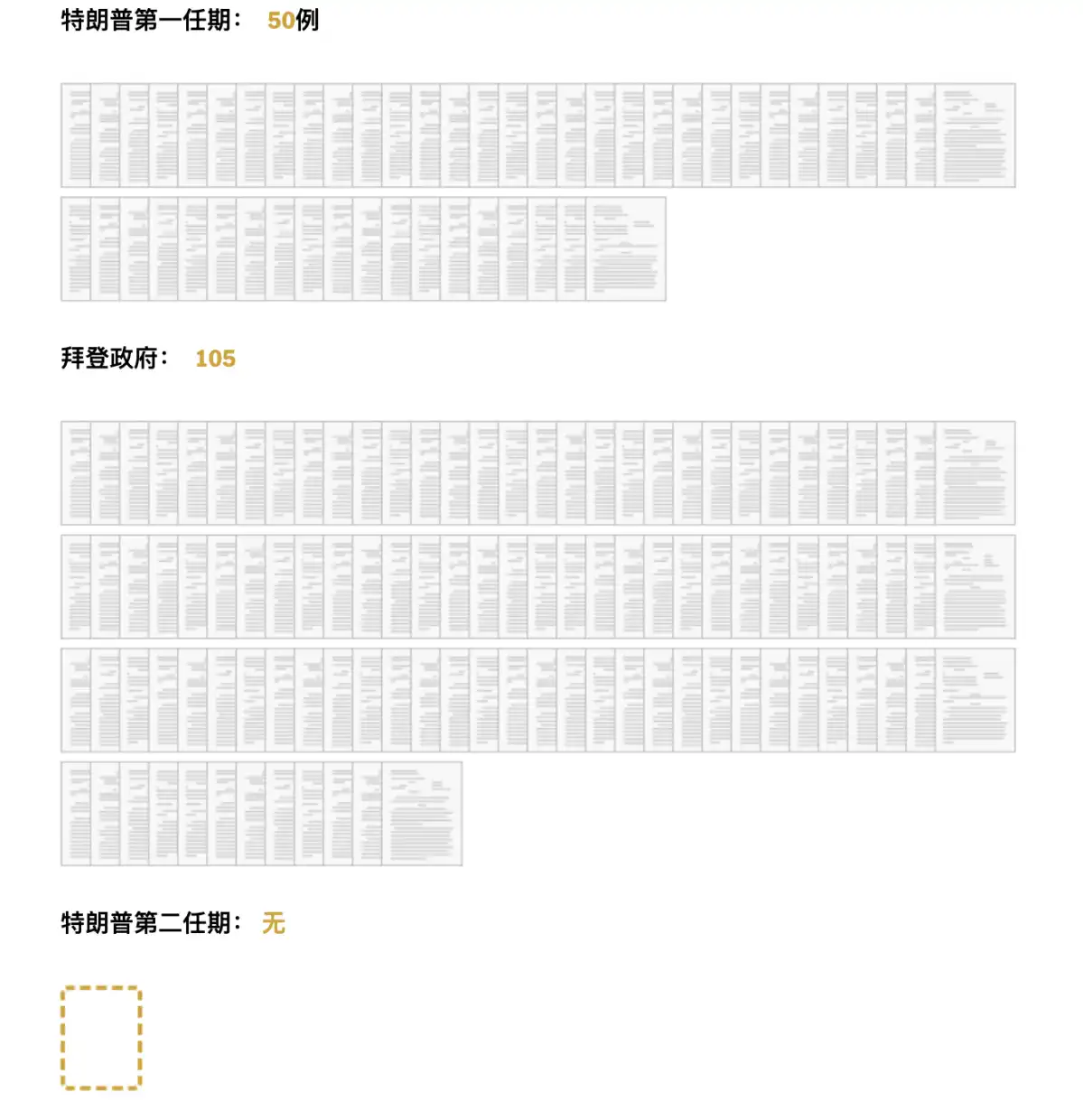
Analysis by The New York Times shows that during the Biden administration, the SEC filed an average of over two cryptocurrency-related cases per month, through channels including federal courts and the agency's internal legal system. Even during Trump's first term, the SEC filed about one cryptocurrency-related case per month on average, including the high-profile Ripple lawsuit.
In stark contrast, after Trump took office again, the SEC has not filed a single cryptocurrency-related case, while dozens of lawsuits against other industries are still proceeding.
Atkins stated in a declaration that these measures by the SEC were merely to rectify the overly aggressive regulatory stance of the previous administration toward the cryptocurrency industry. He said the SEC under Biden used enforcement power to forcibly implement new policies. He emphasized: "I have made it clear that we will completely abandon the model of using enforcement as a substitute for regulation."
While cryptocurrency companies cheer this new era, veteran SEC lawyers who led these cases are deeply concerned about the trend of relaxed regulation. They worry that this agency, founded during the worst of the Great Depression and nearly a century old, with its original purpose of protecting investor interests and maintaining market order, will now, by relaxing regulatory pressure, embolden the cryptocurrency industry, thereby harming consumer rights and even posing risks to the entire financial system.
Christopher E. Martin, a former senior litigation attorney at the SEC who led a lawsuit against a cryptocurrency company, chose to retire after the SEC dismissed the case this year. Speaking about the SEC's broad relaxation of regulation, he said bluntly: "This is complete capitulation, simply throwing investors to the wolves."
The End of Regulatory Crackdowns
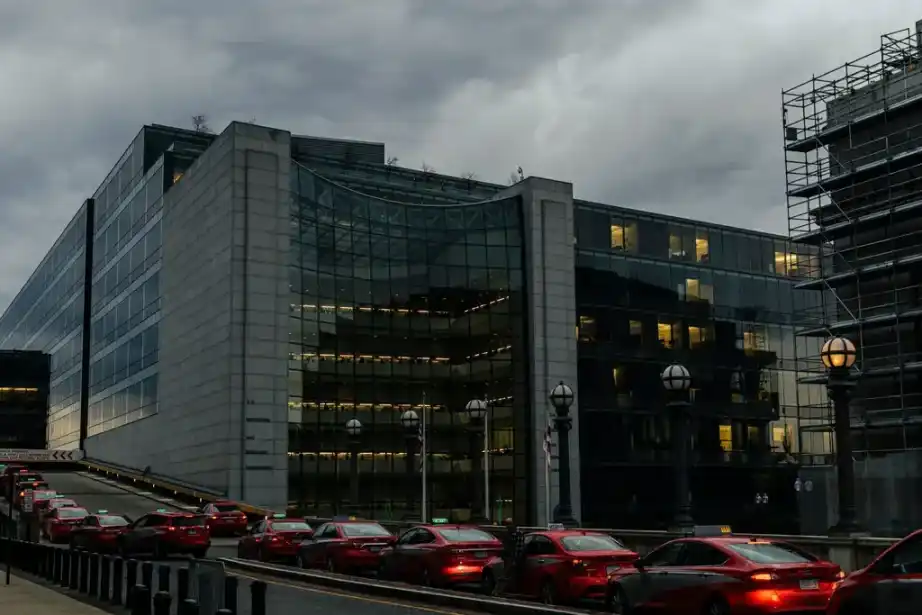
Late last year, inside the glass-walled SEC headquarters in Washington, regulatory actions against cryptocurrency had nearly ground to a halt. Gary Gensler, the SEC chairman during the Biden administration, had wanted to advance multiple cryptocurrency investigations, but his term was counting down.
Previously, Trump had just announced the launch of a cryptocurrency project called World Liberty Financial with his family,紧接着 (immediately after) successfully won re-election, and he had long publicly declared his intention to limit the SEC's power.
In fact, Trump has not always supported the cryptocurrency industry. During his first term, he once tweeted that cryptocurrency was purely air and could facilitate illegal activities like drug trafficking. The SEC at that time also adopted a tough regulatory stance, even establishing a dedicated unit to investigate online violations in the cryptocurrency field and filing dozens of related lawsuits.
During the Biden administration, the SEC's regulation of cryptocurrency escalated further. In 2022, the large cryptocurrency exchange FTX collapsed, and that same year the size of the SEC's cryptocurrency regulatory division nearly doubled, expanding to about 50 lawyers and industry experts.
Whether during Trump's first term or the Biden administration, the SEC始终 believed that since investors might put their life savings into cryptocurrency, they had the right to understand the risks. But a thorny legal question始终 plagued the SEC: Did the agency truly have the authority to file these lawsuits against the cryptocurrency industry? The answer depended on whether cryptocurrency qualifies as a security, a derivative category of modern stocks and other financial instruments.
The SEC claimed that many cryptocurrencies are essentially securities, therefore cryptocurrency exchanges and brokers must register with the SEC, disclose detailed information as required, and some institutions must undergo independent review. If registration obligations are not fulfilled, the SEC can sue them under securities laws.
The cryptocurrency industry countered that most cryptocurrencies are not securities but a special type of financial product that should have its own专属 regulatory rules, which the SEC had not yet formulated. Summer Mersinger, CEO of the cryptocurrency industry association Blockchain Association, said: "We don't want to escape regulation, we just hope to have clear and definite rules as a basis for operation."
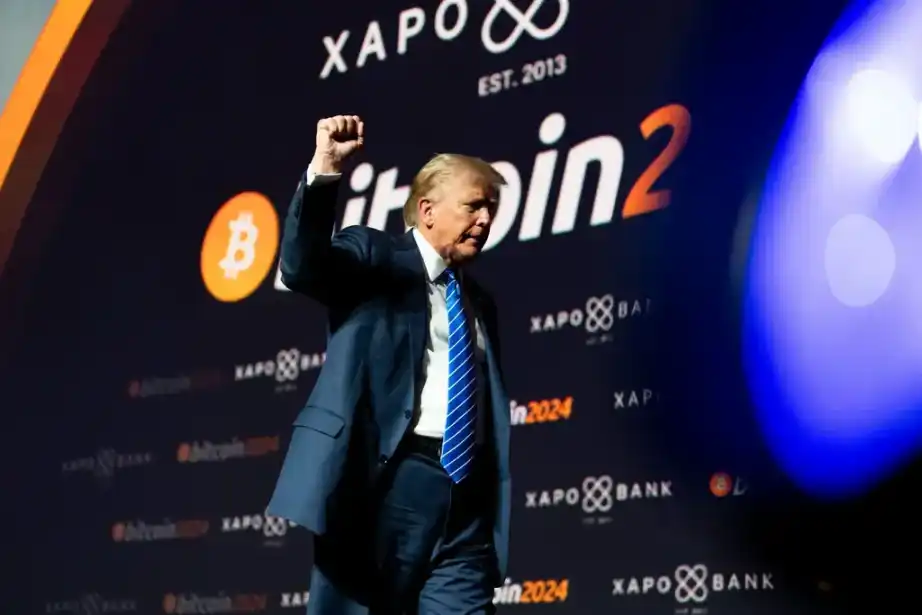
2024 marked a turning point, with Trump's attitude completely shifting from skepticism to endorsement of cryptocurrency. In a speech that July, he promised cryptocurrency practitioners that the "deliberate crackdown" on the industry would stop, proclaiming "I will fire Gary Gensler on day one."
The SEC, as an independent agency, has 5 presidentially appointed commissioners, with the chairman typically aligned with the administration that appointed him. Decisions on whether to file, settle, or dismiss cases require a vote by the commissioners, but the actual investigative work is done by dedicated enforcement staff. This mechanism allows for flexible adjustment of regulatory focus while avoiding major policy fluctuations due to sudden political shifts.
But after Trump's second electoral victory, the atmosphere at the SEC changed dramatically. Shortly after the election, Gensler announced his resignation. The cryptocurrency regulatory division, once a hot岗位 for career advancement, suddenly became a "hot potato."
According to anonymous sources familiar with the matter, during the presidential transition, Gensler's enforcement director Sanjay Wadhwa pleaded with enforcement staff to "do the job the American people pay us to do."
But some staff began to退缩 (hold back). Sources said one executive in the cryptocurrency regulatory team took several weeks of leave without authorization, ignoring emails related to cases; another executive refused to sign documents related to the few cryptocurrency cases filed by the SEC after the election;还有些工作人员干脆停止处理加密货币案件 (some staff simply stopped handling cryptocurrency cases),彻底阻碍 (completely hindering) Gensler's final efforts to advance regulation.
Victor Suthammanont, who worked at the SEC for ten years and served as an enforcement advisor to Gensler before leaving, said that after previous two government transitions, staff always坚守岗位、正常履职 (stayed at their posts and performed their duties normally). "But this transition was completely different, the internal atmosphere of the agency changed instantly," Suthammanont said, though he did not discuss specific cases.
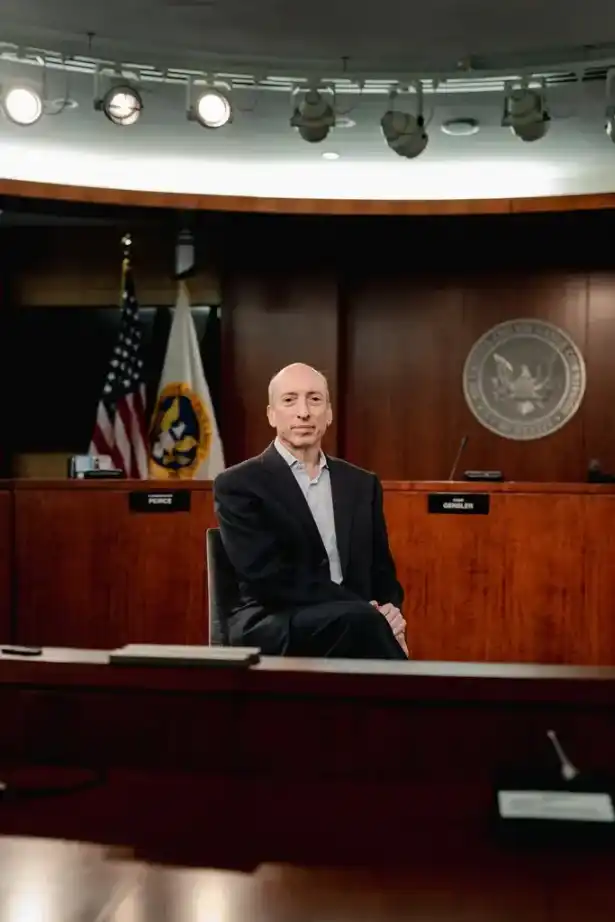
Gary Gensler announced his resignation after Trump won re-election
After Trump was sworn in, the situation became irreversible. He first appointed SEC Republican commissioner Mark T. Uyeda as acting chairman, pending Senate confirmation of his nominee Paul S. Atkins. Uyeda had long opposed the SEC's approach to cryptocurrency cases, telling The New York Times in an interview that many of Gensler's regulatory moves were based on "new theories lacking support from existing law."
Gensler, in a 2022 speech, had expressed a diametrically opposite view, stating: "Even with new technologies, existing laws do not become obsolete."
In early February 2025, Uyeda transferred Jorge G. Tenreiro from his position as head of SEC litigation. Tenreiro had previously led the work of the cryptocurrency regulatory division and overseen many related cases; this transfer to the information technology department was seen within the SEC as a humiliating demotion.
After Tenreiro's departure, the SEC began to stop investigations into several cryptocurrency companies that might face lawsuits. Although some investigations continued, at least 10 companies announced they were no longer under SEC investigation, one of which issued such an announcement just last week.
No Room for Negotiation
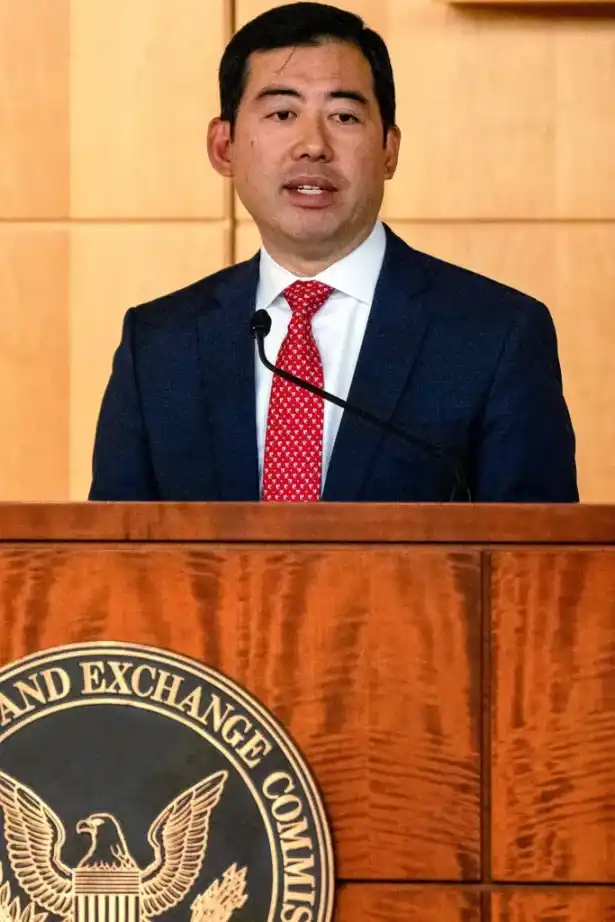
Uyeda soon faced a more棘手 (thorny) problem: how to handle the cryptocurrency lawsuits left over from the Biden administration that were still under adjudication. The SEC suspending investigations is common, but dismissing cases already in litigation is extremely rare and requires approval by a vote of the Commissioners.
The lawsuit against Coinbase, the largest U.S. cryptocurrency exchange, for failing to register, was a high-profile case in the cryptocurrency field. During the Biden administration, Coinbase adopted a tough defense strategy, successfully persuading a judge to allow a higher court to review the case before trial.
Now with the SEC under Trump's control, Coinbase was among the first companies to apply for dismissal of its case. Conventionally, the SEC chairman's office does not usually get involved in (介入) negotiations for such cases, leaving it to dedicated enforcement lawyers. But during these negotiations, staff from Uyeda's office participated in some of the talks with Coinbase alongside the enforcement lawyers.
Coinbase Chief Legal Officer Paul Grewal, a former federal judge, said in an interview: "We always ensured timely updates to the incoming chairman's office on the progress of case negotiations, ensuring they were fully informed." Uyeda said his staff's participation in such coordination meetings was "完全合乎规范 (completely within norms)."
Initially, the SEC under Uyeda's leadership was unwilling to dismiss the case entirely. Informed sources revealed that the SEC's initial proposal was only to suspend the case. But this proposal was rejected by Coinbase.
The SEC then made greater concessions (作出更大让步), proposing to dismiss the case but reserve the right to reopen it if leadership changed its mind later, but this proposal was also not accepted by Coinbase. Grewal stated firmly: "Our position was very clear, either they dismiss the case completely, or we continue to defend ourselves. There was no room for negotiation on this matter."
Ultimately, the SEC chose to compromise. By then, Gensler and another Democratic commissioner had left, leaving the SEC commission with only two Republican commissioners and one Democratic commissioner.
Uyeda did not respond specifically to this decision, but said: "It was not appropriate to continue pushing these types of cases, especially if the SEC might soon no longer endorse the theories underlying the litigation."
The remaining Democratic commissioner, Caroline A. Crenshaw, said bluntly in an interview that the SEC's approach gave the cryptocurrency industry a major advantage, "They can practically do whatever they want without facing any consequences."
Change in Attitude

After the Coinbase case was dismissed, the cryptocurrency industry saw it as a signal of the SEC's capitulation. Lawyers for other cryptocurrency companies followed suit, seeking similar outcomes for their clients. By the end of May, the SEC had dismissed another 6 cryptocurrency-related cases.
Analysis of court records by The New York Times found this phenomenon highly anomalous. During the Biden administration, the SEC never voluntarily dismissed any cryptocurrency case left over from Trump's first term. During that period, only one case was dismissed due to the death of a defendant, and in another case, part of the claims were dropped due to an unfavorable ruling by a judge.
After Trump began his second term, however, 33% of the cryptocurrency cases left over from the Biden administration were dismissed, compared to a dismissal rate of only 4% for cases in other industries.
Despite the SEC's repeated promises to continue pursuing securities fraud, it still dismissed the lawsuit against Binance. Previously, the SEC had accused two affiliated entities of Binance of fraudulent behavior, alleging they misled consumers about preventing manipulative trading.
Additionally, the SEC applied to the court to suspend the fraud case against Justin Sun and the Tron Foundation he founded. There are 4 such cases suspended pending settlement negotiations; the SEC has not yet announced the outcome of this case.
The Trump administration inherited a total of 23 cryptocurrency cases, 21 originating from the Biden era and 2 left over from Trump's first term. The SEC has relaxed its approach in 14 of these cases. Of these 14 cases, 8 involved companies that established connections with Trump and his family around the time the cases were handled.
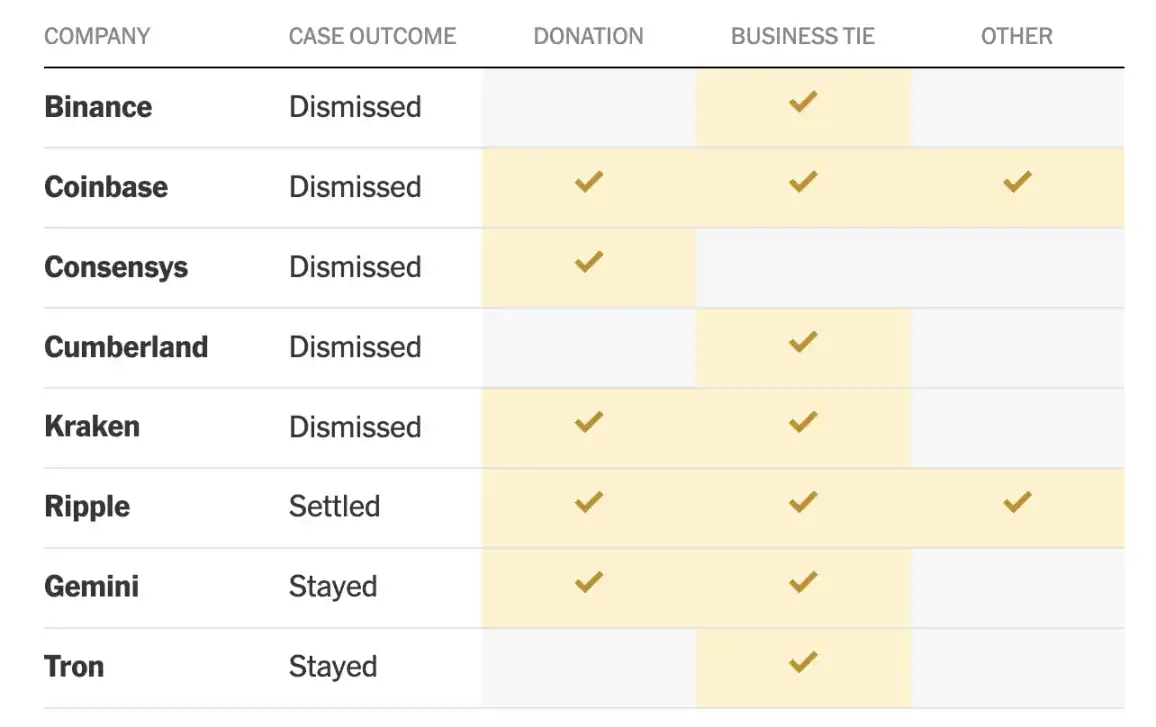
For example, Justin Sun spent $75 million to buy tokens issued by World Liberty Financial. The Tron Foundation did not respond to multiple requests for comment; Justin Sun and the Tron Foundation stated in court filings that the SEC lacked evidence to prove fraud and lacked the authority to sue them.
Weeks before the Binance case was dismissed, the company participated in a $2 billion business transaction using stablecoins issued by World Liberty Financial. This transaction was expected to bring tens of millions of dollars in annual revenue to the Trump family.
A spokesperson for World Liberty Financial stated that "the company has no connection whatsoever to the U.S. government" and "does not exert any influence on government policy-making or decision-making processes." Binance said in a statement that the SEC's lawsuit against it was essentially "targeted suppression of the cryptocurrency industry."
In March 2025, the SEC dismissed the case accusing cryptocurrency trader Cumberland of conducting unregistered securities business. About two months later, Cumberland's parent company, DRW, invested nearly $100 million in the Trump family's media company. DRW executives said the company only got the investment opportunity after the case was dismissed, and the SEC dismissed the case simply because the allegations lacked factual basis.
Ripple, which donated nearly $5 million to Trump's inauguration, was also embroiled in litigation. During Trump's first term, the SEC accused Ripple of failing to disclose key information to investors when issuing crypto tokens. Last year, a federal judge dismissed some of the SEC's charges but still ruled that Ripple violated securities laws and fined it $125 million.
After Trump took office again, the SEC tried to reduce the fine to $50 million. The judge sharply criticized the SEC for this reversal and rejected the request. Ripple argued to the judge that it deserved a lighter penalty, partly because the SEC had dismissed subsequent similar cryptocurrency cases. Ultimately, Ripple paid the full fine. In July of this year, the Trump family's media company announced plans to include Ripple's cryptocurrency in a public-facing investment fund.
Hester Peirce, an SEC Republican commissioner who heads the agency's new cryptocurrency task force, said in an interview that dismissing many cryptocurrency cases was correcting past mistakes, as these cases should never have been filed in the first place.
She said: "I believe the real overreach occurred in previous years, when the SEC filed many cases without any legal basis." She added that these lawsuits hindered legitimate industry innovation. Peirce emphasized that case handling is based solely on facts and specific circumstances, unrelated to "the connections of the involved parties," and involves no political or economic considerations.
Deep Pockets
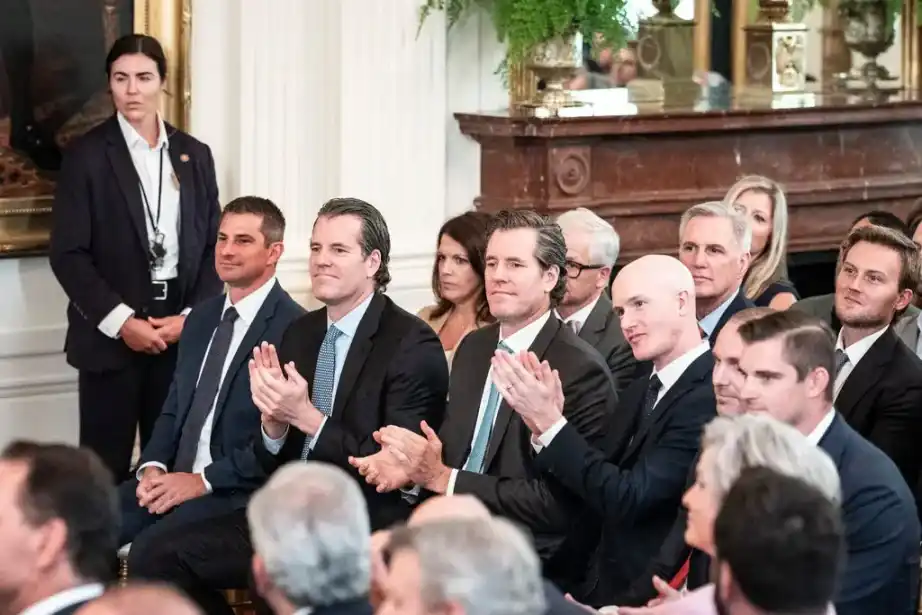
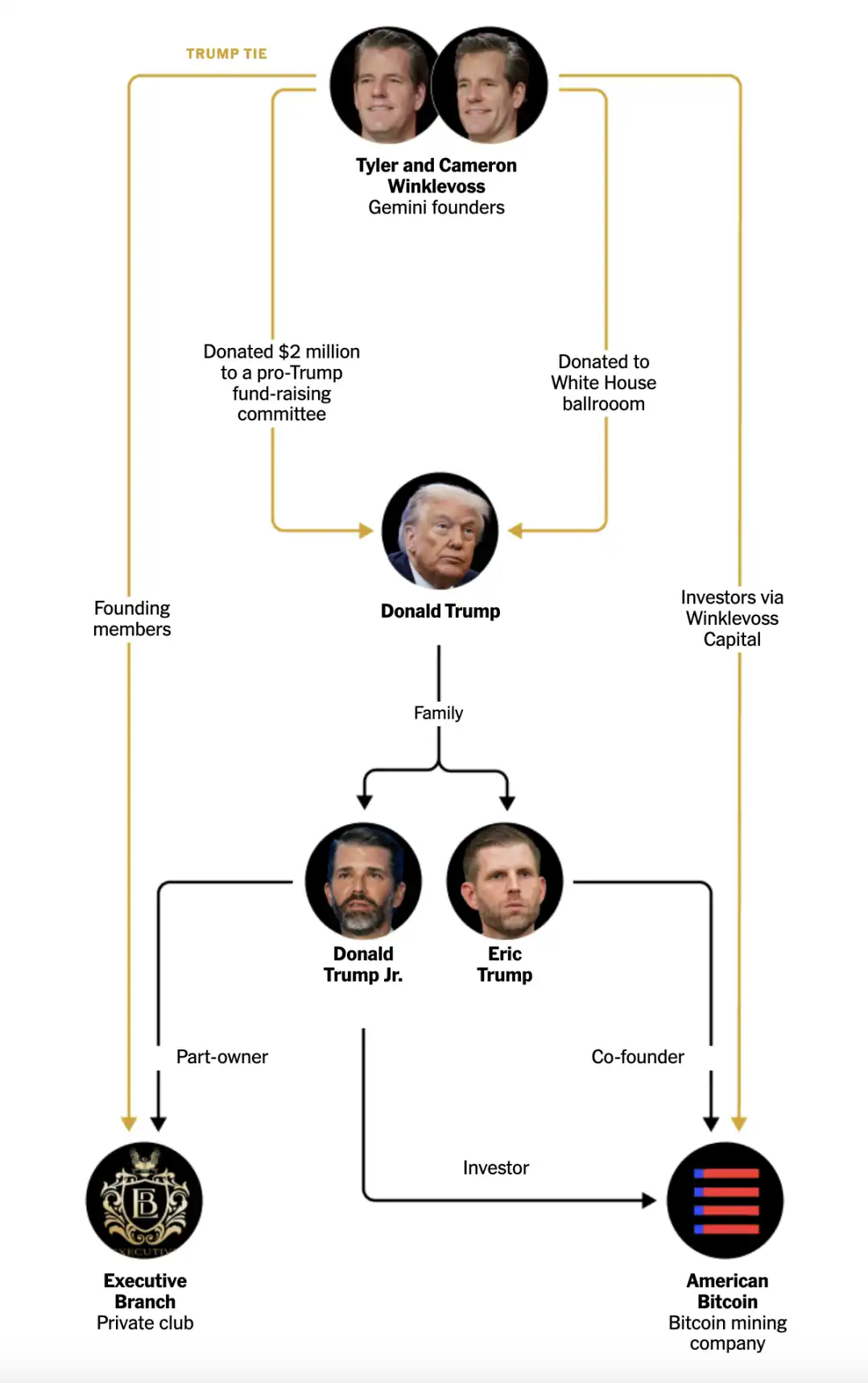
Few in the cryptocurrency industry are closer to Trump than brothers Tyler Winklevoss and Cameron Winklevoss. The brothers founded and operate the cryptocurrency company Gemini Trust. They not only provided funding to committees supporting Trump's re-election and other Republican-related organizations but also contributed to the renovation of the White House banquet hall favored by Trump. Additionally, they provided funding for a high-end private club in Washington called Executive Branch, in which Trump's eldest son, Donald Trump Jr., is a shareholder.
The brothers' investment company recently also injected capital into a new cryptocurrency mining company called American Bitcoin. Trump's second son, Eric Trump, is a co-founder and chief strategy officer of this company, and eldest son Donald Trump Jr. is also an investor.
Trump has repeatedly publicly praised the brothers, calling them "talented and good-looking" people with both intelligence and looks. He remarked at a White House event: "They have the looks, the brains, and vast wealth."
But Gemini Trust has also been deeply involved in legal disputes.
In December 2020, Gemini Trust partnered with another company, Genesis Global Capital, to offer Gemini's clients a service to lend crypto assets to Genesis, which would then relend these assets to larger institutional investors.
Genesis would pay interest to users and promised they could redeem their assets at any time; Gemini acted as a middleman, earning a corresponding share. Gemini advertised that the project could provide account holders with an annualized yield of up to 8%.
San Diego data scientist Peter Chen said in an interview that he invested over $70,000 in the project because he trusted Gemini.
"Gemini gave me the impression of being compliantly operated, strictly following rules, one of the most well-regulated companies in the cryptocurrency field," he recalled.

However, in late 2022, Genesis, facing bankruptcy crisis, froze the accounts of 230,000 clients.
A 73-year-old grandmother pleaded with Gemini to return her life savings of $199,000. According to lawsuit documents filed by New York state regulators, she wrote in her plea: "Without this money, I am completely desperate."
In May 2024, Genesis reached a $2 billion settlement with New York state regulators, and clients' funds were eventually recovered. Gemini also settled with New York state, agreeing to pay up to $50 million if necessary to cover remaining client losses. Gemini insisted it had done nothing wrong, blaming the crisis on Genesis, and emphasized that ultimately no client suffered losses.
But the SEC also sued both companies, accusing them of offering crypto assets without registration. Tyler Winklevoss called the lawsuit on social media "deliberately fabricated charges."
Genesis chose to settle with the SEC, but Gemini insisted on defending the lawsuit until April 2025, when the SEC suddenly proposed suspending the case to negotiate a resolution. In September of the same year, the SEC disclosed that it had reached a settlement agreement with Gemini, which is still pending a vote by the commissioners.
The SEC told the federal judge overseeing the case that the agreement "will completely end this litigation dispute."