The Era of Bitcoin Dominating Crypto Is Over

marsbitОпубліковано о 2026-06-01Востаннє оновлено о 2026-06-01

Анотація

The era of Bitcoin's dominance over the entire crypto market is ending. The crypto economy is now bifurcating into two distinct camps: endogenous assets and exogenous assets. Endogenous assets, like Bitcoin and many traditional cryptocurrencies, derive their value primarily from the broader crypto market's price movements. Their fortunes rise and fall with the market cycle. Exogenous assets, however, are increasingly decoupled from crypto market volatility. These projects, while technically part of the crypto space, have business models and value drivers that operate independently. Examples include Venice, which monetizes private AI inference services; Figure, a fintech firm using blockchain to streamline home equity loans; and stablecoin-related companies like BVNK and Bridge, which see growth unrelated to crypto bull or bear markets. This shift is fundamental. Past narratives of a "blockchain over Bitcoin" focus failed because they lacked sustainable, quantifiable demand and revenue streams that could translate to token value. The current cycle is different: exogenous projects generate real revenue from paying users, and investors are beginning to evaluate them based on fundamentals rather than mere market narrative. While endogenous assets will remain relevant—akin to gold and gold mining stocks in a portfolio—their performance drivers are now distinct from those of exogenous assets. Consequently, analyzing exogenous assets requires a traditional, fundamentals-based app...

Author: Charlie

Compiled by: Luffy, Foresight News

For a long time, the price movements of the entire crypto market have revolved around Bitcoin. Today, that era is coming to an end.

The crypto economy has now diverged into two major camps: endogenous assets and exogenous assets.

The so-called endogenous assets are the traditional crypto categories familiar to the public: the value of these tokens and projects is entirely dependent on the rise and fall of the overall crypto asset market. Exogenous assets, on the other hand, only nominally belong to the crypto track; their value movements are increasingly independent of the crypto market.
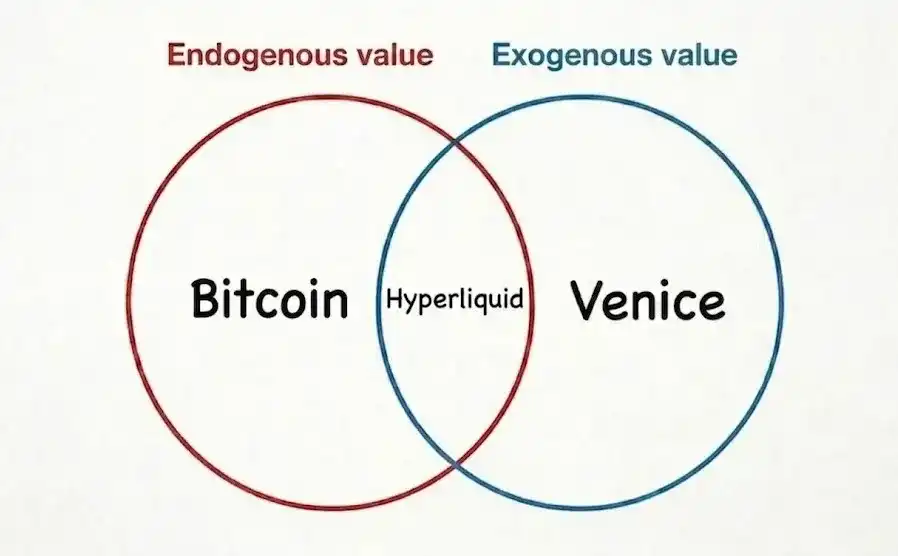
Bitcoin's value stems from its inherent attributes and is reflected in its price. Price increases further reinforce the market's perception of its value attributes. At the peak of a bull market, Bitcoin is hailed as 'interstellar universal currency,' the most scarce digital circulating asset in human hands; at the trough of a bear market, it is disparaged as a digital collectible with no cash flow support.

Hyperliquid sits between the two camps. Most of its business still relies on crypto market conditions, but both supply and demand are continuously expanding. Many on-chain financial infrastructures fall into this category, with underlying assets gradually shifting towards tokenized real-world asset categories.
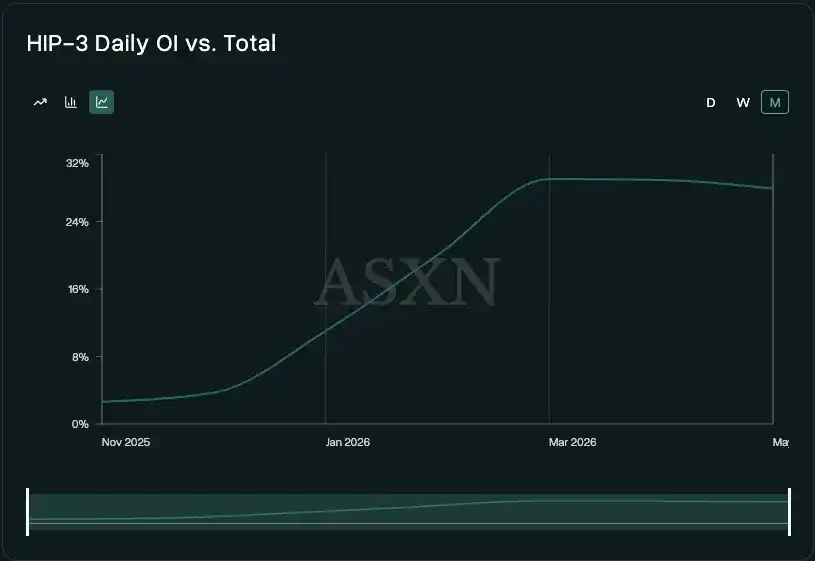
HIP-3 open interest roughly reflects the activity of non-crypto-related trading. Currently, HIP-3 contracts account for about 30% of Hyperliquid's total open interest, whereas in November 2025, this proportion was only 4%. The upcoming HIP-4 prediction market will further drive growth, bringing new trading users and trading targets.

Projects like Venice fall entirely into the exogenous camp; their development logic is completely detached from the crypto market. Although there is some overlap in user base, its business model leans more towards consumer-grade artificial intelligence rather than native crypto products like Uniswap. Uniswap's core business is still users trading various endogenous assets, so its performance naturally fluctuates with asset prices; Venice, however, packages private multimodal inference services and adopts a 'pay-per-use + subscription' fee model.

Venice's only connection to the crypto field is its choice of tokens as a value-carrying medium, and the fact that some of its compute power providers have a crypto industry background. Project lead Erik Voorhees is deeply involved in the crypto industry and believes that, if used properly, tokens can be excellent marketing tools.

Public company Figure is also a typical case. This fintech lending company developed its own blockchain, reducing the approval time for home equity loans to under 5 minutes. For them, blockchain is just supporting technology; the core value lies in the credit business itself.

The large-scale rise of exogenous tracks, whether in the token market or the listed company sector, has profound significance. In the past, because the vast majority of business models were deeply tied to crypto asset prices, pure bottom-up fundamental investing was difficult to implement. The crypto industry has not been without narratives favoring 'blockchain over Bitcoin,' but past cycles always reverted to Bitcoin's performance. The fundamental reason was that these tracks never managed to establish stable demand and generate continuous revenue; even when there was revenue, it couldn't be transmitted to token value. Once token prices stopped rising, the projects lost their support.

This cycle is fundamentally different. Now we can clearly see paying user groups and payment logic. Demand in most tracks is quantifiable and is no longer driven purely by sentiment hype. Simultaneously, the mechanisms for tokens as value carriers are continuously improving. Venice's revenue comes from users genuinely paying for AI inference services; even if the overall crypto market declines, its business won't be significantly impacted because it doesn't rely on token price movements. This cycle possesses two core advantages that previous booms lacked: sustainable real usage demand, and investors beginning to invest based on fundamentals rather than market narratives alone.

The stablecoin track in the private market is similar. In March 2026, Mastercard announced it would acquire BVNK for up to $1.8 billion. This company was valued at just $750 million when it completed its Series B round 15 months prior. Another stablecoin-related company, Bridge, was acquired by Stripe for $1.1 billion in February 2025. According to Stripe's annual report, Bridge's current business is growing at four times per year. The development of these companies is completely decoupled from the crypto industry's bull and bear cycles.

This is not to say we are bearish on endogenous assets. Just as gold and even small gold mining companies have their place in an investment portfolio, Bitcoin and a host of endogenous crypto assets also have their place. But the performance drivers and market correlations of the two asset types have fundamentally diverged, and the data confirms this.
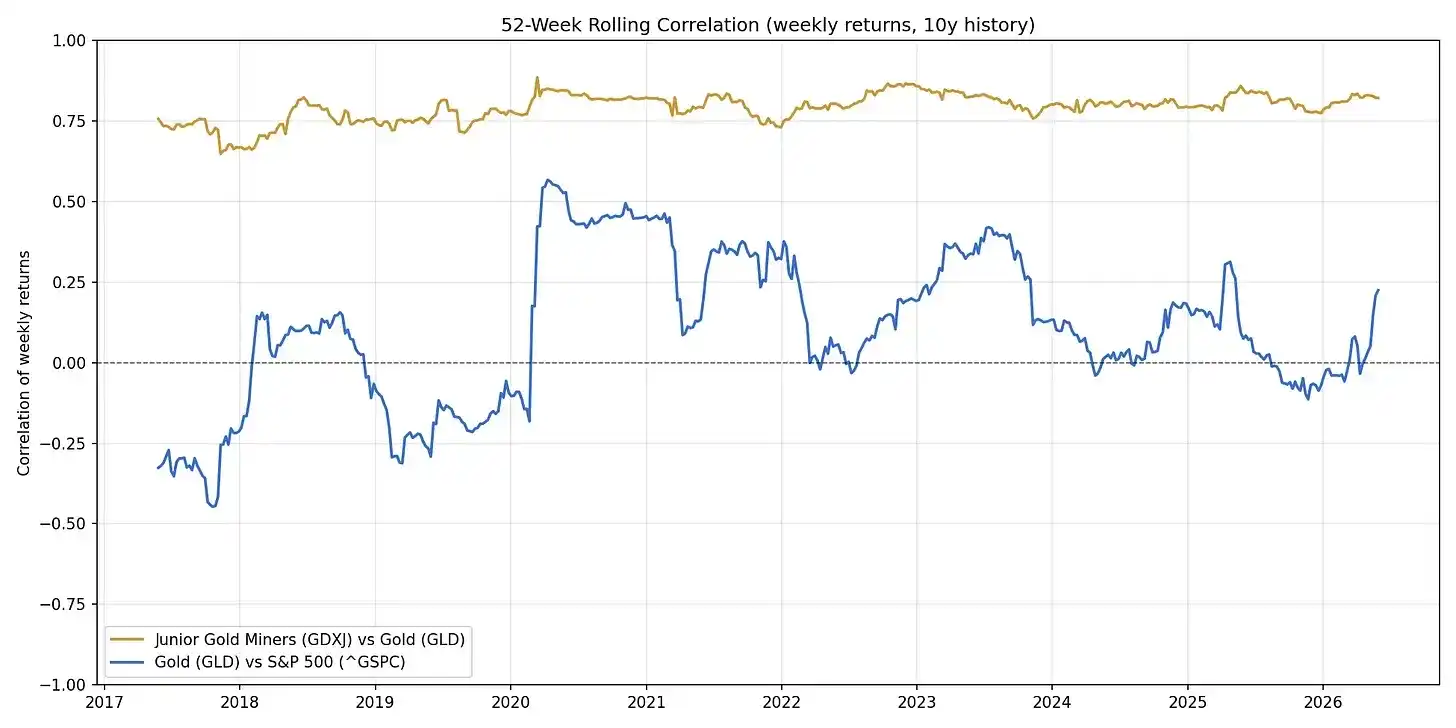
This analogy can be visualized: The correlation coefficient between small gold mining stocks and gold prices remains around 0.75 over the long term. This is precisely the current state of the traditional crypto market — a host of crypto assets are like small gold mines, with Bitcoin corresponding to gold. The entire track is leveraged investment against Bitcoin. The blue curve in the chart represents another relationship: Gold and the S&P 500 index exhibit weak linkage due to macroeconomic influences, but each follows its own independent logic. This is also the future direction for exogenous assets. In the long run, these assets will gradually break free from the 'following Bitcoin's ups and downs' trend.
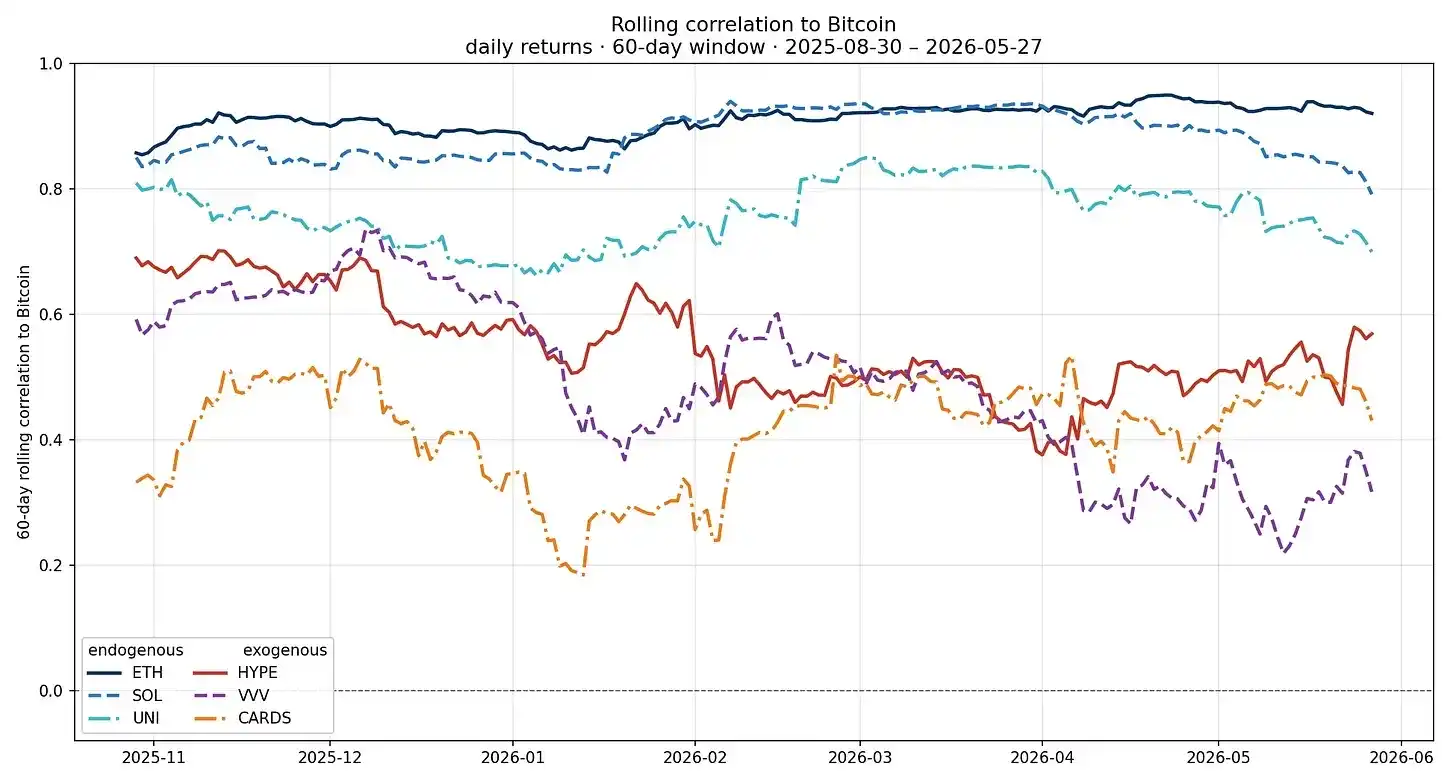
It should be noted that many exogenous assets themselves issue tokens. This phenomenon both confirms the above trend and represents a special case.

Currently, the vast majority of endogenous assets remain highly correlated with Bitcoin's movements. A few exogenous assets show reduced correlation, but due to their short development cycles, they don't yet offer strong reference value. Industry patterns have always been fundamentals first, followed by changes in market relationships.

This change has also completely rewritten the logic of industry analysis. Researching exogenous assets requires fundamental due diligence like analyzing traditional companies: mapping paying user groups, calculating unit economics, and assessing industry moats. Bitcoin price is no longer the primary reference indicator. Analyzing such projects is more akin to fintech investors making judgments, with the extra step of asset custody.

Here are the currently promising exogenous tracks:

  • On-chain exchanges and brokerage service providers
  • Settlement and redemption solutions for long-tail asset tokenization
  • Deep integration of crypto + AI (private inference, distributed open-source model training like Nous Research's Psyche, etc.)
  • New digital banks (Payy and Raycash focusing on privacy protection are worth watching; Aztec and Zama providing programmable privacy infrastructure also have potential)
  • Lending track (Morpho has become mainstream in institutional repo markets; smaller projects like Valinor, 3jane focus on private credit niches)
  • Stablecoin issuers, real-world asset tokenization service providers
  • Payment rails (In general payments, Stripe and Tempo are industry benchmarks; in agent payments, Coinbase currently leads)
  • Non-financial crypto consumer products (Represented by Venice, Collector Crypt; these projects imbue tokens with real-world business value, driving product adoption and marketing empowerment)
  • Agent economy (Core opportunity lies in the access layer for agents, service providers, and creator collaboration ecosystems, which are less replaceable. Cloudflare is ahead in deployment, but whether it will charge for traffic or merely provide basic functional services remains to be seen)

At this stage, investing in equity of related companies remains the safest way to gain exposure to the above tracks; quality token targets are exceptional cases. The role of tokens will only increase as their value-carrying mechanisms continue to optimize, a process requiring joint efforts from regulators and the entire industry. Progress is being made: on the regulatory front, the CLARITY Act is steadily advancing; on the industry side, institutions like Blockworks are promoting market information transparency. The token mechanism still has a long way to go.

But none of these details change a core trend: The driving forces of the crypto market are shifting from a single factor to multiple factors. The focus of industry research is shifting from interpreting Bitcoin price charts to deep-diving into company fundamentals. In the next decade, there will be no need to wonder why the 'crypto market' no longer moves in unison, because the industry landscape has been fundamentally renewed.


Трендові криптовалюти

Пов'язані питання

QAccording to the article, what is the key difference between endogenous and exogenous assets in the crypto market?

AEndogenous assets are traditional crypto assets whose value is completely dependent on the overall crypto market sentiment and Bitcoin's price movements. Their narratives often shift with market cycles. Exogenous assets, while nominally part of the crypto space, derive their value from independent fundamentals, such as real-world demand for specific services (e.g., AI inference, lending, payments). Their business models and revenue streams are increasingly decoupled from the price of Bitcoin or the general crypto market cycle.

QWhat two core advantages does the current cycle possess that previous crypto booms lacked, according to the author?

AThe current cycle possesses two core advantages previous booms lacked: 1) Sustainable, actual usage demand from paying customers, and 2) Investment decisions based increasingly on fundamental analysis of business models and revenue rather than purely on market narratives and speculation.

QUsing the analogy from the article, how is the relationship between traditional crypto assets and Bitcoin described, and how does it contrast with the future of exogenous assets?

ATraditional crypto assets are likened to small gold mining stocks, which have a high correlation (around 0.75) to the price of gold (Bitcoin). They essentially represent leveraged bets on Bitcoin. In contrast, the future for exogenous assets is compared to the relationship between gold and the S&P 500: they may be weakly linked by macroeconomics but largely follow independent, fundamental-driven logic and will gradually decouple from Bitcoin's price movements.

QWhat shift in analytical approach does the article suggest is necessary for evaluating exogenous crypto assets?

AThe article suggests that analyzing exogenous crypto assets requires a shift to a traditional fundamental due diligence approach, similar to analyzing fintech or tech companies. This involves examining the paying user base, unit economics, competitive moats, and business fundamentals. The price of Bitcoin is no longer the primary reference point, with the main additional consideration being the nuances of digital asset custody.

QName three example sectors or companies mentioned in the article that are categorized as exogenous or hybrid crypto assets.

AThree examples are: 1) Venice (a consumer AI service using tokens for payment/marketing), 2) Figure (a fintech lending company using its own blockchain to streamline loan processes), and 3) Hyperliquid (a hybrid platform where a growing portion of its business, like HIP-3 contracts, is based on non-crypto trading activity). Other examples include stablecoin issuers like BVNK, payment channels like Stripe/Tempo, and privacy-focused digital banks like Payy.

Пов'язані матеріали

After Three Consecutive Quarters of Decline, Can the Crypto Market Find a Window for Stabilization in Q3?

The cryptocurrency market has just concluded its worst-performing quarter since 2022, with total capitalization dropping 12.6% to $2.1 trillion. All core metrics indicate capital is leaving the sector, not just rotating within it. Bitcoin fell 14.2% and Ethereum dropped 25.4% in Q2, breaking their previous correlation with US tech stocks. A key driver is the reversal in US spot Bitcoin ETF flows, which saw a net outflow of approximately $4.67 billion in Q2, including a record monthly outflow near $4.5 billion in June. While recent data suggests long-term holders are accumulating again, sustained ETF outflows mean continued selling pressure. Market focus is now singularly on the Federal Reserve. The upcoming July FOMC meeting is seen as the most critical event for Q3. A dovish signal could support Bitcoin reclaiming a $68,000-$84,000 range, while a hawkish stance might establish a new trading band around $50,000-$56,000. Additionally, regulatory uncertainty persists, with the progress of the crucial *CLARITY Act* stalling in the Senate, reducing its perceived 2026 passage probability to 40-45%. Despite the broad downturn, a few sectors showed growth. Prediction markets saw nominal volume surge 48.7% year-over-year to $113.8 billion, and tokenized collectibles transaction volume rose 143% quarterly to $1.4 billion. The Real-World Asset (RWA) tokenization sector also continued steady growth, now representing ~$28.1 billion in on-chain value. The market's foundation for an extreme crash appears limited, with Bitcoin price hovering near its 200-week moving average. However, the trading paradigm has shifted from narrative-driven speculation to decisions based on price action, policy developments, and interest rate expectations, making a broad sentiment-driven rally unlikely in the near term.

marsbit3 год тому

After Three Consecutive Quarters of Decline, Can the Crypto Market Find a Window for Stabilization in Q3?

marsbit3 год тому

BIT Trading Moment: BTC Still Suppressed by Weekly 200 EMA, Rejection May Restart Decline; Storage and Semiconductors that Surged Last Night Begin Falling in Evening Trading

**Crypto & Stock Market Wrap: Bitcoin Tests Resistance, Stocks Retreat After AI Surge** Bitcoin consolidates around $66,000, facing key resistance near $68,000—an area seen as a major psychological and technical hurdle where previous rallies have failed. Analysts note the cryptocurrency is caught between its 200-week moving average (~$63,333) and 200-week EMA (~$68,328). A clear break above $68k is needed to signal a stronger bullish trend, while a rejection could lead to a retest of $63k support. Market sentiment remains cautious, with low futures open interest pointing to a low-liquidity rebound rather than a full bull market. Bitcoin spot ETFs saw another $203 million inflow. US stock futures pointed lower after a strong Tuesday session led by a massive rebound in semiconductors and memory stocks. The rally was fueled by renewed optimism about AI-driven hardware demand, with Micron, SanDisk, and SK Hynix surging. However, those gains reversed in pre-market trading. Super Micro Computer (SMCI) soared over 20% after hours on strong guidance and a record backlog. Other standouts included Rocket Lab and nuclear energy plays Oklo and X-Energy. Rising oil prices (Brent above $91) and climbing Treasury yields (10-year near 4.64%), however, are reigniting inflation concerns and acting as a headwind for equities. In Asia, markets were mixed. South Korea's KOSPI pared early gains to close slightly higher as semiconductor stocks like SK Hynix gave back initial surges. Japan's Nikkei edged lower as the yen hit a fresh 38-year low against the dollar, raising fears of potential market intervention. Key events to watch include the Samsung Galaxy launch, AMD's AI event, and a slew of major tech earnings from Alphabet, Tesla, and IBM after the close on Wednesday, followed by the ECB meeting and Intel's earnings on Thursday.

marsbit3 год тому

BIT Trading Moment: BTC Still Suppressed by Weekly 200 EMA, Rejection May Restart Decline; Storage and Semiconductors that Surged Last Night Begin Falling in Evening Trading

marsbit3 год тому

Former CFTC Chairman, Circle President Tarbert: Preaching Long-Termism While Cashing Out $30 Million Himself

Former CFTC Chairman and Circle President Heath Tarbert has consistently advocated for a long-term vision in public, urging patience from investors as Circle’s stock price has fallen significantly from its peak. However, it has been revealed that since Circle’s IPO, Tarbert has continuously sold his CRCL shares through pre-arranged trading plans, cashing out approximately $30 million, without making any public market purchases. This contrast between his public messaging and personal actions has drawn criticism. Tarbert joined Circle in July 2023 as Chief Legal Officer, leveraging his regulatory experience to help guide the company through its IPO and expansion. Despite promoting stablecoins as long-term infrastructure, he established a 10b5-1 trading plan just before Circle went public, leading to substantial stock sales over the following year. In March 2026, he initiated another plan to sell more shares. His career trajectory highlights a pattern of moving between high-level regulatory roles and influential positions in the financial sector. After resigning as CFTC Chairman in early 2021, he joined Citadel Securities as Chief Legal Officer just 27 days later, during a period of intense regulatory scrutiny for the firm. He later joined Circle, aiding its efforts to navigate regulatory challenges for its public listing. While Tarbert's expertise in policy and compliance is valuable to companies like Circle, his actions—advocating long-term confidence while personally divesting—raise questions about the alignment between his public statements and his private financial decisions, leaving investors who followed his advice to bear the market risks.

marsbit3 год тому

Former CFTC Chairman, Circle President Tarbert: Preaching Long-Termism While Cashing Out $30 Million Himself

marsbit3 год тому

Gate Research Institute: The 'Wall Street-ization' Wave of Crypto Financial Products – Competition or Integration?

The article titled "Gate Research Institute: Are Crypto Financial Products Sparking a 'Wall Street' Wave—Competition or Convergence?" explores the evolving relationship between the crypto ecosystem and traditional finance (TradFi). The piece begins by reflecting on Bitcoin's original 2009 vision of decentralization, disintermediation, and moving away from banks. It then contrasts this with the 2024 landscape, where key crypto assets like Bitcoin are increasingly held through Wall Street products like ETFs issued by giants like BlackRock. The article questions whether this signifies that TradFi is systematically taking over the rights to issue, price, custody, and distribute crypto financial assets. The core argument is that this is not a zero-sum takeover but rather a bidirectional convergence where each side addresses the other's weaknesses. Crypto offers 24/7 global markets, programmable settlement, and open access but lacks compliant channels, institutional-grade custody, deep fiat liquidity, and mainstream distribution. TradFi possesses these but is constrained by legacy systems, limited operating hours, and slow settlement. Two primary convergence paths are highlighted: * **Path A (CEX to TradFi):** Exemplified by Gate, which has progressed from offering tokenized stocks and CFDs to providing direct, real stock trading (US, Hong Kong, South Korea) within its platform, using USDT. * **Path B (TradFi to Crypto):** Exemplified by Robinhood, which has integrated crypto trading, acquired exchanges like Bitstamp, and is moving traditional assets like stocks onto the blockchain via tokenization and its own Layer 2. Both paths are ultimately competing to become the next-generation, unified financial account—a "super account" where users can seamlessly trade cryptocurrencies, stocks, ETFs, RWA (Real World Assets), and tokenized treasury products in one interface. The growth of RWA and tokenized treasuries (e.g., BlackRock's BUIDL) is presented as the asset-layer fusion, providing stable, yield-bearing assets on-chain and acting as a bridge between the two worlds. In conclusion, the "Wall Street-ization" of crypto is framed as a mutual transformation. Decentralized ideals persist in the protocol layer, while at the application layer, a more efficient, global, and accessible unified capital market is emerging from this convergence. The future competition lies not between crypto exchanges and stockbrokers, but between platforms vying to offer the most comprehensive asset coverage, liquidity, and user experience within a single account.

marsbit3 год тому

Gate Research Institute: The 'Wall Street-ization' Wave of Crypto Financial Products – Competition or Integration?

marsbit3 год тому

Торгівля

Спот

Популярні статті

Що таке BITCOIN

Розуміння HarryPotterObamaSonic10Inu (ERC-20) та його позиції у крипто-просторі Останніми роками ринок криптовалют спостерігав за зростанням популярності мем-коінів, які привертають інтерес не тільки трейдерів, але й тих, хто шукає спілкування та розважальну цінність. Серед цих унікальних токенів є HarryPotterObamaSonic10Inu (ERC-20), інтригуючий проект, що поєднує культурні посилання з тканинами криптовалюти. Ця стаття досліджує ключові аспекти HarryPotterObamaSonic10Inu, вивчаючи його механізми, спільноту та його взаємодію з ширшим крипто-ландшафтом. Що таке HarryPotterObamaSonic10Inu (ERC-20)? Як випливає з його назви, HarryPotterObamaSonic10Inu є мем-коіном, побудованим на блокчейні Ethereum, класифікованим за стандартом ERC-20. На відміну від традиційних криптовалют, які можуть підкреслювати практичну корисність або інвестиційний потенціал, цей токен процвітає завдяки розважальній цінності та силі своєї спільноти. Проект спрямований на створення середовища, де зацікавлені користувачі можуть об'єднуватися, ділитися ідеями та брати участь у заходах, натхненних різноманітними культурними явищами. Однією з примітних особливостей HarryPotterObamaSonic10Inu є нульовий податок на транзакції. Цей привабливий елемент має на меті заохочувати торгівлю та участь у спільноті, позбавлену додаткових витрат, які можуть відлякувати дрібних трейдерів. Загальна пропозиція монет становить один мільярд токенів, що позначає намір підтримувати суттєву циркуляцію в межах спільноти. Творець HarryPotterObamaSonic10Inu (ERC-20) Походження HarryPotterObamaSonic10Inu дещо окутане таємницею; деталі про творця залишаються невідомими. Розвиток цього токена позбавлений впізнаваної команди або чіткої стратегії, що не є рідкістю в секторі мем-коінів. Натомість проект виник органічно, а його розвиток значною мірою залежить від ентузіазму та участі його спільноти. Інвестори HarryPotterObamaSonic10Inu (ERC-20) Щодо зовнішніх інвестицій та підтримки, HarryPotterObamaSonic10Inu також залишається невизначеним. Токен не зазначає жодних відомих інвестиційних фондів або значної організаційної підтримки. Натомість життєва сила проекту полягає в його базовій спільноті, яка інформує про його зростання та стійкість через колективні дії та залученість у крипто-просторі. Як працює HarryPotterObamaSonic10Inu (ERC-20)? Як мем-коін, HarryPotterObamaSonic10Inu функціонує передусім поза традиційними рамками, що часто регулюють вартість активів. Є кілька відмінних аспектів, що визначають, як працює проект: Транзакції без податку: Завдяки відсутності податкових зборів на транзакції, користувачі можуть вільно купувати та продавати токен, не турбуючись про приховані витрати. Залучення спільноти: Проект процвітає завдяки взаємодії спільноти, використовуючи соціальні медіа для створення шуму та сприяння залученню. Обговорення, обмін контентом та залученість є ключовими елементами, що допомагають розширити його охоплення та зміцнити лояльність серед прихильників. Відсутність практичної корисності: Слід зазначити, що HarryPotterObamaSonic10Inu не пропонує конкретної корисності в рамках фінансової екосистеми. Натомість він класифікується як токен, що призначений в основному для розваги та спільнотних активностей. Культурне посилання: Токен кмітливо вплітає елементи популярної культури, щоб привернути інтерес, зв'язуючи з ентузіастами мемів та крипто-стежками. HarryPotterObamaSonic10Inu ілюструє, як мем-коіни функціонують інакше, ніж традиційні криптовалютні проекти, увійшовши на ринок як інноваційні соціальні конструкти, а не утилітарні активи. Хронологія HarryPotterObamaSonic10Inu (ERC-20) Історія HarryPotterObamaSonic10Inu відзначена кількома значними етапами: Створення: Токен виник з вірусного мему, захопивши уяву багатьох крипто-ентузіастів. Конкретні дати створення недоступні, що підкреслює його органічний розвиток. Лістинг на біржах: HarryPotterObamaSonic10Inu з'явився на різних біржах, дозволяючи зручніший доступ і торгівлю спільноти. Ініціативи залучення спільноти: Ведення діяльності, спрямованої на покращення взаємодії спільноти, включаючи конкурси, кампанії в соціальних мережах та створення контенту від фанатів та прихильників. Плани на майбутнє: Дорожня карта проекту включає запуск колекції NFT, мерчандайзинг та електронну комерцію, пов'язану з його культурними темами, що далі залучає спільноту та намагається додати більше вимірів до його екосистеми. Ключові моменти про HarryPotterObamaSonic10Inu (ERC-20) Спільнотний підхід: Проект надає пріоритет колективному внеску та креативності, забезпечуючи, щоб участь користувачів була в центрі його розвитку. Класифікація як мем-коін: Це є його епігенез розважальної криптовалюти, що відрізняється від традиційних інвестиційних інструментів. Жодного прямого відношення до Bitcoin: Незважаючи на схожість у назві, HarryPotterObamaSonic10Inu є відмінним і не має жодного зв’язку з Bitcoin або іншими усталеними криптовалютами. Зосередженість на співпраці: HarryPotterObamaSonic10Inu створено для того, щоб надати простір для співпраці та обміну історіями серед його власників, забезпечуючи шлях для творчості та спільного зв'язку. Перспективи на майбутнє: Амбіція розширитися за межі початкової концепції в NFT та мерчандайз відкриває шлях для проекту потенційно потрапити в більш мейнстрімні сфери цифрової культури. Оскільки мем-коіни продовжують захоплювати уяву спільноти криптовалют, HarryPotterObamaSonic10Inu (ERC-20) вирізняється своїми культурними зв'язками та орієнтованим на спільноту підходом. Хоча він може не відповідати типовій моделі утилітарного токена, його суть полягає в радощах і товариськості, що підтримуються серед його прихильників, підкреслюючи еволюційну природу криптовалют в усе більш цифрову епоху. Оскільки проект продовжує розвиватися, важливо спостерігати за тим, як динаміка спільноти вплине на його траєкторію в постійно змінюваному ландшафті технології блокчейн.

2.2k переглядів усьогоОпубліковано 2024.04.01Оновлено 2024.12.03

Що таке BITCOIN

Як купити BTC

Ласкаво просимо до HTX.com! Ми зробили покупку Bitcoin (BTC) простою та зручною. Дотримуйтесь нашої покрокової інструкції, щоб розпочати свою криптовалютну подорож.Крок 1: Створіть обліковий запис на HTXВикористовуйте свою електронну пошту або номер телефону, щоб зареєструвати обліковий запис на HTX безплатно. Пройдіть безпроблемну реєстрацію й отримайте доступ до всіх функцій.ЗареєструватисьКрок 2: Перейдіть до розділу Купити крипту і виберіть спосіб оплатиКредитна/дебетова картка: використовуйте вашу картку Visa або Mastercard, щоб миттєво купити Bitcoin (BTC).Баланс: використовуйте кошти з балансу вашого рахунку HTX для безперешкодної торгівлі.Треті особи: ми додали популярні способи оплати, такі як Google Pay та Apple Pay, щоб підвищити зручність.P2P: Торгуйте безпосередньо з іншими користувачами на HTX.Позабіржова торгівля (OTC): ми пропонуємо індивідуальні послуги та конкурентні обмінні курси для трейдерів.Крок 3: Зберігайте свої Bitcoin (BTC)Після придбання Bitcoin (BTC) збережіть його у своєму обліковому записі на HTX. Крім того, ви можете відправити його в інше місце за допомогою блокчейн-переказу або використовувати його для торгівлі іншими криптовалютами.Крок 4: Торгівля Bitcoin (BTC)Легко торгуйте Bitcoin (BTC) на спотовому ринку HTX. Просто увійдіть до свого облікового запису, виберіть торгову пару, укладайте угоди та спостерігайте за ними в режимі реального часу. Ми пропонуємо зручний досвід як для початківців, так і для досвідчених трейдерів.

5.0k переглядів усьогоОпубліковано 2024.12.12Оновлено 2026.06.02

Як купити BTC

Що таке $BITCOIN

ЦИФРОВЕ ЗОЛОТО ($BITCOIN): Комплексний аналіз Вступ до ЦИФРОВОГО ЗОЛОТА ($BITCOIN) ЦИФРОВЕ ЗОЛОТО ($BITCOIN) — це проект на основі блокчейну, що працює в мережі Solana, який має на меті поєднати характеристики традиційних дорогоцінних металів з інноваціями децентралізованих технологій. Хоча він має таку ж назву, як і Bitcoin, який часто називають “цифровим золотом” через його сприйняття як засобу збереження вартості, ЦИФРОВЕ ЗОЛОТО є окремим токеном, розробленим для створення унікальної екосистеми в ландшафті Web3. Його мета — позиціонувати себе як життєздатний альтернативний цифровий актив, хоча деталі щодо його застосувань і функціональностей все ще розробляються. Що таке ЦИФРОВЕ ЗОЛОТО ($BITCOIN)? ЦИФРОВЕ ЗОЛОТО ($BITCOIN) — це токен криптовалюти, спеціально розроблений для використання в блокчейні Solana. На відміну від Bitcoin, який виконує широко визнану роль зберігання вартості, цей токен, здається, зосереджується на більш широких застосуваннях і характеристиках. Помітні аспекти включають: Інфраструктура блокчейну: Токен побудований на блокчейні Solana, відомому своєю здатністю обробляти швидкі та низьковартісні транзакції. Динаміка постачання: ЦИФРОВЕ ЗОЛОТО має максимальне постачання, обмежене 100 квадрильйонами токенів (100P $BITCOIN), хоча деталі щодо його обігового постачання наразі не розголошуються. Утиліта: Хоча точні функціональності не викладені, є вказівки на те, що токен може бути використаний для різних застосувань, потенційно пов'язаних з децентралізованими додатками (dApps) або стратегіями токенізації активів. Хто є творцем ЦИФРОВОГО ЗОЛОТА ($BITCOIN)? На даний момент особа творців і команди розробників, що стоять за ЦИФРОВИМ ЗОЛОТОМ ($BITCOIN), залишається невідомою. Ця ситуація є типовою для багатьох інноваційних проектів у сфері блокчейну, особливо тих, що пов'язані з децентралізованими фінансами та феноменом мем-коінів. Хоча така анонімність може сприяти культурі, орієнтованій на спільноту, вона посилює занепокоєння щодо управління та підзвітності. Хто є інвесторами ЦИФРОВОГО ЗОЛОТА ($BITCOIN)? Доступна інформація вказує на те, що ЦИФРОВЕ ЗОЛОТО ($BITCOIN) не має жодних відомих інституційних спонсорів або помітних венчурних капіталовкладень. Проект, здається, працює за моделлю “рівний до рівного”, зосереджуючись на підтримці та прийнятті спільноти, а не на традиційних шляхах фінансування. Його активність і ліквідність переважно розташовані на децентралізованих біржах (DEX), таких як PumpSwap, а не на встановлених централізованих торгових платформах, що ще більше підкреслює його підхід знизу вгору. Як працює ЦИФРОВЕ ЗОЛОТО ($BITCOIN) Операційні механізми ЦИФРОВОГО ЗОЛОТА ($BITCOIN) можна детальніше розглянути на основі його дизайну блокчейну та характеристик мережі: Механізм консенсусу: Використовуючи унікальний proof-of-history (PoH) Solana в поєднанні з моделлю proof-of-stake (PoS), проект забезпечує ефективну валідацію транзакцій, що сприяє високій продуктивності мережі. Токеноміка: Хоча конкретні дефляційні механізми не були детально описані, велике максимальне постачання токенів вказує на те, що воно може задовольняти мікротранзакції або нішеві випадки використання, які ще потрібно визначити. Інтероперабельність: Існує потенціал для інтеграції з більш широкою екосистемою Solana, включаючи різні платформи децентралізованих фінансів (DeFi). Однак деталі щодо конкретних інтеграцій залишаються невизначеними. Хронологія ключових подій Ось хронологія, яка підкреслює значні віхи, пов'язані з ЦИФРОВИМ ЗОЛОТОМ ($BITCOIN): 2023: Початкове розгортання токена відбувається на блокчейні Solana, позначене його адресою контракту. 2024: ЦИФРОВЕ ЗОЛОТО набуває видимості, оскільки стає доступним для торгівлі на децентралізованих біржах, таких як PumpSwap, що дозволяє користувачам торгувати ним проти SOL. 2025: Проект спостерігає спорадичну торгову активність і потенційний інтерес до ініціатив, очолюваних спільнотою, хоча на даний момент не зафіксовано жодних значних партнерств або технічних досягнень. Критичний аналіз Сильні сторони Масштабованість: Основна інфраструктура Solana підтримує високі обсяги транзакцій, що може підвищити утиліту $BITCOIN у різних сценаріях транзакцій. Доступність: Потенційно низька торгова ціна за токен може привабити роздрібних інвесторів, сприяючи більш широкій участі завдяки можливостям дробового володіння. Ризики Відсутність прозорості: Відсутність публічно відомих спонсорів, розробників або процесу аудиту може викликати скептицизм щодо стійкості та надійності проекту. Волатильність ринку: Торгова активність сильно залежить від спекулятивної поведінки, що може призвести до значної волатильності цін і невизначеності для інвесторів. Висновок ЦИФРОВЕ ЗОЛОТО ($BITCOIN) постає як цікавій, але неоднозначний проект у швидко розвиваючійся екосистемі Solana. Хоча він намагається використати наратив “цифрового золота”, його відхід від встановленої ролі Bitcoin як засобу збереження вартості підкреслює необхідність чіткішого розмежування його передбачуваної утиліти та структури управління. Майбутнє прийняття та адаптація, ймовірно, залежатиме від вирішення поточної непрозорості та більш чіткого визначення його операційних та економічних стратегій. Примітка: Цей звіт охоплює синтезовану інформацію, доступну станом на жовтень 2023 року, і можуть відбутися події, що виходять за межі дослідницького періоду.

160 переглядів усьогоОпубліковано 2025.05.13Оновлено 2025.05.13

Що таке $BITCOIN

Обговорення

Ласкаво просимо до спільноти HTX. Тут ви можете бути в курсі останніх подій розвитку платформи та отримати доступ до професійної ринкової інформації. Нижче представлені думки користувачів щодо ціни BTC (BTC).

活动图片













