The Bitcoin Inheritance Challenge: How to Help Your Family Recover Your Assets?

比推Опубліковано о 2026-03-18Востаннє оновлено о 2026-03-18

Анотація

Self-custody of Bitcoin fundamentally changes estate planning. A robust inheritance plan must protect assets during the owner’s lifetime while ensuring designated individuals can recover them after death. Bitcoin’s key advantage—bypassing banks and custodians—also complicates inheritance, as the network only recognizes cryptographic keys, not legal documents. Key challenges include balancing security and accessibility, managing technical complexity for non-expert heirs, preserving privacy, and ensuring long-term viability. Common solutions include: 1. Custodial Inheritance: Relies on exchanges or institutions, sacrificing self-custody benefits for familiar legal processes. 2. DIY Inheritance: Ranges from simple seed-phrase handovers to complex multisig setups. High autonomy but requires technical competence from heirs. 3. Assisted Custody: Uses a service provider for multisig setup and recovery guidance, improving usability but depending on the provider’s longevity. 4. On-Chain Collaborative Inheritance: Combines assisted recovery with on-chain fallbacks (e.g., timelocks), ensuring access even if the provider fails. The strongest plans integrate a smooth, guided recovery path with a durable on-chain backup. Regular testing and updates are crucial. Inheritance isn’t just a technical issue—it must align with legal frameworks and family circumstances. Ultimately, a well-designed Bitcoin inheritance plan ensures assets remain secure, private, and recoverable for generati...

Author: Nunchuk

Compiled by: AididiaoJP, Foresight News

Original title: "After You're Gone": How Should Bitcoin Be Inherited?


Self-custody is changing the way we plan for inheritance. A good Bitcoin inheritance plan must: protect your Bitcoin during your lifetime, while also ensuring that designated individuals can successfully recover these assets after you pass away.

Bitcoin grants individuals a rare ability: to hold wealth without relying on banks, brokerages, or custodial institutions. This is one of its greatest advantages.

But it is precisely this feature that makes inheritance exceptionally difficult.

For traditional assets, there is usually an intermediary institution. Banks can freeze accounts, verify documents, cooperate with courts, and transfer control. Bitcoin is completely different. The network does not recognize heirs, death certificates, probate documents, nor does it handle customer service requests. It only recognizes keys and spending conditions.

This leads to a simple but severe problem: the very characteristics that make Bitcoin difficult to steal also make it difficult to inherit.

Why Bitcoin is Different

Bitcoin inheritance is essentially a "recovery design" problem: who can access the Bitcoin, under what conditions, and through what safeguards.

The first challenge is the contradiction between security and accessibility. During your life, you need strong protection against theft, coercion, and operational errors; after you die or become incapacitated, you want trusted individuals to have a clear path to recovery. These two goals are often in conflict.

The second challenge is complexity. Many powerful Bitcoin setups (especially multisig) might be clear to the designer, but they can be completely incomprehensible to a spouse, children, trustees, or executors who don't regularly use Bitcoin. A plan that only a calm, technical person can operate is likely to fail when recovery is truly needed.

The third challenge is privacy. Inheritance planning exposes sensitive information: who owns Bitcoin, roughly how much, and who will inherit it. A poorly designed plan creates unnecessary risks for both the owner and the heirs.

The fourth challenge is time. A true inheritance plan might need to remain effective for years or even decades. This means evaluating a solution not just on whether it works today, but on whether it can outlast devices, assumptions, and even the companies involved in its setup.

This is more important than many realize. An inheritance plan that relies on a specific company existing forever might be convenient, but it is certainly not durable.

Six Questions to Ask Yourself

Every Bitcoin inheritance solution involves trade-offs. The simplest way to compare them is to ask six questions:

  • Autonomy: Does it preserve your full control over the assets, or does it rely on a company, custodian, trustee, or legal process to function?

  • Security: During your lifetime, does it effectively prevent Bitcoin from being stolen, coerced, or accidentally misplaced?

  • Heir Experience: Can your designated heirs actually recover the funds without confusion or making fatal mistakes?

  • Privacy: How much sensitive information about you or your family does this solution expose?

  • Flexibility: Is it easy to update the plan when beneficiaries, timelines, or family circumstances change?

  • Legal Compatibility: If needed, can it work alongside wills, trusts, or trustee systems?

No single solution excels in all dimensions, but these six questions make the trade-offs clear.

Four Common Solutions

1. Custodial Inheritance

The most traditional method is to keep Bitcoin on an exchange, in an ETF, with a brokerage, or with another custodian, and let the traditional legal system handle the transfer.

Its appeal is obvious: accounts are tied to identity, there are statements, customer support, and a relatively clear legal process for heirs.

But the cost is also clear: the institution holds the private keys. This means whether the assets can be withdrawn depends on the institution's policies, compliance processes, jurisdiction, and its ability to survive long-term. Heirs might face the dual hurdles of both the legal system and the trading platform. The concentration of vast amounts of sensitive customer data in one place also introduces privacy and security risks that don't exist with self-custody.

This approach is feasible, but its way of solving the inheritance problem essentially abandons the core value proposition of self-custodying Bitcoin.

2. DIY Inheritance

DIY inheritance covers a broad spectrum. At the simplest end is single-signature handover: directly leaving the seed phrase, hardware wallet, or a complete recovery backup to heirs. At the complex end are multisig and timelock setups built with open-source tools.

These should not be conflated.

From a security perspective, the most vulnerable is the simple single-signature handover. Each additional seed phrase backup is another target for theft, especially when a single person or location can unlock the entire wallet. Leaving complete recovery materials in a home safe, office drawer, or bank safety deposit box with no additional protection is even riskier.

Adding a BIP39 passphrase can improve this situation, but it brings new risks: there's no checksum to detect transcription errors; short passphrases can be brute-forced; long and complex passphrases might be impossible for the owner or heirs to accurately reproduce years later, locking them out of the wallet.

On the other end, well-designed DIY multisig or timelock scheme can be extremely robust. Many experienced Bitcoin users choose this path for good reason. But the cost is operational: the responsibility for setup, maintenance, and recovery falls entirely on the owner and their heirs, with often no one to ask for help if something goes wrong.

If executed properly, DIY can offer极强的 (extremely strong) autonomy and security, but it demands more from everyone involved.

3. Service-Assisted Collaborative Custody

There is a middle path: collaborative custody. In this model, the owner still uses a multisig setup, but a service provider assists with account setup, key management, recovery operations, and the inheritance process.

Compared to pure custody or pure DIY, this is a definite step forward. The owner retains more control, while heirs get assistance when needed.

Most of these services handle the inheritance logic off-chain: waiting periods, proof of life checks, beneficiary arrangements, and recovery processes are coordinated through the service provider's systems, rather than being directly encoded into the Bitcoin chain's spending conditions.

This has clear benefits. Off-chain inheritance is easier to update. If the owner wants to change beneficiaries, adjust waiting periods, or set up more complex phased distribution plans, off-chain operations are usually much more convenient than fully on-chain solutions.

The cost is the reliability of the recovery path. Whether inheritance can be realized still depends on whether the service provider exists and is willing to cooperate when the heirs make a request.

For many families, this is still a good choice, especially when guided recovery and operational flexibility are important.

4. On-Chain Collaborative Inheritance

A newer model builds on collaborative support by adding an on-chain fallback option.

The owner still gets the security of multisig and the guidance of a service provider, but the recovery path for inheritance is also written into the Bitcoin chain's spending rules. For example, using a timelock to set a deadline, after which the spending conditions automatically change, allowing heirs to recover the funds on their own even if the service provider is unavailable.

This is an important change in risk control: the recovery path is anchored in Bitcoin's rules, not just dependent on the continued cooperation of a single service provider.

This model, of course, also has costs. Because part of the plan is enforced on-chain, it is less convenient to adjust. Modifying inheritance timing or plan structure might require moving funds and paying network fees.

But for holders who want collaborative support while also having a long-term reliable backup, on-chain inheritance is a significant advancement.
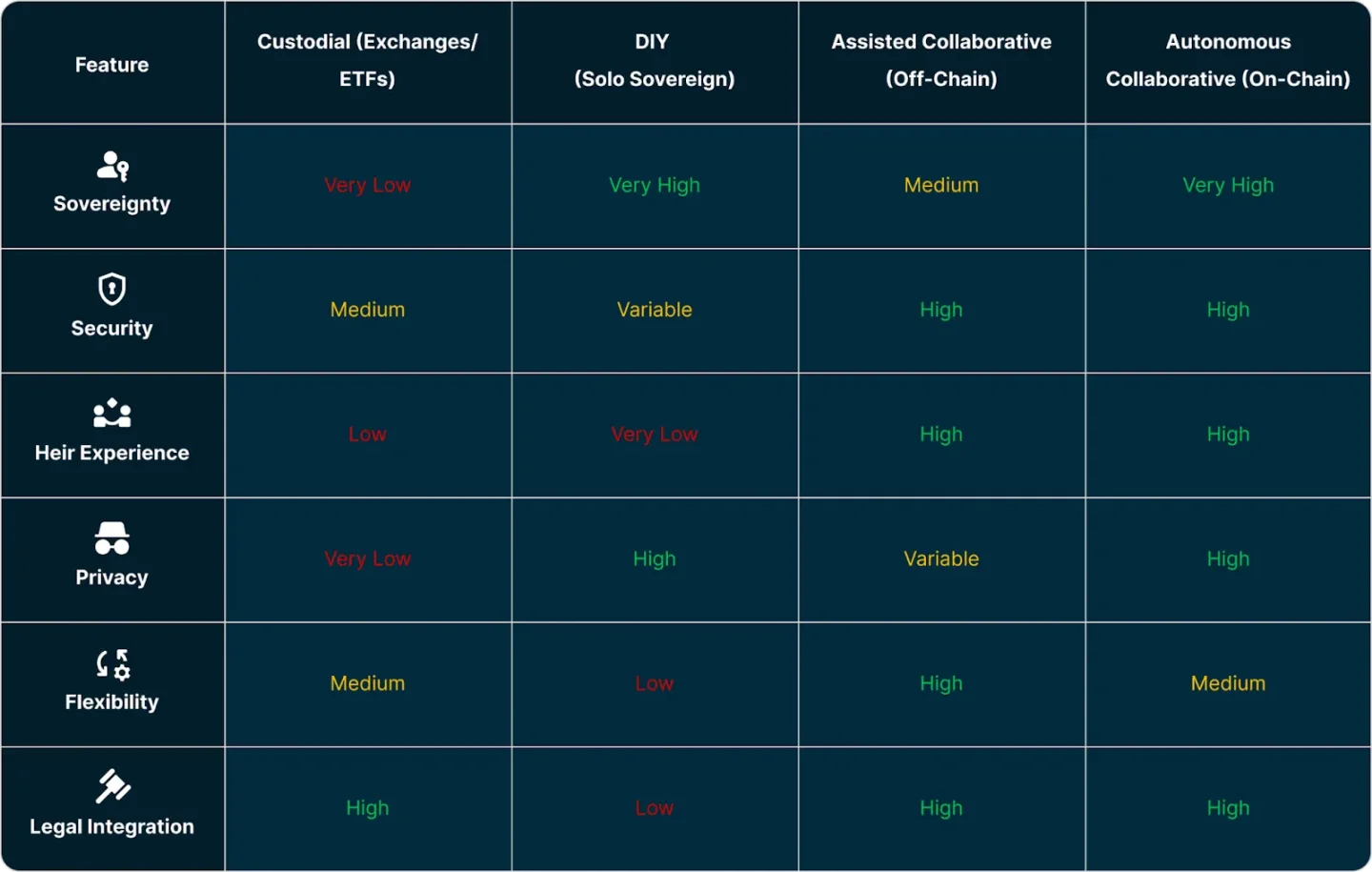
Where the Real Trade-offs Lie

When comparing modern inheritance solutions, the most meaningful question isn't "which is best," but "what are you most trying to optimize for?"

Off-chain collaborative solutions often excel in flexibility: easy to update, adaptable to family changes, and simple to adjust over time.

On-chain collaborative solutions often excel in durability: the fallback path is designed to work even if the service provider fails, which is crucial for inheritance plans that need to remain effective for decades.

Many families could reasonably choose either. The key is what matters most to you.

If you view Bitcoin as generational wealth, then durability should be a core consideration.

Smooth Path + Last Line of Defense

Most Bitcoin inheritance solutions tend to lean towards two extremes.

One end sacrifices autonomy for convenience: easy to understand, but heavily reliant on institutions, identity verification, or service provider cooperation.

The other end sacrifices usability for autonomy: reduces trust in third parties, but places the complex technical burden on the heirs, and at their most vulnerable time.

The most robust方案 (solution) combines both paths.

The first is the smooth path: when the service provider is available and everything is normal, heirs recover the assets through a guided process that is smooth, low-stress, and error-resistant.

The second is the last line of defense: a recovery path enforced by the Bitcoin network, executable even if the service provider disappears.

This combination is important because it aligns with real inheritance scenarios: most people want their families to receive help, not face complex technical operations alone; simultaneously, very few are willing to entrust their legacy to a company that "must exist forever."

Estate Planning is Still Important

A common misconception is that Bitcoin inheritance must either completely脱离 (break away from) the traditional system or be fully integrated into the traditional financial system.

In reality, many families need a hybrid model.

Some holders want Bitcoin transferred directly and privately to their families. Others want trustee involvement, for example, for phased distribution, protecting minor children, or integrating with existing trusts. Some want to clarify their intentions with legal documents, while keeping the actual recovery path out of public probate records.

A good Bitcoin inheritance solution should support these different choices.

Therefore, it helps to think about two questions separately: Who should receive these assets? Who can actually recover these assets?

A will or trust can clarify intentions, define beneficiaries, and set legal obligations, but it doesn't itself solve the "how to recover" problem. Conversely, a purely technical recovery solution cannot bypass tax, reporting, and inheritance law requirements.

The most comprehensive plans consider both levels clearly.

Common Mistakes

Many inheritance plans fail for very ordinary reasons.

One mistake is assuming a spouse, child, or executor will "figure it out." Possessing a hardware wallet does not equate to understanding the recovery process.

Another mistake is concentrating too much power in a single point: one document, one device, one envelope that can completely unlock the funds. This certainly facilitates inheritance, but it also facilitates theft.

Another mistake is overestimating the security of a "passphrase" without thinking through the human factors in recovery. A passphrase can indeed enhance the security of a single-signature setup, but only if there is true operational discipline in every step of creation, storage, and communication.

Finally, many people make a plan once and never revisit it. Beneficiaries may change, devices may fail, family relationships may shift. A Bitcoin inheritance plan is not a static object, but a system that needs regular review.

A Simple Action List

Inheritance planning can start simple, as long as each step is intentional and regularly revisited.

  • Step 1: Determine who should inherit your Bitcoin, and whether these individuals have the ability to handle self-custody directly. Some can receive Bitcoin directly, others might need a trustee, phased handover, or guided assistance.

  • Step 2: Choose an appropriate security model based on the size of the assets and the situation of the heirs. The larger the amount, the more important multisig and formal inheritance design become.

  • Step 3: Store secrets and instructions separately. Private keys, hardware devices, and "instruction manuals" (explaining how to recover) are best kept separate, and preferably not given to the same person.

  • Step 4: Clarify what you value most. Some families are better suited for flexible off-chain coordination, others need an on-chain fallback that can outlive the service provider.

  • Step 5: Test the plan. Not with all assets, but enough to verify that the recovery path is actually usable. A plan never rehearsed is just a theory.

  • Step 6: Review your plan after major life events and periodically. Marriage, divorce, childbirth, death, moving, service providers changing – all can affect whether the original plan remains sound.

The Final Question: The True Test of Self-Custody

It's easy to think of inheritance as something to deal with "later." But in reality, it is the ultimate test of whether a custody solution is truly robust.

Custodial solutions offer familiarity, but at the cost of reintroducing reliance on institutions. DIY solutions can be excellent if technically sound, but demand more from both the owner and the heirs. Off-chain collaborative inheritance improves usability and flexibility. On-chain collaborative inheritance adds a robust long-term backup.

The most important recent advancement in this field is inheritance design that combines guided recovery with autonomous on-chain fallbacks.

For holders who want Bitcoin to become generational wealth, this shift in direction makes a lot of sense. The goal is no longer just "leaving instructions," but "leaving a recovery path that is secure, private, and operable in the long term."


Twitter:https://twitter.com/BitpushNewsCN

Bitpush TG Discussion Group:https://t.me/BitPushCommunity

Bitpush TG Subscription: https://t.me/bitpush

Original link:https://www.bitpush.news/articles/7620845

Пов'язані питання

QWhat is the core challenge of Bitcoin inheritance according to the article?

AThe core challenge is the conflict between security and accessibility: Bitcoin's design makes it difficult to steal, but this same feature also makes it difficult for intended heirs to recover the assets after the owner's death or incapacitation.

QWhat are the four common solutions for Bitcoin inheritance mentioned in the article?

AThe four common solutions are: 1. Custodial Inheritance, 2. DIY Inheritance, 3. Service-Assisted Collaborative Custody, and 4. On-Chain Collaborative Inheritance.

QWhat key advantage does an On-Chain Collaborative Inheritance model provide?

AIt provides a robust, permanent backup recovery path that is enforced by the Bitcoin network's rules, ensuring the inheritance plan remains executable even if the service provider goes out of business or is unavailable.

QWhat is a major pitfall of relying solely on a 'passphrase' for security in a DIY inheritance plan?

AIt introduces new risks: there is no checksum to detect transcription errors; a short passphrase could be brute-forced; and a long, complex one might be impossible for the owner or heirs to accurately reproduce years later, potentially locking them out of the wallet.

QWhat is the recommended first step in creating a Bitcoin inheritance plan?

AThe first step is to determine who should inherit the Bitcoin and assess whether those individuals have the capability to handle self-custody directly, or if they would require a trustee, a staged handover, or guided assistance.

Пов'язані матеріали

Торгівля

Спот
Ф'ючерси

Популярні статті

Що таке BITCOIN

Розуміння HarryPotterObamaSonic10Inu (ERC-20) та його позиції у крипто-просторі Останніми роками ринок криптовалют спостерігав за зростанням популярності мем-коінів, які привертають інтерес не тільки трейдерів, але й тих, хто шукає спілкування та розважальну цінність. Серед цих унікальних токенів є HarryPotterObamaSonic10Inu (ERC-20), інтригуючий проект, що поєднує культурні посилання з тканинами криптовалюти. Ця стаття досліджує ключові аспекти HarryPotterObamaSonic10Inu, вивчаючи його механізми, спільноту та його взаємодію з ширшим крипто-ландшафтом. Що таке HarryPotterObamaSonic10Inu (ERC-20)? Як випливає з його назви, HarryPotterObamaSonic10Inu є мем-коіном, побудованим на блокчейні Ethereum, класифікованим за стандартом ERC-20. На відміну від традиційних криптовалют, які можуть підкреслювати практичну корисність або інвестиційний потенціал, цей токен процвітає завдяки розважальній цінності та силі своєї спільноти. Проект спрямований на створення середовища, де зацікавлені користувачі можуть об'єднуватися, ділитися ідеями та брати участь у заходах, натхненних різноманітними культурними явищами. Однією з примітних особливостей HarryPotterObamaSonic10Inu є нульовий податок на транзакції. Цей привабливий елемент має на меті заохочувати торгівлю та участь у спільноті, позбавлену додаткових витрат, які можуть відлякувати дрібних трейдерів. Загальна пропозиція монет становить один мільярд токенів, що позначає намір підтримувати суттєву циркуляцію в межах спільноти. Творець HarryPotterObamaSonic10Inu (ERC-20) Походження HarryPotterObamaSonic10Inu дещо окутане таємницею; деталі про творця залишаються невідомими. Розвиток цього токена позбавлений впізнаваної команди або чіткої стратегії, що не є рідкістю в секторі мем-коінів. Натомість проект виник органічно, а його розвиток значною мірою залежить від ентузіазму та участі його спільноти. Інвестори HarryPotterObamaSonic10Inu (ERC-20) Щодо зовнішніх інвестицій та підтримки, HarryPotterObamaSonic10Inu також залишається невизначеним. Токен не зазначає жодних відомих інвестиційних фондів або значної організаційної підтримки. Натомість життєва сила проекту полягає в його базовій спільноті, яка інформує про його зростання та стійкість через колективні дії та залученість у крипто-просторі. Як працює HarryPotterObamaSonic10Inu (ERC-20)? Як мем-коін, HarryPotterObamaSonic10Inu функціонує передусім поза традиційними рамками, що часто регулюють вартість активів. Є кілька відмінних аспектів, що визначають, як працює проект: Транзакції без податку: Завдяки відсутності податкових зборів на транзакції, користувачі можуть вільно купувати та продавати токен, не турбуючись про приховані витрати. Залучення спільноти: Проект процвітає завдяки взаємодії спільноти, використовуючи соціальні медіа для створення шуму та сприяння залученню. Обговорення, обмін контентом та залученість є ключовими елементами, що допомагають розширити його охоплення та зміцнити лояльність серед прихильників. Відсутність практичної корисності: Слід зазначити, що HarryPotterObamaSonic10Inu не пропонує конкретної корисності в рамках фінансової екосистеми. Натомість він класифікується як токен, що призначений в основному для розваги та спільнотних активностей. Культурне посилання: Токен кмітливо вплітає елементи популярної культури, щоб привернути інтерес, зв'язуючи з ентузіастами мемів та крипто-стежками. HarryPotterObamaSonic10Inu ілюструє, як мем-коіни функціонують інакше, ніж традиційні криптовалютні проекти, увійшовши на ринок як інноваційні соціальні конструкти, а не утилітарні активи. Хронологія HarryPotterObamaSonic10Inu (ERC-20) Історія HarryPotterObamaSonic10Inu відзначена кількома значними етапами: Створення: Токен виник з вірусного мему, захопивши уяву багатьох крипто-ентузіастів. Конкретні дати створення недоступні, що підкреслює його органічний розвиток. Лістинг на біржах: HarryPotterObamaSonic10Inu з'явився на різних біржах, дозволяючи зручніший доступ і торгівлю спільноти. Ініціативи залучення спільноти: Ведення діяльності, спрямованої на покращення взаємодії спільноти, включаючи конкурси, кампанії в соціальних мережах та створення контенту від фанатів та прихильників. Плани на майбутнє: Дорожня карта проекту включає запуск колекції NFT, мерчандайзинг та електронну комерцію, пов'язану з його культурними темами, що далі залучає спільноту та намагається додати більше вимірів до його екосистеми. Ключові моменти про HarryPotterObamaSonic10Inu (ERC-20) Спільнотний підхід: Проект надає пріоритет колективному внеску та креативності, забезпечуючи, щоб участь користувачів була в центрі його розвитку. Класифікація як мем-коін: Це є його епігенез розважальної криптовалюти, що відрізняється від традиційних інвестиційних інструментів. Жодного прямого відношення до Bitcoin: Незважаючи на схожість у назві, HarryPotterObamaSonic10Inu є відмінним і не має жодного зв’язку з Bitcoin або іншими усталеними криптовалютами. Зосередженість на співпраці: HarryPotterObamaSonic10Inu створено для того, щоб надати простір для співпраці та обміну історіями серед його власників, забезпечуючи шлях для творчості та спільного зв'язку. Перспективи на майбутнє: Амбіція розширитися за межі початкової концепції в NFT та мерчандайз відкриває шлях для проекту потенційно потрапити в більш мейнстрімні сфери цифрової культури. Оскільки мем-коіни продовжують захоплювати уяву спільноти криптовалют, HarryPotterObamaSonic10Inu (ERC-20) вирізняється своїми культурними зв'язками та орієнтованим на спільноту підходом. Хоча він може не відповідати типовій моделі утилітарного токена, його суть полягає в радощах і товариськості, що підтримуються серед його прихильників, підкреслюючи еволюційну природу криптовалют в усе більш цифрову епоху. Оскільки проект продовжує розвиватися, важливо спостерігати за тим, як динаміка спільноти вплине на його траєкторію в постійно змінюваному ландшафті технології блокчейн.

1.7k переглядів усьогоОпубліковано 2024.04.01Оновлено 2024.12.03

Що таке BITCOIN

Як купити BTC

Ласкаво просимо до HTX.com! Ми зробили покупку Bitcoin (BTC) простою та зручною. Дотримуйтесь нашої покрокової інструкції, щоб розпочати свою криптовалютну подорож.Крок 1: Створіть обліковий запис на HTXВикористовуйте свою електронну пошту або номер телефону, щоб зареєструвати обліковий запис на HTX безплатно. Пройдіть безпроблемну реєстрацію й отримайте доступ до всіх функцій.ЗареєструватисьКрок 2: Перейдіть до розділу Купити крипту і виберіть спосіб оплатиКредитна/дебетова картка: використовуйте вашу картку Visa або Mastercard, щоб миттєво купити Bitcoin (BTC).Баланс: використовуйте кошти з балансу вашого рахунку HTX для безперешкодної торгівлі.Треті особи: ми додали популярні способи оплати, такі як Google Pay та Apple Pay, щоб підвищити зручність.P2P: Торгуйте безпосередньо з іншими користувачами на HTX.Позабіржова торгівля (OTC): ми пропонуємо індивідуальні послуги та конкурентні обмінні курси для трейдерів.Крок 3: Зберігайте свої Bitcoin (BTC)Після придбання Bitcoin (BTC) збережіть його у своєму обліковому записі на HTX. Крім того, ви можете відправити його в інше місце за допомогою блокчейн-переказу або використовувати його для торгівлі іншими криптовалютами.Крок 4: Торгівля Bitcoin (BTC)Легко торгуйте Bitcoin (BTC) на спотовому ринку HTX. Просто увійдіть до свого облікового запису, виберіть торгову пару, укладайте угоди та спостерігайте за ними в режимі реального часу. Ми пропонуємо зручний досвід як для початківців, так і для досвідчених трейдерів.

4.3k переглядів усьогоОпубліковано 2024.12.12Оновлено 2025.03.21

Як купити BTC

Що таке $BITCOIN

ЦИФРОВЕ ЗОЛОТО ($BITCOIN): Комплексний аналіз Вступ до ЦИФРОВОГО ЗОЛОТА ($BITCOIN) ЦИФРОВЕ ЗОЛОТО ($BITCOIN) — це проект на основі блокчейну, що працює в мережі Solana, який має на меті поєднати характеристики традиційних дорогоцінних металів з інноваціями децентралізованих технологій. Хоча він має таку ж назву, як і Bitcoin, який часто називають “цифровим золотом” через його сприйняття як засобу збереження вартості, ЦИФРОВЕ ЗОЛОТО є окремим токеном, розробленим для створення унікальної екосистеми в ландшафті Web3. Його мета — позиціонувати себе як життєздатний альтернативний цифровий актив, хоча деталі щодо його застосувань і функціональностей все ще розробляються. Що таке ЦИФРОВЕ ЗОЛОТО ($BITCOIN)? ЦИФРОВЕ ЗОЛОТО ($BITCOIN) — це токен криптовалюти, спеціально розроблений для використання в блокчейні Solana. На відміну від Bitcoin, який виконує широко визнану роль зберігання вартості, цей токен, здається, зосереджується на більш широких застосуваннях і характеристиках. Помітні аспекти включають: Інфраструктура блокчейну: Токен побудований на блокчейні Solana, відомому своєю здатністю обробляти швидкі та низьковартісні транзакції. Динаміка постачання: ЦИФРОВЕ ЗОЛОТО має максимальне постачання, обмежене 100 квадрильйонами токенів (100P $BITCOIN), хоча деталі щодо його обігового постачання наразі не розголошуються. Утиліта: Хоча точні функціональності не викладені, є вказівки на те, що токен може бути використаний для різних застосувань, потенційно пов'язаних з децентралізованими додатками (dApps) або стратегіями токенізації активів. Хто є творцем ЦИФРОВОГО ЗОЛОТА ($BITCOIN)? На даний момент особа творців і команди розробників, що стоять за ЦИФРОВИМ ЗОЛОТОМ ($BITCOIN), залишається невідомою. Ця ситуація є типовою для багатьох інноваційних проектів у сфері блокчейну, особливо тих, що пов'язані з децентралізованими фінансами та феноменом мем-коінів. Хоча така анонімність може сприяти культурі, орієнтованій на спільноту, вона посилює занепокоєння щодо управління та підзвітності. Хто є інвесторами ЦИФРОВОГО ЗОЛОТА ($BITCOIN)? Доступна інформація вказує на те, що ЦИФРОВЕ ЗОЛОТО ($BITCOIN) не має жодних відомих інституційних спонсорів або помітних венчурних капіталовкладень. Проект, здається, працює за моделлю “рівний до рівного”, зосереджуючись на підтримці та прийнятті спільноти, а не на традиційних шляхах фінансування. Його активність і ліквідність переважно розташовані на децентралізованих біржах (DEX), таких як PumpSwap, а не на встановлених централізованих торгових платформах, що ще більше підкреслює його підхід знизу вгору. Як працює ЦИФРОВЕ ЗОЛОТО ($BITCOIN) Операційні механізми ЦИФРОВОГО ЗОЛОТА ($BITCOIN) можна детальніше розглянути на основі його дизайну блокчейну та характеристик мережі: Механізм консенсусу: Використовуючи унікальний proof-of-history (PoH) Solana в поєднанні з моделлю proof-of-stake (PoS), проект забезпечує ефективну валідацію транзакцій, що сприяє високій продуктивності мережі. Токеноміка: Хоча конкретні дефляційні механізми не були детально описані, велике максимальне постачання токенів вказує на те, що воно може задовольняти мікротранзакції або нішеві випадки використання, які ще потрібно визначити. Інтероперабельність: Існує потенціал для інтеграції з більш широкою екосистемою Solana, включаючи різні платформи децентралізованих фінансів (DeFi). Однак деталі щодо конкретних інтеграцій залишаються невизначеними. Хронологія ключових подій Ось хронологія, яка підкреслює значні віхи, пов'язані з ЦИФРОВИМ ЗОЛОТОМ ($BITCOIN): 2023: Початкове розгортання токена відбувається на блокчейні Solana, позначене його адресою контракту. 2024: ЦИФРОВЕ ЗОЛОТО набуває видимості, оскільки стає доступним для торгівлі на децентралізованих біржах, таких як PumpSwap, що дозволяє користувачам торгувати ним проти SOL. 2025: Проект спостерігає спорадичну торгову активність і потенційний інтерес до ініціатив, очолюваних спільнотою, хоча на даний момент не зафіксовано жодних значних партнерств або технічних досягнень. Критичний аналіз Сильні сторони Масштабованість: Основна інфраструктура Solana підтримує високі обсяги транзакцій, що може підвищити утиліту $BITCOIN у різних сценаріях транзакцій. Доступність: Потенційно низька торгова ціна за токен може привабити роздрібних інвесторів, сприяючи більш широкій участі завдяки можливостям дробового володіння. Ризики Відсутність прозорості: Відсутність публічно відомих спонсорів, розробників або процесу аудиту може викликати скептицизм щодо стійкості та надійності проекту. Волатильність ринку: Торгова активність сильно залежить від спекулятивної поведінки, що може призвести до значної волатильності цін і невизначеності для інвесторів. Висновок ЦИФРОВЕ ЗОЛОТО ($BITCOIN) постає як цікавій, але неоднозначний проект у швидко розвиваючійся екосистемі Solana. Хоча він намагається використати наратив “цифрового золота”, його відхід від встановленої ролі Bitcoin як засобу збереження вартості підкреслює необхідність чіткішого розмежування його передбачуваної утиліти та структури управління. Майбутнє прийняття та адаптація, ймовірно, залежатиме від вирішення поточної непрозорості та більш чіткого визначення його операційних та економічних стратегій. Примітка: Цей звіт охоплює синтезовану інформацію, доступну станом на жовтень 2023 року, і можуть відбутися події, що виходять за межі дослідницького періоду.

75 переглядів усьогоОпубліковано 2025.05.13Оновлено 2025.05.13

Що таке $BITCOIN

Обговорення

Ласкаво просимо до спільноти HTX. Тут ви можете бути в курсі останніх подій розвитку платформи та отримати доступ до професійної ринкової інформації. Нижче представлені думки користувачів щодо ціни BTC (BTC).

活动图片














