The Banking Industry's Resistance: The Endless Debate Over Stablecoin Interest Payments

marsbitОпубліковано о 2026-01-09Востаннє оновлено о 2026-01-09

Анотація

The article discusses the ongoing regulatory debate in the U.S. regarding interest payments on stablecoins. The proposed *GENIUS Act* currently prohibits stablecoin *issuers* from paying interest to holders. However, platforms like Coinbase can still offer yields (e.g., 3.35% on USDC) because they act as *distributors*, not issuers. This loophole has sparked a significant political battle. The American Bankers Association (ABA) is leading efforts to expand the interest ban to include distributors in the upcoming *Crypto Market Structure Bill*. Banks argue that stablecoins threaten their deposit base, reduce lending capacity, and lack FDIC insurance, thereby endangering their traditional business model. The crypto industry strongly opposes this expansion. Coinbase's Chief Policy Officer argues stablecoins haven't caused significant bank deposit outflows. Think tank Paradigm suggests that banning interest on stablecoins used for payments would be akin to a "holding tax" on consumers. The article contrasts the U.S. situation with approaches in China and South Korea. China's digital yuan (a CBDC) pays interest to promote adoption, while South Korea's policy mirrors the current U.S. stance—banning issuer interest but not distributor interest. The conclusion warns that if the ABA's lobbying succeeds, it would cripple the crypto industry. It argues that traditional finance should adapt to innovation, citing examples of banks and asset managers (like BNY Mellon, JPMorgan, and Bla...

Written by: 100y.eth

Compiled by: Saoirse, Foresight News

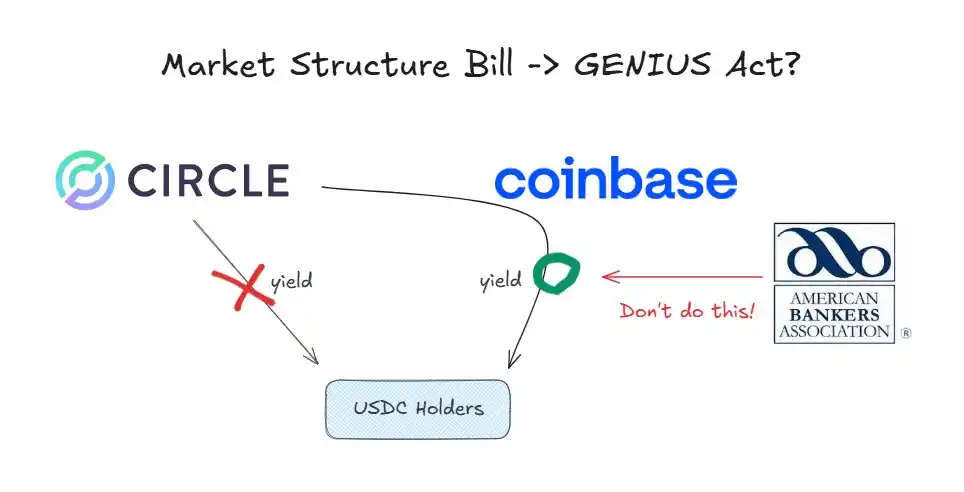
According to the GENIUS Act, stablecoin issuers are prohibited from paying interest to stablecoin holders.

However, Coinbase is currently offering a 3.35% reward to users holding USDC on its platform. This is possible because the GENIUS Act only prohibits issuers from paying interest and does not impose restrictions on distributors.

Yet, ahead of the review of the Crypto Market Structure Act (which aims to systematize cryptocurrency regulation) by the relevant U.S. Senate committee on January 15, a debate over "whether the stablecoin interest payment ban should be extended to the distribution level" has fully erupted.
Strong Opposition from the Banking Industry

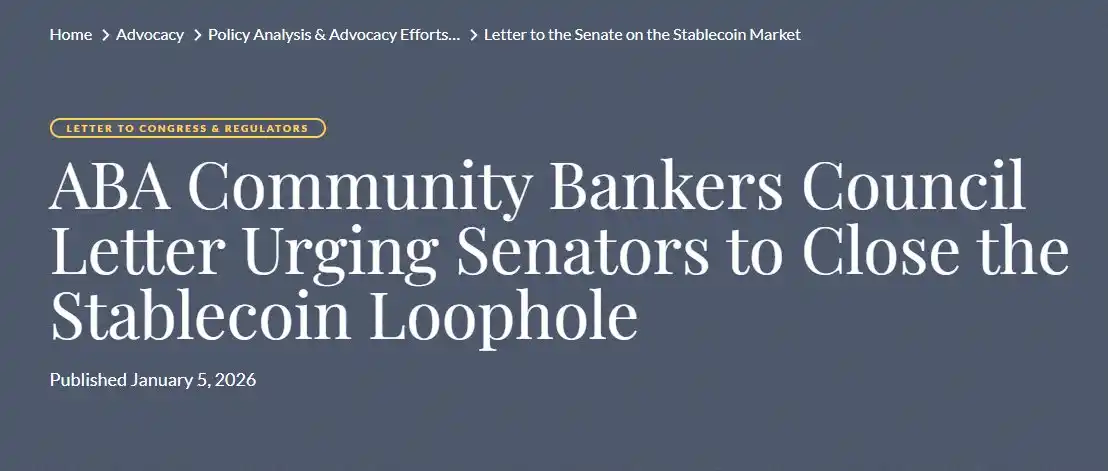
The American Bankers Association (ABA) is the primary group calling for a comprehensive ban on stablecoin interest payments. In a public letter released on January 5, the association argued that the interest payment ban in the GENIUS Act should not only apply to issuers but should also be broadly interpreted to extend to affiliated parties. They are pushing for this interpretation to be explicitly written into the Crypto Market Structure Act.
The Reasons Behind the Banking Industry's Firm Opposition

The banking industry's determination to completely ban stablecoin interest payments is quite simple:

  • Concern over deposit outflows;
  • Reduced deposits mean diminished lending capacity;
  • Stablecoins are not protected by Federal Deposit Insurance Corporation (FDIC) insurance.

Ultimately, stablecoins are threatening the stable and highly profitable business model that the banking industry has relied on for decades.

The Crypto Industry's Counterattack

From the perspective of the crypto industry, this move by the banking sector is a major problem. If the restrictions of the GENIUS Act are expanded through the Crypto Market Structure Act due to banking lobbying pressure, it would effectively rewrite and narrow the scope of this already passed act. Unsurprisingly, this has sparked strong opposition from the crypto industry.

Coinbase's Stance

Coinbase Chief Policy Officer Faryar Shirzad countered, citing relevant research indicating that stablecoins have not caused substantial outflows of bank deposits. He also used news about the digital yuan paying interest as a new argument in this debate.

Paradigm's Perspective

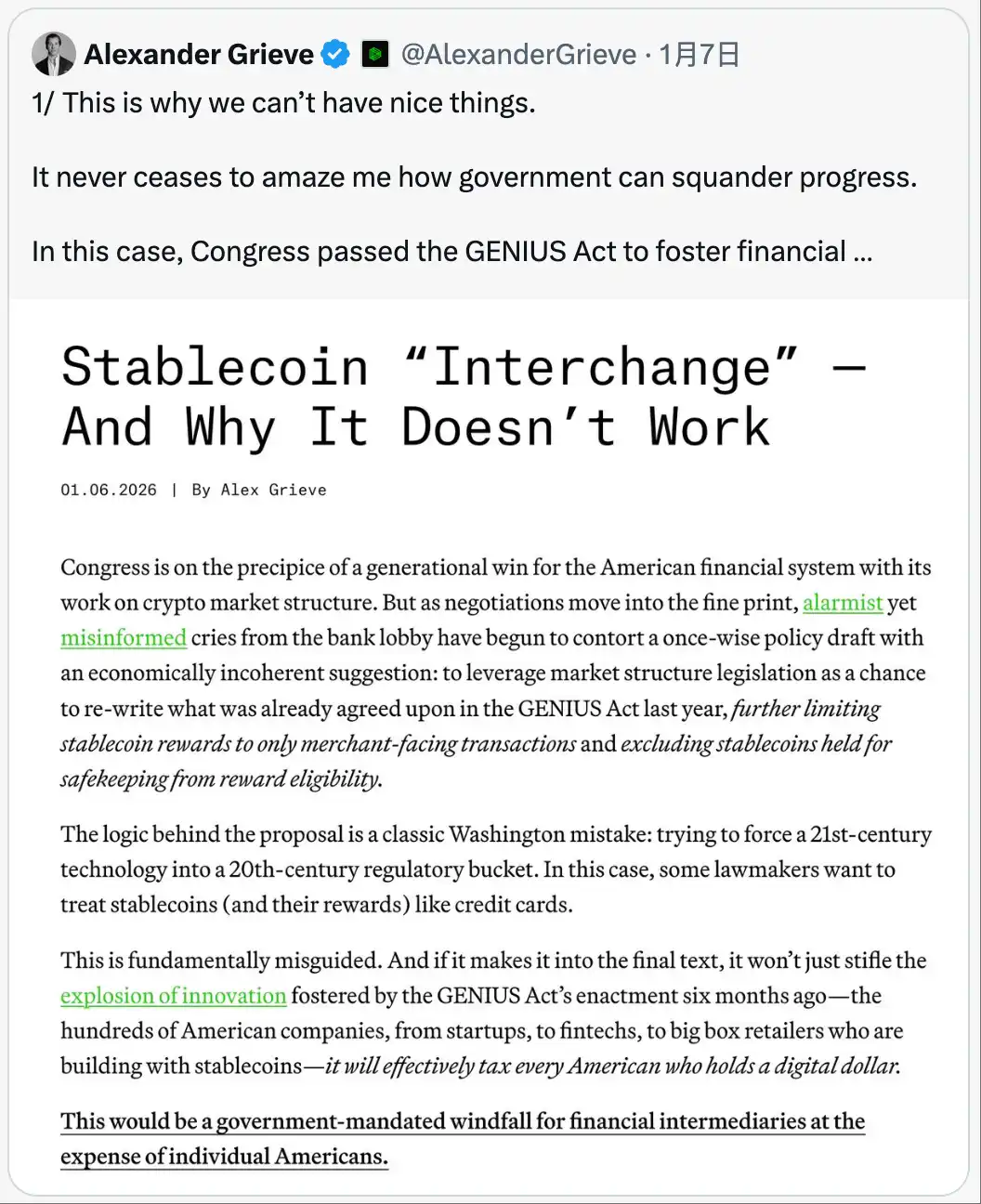
Alexander Grieve, Vice President of Government Affairs at crypto investment firm Paradigm, offered another viewpoint. He argued that even if interest payments are only allowed for stablecoins used in payment scenarios, it would effectively equate to a "holding tax" for consumers.
What About China and South Korea?

Although China and South Korea have not advanced cryptocurrency-related policies as rapidly as some other Asian countries, both have recently introduced a series of new measures surrounding Central Bank Digital Currencies (CBDCs) and stablecoin policies. The differences in their approaches to interest payments are particularly noteworthy:

The People's Bank of China has decided to pay interest on the digital yuan, treating it the same as ordinary bank deposits, to promote its adoption.

South Korea's policy direction is closer to that of the U.S.: it prohibits issuers from paying interest but does not explicitly ban distributors from doing so.

From a macro perspective, China's aggressive policy stance is understandable. The digital yuan is not a private stablecoin but a法定数字货币 (fiat digital currency) issued directly by the central bank. Promoting the digital yuan can both counterbalance the dominance of private platforms like Alipay and WeChat Pay and strengthen the financial system centered around the central bank.

Conclusion

New technologies give rise to new industries, and the rise of new industries often poses a threat to traditional ones.

Traditional financial institutions, represented by banks, are facing the irreversible trend of transitioning to the stablecoin era. At this juncture, resisting change is more harmful than beneficial; embracing change and exploring new opportunities is the wiser choice.

In fact, even for existing market participants, the stablecoin industry holds immense opportunities. Many banks have already begun to actively position themselves:

  • The Bank of New York Mellon is developing its business around stablecoin reserve custody;
  • Cross River Bank acts as an intermediary for Circle's USDC fiat on-ramp channels through Application Programming Interfaces (APIs);
  • JPMorgan Chase is experimenting with tokenized deposits.

Major card networks also have vested interests at stake. As on-chain payment volumes grow, the business of traditional card networks may shrink. However, companies like Visa and Mastercard have chosen not to fight this trend but instead actively support stablecoin payment settlements, seeking new growth opportunities顺势.

Asset management firms are also entering the fray. Funds like BlackRock are actively advancing the tokenization of various investment funds.

If the banking industry's lobbying succeeds and a comprehensive ban on stablecoin interest payments is written into the Crypto Market Structure Act, the crypto industry will suffer a heavy blow.

As a practitioner in the crypto industry, I can only hope that the Crypto Market Structure Act will not include provisions that effectively nullify the GENIUS Act.


Пов'язані питання

QWhat is the main argument of the American Bankers Association (ABA) regarding stablecoin interest payments?

AThe American Bankers Association argues that the interest payment ban in the GENIUS Act should not only apply to issuers but should be broadly interpreted and extended to include associated parties, such as distributors. They are pushing for this interpretation to be explicitly written into the Crypto Market Structure Act.

QWhy are traditional banks strongly opposed to stablecoins paying interest?

ABanks are opposed because they fear it will lead to an outflow of bank deposits, which would reduce their lending capacity. Additionally, stablecoins are not protected by FDIC insurance, and they threaten the stable, high-profit business model that banks have relied on for decades.

QHow does Coinbase currently provide rewards for USDC holders, and what is their defense against the proposed restrictions?

ACoinbase provides a 3.35% reward to users who hold USDC on its platform. They defend this practice by citing research that stablecoins have not caused a substantial outflow of bank deposits. They also reference China's digital yuan, which pays interest, as a counterpoint in the debate.

QWhat is the difference between China's and South Korea's policies on paying interest for their digital currencies?

AChina's central bank pays interest on its digital yuan, treating it similarly to traditional bank deposits to promote adoption. In contrast, South Korea's policy is closer to the U.S. approach: it prohibits issuers from paying interest but does not explicitly ban distributors from doing so.

QWhat potential impact could the Crypto Market Structure Act have on the crypto industry if it includes a broad ban on stablecoin interest payments?

AIf the Crypto Market Structure Act includes a broad ban on stablecoin interest payments, extending it to distributors, it would severely harm the crypto industry. This would effectively nullify the GENIUS Act's provisions and stifle innovation, as it would prevent platforms like Coinbase from offering rewards, limiting the utility and attractiveness of stablecoins for consumers.

Пов'язані матеріали

Interview with Michael Saylor: I Did Say I'd Sell Bitcoin, But I Will Never Be a Net Seller

**Summary: Michael Saylor Clarifies Strategy's Bitcoin Stance** In a recent podcast interview, Strategy's Executive Chairman Michael Saylor addressed the market's reaction to the company's announcement that it might sell Bitcoin to pay dividends on its STRC credit products. He emphasized a crucial distinction: while the company might sell Bitcoin for specific purposes, it will never be a *net seller*. Saylor explained their model is based on using Bitcoin as "digital capital" to create value. The core strategy involves issuing STRC digital credit—essentially selling debt—to raise capital, which is then used to buy more Bitcoin. He estimates Bitcoin appreciates at roughly 40% annually. A small portion of these capital gains (e.g., ~2.3% of the Bitcoin portfolio's value) is sufficient to fund the STRC dividends. Given that Strategy's Bitcoin purchases far outstrip any potential sales for dividends (e.g., buying $3.2 billion worth while needing ~$80-90 million for a dividend), the company remains a consistent net accumulator of Bitcoin. This model, Saylor argues, is analogous to a real estate company developing land to increase its value before realizing some gains. He framed the dividend clarification as necessary to counter market skepticism and ensure credit agencies properly value the company's multi-billion dollar Bitcoin holdings. Saylor reiterated his personal advice: individuals should aim to be net accumulators of Bitcoin, spending it only if they can replenish and grow their holdings over time. Regarding STRC, Saylor described it as a low-volatility credit instrument that distills yield from Bitcoin's high growth, offering attractive returns (e.g., ~11-12% yield) for risk-averse investors. He noted that Strategy's STRC issuance now constitutes about 60% of the U.S. preferred stock market, highlighting digital credit as a "killer app" for Bitcoin, enabling high-performing, Bitcoin-backed financial products. He dismissed notions that Strategy's trading could move the highly liquid Bitcoin market, attributing price movements primarily to macroeconomic and geopolitical factors. Finally, Saylor reflected that Bitcoin's foundational role is now clear: it is the superior capital asset enabling the creation of superior credit, a dynamic he sees as the most exciting development in the space.

marsbit5 хв тому

Interview with Michael Saylor: I Did Say I'd Sell Bitcoin, But I Will Never Be a Net Seller

marsbit5 хв тому

380,000 Apps Exposed, 2,000+ Apps Leaked Secrets: AI Programming Turns 'Intranet' into Public Internet

Israeli cybersecurity firm RedAccess uncovered a severe data exposure trend linked to "vibe coding" or AI-powered software development tools. Their research found approximately 38,000 publicly accessible web applications built with platforms like Lovable, Base44, Netlify, and Replit. Of these, an estimated 2,000 apps exposed sensitive corporate and personal data, including medical records, financial information, internal strategic documents, and customer chat logs. In some cases, access even granted administrative privileges. The core issue stems from default privacy settings that make applications public by default, combined with a lack of built-in security controls (like authentication) in the AI-generated code. This allows employees without security expertise—"citizen developers"—to easily create and deploy applications that bypass standard corporate security reviews. The exposed apps, often indexed by search engines, are trivially discoverable. While some platform providers (Replit, Lovable, Wix/Base44) argue that security configuration is the user's responsibility and question the validity of some findings, security researchers confirm the widespread reality of such exposures. This pattern, also noted in prior studies, highlights a critical security gap as AI democratizes app creation, potentially leading to massive, unintentional data leaks.

marsbit1 год тому

380,000 Apps Exposed, 2,000+ Apps Leaked Secrets: AI Programming Turns 'Intranet' into Public Internet

marsbit1 год тому

Attracting Global Capital, Asia's New 'Super Cycle' Is Unfolding

Investors are turning to Asia as the next frontier for global equity growth, with a new "super cycle" unfolding across the region. Driven by the AI revolution, Asian markets, particularly South Korea, have seen significant rallies. According to Morgan Stanley analysis, the underlying drivers of Asia's industrial cycle are shifting from traditional sectors like real estate and manufacturing to massive investments in AI infrastructure, energy security and transition, and supply chain resilience. Fixed asset investment in Asia is projected to grow from around $11 trillion in 2025 to $16 trillion by 2030, with a 7% annual growth rate from 2026-2030. The AI wave is a primary catalyst, driving immense capital expenditure for chips, servers, data centers, and power systems. Asia is central to this hardware supply chain. In China, AI investment is focused on building a full-system domestic capability, with the local AI chip market potentially reaching $86 billion by 2030. Beyond AI, China's export story is expanding from EVs and batteries to robotics. The country already captures about half of new global industrial robot demand and over 90% of humanoid robot shipments. This growth phase mirrors the early stages of China's EV export boom. Simultaneously, energy security investments, spurred by AI's massive power needs, are rising, with China benefiting from its leadership in solar, batteries, and EVs. Regional defense spending is also increasing structurally, supporting demand for advanced manufacturing. The main beneficiaries are China, South Korea, and Japan, positioned in core supply chain areas. However, risks remain, including potential overcapacity, profit margin pressures from competition, persistent technological restrictions, geopolitical friction, and workforce displacement due to AI-driven automation. Market volatility is also expected to increase as investor expectations diverge on the realization of these capital investment and export themes.

marsbit1 год тому

Attracting Global Capital, Asia's New 'Super Cycle' Is Unfolding

marsbit1 год тому

Торгівля

Спот
Ф'ючерси
活动图片