Tether Scraps $20 Billion Funding Ambitions Due To Investor Opposition

bitcoinistОпубліковано о 2026-02-05Востаннє оновлено о 2026-02-05

Анотація

Cryptocurrency giant Tether has significantly scaled back its fundraising ambitions, reducing its target from an initial $15–20 billion to potentially as low as $5 billion. This shift follows investor resistance to the company's proposed $500 billion valuation. CEO Paolo Ardoino clarified that the $500 billion figure was a maximum valuation cap, not a firm target, and noted that internal reluctance from existing shareholders to sell equity has complicated efforts to structure a larger round. Despite the fundraising challenges, Tether reported strong 2025 net profits exceeding $10 billion and continues to expand its USDT stablecoin supply, which now circulates approximately $186 billion. The company has also diversified its reserves, including significant gold purchases, and launched a new dollar-pegged stablecoin, USA₮, for the U.S. market.

Crypto giant Tether is reportedly encountering resistance in its latest fundraising efforts, prompting a significant rethink of how much capital it plans to raise.

According to people familiar with the discussions, investor pushback over the company’s ambitious $500 billion valuation has led advisers to consider a much smaller funding round, potentially as low as $5 billion.

Shareholder Hesitation Slows Tether Fundraise

The revised target marks a sharp shift from earlier talks last year, when Tether was said to be exploring a raise of between $15 billion and $20 billion.

Chief Executive Officer Paolo Ardoino pushed back on the notion that the company was aiming to raise funds at a $500 billion valuation, describing that figure as a misunderstanding.

Speaking to the Financial Times, Ardoino said the number represented the maximum valuation at which Tether would have been willing to sell shares, not a firm objective. Ardoino also noted that interest from potential investors at that valuation had been strong, but that progress has been slowed by internal considerations.

In particular, some existing shareholders have been reluctant to sell equity, complicating efforts to structure a larger fundraising round and contributing to the decision by advisers to explore a more modest raise.

Concerns around shareholder sales have surfaced before. Last year, Bitcoinist reported that Tether was weighing several options to manage its capital strategy, including share buybacks and the potential tokenization of company shares on a blockchain once a fundraising deal is completed.

At the time, those discussions were driven by worries that certain investors selling their stakes could undermine the company’s broader fundraising plans.

Tether later confirmed it had blocked at least one shareholder from proceeding with plans to divest, calling it “imprudent” for any investor to attempt to sidestep formal processes overseen by leading global investment banks.

Profits And Reserves While Rolling Out USA₮

Despite the fundraising uncertainty, Tether’s financial position appears robust. The company reported net profits exceeding $10 billion for 2025, while the supply of its flagship stablecoin, USDT, expanded to approximately $186 billion in circulation.

By year‐end, Tether reportedly held several billion dollars in excess reserves, with total assets comfortably exceeding liabilities. That financial cushion has helped ease concerns among investors about whether the company can adequately back such a large volume of stablecoins.

Tether has also continued to diversify its reserves. Recent filings and public statements indicate that the firm purchased roughly 27 metric tons of gold in the final quarter of the year.

At the same time, Tether is expanding its footprint in the United States. The company has officially launched a new dollar‐pegged stablecoin, called USA₮, designed specifically for the US market..

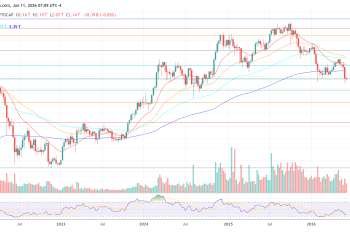
The total crypto market cap drop below the $2.5 trillion mark on the daily chart. Source: TOTAL on TradingView.com

Featured image from OpenArt, chart from TradingView.com

Пов'язані питання

QWhy did Tether significantly reduce its fundraising target from up to $20 billion to potentially as low as $5 billion?

ATether reduced its fundraising target due to investor pushback over the company's ambitious $500 billion valuation and reluctance from some existing shareholders to sell their equity, which complicated efforts to structure a larger round.

QWhat did Tether's CEO, Paolo Ardoino, clarify regarding the reported $500 billion valuation?

APaolo Ardoino clarified that the $500 billion figure was a misunderstanding; it represented the maximum valuation at which Tether would have been willing to sell shares, not a firm objective for the fundraising.

QWhat financial performance did Tether report for 2025, and what is the current circulation of its USDT stablecoin?

ATether reported net profits exceeding $10 billion for 2025, and the supply of its USDT stablecoin expanded to approximately $186 billion in circulation.

QHow has Tether diversified its reserves, according to recent filings and statements?

ATether has diversified its reserves by purchasing roughly 27 metric tons of gold in the final quarter of the year.

QWhat new product has Tether launched specifically for the US market?

ATether has launched a new dollar-pegged stablecoin called USA₮, which is designed specifically for the US market.

Пов'язані матеріали

380,000 Apps Exposed, 2,000+ Apps Leaked Secrets: AI Programming Turns 'Intranet' into Public Internet

Israeli cybersecurity firm RedAccess uncovered a severe data exposure trend linked to "vibe coding" or AI-powered software development tools. Their research found approximately 38,000 publicly accessible web applications built with platforms like Lovable, Base44, Netlify, and Replit. Of these, an estimated 2,000 apps exposed sensitive corporate and personal data, including medical records, financial information, internal strategic documents, and customer chat logs. In some cases, access even granted administrative privileges. The core issue stems from default privacy settings that make applications public by default, combined with a lack of built-in security controls (like authentication) in the AI-generated code. This allows employees without security expertise—"citizen developers"—to easily create and deploy applications that bypass standard corporate security reviews. The exposed apps, often indexed by search engines, are trivially discoverable. While some platform providers (Replit, Lovable, Wix/Base44) argue that security configuration is the user's responsibility and question the validity of some findings, security researchers confirm the widespread reality of such exposures. This pattern, also noted in prior studies, highlights a critical security gap as AI democratizes app creation, potentially leading to massive, unintentional data leaks.

marsbit52 хв тому

380,000 Apps Exposed, 2,000+ Apps Leaked Secrets: AI Programming Turns 'Intranet' into Public Internet

marsbit52 хв тому

Attracting Global Capital, Asia's New 'Super Cycle' Is Unfolding

Investors are turning to Asia as the next frontier for global equity growth, with a new "super cycle" unfolding across the region. Driven by the AI revolution, Asian markets, particularly South Korea, have seen significant rallies. According to Morgan Stanley analysis, the underlying drivers of Asia's industrial cycle are shifting from traditional sectors like real estate and manufacturing to massive investments in AI infrastructure, energy security and transition, and supply chain resilience. Fixed asset investment in Asia is projected to grow from around $11 trillion in 2025 to $16 trillion by 2030, with a 7% annual growth rate from 2026-2030. The AI wave is a primary catalyst, driving immense capital expenditure for chips, servers, data centers, and power systems. Asia is central to this hardware supply chain. In China, AI investment is focused on building a full-system domestic capability, with the local AI chip market potentially reaching $86 billion by 2030. Beyond AI, China's export story is expanding from EVs and batteries to robotics. The country already captures about half of new global industrial robot demand and over 90% of humanoid robot shipments. This growth phase mirrors the early stages of China's EV export boom. Simultaneously, energy security investments, spurred by AI's massive power needs, are rising, with China benefiting from its leadership in solar, batteries, and EVs. Regional defense spending is also increasing structurally, supporting demand for advanced manufacturing. The main beneficiaries are China, South Korea, and Japan, positioned in core supply chain areas. However, risks remain, including potential overcapacity, profit margin pressures from competition, persistent technological restrictions, geopolitical friction, and workforce displacement due to AI-driven automation. Market volatility is also expected to increase as investor expectations diverge on the realization of these capital investment and export themes.

marsbit52 хв тому

Attracting Global Capital, Asia's New 'Super Cycle' Is Unfolding

marsbit52 хв тому

Funding Weekly Report | 14 Public Funding Events, Kalshi Completes $10B New Funding Round at $220B Valuation Led by Coatue Management

Weekly Funding Roundup: 14 Deals and $10.49B+ in Total Funding, Led by Kalshi's $1B Round Last week (5.4-5.10) saw 14 notable funding events in the global blockchain ecosystem, raising over $10.49 billion in total. Key highlights include Kalshi, a prediction market platform, securing a $1 billion round led by Coatue Management, reaching a $22 billion valuation. The platform now boasts ~2 million MAUs and $178B in annualized trading volume. In DeFi, regulated on-chain reinsurer OnRe raised $5 million in Series A funding, and Bitcoin-backed credit protocol Saturn Credit completed a $2 million seed round. For Infrastructure & Tools, OpenTrade raised $17 million to expand its stablecoin yield infrastructure, and RWA platform Balcony secured $12.7 million to deploy its property settlement service in the US. Centralized Finance saw one deal: AI-driven trading platform Stockcoin.ai completed a seed round led by Amber Group. In the prediction market sector alongside Kalshi, AI-powered platform Elastics raised $2 million. Other notable deals include SC Ventures' strategic investment in crypto market maker GSR and Centrifuge securing a "seven-figure" investment from Coinbase to become a core RWA partner for Base. On the investor side, Haun Ventures raised a new $1 billion fund targeting crypto and AI, and Multi Investment raised ~$616 million to focus on blockchain and Web3 investments.

marsbit1 год тому

Funding Weekly Report | 14 Public Funding Events, Kalshi Completes $10B New Funding Round at $220B Valuation Led by Coatue Management

marsbit1 год тому

Торгівля

Спот
Ф'ючерси
活动图片