Tether Fails $500B Evaluation Amidst Investor Pushback as HYPER Gains Momentum

bitcoinistОпубліковано о 2026-02-04Востаннє оновлено о 2026-02-04

Анотація

The cryptocurrency market is experiencing a significant shift as Tether (USDT) faces investor resistance and fails to achieve a $500 billion valuation, driven by transparency concerns and a move towards decentralized alternatives. This has led to a rotation of liquidity into Bitcoin Layer 2 solutions, which aim to unlock Bitcoin's dormant capital by enhancing its utility. Bitcoin Hyper ($HYPER) is emerging as a key player, integrating the Solana Virtual Machine (SVM) to offer high-speed execution and smart contract capabilities while maintaining Bitcoin's security. It enables sub-second transactions, decentralized finance (DeFi) applications, and seamless BTC transfers, addressing scalability issues. The project has raised over $31.2 million in its presale, indicating strong institutional confidence. With a current token price of $0.0136751, it offers staking rewards and aims to attract long-term investors amid growing interest in Bitcoin's programmability.

The cryptocurrency market is witnessing a decoupling event play out in real-time.

Tether (USDT), long considered the unshakeable bedrock of stablecoin liquidity, has hit a wall in its pursuit of a $500B-implied market valuation.

Institutional investors have reportedly balked at the metrics, spooked by transparency concerns and a regulatory landscape shifting toward decentralized alternatives. This stalemate at the half-trillion-dollar mark isn’t just a pricing failure; it’s a signal that risk appetite is rotating.

But here’s the kicker: liquidity isn’t leaving the ecosystem. It’s just moving deeper into the Bitcoin infrastructure. The market is bored with simple store-of-value assets; traders want utility layers capable of unlocking Bitcoin’s dormant capital.

That shift explains the sudden surge in Bitcoin Layer 2 solutions, which are quietly absorbing the liquidity Tether failed to capture.

Investors appear to be hedging against stablecoin stagnation by betting on the ‘programmability’ of Bitcoin. The logic holds up: if Bitcoin is the gold standard, the rails allowing it to transact like Solana or Ethereum are the ultimate pick-and-shovel plays.

This environment created a perfect storm for emerging protocols like Bitcoin Hyper ($HYPER), which is seeing its valuation climb while Tether’s dominance faces scrutiny.

You can buy your $HYPER here.

Bitcoin Hyper Bridges the Gap Between Store of Value and High-Speed Execution

The core friction point in the current market isn’t a lack of assets, it’s a lack of velocity.

Bitcoin holds over a trillion dollars in value, yet that capital remains largely inert, trapped by slow block times and the absence of native smart contracts. Bitcoin Hyper ($HYPER) answers this bottleneck not just as a sidechain, but as the first Bitcoin Layer 2 to integrate the Solana Virtual Machine (SVM).

Why does this technical architecture matter? It solves the ‘trilemma’ without sacrificing Bitcoin’s security, which is one of Bitcoin Hyper’s mantras.
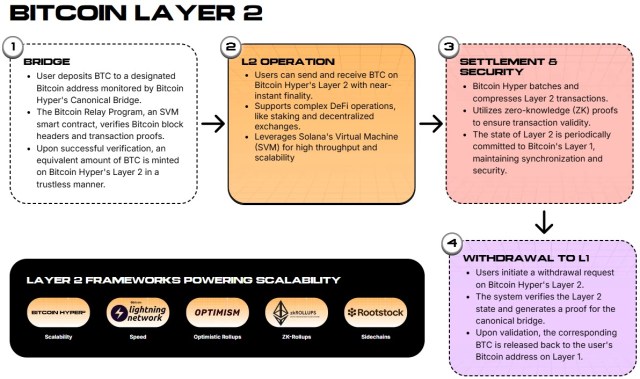
By using the SVM for execution, Bitcoin Hyper achieves the sub-second finality and low-latency performance DeFi developers require, all while anchoring its state to Bitcoin L1.

Finally, developers can write in Rust and deploy high-speed dApps that actually settle on Bitcoin. For the market, that utility is tangible. The protocol offers a Decentralized Canonical Bridge for seamless $BTC transfers and supports SPL-compatible tokens modified for Layer 2 operations.

This opens the door for high-frequency trading, gaming, and complex lending protocols directly on the Bitcoin network, use cases that were previously impossible. Plus, the integration of high-speed payments in wrapped $BTC with negligible fees addresses the precise scalability issues that have historically held the ecosystem back.

Check the $HYPER presale.

Whale Accumulation Signals Confidence With Over $31M Raised

While Tether struggles to justify its valuation, smart money is aggressively positioning itself in the Bitcoin Hyper presale. The sentiment contrast is stark. According to official data, the project has raised over $31.2M. That figure suggests robust institutional confidence, even as the broader market hesitates on stablecoins.

Traders watching this setup will notice this pattern often precedes retail adoption, as whales position themselves before the Token Generation Event.

Frankly, the tokenomics look designed to discourage mercenary capital rotation. With the token currently priced at $0.0136751, early participants are eyeing immediate staking opportunities post-TGE. The protocol offers high APY staking rewards, with a modest 7-day vesting period for presale stakers to prevent immediate dump pressure.

For investors fatigued by the regulatory ambiguity surrounding centralized stablecoins, the programmatic certainty of a Bitcoin L2 offers a compelling alternative, while the presale performance creates the expected FOMO.

Buy your $HYPER today.

Disclaimer: The content of this article is for informational purposes only and does not constitute financial advice. Cryptocurrency investments, including presales and Layer 2 tokens, carry inherent risks. Always perform your own due diligence before investing.


Пов'язані питання

QWhy has Tether (USDT) failed to achieve a $500 billion market valuation according to the article?

AInstitutional investors balked at the metrics due to transparency concerns and a regulatory landscape favoring decentralized alternatives, signaling a shift in risk appetite.

QWhat is Bitcoin Hyper ($HYPER) and how does it address the limitations of Bitcoin?

ABitcoin Hyper is a Bitcoin Layer 2 solution that integrates the Solana Virtual Machine (SVM) to enable sub-second finality, low-latency performance, and support for high-speed dApps, gaming, and DeFi on Bitcoin, solving its scalability and smart contract limitations.

QHow much has the Bitcoin Hyper ($HYPER) presale raised and what does this indicate?

AThe Bitcoin Hyper presale has raised over $31.2 million, indicating robust institutional confidence and smart money positioning ahead of retail adoption, contrasting with Tether's struggles.

QWhat technical feature allows Bitcoin Hyper to achieve high-speed execution while maintaining Bitcoin's security?

ABitcoin Hyper uses the Solana Virtual Machine (SVM) for execution, achieving sub-second finality and low-latency performance while anchoring its state to Bitcoin L1, thus maintaining Bitcoin's security.

QWhat are the benefits of Bitcoin Hyper's integration of SPL-compatible tokens and a Decentralized Canonical Bridge?

AThe integration allows seamless $BTC transfers, supports Layer 2 operations for SPL-compatible tokens, and enables high-frequency trading, gaming, and complex lending protocols directly on the Bitcoin network with negligible fees.

Пов'язані матеріали

Goldman Sachs Bows Down, Bitcoin Finally Breaks Through the Gates of Wall Street

Wall Street giants, including Goldman Sachs, Morgan Stanley, Charles Schwab, and the New York Stock Exchange, have reversed their long-standing opposition to Bitcoin and are now actively embracing it. After years of dismissing Bitcoin as a scam, a bubble, or a tool for illicit activities, these institutions are launching Bitcoin ETFs, enabling spot trading, and building dedicated crypto infrastructure. Goldman Sachs, which once called Bitcoin a "fraud tool," is now offering Bitcoin ETFs. Morgan Stanley, which internally banned the term "cryptocurrency," has launched its largest-ever ETF backed by Bitcoin. Charles Schwab has opened spot crypto trading for its retail clients, integrating Bitcoin alongside traditional assets. The NYSE is building robust infrastructure to support digital assets, signaling a long-term commitment. This dramatic shift is driven not by a change in ideology but by economic necessity. As Bitcoin repeatedly survived market crashes and grew into a multi-trillion-dollar asset class, ignoring it became too costly. Wall Street’s business model relies on capturing fees, and Bitcoin’s rise represented a massive wealth transfer occurring outside their ecosystem. The fear of missing out (FOMO) and client demand forced these institutions to capitulate. The article frames this as a historic surrender to Bitcoin’s mathematical inevitability. Unlike the trust-based traditional financial system, Bitcoin operates on decentralized, transparent, and unchangeable rules. Its scarcity and resilience make it a hedge against fiat currency devaluation and systemic risk. The narrative has flipped: not holding Bitcoin is now seen as the greater risk. The author concludes that Bitcoin has not been co-opted by Wall Street; instead, it has co-opted Wall Street, marking a fundamental shift in the global financial architecture.

marsbit10 хв тому

Goldman Sachs Bows Down, Bitcoin Finally Breaks Through the Gates of Wall Street

marsbit10 хв тому

Торгівля

Спот
Ф'ючерси
活动图片