Tens of Millions of Errors Per Hour: Investigation Reveals the 'Accuracy Illusion' of Google AI Search

marsbitОпубліковано о 2026-04-10Востаннє оновлено о 2026-04-10

Анотація

A New York Times investigation, in collaboration with AI startup Oumi, reveals significant accuracy and reliability issues with Google's AI Overviews search feature. Testing over 4,300 queries showed the accuracy rate improved from 85% (Gemini 2) to 91% (Gemini 3). However, given Google's scale of ~5 trillion annual searches, this 9% error rate translates to over 57 million incorrect answers generated hourly. A more critical issue is the prevalence of unsubstantiated citations. For correct answers, the rate of "unfounded citations"—where provided source links do not support the AI's claims—worsened, rising from 37% with Gemini 2 to 56% with Gemini 3. This makes it difficult for users to verify the information. The AI also heavily relies on low-quality sources, with Facebook and Reddit being its second and fourth most cited domains. Furthermore, the system is highly susceptible to manipulation. A BBC journalist successfully "poisoned" it by publishing a fake article; Google's AI began presenting the false information as fact within 24 hours. Google disputed the study's methodology, criticizing the use of the SimpleQA benchmark and an AI model (Oumi's HallOumi) to evaluate its own AI. The company maintains that its internal safeguards and ranking systems improve accuracy beyond the base model's performance.

Author: Claude, Deep Tide TechFlow

Deep Tide Introduction: The latest test by The New York Times in collaboration with AI startup Oumi shows that the accuracy rate of Google Search's AI Overviews feature is about 91%. However, given Google's scale of processing 5 trillion searches annually, this translates to tens of millions of incorrect answers generated every hour. More troublingly, even when the answers are correct, over half of the cited links fail to support their conclusions.
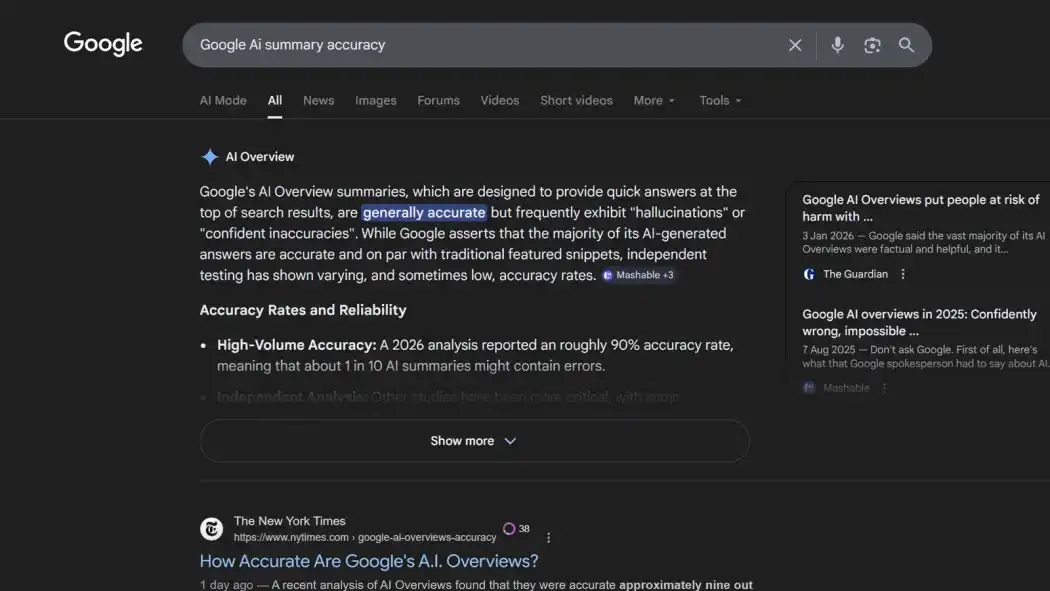
Google is delivering misinformation to users on an unprecedented scale, and most people are completely unaware.

According to The New York Times, AI startup Oumi, commissioned by the publication, used the industry-standard test SimpleQA developed by OpenAI to evaluate the accuracy of Google's AI Overviews feature. The test covered 4,326 search queries, conducting one round in October last year (powered by Gemini 2) and another in February this year (upgraded to Gemini 3). The results showed that Gemini 2's accuracy was about 85%, which improved to 91% with Gemini 3.

91% sounds good, but it's a different story when considering Google's scale. Google processes approximately 5 trillion search queries annually. Calculating with a 9% error rate, AI Overviews generates over 57 million inaccurate answers per hour, nearly 1 million per minute.

Correct Answers, Wrong Sources

More alarming than the accuracy rate is the issue of "unanchored" citation sources.

Oumi's data shows that in the Gemini 2 era, 37% of correct answers had "unsupported citations," meaning the links attached to the AI summaries did not support the information provided. After upgrading to Gemini 3, this proportion increased instead of decreasing, jumping to 56%. In other words, while the model gives correct answers, it's increasingly failing to "show its work."

Oumi CEO Manos Koukoumidis pointedly questioned: "Even if the answer is correct, how do you know it's correct? How do you verify it?"

The problem is exacerbated by AI Overviews' heavy reliance on low-quality sources. Oumi found that Facebook and Reddit are the second and fourth most cited sources for AI Overviews, respectively. In inaccurate answers, Facebook was cited 7% of the time, higher than the 5% in accurate answers.

BBC Journalist's Fake Article "Poisoned" Results Within 24 Hours

Another serious flaw of AI Overviews is its susceptibility to manipulation.

A BBC journalist tested the system with a deliberately fabricated false article. In less than 24 hours, Google's AI Overview presented the false information from the article as fact to users.

This means anyone who understands how the system works could potentially "poison" AI search results by publishing false content and boosting its traffic. Google spokesperson Ned Adriance responded by saying the search AI feature is built on the same ranking and security mechanisms that block spam, and claimed that "most examples in the test are unrealistic queries that people wouldn't actually search for."

Google's Rebuttal: The Test Itself Is Flawed

Google raised several objections to Oumi's research. A Google spokesperson called the study "seriously flawed," citing reasons including: the SimpleQA benchmark itself contains inaccurate information; Oumi used its own AI model HallOumi to judge another AI's performance, potentially introducing additional errors; and the test content doesn't reflect real user search behavior.

Google's internal tests also showed that when Gemini 3 operates independently outside the Google Search framework, it produces false outputs at a rate as high as 28%. But Google emphasized that AI Overviews leverages the search ranking system to improve accuracy, performing better than the model itself.

However, as PCMag's commentary pointed out the logical paradox: If your defense is that "the report pointing out our AI's inaccuracies itself uses potentially inaccurate AI," this probably doesn't enhance users' confidence in your product's accuracy.

Пов'язані питання

QWhat is the accuracy rate of Google's AI Overviews feature according to the Oumi study?

AThe accuracy rate of Google's AI Overviews was found to be approximately 91% when powered by Gemini 3, an improvement from about 85% with Gemini 2.

QHow many inaccurate answers does the article estimate Google's AI Overviews produces per hour?

ABased on Google's annual volume of 5 trillion searches and a 9% error rate, the AI Overviews feature is estimated to produce over 57 million inaccurate answers per hour.

QWhat is the 'unsubstantiated citation' problem identified in the report?

AThe 'unsubstantiated citation' problem refers to instances where the AI Overviews provides a correct answer, but the attached source links do not actually support the information given. This issue increased from 37% with Gemini 2 to 56% with Gemini 3.

QWhich low-quality websites are frequently used as sources by AI Overviews, according to the Oumi data?

AAccording to Oumi's data, Facebook and Reddit are the second and fourth most cited sources by AI Overviews, with Facebook being cited more frequently in inaccurate answers.

QHow did Google respond to the findings of the Oumi study?

AGoogle criticized the study, calling it 'seriously flawed.' Their spokesperson argued that the SimpleQA benchmark itself contains inaccuracies, that using an AI (HallOumi) to judge another AI introduces errors, and that the test queries do not reflect real user search behavior.

Пов'язані матеріали

Can Generative Models Finally Be Trained End-to-End? The Core Is a For Loop

This article introduces a novel training paradigm for generative models called Explorative Modeling (XM), which enables true end-to-end training. Traditionally, powerful generative models like autoregressive and diffusion models are not trained end-to-end. They are trained to predict a single small step but require iterative multi-step sampling for inference. This "exposure bias" leads to error accumulation and limits performance. The core challenge XM addresses is "mode blurring." In generative tasks, a single input (e.g., "generate a dog") corresponds to many valid outputs (multiple modes). Standard training objectives like reconstruction loss force the model to average these modes, producing unrealistic, blurry outputs. To avoid this, existing models break generation into many small, almost deterministic steps, sacrificing end-to-end training. XM tackles this by restructuring the training loop itself. Its key insight is to amplify "generative expressivity." For each training input, instead of generating one sample, the model generates K candidate outputs. Only the candidate closest to the real data is used for computing the loss and updating the model via backpropagation. This simple "best-of-K" mechanism is implemented as a short for-loop. By exploring multiple possibilities, the model learns to distribute its guesses across different modes rather than collapsing to their uninformative average. The paper demonstrates that "exploration" acts as a new, powerful scaling axis. Gains from XM increase with model size, data scale, and compute. Experiments show improvements in FID scores for image generation and significant efficiency gains, sometimes outperforming larger models without exploration. When pushed to the limit, XM enables fully single-step, end-to-end generative models. In robotics tasks, an "Explorative Policy" matched the performance of a 100-step Diffusion Policy with a single forward pass, drastically improving inference speed. While the best-of-K concept is not entirely new, the authors' contribution lies in formally understanding it as a direct method to boost generative expressivity without fragmenting the generation process. This work suggests that as models scale, enhancing exploration during training may become crucial for overcoming fundamental performance bottlenecks.

marsbit50 хв тому

Can Generative Models Finally Be Trained End-to-End? The Core Is a For Loop

marsbit50 хв тому

Annual Salary of Millions Competing for Electricians, Meta Rushes to Open Its Own Technical School

The AI boom is facing an unexpected bottleneck: a severe shortage of skilled construction workers and electricians. As tech giants like Meta, OpenAI, and Alphabet race to build massive data centers—such as OpenAI's $16 billion "Stargate" project—they are hitting a critical labor wall. The U.S. needs an estimated 130,000 more electricians, 240,000 construction workers, and 150,000 supervisors by 2030 for AI infrastructure alone, but tens of thousands of electrician jobs go unfilled each year. While AI companies offer high premiums, with electricians earning up to $280,000 annually, worker scarcity still causes massive losses—delays on a single project can cost $14.2 million per month. The complexity of building AI data centers, which require immense power (equivalent to powering hundreds of thousands of homes), sophisticated electrical systems, and advanced liquid cooling solutions, demands highly skilled technicians who are in short supply. To combat this, companies are investing heavily in training. Meta has committed $115 million to a free training school offering tuition, housing, and stipends, targeting 5,000 new workers. OpenAI is partnering with unions to secure skilled labor. These efforts are paying off, with a significant rise in Gen Z interest in trade schools over college. However, the power demands are staggering. AI data centers are driving a rapid surge in electricity consumption, projected to account for up to 12% of U.S. power use by 2028 and raising costs for consumers. Furthermore, the construction boom is project-based, leading to a potential future glut of trained workers once building peaks, which could depress wages industry-wide. The race for AI supremacy now depends as much on skilled hands as on advanced chips.

marsbit2 год тому

Annual Salary of Millions Competing for Electricians, Meta Rushes to Open Its Own Technical School

marsbit2 год тому

Торгівля

Спот
活动图片