Teachers union claims risks to retirement funds in crypto market structure

cointelegraphОпубліковано о 2025-12-10Востаннє оновлено о 2025-12-10

Анотація

The American Federation of Teachers (AFT) opposes the Senate's proposed crypto market structure legislation, arguing it threatens retirement fund stability. The union claims the bill fails to regulate crypto assets with the same rigor as traditional pension holdings and could expose retirement plans like 401(k)s to unsafe investments. Similar concerns were raised by another labor group in October. Meanwhile, former President Trump has issued an executive order to allow cryptocurrencies in 401(k) plans, and some asset managers have already started including crypto in retirement portfolios. The Senate is expected to release an updated draft of the bill soon.

The American Federation of Teachers (AFT), a union championing educators in the United States, has voiced its opposition to crypto market structure legislation moving through the Senate, claiming it “threatens the stability of their retirement security.”

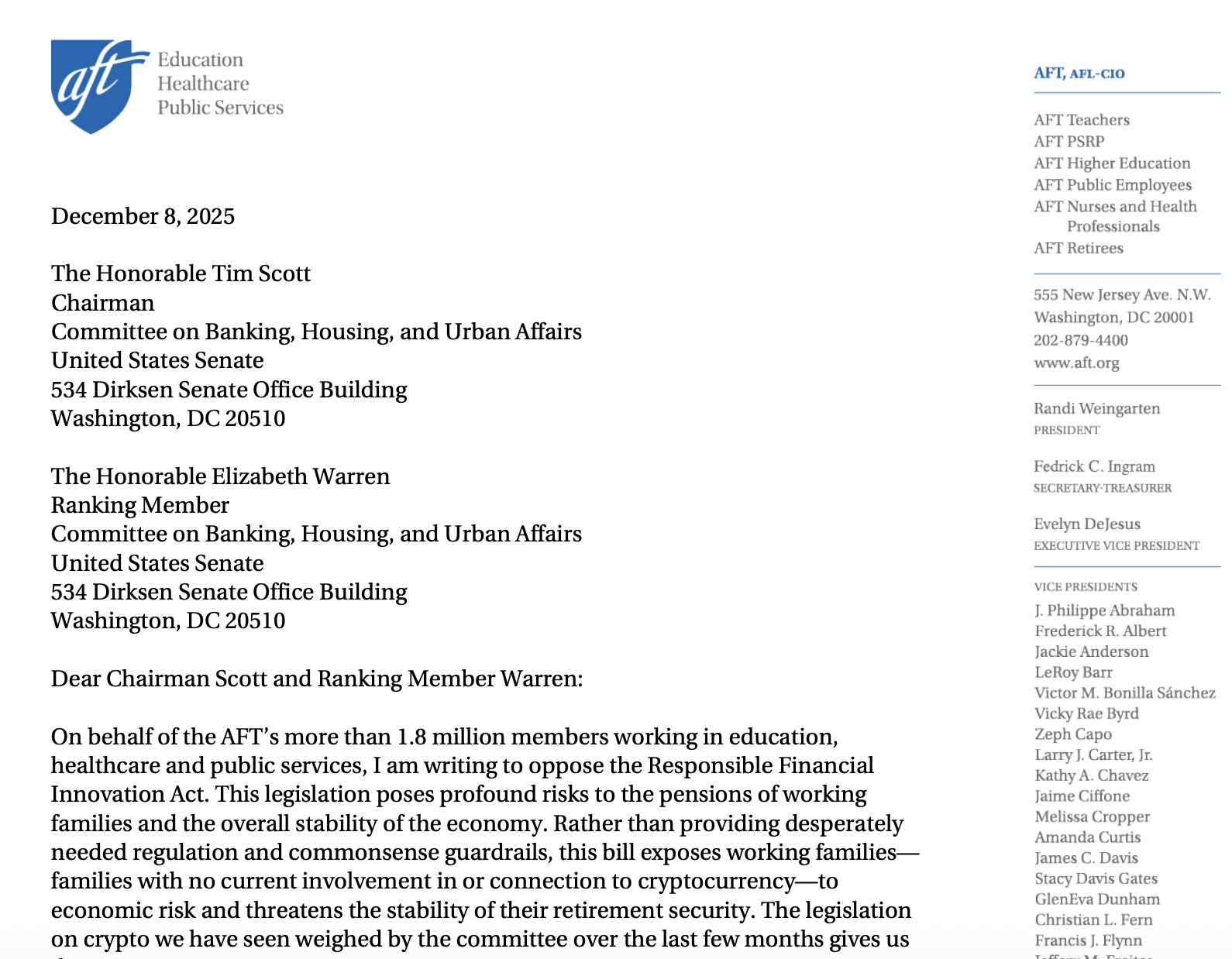
In a Monday letter to Republican and Democratic leaders on the US Senate Banking Committee provided by CNBC, the AFT said it opposed passage of the Responsible Financial Innovation Act, the bill that senators said “built on” the House of Representatives’ proposed solution to market structure, the CLARITY Act. According to the teachers’ union, the bill presents “profound risks” to economic stability and retirement plans.

“This bill fails to provide a regulatory structure for crypto assets and stablecoin that is equivalent to that for other pension holdings,” said the letter. “Most pensions do not carry crypto assets because of their risk. This legislation pretends that crypto assets are stable and mainstream, and they are not.”
Source: CNBC

The CLARITY Act, a July draft of the market structure bill proposed by the Senate Banking Committee, and a November draft from the Senate Agriculture Committee did not explicitly mention allowing digital assets to be used in pensions or retirement funds. The AFT claimed that if the bill were to be passed, “Pensions and 401(k) plans will end up having unsafe assets even if they were invested in traditional securities.”

The American Federation of Labor and Congress of Industrial Organizations raised similar concerns over the market structure bill posing risks to “retirement funds and to the overall financial stability of the US economy” in an October letter to the banking committee. The group claimed that the legislation would “increase workers’ exposure by greenlighting retirement plans like 401(k)s and pensions to hold this risky asset.”

Related: Japan plans major shift as crypto moves from payments to securities law

The AFT represents 1.8 million members working in education, healthcare and public services. According to the National Association of State Retirement Administrators, aggregate public pension assets, including teachers, totaled more than $6.5 trillion as of the second quarter of 2025, while the Investment Company Institute reported in September that total retirement assets in the US were about $45.8 trillion.

Trump is addressing crypto in retirement funds through executive orders

Separate from the Senate’s efforts to pass market structure, US President Donald Trump has attempted to change policy to allow cryptocurrencies to be included in 401(k) retirement plans. In August, Trump signed an executive order directing the Labor Department to reevaluate restrictions around alternative assets in defined-contribution plans, including digital assets.

Asset management companies have already been making moves signaling openness to adding digital assets to individual retirement arrangements (IRAs) and 401(k)s.

In October, Morgan Stanley reportedly began allowing its advisers to suggest crypto funds as part of its clients’ retirement portfolios. State-managed retirement funds, such as those in Michigan and Wisconsin, also have exposure to crypto through digital asset-linked exchange-traded funds.

It’s unclear when the Senate will vote on a market structure bill in the full chamber. Wyoming Senator Cynthia Lummis, one of the bill’s most outspoken proponents, said on Tuesday that she anticipated the banking committee releasing an updated draft this week, with a possible markup hearing before Congress broke for the holidays.

Magazine: When privacy and AML laws conflict: Crypto projects’ impossible choice

Трендові криптовалюти

Пов'язані матеріали

Bitcoin Falls Below $60,000 Again; After 20 Months, We've Reached a New Low

Bitcoin Drops Below $60,000, Hitting a 20-Month Low Bitcoin fell below the key $60,000 psychological level again, reaching a low of $59,023—its lowest point in approximately 20 months, dating back to October 2024. While it later recovered slightly to around $60,600, this marks its third significant breach of $60,000 this year. The downturn is attributed to two primary factors. First, U.S. spot Bitcoin ETFs are experiencing their longest streak of net outflows since launch, with nearly $5.94 billion withdrawn over 30 days. This creates sustained selling pressure as Authorized Participants sell Bitcoin to meet redemptions. Second, shifting macroeconomic expectations are adding pressure. Strong U.S. job data and hawkish remarks from Fed officials have increased market pricing for potential rate hikes, reversing the earlier liquidity-driven bullish sentiment and prompting a shift away from risk assets like Bitcoin. Analyst views are mixed. 21Shares maintains a bullish long-term outlook, expecting prices to recover towards $100,000, citing historical post-halving cycles and substantial ETF holdings as a base. In contrast, Arthur Hayes predicts a potential bottom around $40,000 within six months due to persistent Fed hawkishness. CryptoQuant suggests, based on on-chain data, that the market may not find a bottom until prices fall below the average investor cost basis around $53,000, potentially extending the bearish phase into late 2026 or early 2027. The immediate focus is on upcoming U.S. inflation data and Fed signals. Lower-than-expected CPI could offer relief, but confirmation of sticky inflation or continued ETF outflows may lead to further downside pressure. Bitcoin's ability to hold above $60,000 remains a critical test for the near-term market direction.

Odaily星球日报41 хв тому

Bitcoin Falls Below $60,000 Again; After 20 Months, We've Reached a New Low

Odaily星球日报41 хв тому

When Billions Begin to Operate Everything by Voice, How Far is ‘All Assets on Chain’?

In June 2026, WeChat began a limited rollout of "Xiaowei," its native AI assistant. This move is more than an upgrade to a smarter chatbot; it signals a crucial step from "universal internet access" toward the broader vision of "full asset tokenization." Xiaowei, powered primarily by WeChat's in-house WeLM model, demonstrates four key capabilities: 1) direct voice/web chat control of app functions, 2) automated access to mini-programs for services, 3) instant comprehension and summarization of complex documents like PDFs, and 4) generating functional mini-program prototypes from simple natural language requests. This represents a fundamental shift from GUI (Graphical User Interface) to LUI (Language User Interface), eliminating friction in human-digital interaction. The rollout is pivotal because it brings AI Agents to China's massive user base with zero friction—no new app downloads or accounts needed. This "seamless access" mirrors past platform revolutions like the App Store or WeChat Mini-Programs, potentially unlocking a global AI Agent market projected to grow from $7.92 billion in 2025 to nearly $295 billion by 2035. The article argues that China's internet evolution has moved from "connecting everyone" to "putting all services online." The next phase is "tokenizing all assets"—a concept broader than just Real World Assets (RWA) like real estate. It encompasses tokenizing personal assets like social influence, attention, and credit history. RWA tokenization itself is forecast to explode from $35 billion in 2025 to over $500 billion in 2026. The convergence of ubiquitous AI Agents and rapidly tokenizing assets points to a future paradigm for wealth management. Your AI Agent could autonomously manage a globally diversified, tokenized portfolio based on your preferences. Initiatives like EXIO Group's full-stack RWA services aim to lower investment barriers, paralleling WeChat's democratization of AI access. In conclusion, the launch of Xiaowei is not merely a technical upgrade but a historic inflection point. It marks AI Agents' transition from niche tools to essential utilities and accelerates the movement toward a future where voice commands seamlessly interact with tokenized value, redefining humanity's relationship with the digital and financial worlds.

marsbit1 год тому

When Billions Begin to Operate Everything by Voice, How Far is ‘All Assets on Chain’?

marsbit1 год тому

SoftBank CEO Masayoshi Son's New Trillion-Dollar "Gamble"

SoftBank founder Masayoshi Son is embroiled in a new trillion-dollar "bet" on Physical AI and humanoid robotics, even as his massive wager on OpenAI faces uncertainty ahead of its potential IPO. Recent reports reveal OpenAI's steep losses—$85 billion net loss by Q1 2026 and a $38.5 billion loss in 2025—casting doubt on its path to a trillion-dollar valuation. SoftBank, OpenAI's second-largest external shareholder with a planned 13% stake, stands to gain hugely if OpenAI succeeds. Undeterred, Son is already pushing forward with his next ambitious venture: consolidating SoftBank's AI and robotics assets into a new U.S.-based company named "Roze," targeting a $100 billion IPO as early as late 2026. This move aligns with his belief that Physical AI, merging AI cognition with robotic physical execution, is the next trillion-dollar frontier. Son's confidence stems from recent AI wins; SoftBank's stock surged and he briefly regained the title of Asia's richest person, largely due to OpenAI's soaring valuation. However, his aggressive strategy has raised internal concerns about over-reliance on OpenAI and strained finances. With competitors like Anthropic advancing rapidly and OpenAI's IPO timing uncertain, Son is racing to capitalize on the AI boom. His long-term vision for Physical AI includes a decade of investments in robotics, from Boston Dynamics to recent acquisitions like ABB's robotics unit, and a planned $1 trillion investment in U.S.-based AI robotics industrial parks. Yet, challenges remain: humanoid robotics firms like Figure AI lack the clear revenue paths of AI software companies, and Roze's lofty valuation faces skepticism. For Son, these bets are also driven by an unfulfilled promise of massive returns to key investors like Saudi Arabia's PIF. Despite risks, he continues to double down, betting that the fusion of AI and physical machines will define the next technological era.

marsbit2 год тому

SoftBank CEO Masayoshi Son's New Trillion-Dollar "Gamble"

marsbit2 год тому

Торгівля

Спот
Ф'ючерси

Популярні статті

Що таке NASDAQ100

Індекс Nasdaq-100 включає 100 найбільших нефінансових компаній, які котируються на фондовому ринку Nasdaq, і широко використовується як еталон для акцій великих компаній зростання та технологічних акцій у США.

14 переглядів усьогоОпубліковано 2026.06.18Оновлено 2026.06.18

Що таке NASDAQ100

Як купити NASDAQ100

Ласкаво просимо до HTX.com! Ми зробили покупку Nasdaq-100 Index (NASDAQ100) простою та зручною. Дотримуйтесь нашої покрокової інструкції, щоб розпочати свою криптовалютну подорож.Крок 1: Створіть обліковий запис на HTXВикористовуйте свою електронну пошту або номер телефону, щоб зареєструвати обліковий запис на HTX безплатно. Пройдіть безпроблемну реєстрацію й отримайте доступ до всіх функцій.ЗареєструватисьКрок 2: Перейдіть до розділу Купити крипту і виберіть спосіб оплатиКредитна/дебетова картка: використовуйте вашу картку Visa або Mastercard, щоб миттєво купити Nasdaq-100 Index (NASDAQ100).Баланс: використовуйте кошти з балансу вашого рахунку HTX для безперешкодної торгівлі.Треті особи: ми додали популярні способи оплати, такі як Google Pay та Apple Pay, щоб підвищити зручність.P2P: Торгуйте безпосередньо з іншими користувачами на HTX.Позабіржова торгівля (OTC): ми пропонуємо індивідуальні послуги та конкурентні обмінні курси для трейдерів.Крок 3: Зберігайте свої Nasdaq-100 Index (NASDAQ100)Після придбання Nasdaq-100 Index (NASDAQ100) збережіть його у своєму обліковому записі на HTX. Крім того, ви можете відправити його в інше місце за допомогою блокчейн-переказу або використовувати його для торгівлі іншими криптовалютами.Крок 4: Торгівля Nasdaq-100 Index (NASDAQ100)Легко торгуйте Nasdaq-100 Index (NASDAQ100) на спотовому ринку HTX. Просто увійдіть до свого облікового запису, виберіть торгову пару, укладайте угоди та спостерігайте за ними в режимі реального часу. Ми пропонуємо зручний досвід як для початківців, так і для досвідчених трейдерів.

11 переглядів усьогоОпубліковано 2026.06.18Оновлено 2026.06.18

Як купити NASDAQ100

Що таке RE

I. Вступ до проекту Re Protocol - це капітальний ринок на блокчейні, який з'єднує капітал стейблкоїнів з повністю забезпеченим, регульованим перестрахуванням. Перестрахування дозволяє страхових компаніям передавати частини своїх ризиків іншим спеціалізованим страховикам, допомагаючи їм поглинати великі збитки та продовжувати надавати покриття. II. Інформація про токен Назва токена: RE(Re) III. Пов'язані посилання Вебсайт:https://re.xyz/ Експлорери:https://bscscan.com/token/0xd41fdb03ba84762dd66a0af1a6c8540ff1ba5dfb https://etherscan.io/token/0x526526528f35ac738177003b8773b402b8df8143 Twitter:https://twitter.com/re Примітка: Вступ до проекту взято з матеріалів, опублікованих або наданих офіційною командою проекту, які є лише для довідки і не є інвестиційною порадою. HTX не несе відповідальності за будь-які прямі або непрямі збитки, що виникають внаслідок цього.

142 переглядів усьогоОпубліковано 2026.06.18Оновлено 2026.06.18

Що таке RE

Обговорення

Ласкаво просимо до спільноти HTX. Тут ви можете бути в курсі останніх подій розвитку платформи та отримати доступ до професійної ринкової інформації. Нижче представлені думки користувачів щодо ціни A (A).

活动图片