# Пов'язані статті щодо State

Центр новин HTX надає останні статті та поглиблений аналіз на тему "State", що охоплює ринкові тренди, оновлення проєктів, технологічні розробки та регуляторну політику в криптоіндустрії.

Ethereum's Next Decade in the Eyes of Vitalik

"Lean Ethereum" Long-Term Roadmap Unveiled by Vitalik Buterin On July 5, 2026, Vitalik Buterin published the "Lean Ethereum" roadmap, positioning it as Ethereum's third major evolution following the Merge. This multi-year, multi-phase upgrade aims to fundamentally transform Ethereum's core protocol through staged network upgrades extending to 2029. Key goals include achieving 1 gigagas per second L1 throughput (a massive increase from the current ~32 TPS), near-instant finality, and quantum-resistant cryptography. The plan involves transitioning Ethereum's security model from full transaction re-execution by all nodes to native verification via recursive STARK proofs. A major proposed change is replacing the EVM with a proof-friendly architecture like RISC-V or leanISA, though this remains a point of contention, especially with L2s like Arbitrum favoring alternatives like WASM. Other planned upgrades include a restructured state model with a large, cheap "warehouse" storage layer to drastically reduce fees for migrated applications, multi-dimensional gas pricing, and a new focus on making privacy a first-class, native protocol feature. While the roadmap significantly raises Ethereum's long-term technical ceiling, analysts note it does not directly address ETH's mid-term token economics or value capture. The plan's multi-year timeline means near-term price impact will likely depend on observable progress milestones, such as the successful deployment of the upcoming Glamsterdam gas limit increase, growth in L2 activity and blob usage, and trends in L1 fee revenue and ETH burn.

链捕手07/11 09:17

Ethereum's Next Decade in the Eyes of Vitalik

链捕手07/11 09:17

Whitepaper 2.0, Two Sets of State Forks, the Rise of Clones: What Happened to Sato Overnight?

On the night of May 7, 2026, the SATO project released "Whitepaper 2.0" alongside significant front-end changes, shifting from "buy/sell" to "mint/burn" terminology. This update aimed to clarify market confusion regarding trading mechanics, token burns, and price discrepancies between its bonding curve and secondary markets. Key changes included explicitly defining the separate existence of the bonding curve pool (for minting/burning) and the secondary SATO/USDT pool, and detailing the core mathematical formulas governing the curve. Concurrently, SATO's market cap fell sharply from near $40 million to around $14.4 million. A fork project, SAT1, emerged with a similar bonding curve model but a key technical difference: SAT1 uses a single unified state variable (`ethCum`) for all core logic (minting, burning, halt trigger), whereas SATO's mechanism relies on two state variables (`ethCum` and `totalMintedFair`), which can drift apart and cause operational discrepancies. Both projects position themselves as operator-free "issuance machines" with asymptotic supply curves approaching 21 million tokens and charge a 0.3% fee on transactions, which remains in the protocol. The article emphasizes that despite intricate designs, both SATO and SAT1 are in highly volatile, sentiment-driven phases, and warns that mechanism innovation does not replace the need for personal risk management.

marsbit05/08 16:12

Whitepaper 2.0, Two Sets of State Forks, the Rise of Clones: What Happened to Sato Overnight?

marsbit05/08 16:12

Stop Saying ‘We Need Privacy’

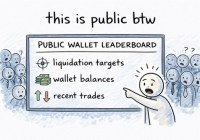
Title: Stop Saying ‘We Need Privacy’ The article argues that "privacy" is not a single concept but rather five distinct problems in the context of blockchain and cryptocurrency. When people demand privacy, they are often referring to one of the following: 1. **Intent Privacy:** Hiding transaction details from observers before execution to prevent front-running by MEV bots. Solutions include private transaction delivery (e.g., Flashbots Protect) and encrypted mempools (e.g., Shutter Network). 2. **Value Privacy:** Concealing the amounts transferred. This is achieved through shielded systems (e.g., Zcash, Penumbra) that use cryptographic proofs to verify transactions without revealing values. Privacy can still be compromised by user behavior patterns. 3. **Graph Privacy:** Protecting the relationships and patterns of who transacts with whom. Techniques include pooled unlinkability (e.g., Tornado Cash mixers) and stealth addresses (e.g., ERC-5564) to break direct on-chain links between transactions. 4. **State Privacy:** Keeping DeFi positions, balances, and liquidation thresholds hidden. This requires storing state as private records and using zero-knowledge proofs (ZK-proofs) to validate state changes without revealing underlying data (e.g., Aztec). Composability and edge interactions remain challenges. 5. **Execution Privacy:** Hiding the computation logic itself, crucial for strategies like auctions or liquidations. Methods include using Trusted Execution Environments (TEEs) (e.g., Secret Network) or ZK-proofs for private execution. The article concludes that privacy often fails at the edges, such as at the RPC (Remote Procedure Call) layer, where providers can collect IP addresses and wallet information. The key is to ask which surface is being protected and where information might leak when users interact with the real world, rather than seeking a single winning privacy model.

比推02/13 00:39

Stop Saying ‘We Need Privacy’

比推02/13 00:39

活动图片