# Пов'язані статті щодо Self-Custody

Центр новин HTX надає останні статті та поглиблений аналіз на тему "Self-Custody", що охоплює ринкові тренди, оновлення проєктів, технологічні розробки та регуляторну політику в криптоіндустрії.

Ether.fi Launches Next-Gen Neobanking Services

Ether.fi, a leading crypto neobank, has announced its summer release, introducing a new generation of its fintech product. This update aims to replace traditional banking by offering tools for savings, earning, trading, lending, and seamless spending. The platform leverages decentralized systems to go beyond traditional finance, incorporating the latest trends like trading tokenized stocks, metals, and active crypto assets. The user app will integrate the Aave platform for lending and borrowing, and will add over 30 new fiat currencies and payment methods including Cash App and Apple Pay. According to CEO Mike Silagadze, the goal is to bridge DeFi with everyday financial needs, providing tools once reserved for institutions. The simplified app requires no special crypto knowledge and aims for a broader audience, moving beyond high-risk trading to offer balanced, secure asset management. As of August 2026, Ether.fi holds $3.5 billion in assets. The update introduces features like integration with xStocks for tokenized equity trading, self-custody benefits, lower fees, and a rewards program. It will also offer crypto-backed loans at rates around 4% and a cash-back card. Part of the revenue from new products will fund buybacks of the $ETHFI token, which traded around $0.38 in mid-August. The new features are available immediately to all users, though some services like tokenized asset trading may be restricted in regions like the US.

cryptonews.ru2 дні тому 15:53

Ether.fi Launches Next-Gen Neobanking Services

cryptonews.ru2 дні тому 15:53

When POAP Also Reaches Its End: The Crypto Industry's 'Closure Wave' Hits, How Should Ordinary Users Cope?

The crypto industry is currently experiencing a wave of project shutdowns and closures. Notable examples include long-standing entities like the BitMEX exchange and the POAP (Proof of Attendance Protocol) project. This trend highlights a key shift: beyond major hacks or scams, many projects with real users and functional products are failing due to an inability to find sustainable business models. This signifies a structural correction, moving away from growth fueled by speculation and incentives toward projects with genuine, revenue-generating utility. For ordinary users, this "slowdown" presents new risks. The principle of "Not your keys, not your coins" addresses control but not the complete picture of asset safety. Assets in a self-custodied wallet can represent different things: native assets (e.g., ETH), protocol deposit tokens, LP tokens, or bridged/wrapped assets. If the underlying protocol, bridge, or even blockchain shuts down, the ability to redeem or exit these assets can be lost, even with the private key. The article outlines three key considerations for users: 1. **Understanding Exit Rights:** Evaluate if you can withdraw funds directly via smart contracts if a project's front-end shuts down (as with dYdX v3). 2. **Distinguishing Assets from Claims:** Recognize that tokens like renBTC are claims on assets held elsewhere; their value depends on the solvency and operation of the issuing bridge or protocol. 3. **Assessing Network Viability:** If an entire L1/L2 blockchain halts, private keys alone cannot facilitate transactions. To navigate this environment, users are advised to look beyond token prices and monitor: * **Financial Sustainability:** Is there real, non-incentivized demand and protocol revenue? * **Project Activity:** Is development active (GitHub), or is the project only maintained on social media? * **Exit Channels:** Know the exact nature, location (chain, contract), and redemption process for your holdings. In conclusion, while project lifecycles ending is a sign of industry maturation, users must develop a more nuanced understanding of self-custody. It involves not just holding private keys but also critically assessing what an asset truly represents and ensuring a viable path to exit, independent of any single project's continued operation.

marsbit08/10 09:39

When POAP Also Reaches Its End: The Crypto Industry's 'Closure Wave' Hits, How Should Ordinary Users Cope?

marsbit08/10 09:39

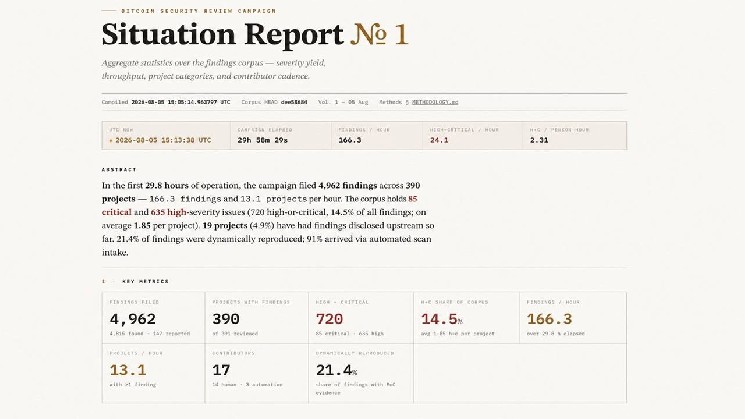
Bitcoin 'Red Team' Uncovers 4,962 Vulnerabilities Following Coldcard Hack

A security vulnerability in the Coldcard hardware wallet led to the theft of over 1,800 BTC (worth more than $116 million at the time) from long-term holders, stemming from a firmware bug first identified in March 2021. This incident prompted the formation of the volunteer 'Bitcoin Red Team,' led by developer Calle and Rob Hamilton, CEO of custody insurance firm Anchorwatch. The team conducted an emergency audit of the broader open-source Bitcoin ecosystem. Sixteen security researchers spent 27.5 hours analyzing 390 Bitcoin-related open-source repositories, combining AI-assisted analysis with manual review. They documented a total of 4,962 vulnerabilities, including 85 classified as critical and 635 as high severity. Funding was provided by the non-profit OpenSats. The team described the ecosystem's security state as "extremely poor," though only about one-fifth of the findings have been independently reproduced so far. The highest concentration of critical issues was found in privacy and coinjoin tools, accounting for 24% of critical finds. Cryptographic libraries had the highest absolute number of issues (1,101) but a lower proportion of high-severity ones. Most analyzed projects had few or no critical problems, with the real danger concentrated in a small group of tools handling private key generation, signing, and privacy-preserving transactions—the same category responsible for the original Coldcard failure. The audit is the first phase of an ongoing effort. The next steps involve verifying which vulnerabilities are actually exploitable and coordinating responsible disclosure with affected projects. For the self-custody community, the audit shows white-hat researchers are now scaling their efforts to match the pace of potential attackers.

cryptonews.ru08/07 13:40

Bitcoin 'Red Team' Uncovers 4,962 Vulnerabilities Following Coldcard Hack

cryptonews.ru08/07 13:40

Canadian Users Account for 25% of Losses Related to Coldcard Vulnerability

Canadian Bitcoin users suffered the highest losses, accounting for 25% of the total, from a vulnerability affecting the Coldcard hardware wallet, a situation analysts link to the strong local presence of its parent company Coinkite headquartered in Toronto. Australia followed with 15-20% of losses, while the US and Thailand accounted for 10-15%. Though the exploit hit English-speaking and early Bitcoin-adopting regions hardest, global impact was seen across Western Europe, Latin America, and key African crypto hubs. The total stolen assets reached $116 million. Galaxy Research identified a March 2021 firmware update—specifically the faulty implementation of a new random number generator (RNG)—as the single point of failure. A configuration error rendered the hardware RNG inactive, silently defaulting to a weaker software-based one, which generated private keys with low entropy for over five years before an attacker stole $70 million from 1,200 wallets in 41 minutes. In response, security experts urged manufacturers to eliminate backup RNG mechanisms in production and strictly adhere to validation standards like NIST FIPS 140-3. For incident response, immediate user communication and clear mitigation steps were prioritized alongside rigorous patch testing. For users with compromised seed phrases, a strict protocol was recommended: purchase a new reputable hardware wallet, generate a new seed offline, verify it with a test transaction, transfer all funds to the new setup, *then* attempt to update the original device's firmware. Experts also advised diversifying risk by using hardware wallets from different manufacturers to avoid a single point of failure. The incident sparked a fundamental debate about self-custody security models. Critics argue that offline storage alone isn't foolproof, highlighting that trust is always delegated to third parties, like wallet manufacturers. The consensus is shifting towards multi-vendor setups and mandatory baseline standards like multi-signature or Multi-Party Computation (MPC) wallets. The goal is to move from "trusting one device" to ensuring no single compromised component or entity can move funds, distributing trust across independent organizational and technological failure domains.

cryptonews.ru08/06 13:51

Canadian Users Account for 25% of Losses Related to Coldcard Vulnerability

cryptonews.ru08/06 13:51

活动图片