# Пов'язані статті щодо HCI

Центр новин HTX надає останні статті та поглиблений аналіз на тему "HCI", що охоплює ринкові тренди, оновлення проєктів, технологічні розробки та регуляторну політику в криптоіндустрії.

Making the Silent Oracle Bones Speak for Three Thousand Years: The First AI-Assisted Interpretation System Mimicking Human Expert Workflow

Breaking the silence of three-thousand-year-old oracle bone inscriptions (OBI) poses immense challenges for researchers, who traditionally rely on laborious cross-referencing across fragmented historical materials. To address this, researchers from Huazhong University of Science and Technology and collaborating institutions have developed AlphaOracle, the first AI system designed to simulate the expert workflow for deciphering OBI. The system integrates a four-step, evidence-based pipeline: 1) parsing and reading-order reconstruction of oracle bone rubbings; 2) morphological analysis of character evolution across historical scripts; 3) contextual verification using large-scale OBI corpora and a specialized masked language model; and 4) literature validation against classical texts and modern scholarly works. AlphaOracle generates comprehensive, traceable reports with candidate interpretations, confidence scores, and source citations for expert review, functioning as an intelligent assistant rather than a final arbiter. In evaluations involving 86 domain experts, 78.7% found the system helpful, estimating an average 64% reduction in analysis time. The system achieved a top-1 accuracy of 23.1% on deciphering withheld known characters and significantly outperformed general-purpose large language models in contextual reasoning tasks. AlphaOracle successfully analyzed several controversial characters, with some results incorporated into authoritative OBI databases. This work demonstrates a promising paradigm where AI enhances the breadth and efficiency of material retrieval and hypothesis generation, while human experts retain the crucial role of deep scholarly judgment, paving the way for systematic AI-assisted research in paleography.

marsbit08/03 08:41

Making the Silent Oracle Bones Speak for Three Thousand Years: The First AI-Assisted Interpretation System Mimicking Human Expert Workflow

marsbit08/03 08:41

a16z: The Next Frontier of AI, The Triple Flywheel of Robotics, Autonomous Science, and Brain-Computer Interfaces

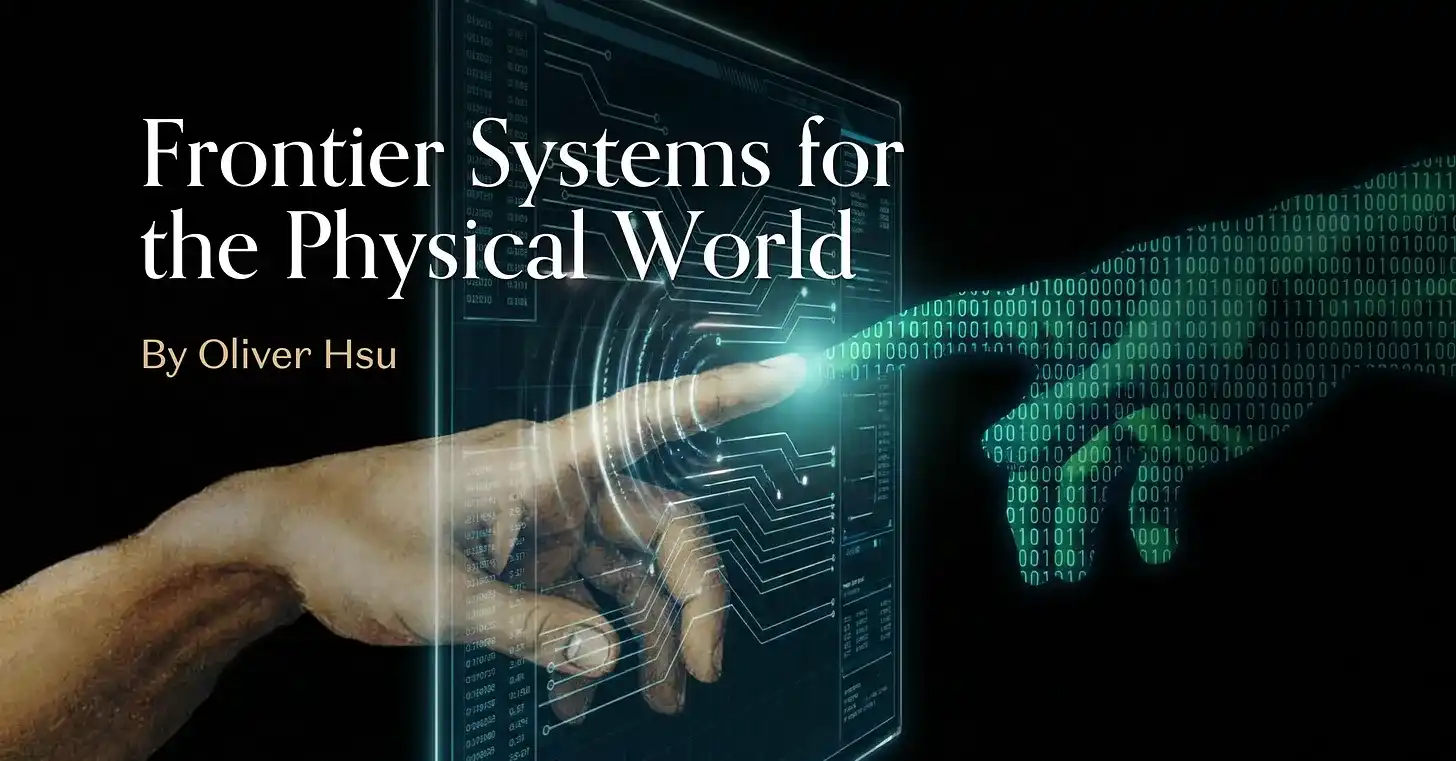
a16z presents a comprehensive investment thesis for the next frontier of AI: Physical AI, centered on a synergistic flywheel of robotics, autonomous science, and novel human-computer interfaces (HCIs) like brain-computers. While the current AI paradigm scales on language and code, the most disruptive future capabilities will emerge from three adjacent fields leveraging five core technical primitives: 1) learned representations of physical dynamics (via models like VLA, WAM, and native embodied models), 2) embodied action architectures (e.g., dual-system designs, diffusion-based motion generation, and RL fine-tuning like RECAP), 3) simulation and synthetic data as scaling infrastructure, 4) expanded sensory channels (touch, neural signals, silent speech, olfaction), and 5) closed-loop agent systems for long-horizon tasks. These primitives converge to power three key domains: * **Robotics:** The literal embodiment of AI, requiring all primitives for real-world physical interaction and manipulation. * **Autonomous Science:** Self-driving labs that conduct hypothesis-experiment-analysis loops, generating structured, causally-grounded data to improve physical AI models. * **Novel HCIs:** Devices (AR glasses, EMG wearables, BCIs) that expand human-AI bandwidth and act as massive data-collection networks for real-world human experience. These domains form a mutually reinforcing flywheel: Robotics enable autonomous labs, which in turn generate valuable data for robotics and materials science. New interfaces provide rich human-physical interaction data to train better robots and scientists. Together, they represent a new scaling axis for AI, moving beyond the digital realm to interact with and learn from physical reality, promising significant emergent capabilities and value.

marsbit04/18 07:05

a16z: The Next Frontier of AI, The Triple Flywheel of Robotics, Autonomous Science, and Brain-Computer Interfaces

marsbit04/18 07:05

活动图片