# Пов'язані статті щодо Forecast

Центр новин HTX надає останні статті та поглиблений аналіз на тему "Forecast", що охоплює ринкові тренди, оновлення проєктів, технологічні розробки та регуляторну політику в криптоіндустрії.

Three AI tools predict XRP price on August 1st

"Three AI tools have made price predictions for XRP as of August 1st. Despite Bitcoin's struggles in July, XRP is currently trading at around $1.1, with a market cap of $68.9 billion and a 24-hour trading volume exceeding $575.7 million, indicating investor interest. To navigate the uncertain price dynamics, analysis was sought from three different AI agents using complex mathematical models and machine learning: 1. **CoinCodex's predictive algorithm** offered the most optimistic forecast. It predicts the average price of XRP in August 2026 will rise to $1.52, with a minimum not falling below $1.21, anticipating a strong influx of liquidity and a bullish sentiment. 2. **Changelly's AI agent** presented a more conservative and realistic outlook based on technical analysis. It forecasts an average August price of $1.18, with a monthly peak unlikely to exceed $1.21, suggesting consolidation without aggressive upward breaks. 3. **DigitalCoinPrice's neural network**, analyzing macroeconomic indicators and trading volumes, showed maximum caution. It predicts very low volatility, with the average price stabilizing at $1.11 and a maximum price also at $1.11. In summary, the AI tools present divergent views: one predicts confident growth above $1.50, another forecasts a slight increase, and the third anticipates a sideways trend (stagnation). This underscores a key rule of the cryptocurrency market: no algorithm offers a 100% guarantee. Investors should always conduct their own research and be aware of the risks."

cryptonews.ru11 год тому

Three AI tools predict XRP price on August 1st

cryptonews.ru11 год тому

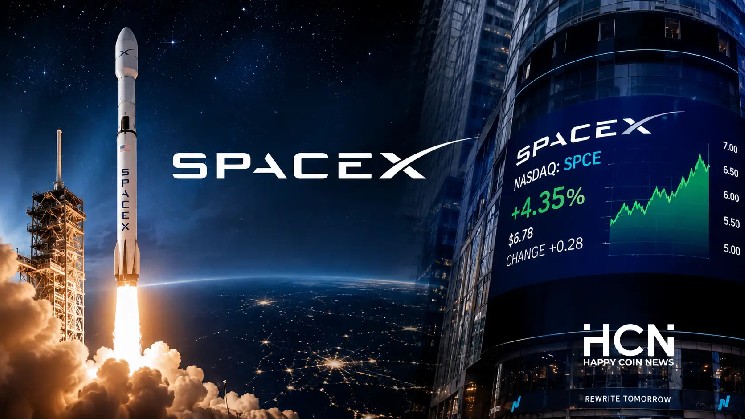
SpaceX Shares Predicted to Recover No Earlier Than Early 2027

Analysts predict that a significant recovery in SpaceX's share price is unlikely before early 2027, when the current insider lock-up period is scheduled to end. Recently, shares have traded in a narrow range around $118-$124, still 48% below their 52-week high of $225.64. The short-term outlook depends heavily on potential insider selling, especially with the 52-week low of $110.85 acting as a floor. SpaceX's market capitalization stands at $1.56 trillion, but the company is not yet profitable, as evidenced by a $4.9 billion net loss in 2025 and an additional $4.28 billion loss in Q1 2026, attributed to heavy investments in Starship and AI infrastructure. The stock is currently trading at over 84 times trailing revenue, a valuation analysts say depends on a substantial future increase in Starlink's cash flow. The unlocking of 911.5 million shares worth ~$116 billion on August 6, 2026, followed by a phased release schedule, adds significant uncertainty. Quarterly results on August 4, 2026, could provide a short-term catalyst if Starlink performs strongly or Starship milestones are met. Wall Street analyst consensus for a 12-month price target is around $240, but individual forecasts vary widely from $63 to $800, reflecting deep divisions over the company's recovery prospects and future valuation. Key ratings include Morgan Stanley's $300 target and Oppenheimer's more modest $190 target.

cryptonews.ru17 год тому

SpaceX Shares Predicted to Recover No Earlier Than Early 2027

cryptonews.ru17 год тому

Five Historic Indicators Simultaneously Flash Signals: Bitcoin Bear Market Bottoms Out

Title: "Five Major Historical Indicators Simultaneously Flash, Bitcoin Bear Market Hits Bottom" Bitcoin is currently down 50% from its all-time high, with the bear market persisting over 40 weeks. A set of long-term cyclical indicators suggests the market may be at or nearing a price and time-cycle low point. Key Indicators: 1. Nasdaq/BTC Relative Strength: The 14-week moving average of the Nasdaq 100/BTC ratio's RSI has reached a historically unprecedented overbought level of 72.6, indicating Bitcoin is extremely oversold relative to equities. Historically, such extremes have preceded major cycle lows and strong outperformance by Bitcoin over the next 1-3 years. 2. Long-Term Expected Returns: Past instances of extreme Nasdaq/BTC RSI readings have been followed by asymmetric positive returns for Bitcoin over a 1-3 year horizon, though the magnitude of gains has diminished each cycle. 3. Gold/BTC Relative Strength: A similar RSI indicator for the Gold/BTC ratio also hit a record high in February 2026, another signal aligning with historical cycle lows for Bitcoin. 4. Bitcoin Realized Price: The on-chain realized price (average cost basis) is currently $53,000, 18% above the spot price. Historically, Bitcoin's spot price has spent only 12% of its time below this level, and every past bear market bottom has occurred below the realized price. 5. Cycle Clock: Previous cycles saw price lows form around 60 weeks after the all-time high. The current cycle is at week 40. If this pattern holds, a low point could form around late November 2026. Conclusion: The convergence of these rare, extreme signals points to Bitcoin being at or very near a long-term cyclical bottom, likely forming before the end of 2026. This period may present a highly attractive opportunity for long-term accumulation, with an asymmetric return profile favoring significant upside over the next 1-3 years, despite noted risks like diminishing marginal returns, small sample size, and potential structural market changes.

marsbit07/24 07:13

Five Historic Indicators Simultaneously Flash Signals: Bitcoin Bear Market Bottoms Out

marsbit07/24 07:13

Wall Street's Take on the June Fed Meeting Minutes: Focus on Core Inflation, No Short-Term Urgency to Hike Rates

Wall Street's View on Fed June Minutes: Inflation is the Key, No Urgency for Near-Term Hike The minutes of the Federal Reserve's June FOMC meeting revealed a unified Wall Street interpretation: inflation remains the true determinant for future policy moves. Major institutions including Goldman Sachs, Morgan Stanley, and Citigroup concluded that the Fed remains data-dependent, with its path hinging on upcoming inflation data. Key takeaways from the minutes: * **No Immediate Tightening**: Despite "a few" participants seeing reasons to hike, none actively advocated for it at the June meeting. The consensus was to hold the federal funds rate steady at 3.5%-3.75%. * **Inflation as the Decisive Factor**: The Fed outlined two primary scenarios. If inflation declines "soon" toward the 2% target, "almost all" officials would support maintaining or eventually cutting rates. If inflation persists high due to factors like AI demand or supply shocks, "almost all" would see some policy tightening as necessary. * **Patience is Warranted**: Officials noted inflation remains above target but cited anchored inflation expectations and a labor market not currently driving price pressures as reasons for patience. The Fed is focused on the *direction* of inflation over the next few months. * **No Policy Framework Shift**: The minutes reaffirmed a data-dependent approach rather than a fundamental shift toward pre-emptive tightening. Institutional Forecasts: * **Morgan Stanley**: Expects rates on hold in 2026, with potential cuts in 2027 if inflation cools. * **Goldman Sachs**: Baseline scenario sees rates unchanged through 2026, with inflation moderating gradually. * **Citigroup**: Takes a more dovish view, suggesting market pricing for a July hike is too aggressive and forecasting potential rate cuts starting in late 2026. Overall, the minutes were perceived as marginally dovish, emphasizing a watchful stance on inflation data with no near-term urgency to hike.

marsbit07/09 02:09

Wall Street's Take on the June Fed Meeting Minutes: Focus on Core Inflation, No Short-Term Urgency to Hike Rates

marsbit07/09 02:09

活动图片