# Пов'язані статті щодо EVM

Центр новин HTX надає останні статті та поглиблений аналіз на тему "EVM", що охоплює ринкові тренди, оновлення проєктів, технологічні розробки та регуляторну політику в криптоіндустрії.

Unbelievable! Cosmos Publishes High-Risk Patch Without Prior Notice, Hackers 'Empty' Project Treasuries First

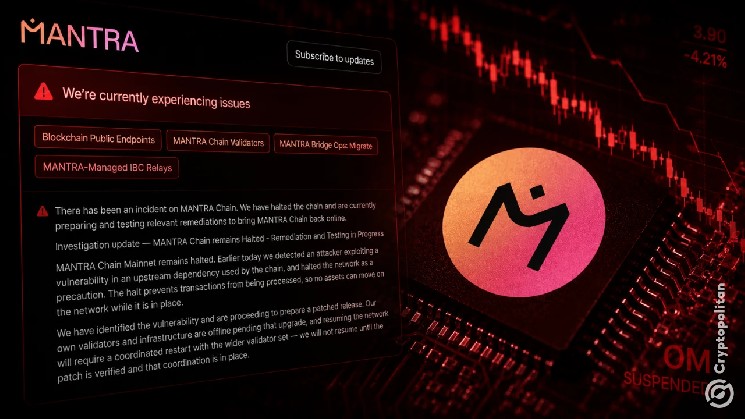
A series of preventable security attacks recently struck multiple Cosmos ecosystem blockchains—including MANTRA, TAC, KiiChain, and Nesa—all built using the Cosmos EVM module. Attackers drained protocol treasury wallets and dumped the stolen tokens, causing assets like KII, TAC, and NES to plunge over 90% within hours. The root cause was a critical security vulnerability. On August 19, Cosmos Labs publicly released version v0.7.2 on GitHub, containing an urgent security patch. However, they failed to privately notify or coordinate with the dependent project teams beforehand, leaving the exploit details openly accessible. This allowed malicious actors to study and execute attacks before most teams could respond. Affected projects like KiiChain criticized Cosmos Labs for bundling the critical fix with unrelated updates and not treating it with the necessary urgency, such as recommending chains to pause operations. The exploit combined three upstream flaws in the Cosmos EVM module, affecting any chain with vesting accounts enabled. Despite some teams, like MANTRA, identifying the issue early, attacks continued for days. Nesa’s token crashed 94% before the team halted its chain. Cosmos Labs eventually issued a belated response, advising chains to pause, but widespread criticism highlighted a severe failure in vulnerability disclosure, patch coordination, and ecosystem communication. This incident underscores deep flaws in Cosmos's security auditing, cross-chain coordination, and emergency response systems, further damaging confidence in an ecosystem already facing significant project departures and declining traction.

marsbit08/25 02:51

Unbelievable! Cosmos Publishes High-Risk Patch Without Prior Notice, Hackers 'Empty' Project Treasuries First

marsbit08/25 02:51

Altcoin Hacked, Leading to Sharp Price Drop! Also Listed on Major Exchanges!

The price of the NES token plummeted significantly following suspicious activity and large sell-offs detected on the network. Blockchain observers suggested that one wallet minted approximately $55 million worth of NES tokens and began selling them on decentralized exchanges. This selling pressure caused the price of NES to drop by up to 40%. According to the data, the address in question still holds around $18 million worth of NES, indicating that market sell-off pressure may continue. Prior to the incident, it was reported that about $12.35 million worth (62.9 million NES tokens) were transferred to the Ethereum mainnet in the morning (Turkish time), with claims that liquidity was withdrawn and tokens were sold on the market later that evening. However, data regarding the $55 million token mint and the transfer of 62.9 million NES tokens has not been independently confirmed. The NESA team confirmed in a statement that they detected malicious activity exploiting a vulnerability in their Layer 1 network originating from Cosmos EVM. They stated they are working to contain the impact, responded promptly, and will restore services after implementing a software patch and additional measures to ensure secure network operation. Nesa also notified all cryptocurrency exchanges and stated deposit operations will resume after necessary work is completed. The article includes a chart showing the NES price decline following the exploit and concludes with a standard disclaimer that this is not investment advice.

cryptonews.ru08/24 17:26

Altcoin Hacked, Leading to Sharp Price Drop! Also Listed on Major Exchanges!

cryptonews.ru08/24 17:26

Hyperliquid is Strongly Strangling HyperEVM

The article analyzes the apparent failure of HyperEVM, the application engine of the Hyperliquid blockchain, contrasting it with the success of its core trading engine, HyperCore. Hyperliquid operates on a dual-engine architecture. HyperCore is a closed, high-performance order-book exchange for perpetuals and spot trading, which dominates on-chain volume and generates massive fees. HyperEVM, launched in February 2025, is an EVM-compatible layer meant for DeFi applications like lending and DEXs, which can access HyperCore's liquidity. Despite Hyperliquid's overall strength in a bear market, a stark divergence exists: * **HyperCore (Trading):** Captures over half of on-chain perpetual volume, generating ~$56M in fees over 30 days. * **HyperEVM (Applications):** All DeFi protocols combined generate less than $60M in fees. TVL is shrinking, daily active addresses are low (~8k), and the ecosystem lacks diversity. The DEX sector is particularly anemic, with most volume concentrated in a single protocol. The article identifies four key reasons for HyperEVM's struggles: 1. **Core Monopoly on Execution:** HyperCore exclusively handles order matching. This makes native DEXs on HyperEVM redundant and limits viable applications to those leveraging its order book (e.g., staking, lending). 2. **Architectural Concentration:** Shared liquidity across interfaces naturally leads to a "winner-takes-most" outcome, explaining the high concentration in both the trading (e.g., trade.xyz) and application layers. 3. **"No Insider" Philosophy:** Hyperliquid's commitment to fair launch means it provides no grants, business development, or marketing support to ecosystem projects, stunting growth. 4. **Complex Developer Experience:** The asynchronous design between HyperEVM and HyperCore (via the CoreWriter contract) creates non-standard development hurdles, as EVM transactions don't roll back if the core action fails. The conclusion is that HyperEVM's weakness is a deliberate trade-off, not an accident. Hyperliquid prioritized building an unbeatable trading engine, sacrificing the development of a broad, independent application ecosystem. HyperEVM functions more as a tokenization layer for HyperCore's liquidity rather than a general-purpose chain. The debate isn't whether it's "dead"—it serves a niche—but whether Hyperliquid ever intended to build a thriving, diverse DeFi ecosystem beyond its core trading product.

marsbit08/11 14:56

Hyperliquid is Strongly Strangling HyperEVM

marsbit08/11 14:56

What's New in Ethereum's Roadmap: Privacy, Quantum Security, Native Rollup?

On August 10, 2024, Ethereum co-founder Vitalik Buterin revealed an updated technical roadmap, highlighting significant changes in priorities and new focus areas. Key new additions include: - **Strong Privacy Protection**: Elevated to a top-tier protocol concern. Proposals like EIP-8250 (keyed nonces for concurrency), EIP-8272 (recent roots for verification), and EIP-8182 (shared protocol-level privacy pools) aim to enable private transfers of ETH and ERC-20s, moving toward default private accounts. - **Quantum Resilience**: Priority increased. The plan addresses risks to ECDSA/BLS signatures, KZG commitments, and ZK systems, exploring solutions like leanSPHINCS signatures, STARK proofs (considered quantum-resistant), and streamlined verification processes. A full L1 upgrade is tentatively targeted for ~2029. - **Native Rollups**: A novel concept where rollups could reuse Ethereum's core validation infrastructure via a new EXECUTE precompile (EIP-8079 draft). This aims to reduce custom code and enhance security for certain L2s, while specialized chains will continue to exist. - **Protocol Simplification & Formal Verification**: Leveraging AI tools to make full-protocol formal verification feasible, aiming for more rigorous and machine-verifiable specifications. Other notable shifts: - State storage is evolving from Verkle trees to a Partitioned Binary Tree (PBT, EIP-8347 draft). - Some 2023 items like VDFs and certain EVM improvements were deprioritized. - Long-term discussions include blob/gas futures and non-EVM instruction sets (e.g., RISC-V). The "Strawmap" outlines potential upgrades through ~2029 but is a directional guide, not a firm timeline. Key milestones to watch include the Glamsterdam (Q4 2026) and Hegotá (2027) forks. Many proposals remain in draft or research phases.

marsbit08/11 07:51

What's New in Ethereum's Roadmap: Privacy, Quantum Security, Native Rollup?

marsbit08/11 07:51

活动图片