Suspending IPO but Accelerating Expansion: Kraken's 'Strategic Retreat for Advancement'

比推Опубліковано о 2026-03-19Востаннє оновлено о 2026-03-19

Анотація

Kraken has paused its IPO plans, initially filed confidentially with the SEC in November 2025, citing unfavorable market conditions. The decision comes amid a significant crypto market downturn, with Bitcoin falling over 52% from its October 2025 high and total market capitalization dropping 42.5%. Other recently listed crypto firms like Gemini and Bullish also saw steep stock declines. Despite the IPO delay, Kraken continues to expand its services. Recent initiatives include a partnership with Nasdaq to develop tokenized stocks, approval for a Federal Reserve master account enabling direct access to Fedwire, and the launch of new products like crypto-backed loans and regulated tokenized stock perpetual futures. Financially, Kraken’s parent company Payward reported strong 2025 results with a 33% increase in adjusted revenue and 26% growth in adjusted EBITDA. However, regulatory developments and ongoing market volatility have created uncertainty, leading Kraken to adopt a wait-and-see approach. The move reflects broader industry challenges as crypto firms navigate shifting regulations and investor sentiment while expanding beyond pure trading into diversified financial services.

Author: Nicky, Foresight News

Original Title: Kraken Suspends IPO Plans, Can Exchanges Not Navigate Bull and Bear Markets?


On March 18, according to CoinDesk, cryptocurrency exchange Kraken has temporarily shelved its IPO plans after confidentially submitting an application to the U.S. Securities and Exchange Commission in November 2025. Sources indicated that the company may reconsider when market conditions improve. This decision follows the surge in crypto company listings in 2025—firms like Circle, Bullish, and Gemini collectively raised $146 billion last year, making Kraken's pause particularly notable.

Kraken's suspension of its IPO is closely tied to the current downturn in the crypto market. According to Bitget data, Bitcoin's price has been declining since hitting an all-time high of $126,200 on October 6, 2025, dropping to around $60,000 by February 6, 2026, a maximum decline of over 52%. As of March 19, it is still hovering near $70,000. During the same period, the total market capitalization of cryptocurrencies shrank from $4.23 trillion to $2.43 trillion, a decrease of 42.5%.

Coinbase, a bellwether for crypto in the U.S. stock market, also experienced significant volatility. After reaching a historic high of $444.6 on July 18, 2025, its stock price fell to a near one-year low of $139.36 on February 12, 2026, a maximum drop of 68.65%. It closed at $202.29 on March 18, with a market cap of $53.42 billion, but market confidence has not fully recovered.

Other recently listed crypto companies are also facing severe challenges. Since its listing on September 12, 2025, Gemini's stock price has fallen from its first-day close of $32 to a low of $5.57 on February 23, 2026, a decline of nearly 82.6%. It closed at $5.96 on March 18, with a market cap of approximately $701 million.

Bullish, after listing on August 13, 2025, saw its stock price drop from $68 to a historic low of $24.79 on February 5, 2026, a decline of 63.5%. It closed at $38.28 on March 18, with a market cap of $5.754 billion.
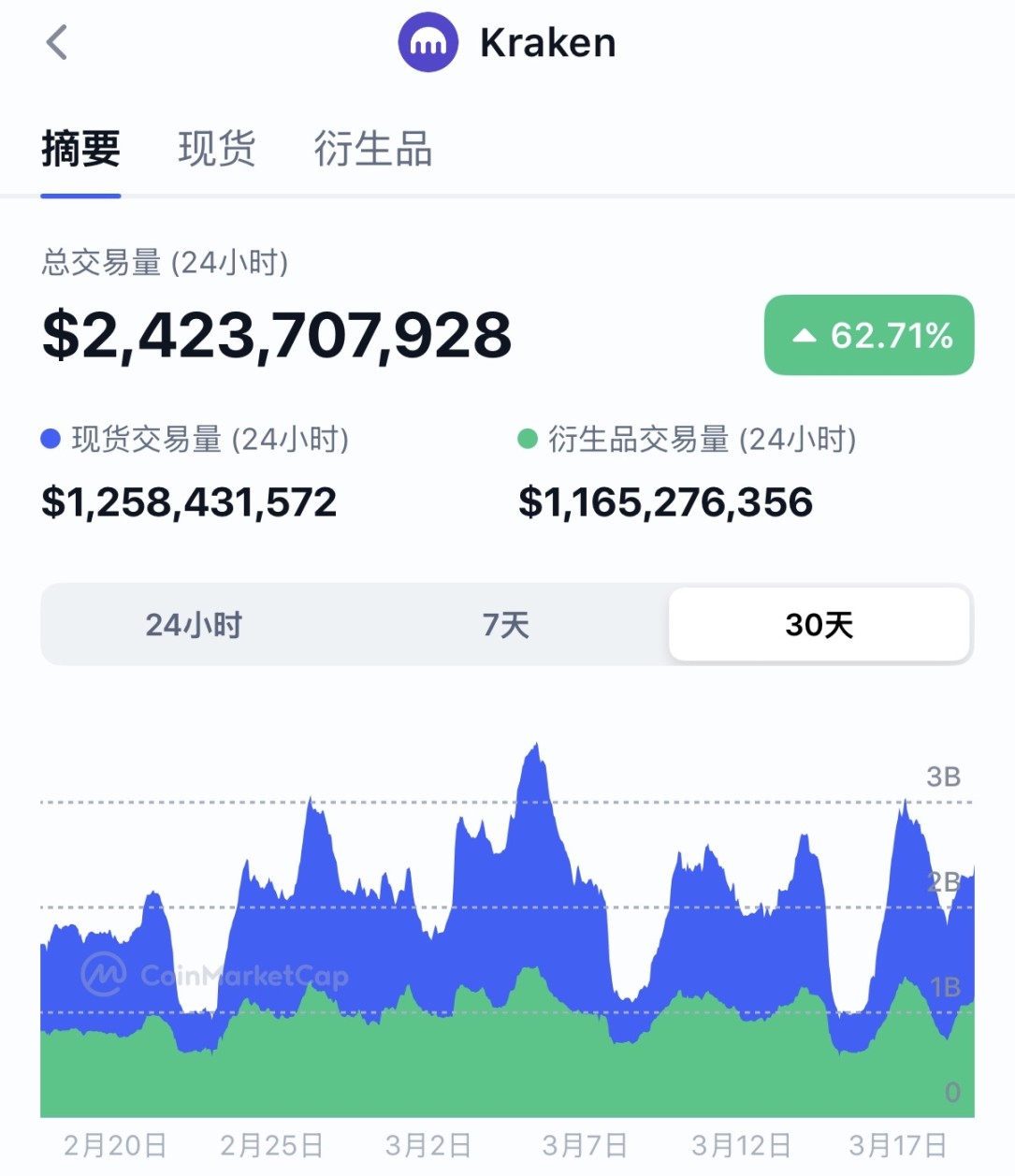
In terms of business scale, Kraken ranks in the middle globally among exchanges. According to CoinMarketCap data, Kraken's spot trading volume in the last 24 hours is approximately $1.2 billion, ranking 14th globally; its derivatives trading volume is about $1.1 billion, ranking 10th. In comparison, Coinbase's spot trading volume in the last 24 hours is around $1.86 billion, ranking second globally, while Binance leads with over $10 billion in spot trading volume and $65.18 billion in derivatives trading volume.

Financially, Kraken's parent company Payward reported 2025 results with adjusted revenue of $2.2 billion, a 33% year-over-year increase; adjusted EBITDA grew 26% to $531 million. Trading business revenue accounted for 47% of total revenue, with the remainder coming from non-trading businesses such as custody, payments, and financing. Total annual trading volume increased 34% to $2 trillion, platform assets grew 12% to $48.5 billion, and the number of customer accounts rose 50% to 5.7 million.

Despite the IPO plans being shelved, Kraken has been active in business expansion and regulatory compliance in recent months. On March 9, 2026, Nasdaq announced a partnership with Kraken to develop tokenized stocks and exchange-traded products, expected to launch in early 2027, focusing on using blockchain technology to streamline corporate governance processes.

On March 4, Kraken received approval for a Federal Reserve master account, becoming the first cryptocurrency company to access the Fed's core payment system, allowing direct use of the Fedwire interbank payment network. On February 25, the company launched its crypto asset staking loan service Flexline, enabling professional traders to access liquidity without selling their holdings. On February 24, Kraken announced the launch of regulated tokenized stock perpetual futures contracts, available to qualified non-U.S. users in over 110 countries, with initial products covering tokenized versions of major indices like the S&P 500 and Nasdaq 100.

Changes in the regulatory environment have added uncertainty to Kraken's path to listing. On March 18, the U.S. Securities and Exchange Commission and the Commodity Futures Trading Commission jointly issued interpretive guidance clarifying the classification standards for crypto assets, ending over a decade of regulatory ambiguity. This document provides clearer compliance guidance for the market but also means companies need to reassess how their business structures align with regulatory requirements. Meanwhile, cryptocurrency market structure legislation advancing in Congress is expected to pass in 2026, further clarifying the regulatory归属 of digital assets.

Kraken's decision to pause its IPO reflects the structural challenges crypto companies face in capital markets. On one hand, the industry is expanding from pure cryptocurrency trading to broader financial services, including stock trading, tokenized assets, and payment infrastructure; on the other hand, market volatility and regulatory uncertainty make investors cautious about valuing such assets.

For the entire cryptocurrency industry, Kraken's delayed listing may signal a turning point. Laura Katherine Mann, a partner at international law firm White & Case, previously noted that 2025 was a test year for crypto company IPOs, and 2026 would be the key node to test the long-term sustainability of digital asset IPOs. The market is judging whether crypto IPOs are a sustainable asset class or a cyclical trade that only during bullish markets. In the current market environment, Kraken's choice to wait for a more opportune moment may be a more prudent strategy.

It is worth noting that other leading players in the crypto industry are also actively adjusting their strategies to adapt to market changes. On March 19, Kris Marszalek, CEO of crypto trading platform Crypto.com, announced that the company is全面推进 its AI transformation, integrating AI tools and talent to enhance operational scale and precision. As part of this strategic adjustment, the company has targeted a reduction of about 12% of positions不适应 the new landscape.


Twitter:https://twitter.com/BitpushNewsCN

Bitpush TG Discussion Group:https://t.me/BitPushCommunity

Bitpush TG Subscription: https://t.me/bitpush

Original Link:https://www.bitpush.news/articles/7621233

Пов'язані питання

QWhy did Kraken decide to pause its IPO plans according to the article?

AKraken paused its IPO plans due to the current downturn in the cryptocurrency market and unfavorable market conditions, with the possibility of reconsidering when conditions improve.

QWhat significant partnership did Kraken announce in March 2026 regarding tokenized assets?

AIn March 2026, Kraken announced a partnership with Nasdaq to develop tokenized stocks and exchange-traded products, leveraging blockchain technology to simplify corporate governance processes.

QHow did the performance of other recently listed crypto companies like Gemini and Bullish compare in the market?

AGemini's stock price fell nearly 82.6% from its first-day close, while Bullish experienced a 63.5% decline from its IPO price, both reflecting severe market challenges.

QWhat regulatory development in the U.S. was highlighted as adding uncertainty to crypto asset classification?

AThe SEC and CFTC jointly issued interpretive guidance clarifying the classification standards for crypto assets, ending over a decade of regulatory ambiguity and requiring companies to reassess their compliance.

QHow does Kraken's business diversification strategy extend beyond cryptocurrency trading?

AKraken has expanded into services such as custody, payments, financing, crypto-asset staking loans, and regulated tokenized stock perpetual futures, aiming to become a broader financial services provider.

Пов'язані матеріали

Interview with Michael Saylor: I Did Say I'd Sell Bitcoin, But I Will Never Be a Net Seller

**Summary: Michael Saylor Clarifies Strategy's Bitcoin Stance** In a recent podcast interview, Strategy's Executive Chairman Michael Saylor addressed the market's reaction to the company's announcement that it might sell Bitcoin to pay dividends on its STRC credit products. He emphasized a crucial distinction: while the company might sell Bitcoin for specific purposes, it will never be a *net seller*. Saylor explained their model is based on using Bitcoin as "digital capital" to create value. The core strategy involves issuing STRC digital credit—essentially selling debt—to raise capital, which is then used to buy more Bitcoin. He estimates Bitcoin appreciates at roughly 40% annually. A small portion of these capital gains (e.g., ~2.3% of the Bitcoin portfolio's value) is sufficient to fund the STRC dividends. Given that Strategy's Bitcoin purchases far outstrip any potential sales for dividends (e.g., buying $3.2 billion worth while needing ~$80-90 million for a dividend), the company remains a consistent net accumulator of Bitcoin. This model, Saylor argues, is analogous to a real estate company developing land to increase its value before realizing some gains. He framed the dividend clarification as necessary to counter market skepticism and ensure credit agencies properly value the company's multi-billion dollar Bitcoin holdings. Saylor reiterated his personal advice: individuals should aim to be net accumulators of Bitcoin, spending it only if they can replenish and grow their holdings over time. Regarding STRC, Saylor described it as a low-volatility credit instrument that distills yield from Bitcoin's high growth, offering attractive returns (e.g., ~11-12% yield) for risk-averse investors. He noted that Strategy's STRC issuance now constitutes about 60% of the U.S. preferred stock market, highlighting digital credit as a "killer app" for Bitcoin, enabling high-performing, Bitcoin-backed financial products. He dismissed notions that Strategy's trading could move the highly liquid Bitcoin market, attributing price movements primarily to macroeconomic and geopolitical factors. Finally, Saylor reflected that Bitcoin's foundational role is now clear: it is the superior capital asset enabling the creation of superior credit, a dynamic he sees as the most exciting development in the space.

marsbit5 хв тому

Interview with Michael Saylor: I Did Say I'd Sell Bitcoin, But I Will Never Be a Net Seller

marsbit5 хв тому

380,000 Apps Exposed, 2,000+ Apps Leaked Secrets: AI Programming Turns 'Intranet' into Public Internet

Israeli cybersecurity firm RedAccess uncovered a severe data exposure trend linked to "vibe coding" or AI-powered software development tools. Their research found approximately 38,000 publicly accessible web applications built with platforms like Lovable, Base44, Netlify, and Replit. Of these, an estimated 2,000 apps exposed sensitive corporate and personal data, including medical records, financial information, internal strategic documents, and customer chat logs. In some cases, access even granted administrative privileges. The core issue stems from default privacy settings that make applications public by default, combined with a lack of built-in security controls (like authentication) in the AI-generated code. This allows employees without security expertise—"citizen developers"—to easily create and deploy applications that bypass standard corporate security reviews. The exposed apps, often indexed by search engines, are trivially discoverable. While some platform providers (Replit, Lovable, Wix/Base44) argue that security configuration is the user's responsibility and question the validity of some findings, security researchers confirm the widespread reality of such exposures. This pattern, also noted in prior studies, highlights a critical security gap as AI democratizes app creation, potentially leading to massive, unintentional data leaks.

marsbit1 год тому

380,000 Apps Exposed, 2,000+ Apps Leaked Secrets: AI Programming Turns 'Intranet' into Public Internet

marsbit1 год тому

Attracting Global Capital, Asia's New 'Super Cycle' Is Unfolding

Investors are turning to Asia as the next frontier for global equity growth, with a new "super cycle" unfolding across the region. Driven by the AI revolution, Asian markets, particularly South Korea, have seen significant rallies. According to Morgan Stanley analysis, the underlying drivers of Asia's industrial cycle are shifting from traditional sectors like real estate and manufacturing to massive investments in AI infrastructure, energy security and transition, and supply chain resilience. Fixed asset investment in Asia is projected to grow from around $11 trillion in 2025 to $16 trillion by 2030, with a 7% annual growth rate from 2026-2030. The AI wave is a primary catalyst, driving immense capital expenditure for chips, servers, data centers, and power systems. Asia is central to this hardware supply chain. In China, AI investment is focused on building a full-system domestic capability, with the local AI chip market potentially reaching $86 billion by 2030. Beyond AI, China's export story is expanding from EVs and batteries to robotics. The country already captures about half of new global industrial robot demand and over 90% of humanoid robot shipments. This growth phase mirrors the early stages of China's EV export boom. Simultaneously, energy security investments, spurred by AI's massive power needs, are rising, with China benefiting from its leadership in solar, batteries, and EVs. Regional defense spending is also increasing structurally, supporting demand for advanced manufacturing. The main beneficiaries are China, South Korea, and Japan, positioned in core supply chain areas. However, risks remain, including potential overcapacity, profit margin pressures from competition, persistent technological restrictions, geopolitical friction, and workforce displacement due to AI-driven automation. Market volatility is also expected to increase as investor expectations diverge on the realization of these capital investment and export themes.

marsbit1 год тому

Attracting Global Capital, Asia's New 'Super Cycle' Is Unfolding

marsbit1 год тому

Торгівля

Спот
Ф'ючерси
活动图片





