Stop Grinding Mindlessly, the Best Airdrops Are Often 'Unexpected Encounters'

marsbitОпубліковано о 2026-01-20Востаннє оновлено о 2026-01-20

Анотація

The article argues that the most valuable crypto airdrops are often "unexpected" and not the result of grinding tedious, predefined tasks. Instead, the best strategy is to build a genuine on-chain footprint by actively using protocols you believe in. Past examples like TIA, DYM, and Monad rewarded active users on various chains and in top protocols, not just those who farmed points. Publicized criteria for points programs are often exploited by Sybil attackers, diluting rewards and leading to burnout and disappointment when expectations aren't met. In contrast, retroactive airdrops with hidden criteria have less competition, as incentive-chasers avoid uncertain rewards. The core logic is that projects value real, high-value on-chain activity over low-value, repetitive Sybil behavior. By focusing on authentic engagement rather than farming, users can build a strong on-chain reputation, avoid being filtered out as a Sybil, and be pleasantly surprised by future airdrops.

Author: FIP Crypto

Compiled by: Deep Tide TechFlow

Deep Tide Intro: In the current landscape of airdrop frenzy and rampant points systems, many investors are experiencing "grinding fatigue." This article proposes a counterintuitive airdrop strategy: the best airdrops aren't "grinded" for; they are encountered unexpectedly through genuine on-chain interactions.

By analyzing cases like Monad, ZKsync, and Base, the author reveals the core logic behind retrospective airdrops—project teams value on-chain footprints that generate real value more than mechanical Sybil behavior. If you feel your airdrop returns are being diluted, this article will teach you how to build a genuine on-chain reputation for efficient, low-pressure earning.

Main Text:

Not all airdrops require endless "grinding," and the ones that don't are often the highest quality.

I've tried various types of airdrops, and many left me utterly exhausted.

But I realized the smartest way to get airdrops is actually not to deliberately "farm" them.

Here is the strategy I currently employ, aimed at "accidentally" getting the highest rewards with minimal effort:

We Get Rewarded for Being Active On-Chain

Not every project does this, but some projects distribute airdrops to active on-chain users.

Here are some examples of past retrospective airdrops:

  • TIA and DYM: Rewarded stakers in the Cosmos ecosystem and active L2 users.
  • AVAIL: Rewarded active L2 users, including Starknet users.
  • PENGU: Rewarded wallets with strong activity records on Ethereum and Solana.
  • MegaETH: SBT eligibility was based on our on-chain contributions.
  • Monad: Rewarded significant traders and depositors in top Ethereum and Solana protocols (they defined this as users who provided substantial value on-chain).

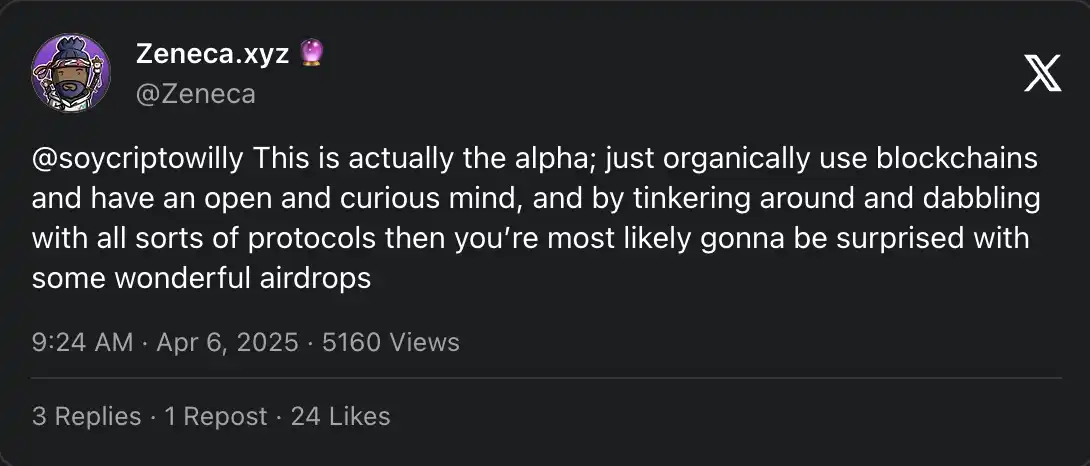
Following @Zeneca's airdrop philosophy, as long as we keep an open mind and explore new things on-chain, airdrops will come naturally.
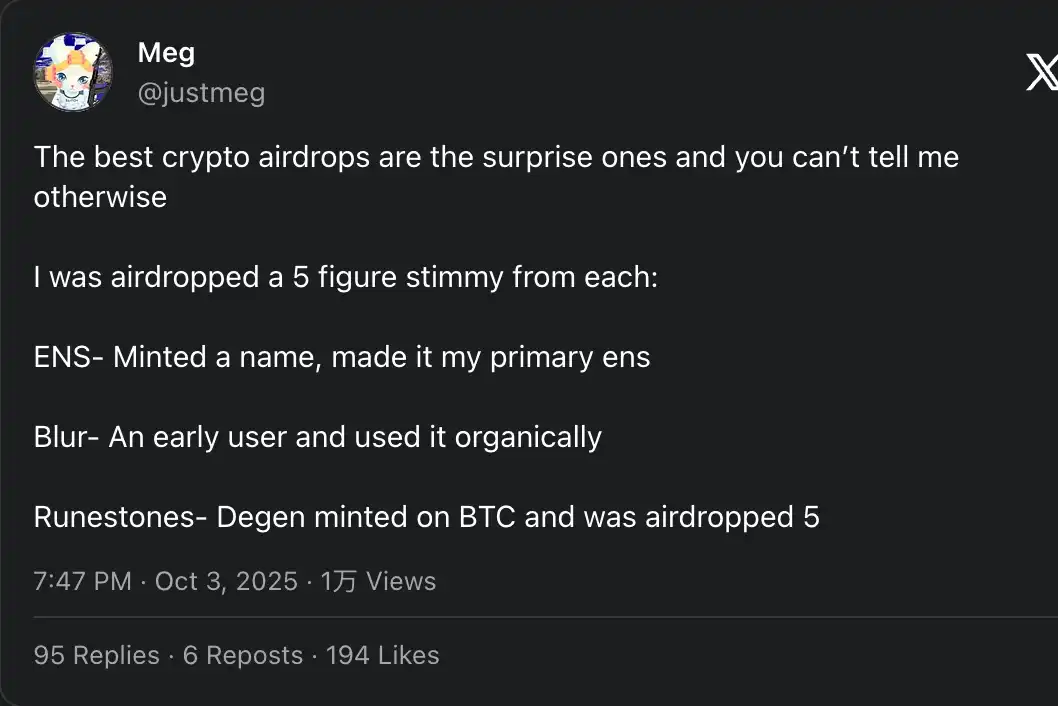
Our footprint makes us eligible for various airdrops simply by interacting with protocols we like.
No One Knows the Criteria

Points programs with clear criteria are boring because the project team directly tells you how to grind them.

One of the most "notorious" projects is MarginFi, which ran a points program for months (or even years?) without ever revealing any token details.

But this is the trap of any points program:

No one promises you anything, and the activity can go on forever.

They can change the rules at any time; that's the game we're playing.

If the sole purpose is to hard-grind a project for an airdrop, many people get frustrated.

When our expectations for airdrop returns are too high:

We are setting ourselves up for massive disappointment.

These programs are also heavily manipulated by Sybils, which further dilutes the allocation.

Meanwhile, retrospective airdrops do not publicly share their criteria.

We can compare the criteria used by two different L2s:

  • ZKsync used Time-Weighted Average Balance (TWAB), but only announced it after the snapshot.
  • Scroll used Marks points across multiple campaigns.

Both used similar factors (liquidity) to determine eligibility.

But Scroll didn't perform well except for favoring whales, while ZKsync was quite lucrative if you had the right strategy.

Many are still angry about missing ZKsync eligibility, but in reality, we could have qualified even with a small amount of capital.

We Have Less Competition

When there's so much uncertainty, no one likes to farm airdrops.

The ideal scenario is like Base or Arbitrum:

Actively denying they will issue a token, until they change their minds and decide to issue one.
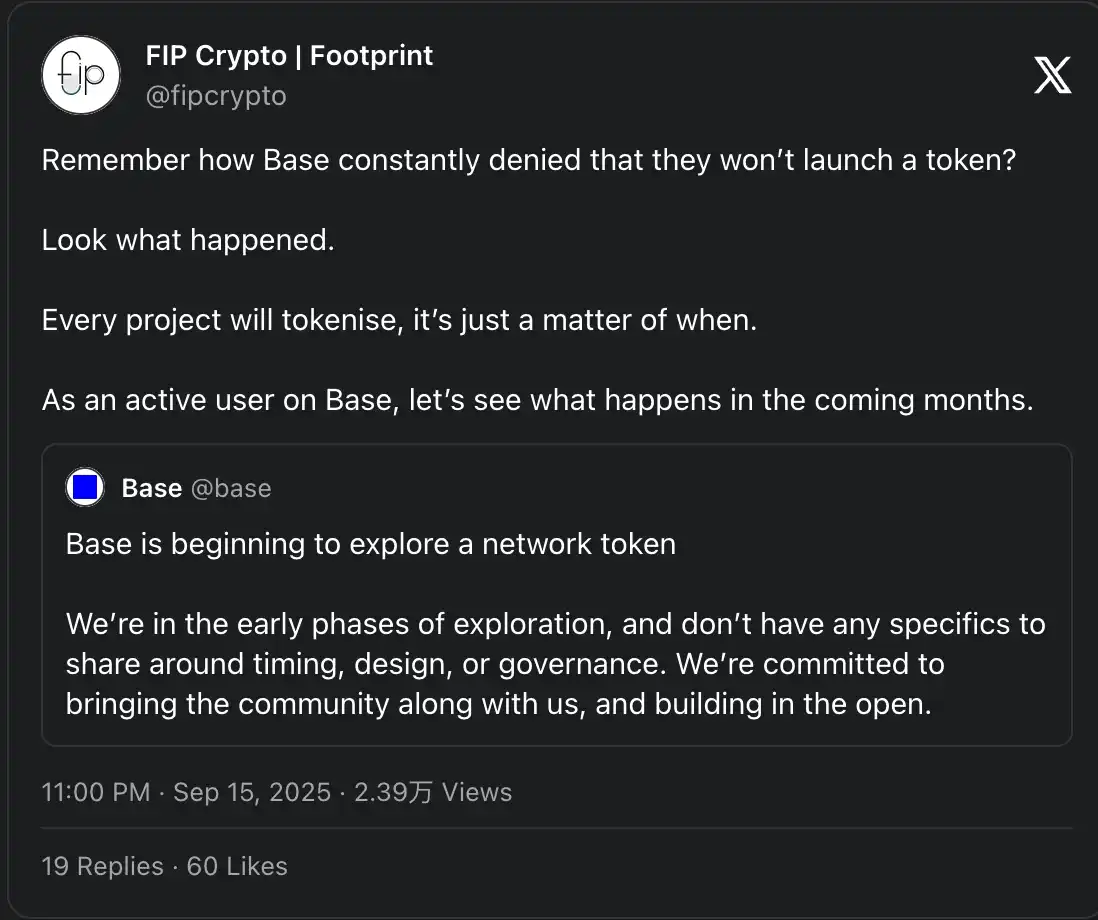
Therefore, fewer wallets actively participate because those solely chasing incentives won't join.

Or they might drop out halfway, as it doesn't make sense from a Return on Investment (ROI) perspective to farm this project.

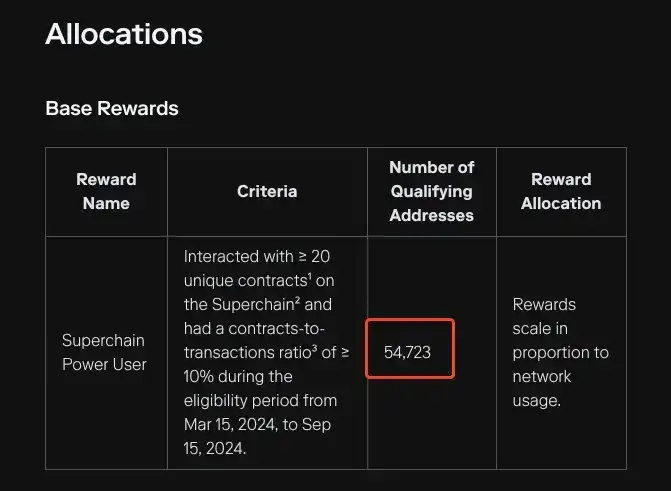
Optimism's 5th airdrop was a huge surprise for me; it turned out only 54,723 wallets were eligible.
Many will adopt a wait-and-see attitude, questioning if it's worth interacting without guarantees.

But the real reward comes from uncertainty:

We risk our time and capital based on our convictions, which could be a failure or a highly rewarding investment.

Even if we fail, it helps us further optimize our strategy and understand what to avoid in the future.

We Don't Get Burned Out

I've been asked countless times which are the best projects to farm.

We are always looking for the next farm, and after the token dump, the next one.

But sometimes, the best way to play airdrops is to use products you enjoy.

Who would have thought that staying active on Aave or Uniswap would make us eligible for a Monad airdrop?
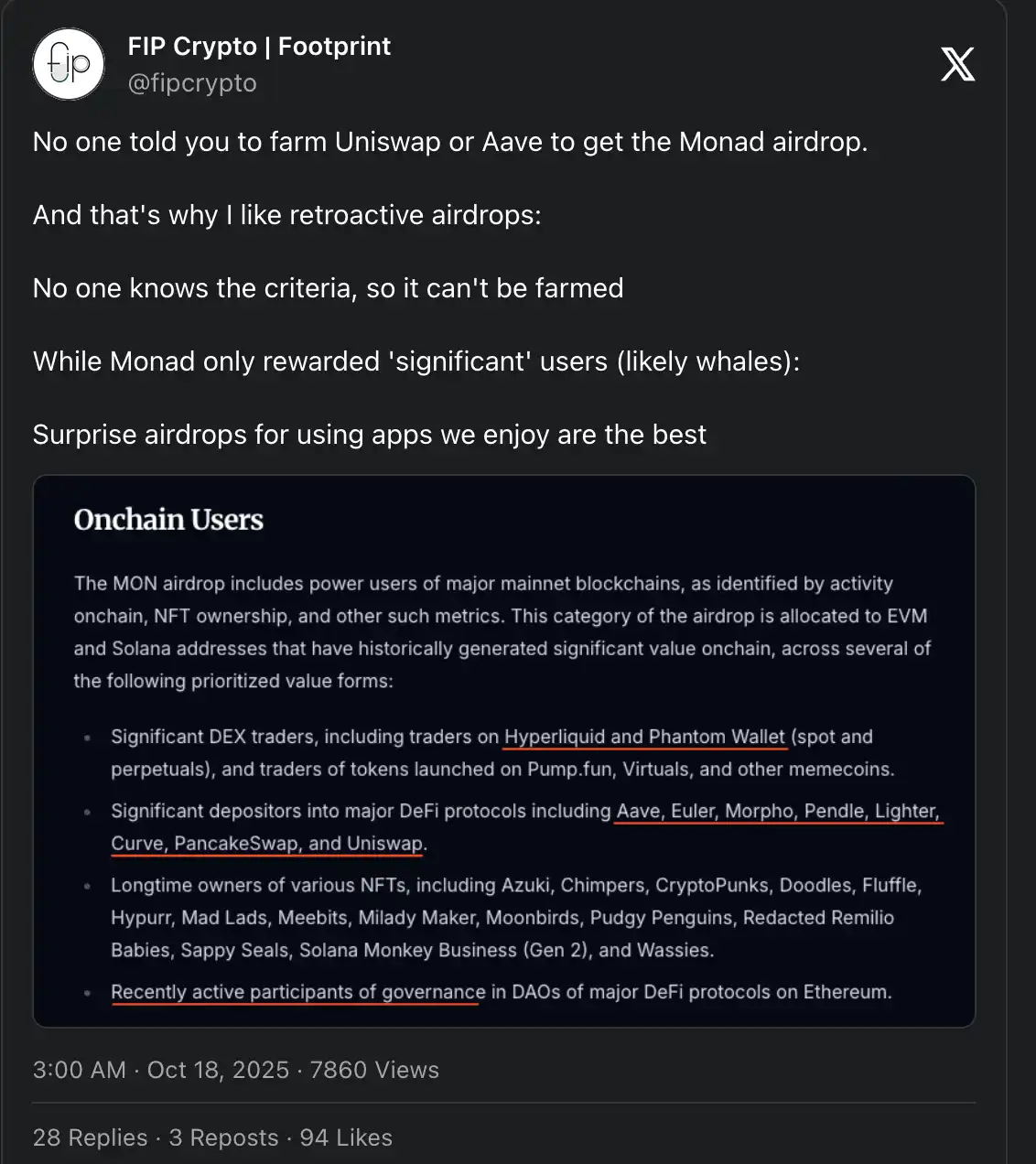
I've been burned out multiple times from constantly searching for the next Alpha.

But if we can get rewarded based on our on-chain footprint:

The real Alpha is interacting with protocols we enjoy using and profiting from in the process.
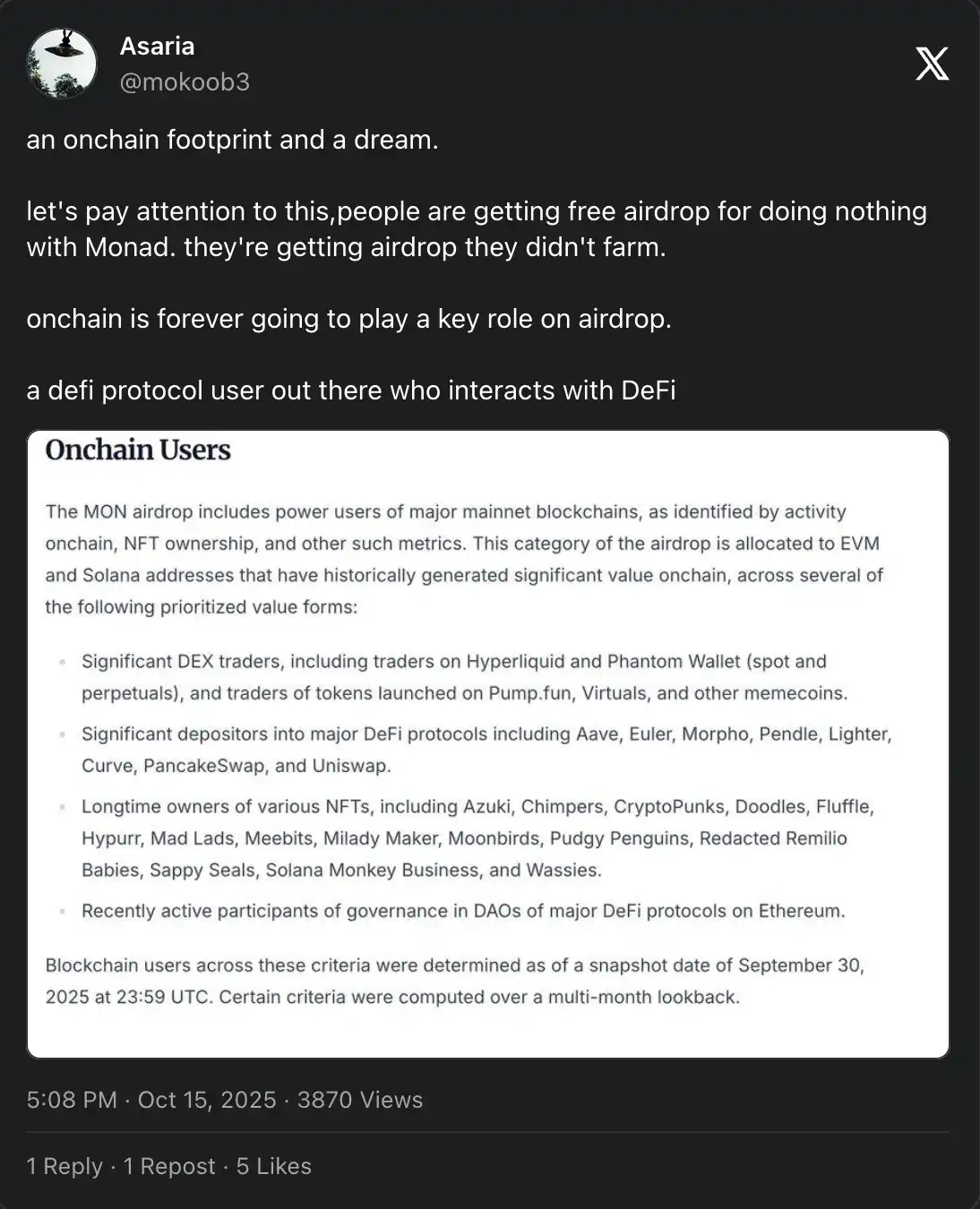
Focusing too much on the end result leads to disappointment.

Receiving surprise airdrops keeps us motivated to continue exploring on-chain.

Sybil Attacks Can't Game the System

Sybil farms mimic real users by performing the most basic operations to gain eligibility.

There will always be Sybils trying to extract value from projects.

But projects using retrospective criteria can adjust rules to filter out Sybils.

Of course, these are never perfect:

  • Real users get falsely filtered out.
  • Some Sybils get allocations.

It's hard to balance between the two; someone always gets left out.

On our end, we can try our best not to be filtered out as Sybils.

It all starts with this principle:

Value is the Primary Criterion

Retrospective airdrops are distributed based on the value your wallet provides.

Monad described it as "addresses that have historically generated significant value on-chain across different forms of value."

If we do the same low-value tasks as Sybils:

We get flagged and lose eligibility.

Project teams don't want to reward farmers who repeatedly make the same low-value swaps.

Instead, they reward high-value contributions.

But there are no strict rules for this; project teams decide which behaviors they want to reward.

So, to be eligible, we just need to find applications we like and use them consistently.

Our footprint will be recognized by other projects, and we'll get rewarded for using applications we enjoy.

Building a Strong On-Chain Social Footprint

The on-chain footprint has been declared dead by many, but I still believe it plays a key role in future airdrops.
Even though airdrops now heavily lean towards social distributions:

The on-chain footprint still forms the foundation of trust for your social reputation.

Others can easily tell if you're faking it or genuinely participating, so there's no point in trying to lie.

You just need to talk about what you've done on-chain to increase your "surface area for luck."

Пов'язані питання

QWhat is the core argument of the article regarding the best strategy to receive airdrops?

AThe article argues that the best airdrops are not obtained through deliberate, repetitive 'farming' but are instead 'unexpectedly' received through genuine, valuable on-chain activity and interaction with protocols one genuinely likes and uses.

QAccording to the author, what is a key advantage of public points programs for airdrops?

AA key disadvantage of public points programs is that they are heavily manipulated by Sybil attacks, which dilutes the rewards for genuine users, and the projects can change the rules at any time with no guarantee of a token distribution.

QHow do retrospective airdrops, like the one from Monad, differ from public points programs?

ARetrospective airdrops do not publicly share their criteria beforehand. They are distributed based on the value a wallet's historical on-chain activity provided, rewarding genuine users rather than low-value, repetitive actions common in Sybil farming.

QWhy does the author suggest that having less competition is beneficial for receiving airdrops?

ALess competition arises when a project's token distribution is uncertain (e.g., Base, Arbitrum initially denying a token). This discourages users who are only motivated by guaranteed incentives, leaving more rewards for those who interact with the protocol based on genuine belief.

QWhat is the recommended way to build a strong on-chain reputation to qualify for future airdrops?

AThe recommended way is to establish a genuine on-chain footprint by actively exploring and consistently using new protocols and applications that you genuinely like, as this valuable activity is what project teams look to reward.

Пов'язані матеріали

Strategy's Loss in the Second Quarter Reaches $8.22 Billion Amid Bitcoin Decline

Strategy, the largest corporate holder of Bitcoin, reported a net loss of $8.22 billion for the second quarter. This loss was primarily driven by an $8.32 billion unrealized loss on its Bitcoin holdings due to a decline in the asset's price during the period. Despite these paper losses, the company increased its Bitcoin holdings to 843,775 BTC, a 25% growth since the start of the year. As part of a new monetization strategy, Strategy sold approximately $218.4 million worth of Bitcoin, mainly to fund dividends for preferred shareholders, with $216 million of that sold after Q2 ended. The company also built a $3.75 billion cash reserve, which it claims is sufficient to cover over two years of dividend and interest payments, aiming to insulate itself from Bitcoin's volatility while meeting obligations. Following the earnings release, Strategy's stock (MSTR) rose 4.7% in regular trading but corrected slightly after-hours. This pattern reflects how the company's accounting results are heavily tied to Bitcoin's price swings, even as its long-term strategy remains unchanged. The report indicates that Strategy is maintaining its core strategy of accumulating Bitcoin while building a financial buffer. This quarterly loss follows a recognizable pattern, with the company posting significant unrealized losses in previous quarters (e.g., $12.4 billion in Q4 2025 and ~$12.5 billion in Q1 2026) due to fair-value accounting. A key technical shift is its new monetization program, which introduces periodic selling pressure on the market, transitioning Strategy from a pure accumulator to a participant that occasionally adds supply. A critical question remains: how long can the cash reserve cover dividend obligations if a Bitcoin price downturn persists beyond two years?

cryptonews.ru16 хв тому

Strategy's Loss in the Second Quarter Reaches $8.22 Billion Amid Bitcoin Decline

cryptonews.ru16 хв тому

Will Terrorist Durov Ban Russian Officials?

Telegram founder Pavel Durov publicly reacted to being labeled a "terrorist" by Russian authorities, stating the designation came after he refused demands for mass surveillance and censorship on the platform. In a Telegram post, he highlighted that this status formally bans him from "publishing information online." Durov concluded with a statement widely circulated: Russian officials "clearly don't understand who can ban whom on the internet." This remark suggests Durov could potentially restrict official Russian government and officials' channels on Telegram, which continue to operate on the platform despite its formal blocking in Russia. The situation parallels previous, slow-moving state directives, like switching officials to domestic cars, contrasted with the current push to migrate all government communication to the Russian-made messenger MAX by 2030. However, reports indicate many officials still use Telegram via workarounds, fearing surveillance on MAX, while alternatives like BiP and KakaoTalk recently became inaccessible in Russia without a VPN. Durov has not specified any immediate actions against state channels. His statement is an initial response, with further developments depending on the authorities' reaction. The dynamic differs from 2020 when Russian regulators lifted a block on Telegram; now, Durov implies control from within the platform itself over the official accounts that persisted through that earlier blockade.

cryptonews.ru16 хв тому

Will Terrorist Durov Ban Russian Officials?

cryptonews.ru16 хв тому

DeepSeek V4 Official Version Arrives, New Capabilities Emerge, Value-for-Money King Enters the Fray

On July 31st, DeepSeek officially launched the public API beta for its DeepSeek-V4-Flash model. A key highlight is its performance on multiple Agent benchmark tests, reportedly nearing or even surpassing the level of the V4-Pro preview version from three months ago. Notably, the Flash model achieves this with significantly smaller scale (130B active parameters vs. Pro's 490B), suggesting that post-training optimization and data quality may be as crucial as raw model size. DeepSeek emphasized that the V4-Flash-0731 uses the same model architecture and size as its preview version, with improvements attributed solely to "re-trained post-training." The update also marks the official debut of DeepSeek's self-developed Agent framework, "Harness." The move signals DeepSeek's strategic push to position its cost-effective Flash model as a competitive base for Agent applications—scenarios requiring autonomous planning, tool usage, and complex task execution—where inference speed and cost are critical. By natively supporting OpenAI's Responses API format and adapting for code-generation scenarios, DeepSeek aims not just to be a cheaper alternative but to establish its own ecosystem in the Agent era. This release follows DeepSeek's record-breaking ~$50 billion fundraising round roughly two months prior, underscoring market confidence in its technology and commercialization prospects. The company is reportedly preparing for another funding round at a valuation of approximately $71 billion. The Flash model's advancement represents a step in fulfilling the high expectations that come with this valuation, setting the stage for the impending release of the V4-Pro official version and intensifying competition in the global Agent landscape.

marsbit20 хв тому

DeepSeek V4 Official Version Arrives, New Capabilities Emerge, Value-for-Money King Enters the Fray

marsbit20 хв тому

Торгівля

Спот
活动图片