Stole $2 Million from pump.fun, Sentenced to 6 Years in Prison, He Chose to 'Self-Destruct'

marsbitОпубліковано о 2026-03-06Востаннє оновлено о 2026-03-06

Анотація

In May 2024, pump.fun was exploited for approximately $2 million worth of SOL and meme coins. The attacker, Jarett Dunn (also known as Stacc), a former employee, was later sentenced to six years in prison. Two days prior to the sentencing, he leaked internal Telegram chats from his time at the company, claiming to be a whistleblower exposing misconduct. However, the leaked messages did not reveal deliberate malicious activities such as market manipulation or fee misconduct by pump.fun. Instead, Dunn highlighted issues like the team's failure to implement KYC/AML measures for live streaming features, which he had warned about, and what he perceived as irresponsible attitudes toward known "Ruggers" (developers who abandon projects after fundraising). Some messages also illustrated the company's early-stage disorganization, including rushed contracts under investor pressure. Dunn, a talented programmer diagnosed with paranoid schizophrenia at age 20, had joined pump.fun just six weeks before the attack. His mother had recently died, and he had been off medication for months. After the exploit, he was arrested near pump.fun’s London office and underwent mental health treatment. He later attempted to withdraw his guilty plea and expressed homelessness in social media posts. The leak included private phone numbers of pump.fun co-founders, raising privacy concerns. The overall narrative portrays a troubled individual whose actions were influenced by personal trauma and mental hea...

In May 2024, pump.fun was hacked, with the attacker stealing approximately $2 million worth of SOL and a large number of meme coins. At the time, the attacker claimed they would airdrop these funds randomly to players on Solana, once dubbed the "Robin Hood of the crypto world."

Jarett Dunn (online alias Stacc), the attacker, is a former pump.fun employee. Last December, he was sentenced to 6 years in prison by a judge in London.
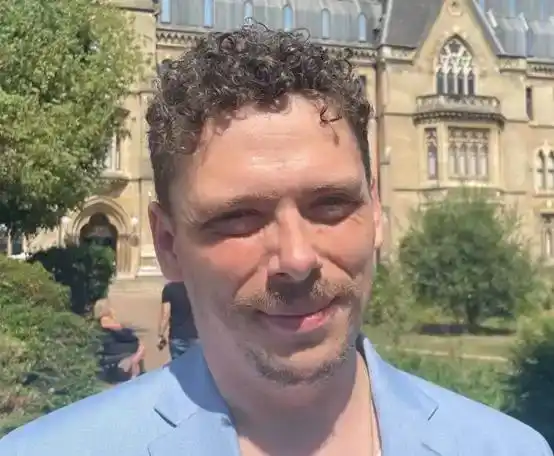
Two days ago, he exposed a large number of Telegram chat records from his time at pump.fun.

So I spent a lot of time going through these chat logs one by one. Honestly, after reading them, I was confused because these records did not contain the kind of intentional malicious content I had imagined, such as the pump.fun team manipulating liquidity or secretly collecting user fees. There was also no content suggesting major personal moral issues with founder alon or other team members.

But in Jarett Dunn's tweet, he called himself a whistleblower and viewed his exposure as a form of "righteous self-destruction." Someone expressed the same doubt in his comments, to which he replied:
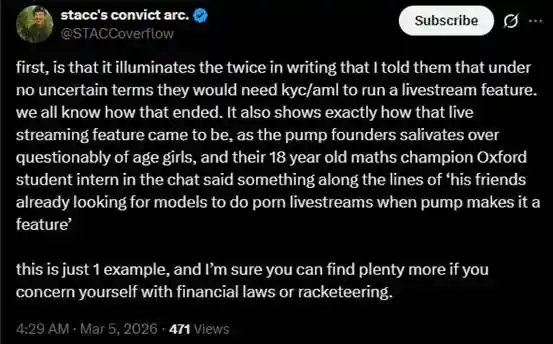
"These records show that I told them twice they must complete the KYC/AML process to enable livestreaming on the platform, (but they ignored it) and then we all know how things ended up (referring to the chaotic and unrestrained livestreaming scene on pump.fun in its early days)."

If this accusation has some merit, the next one is a bit more of a leap:

"An employee said something like this in the group: his friend was already looking for models to do porn as soon as pump.fun's livestreaming went live."

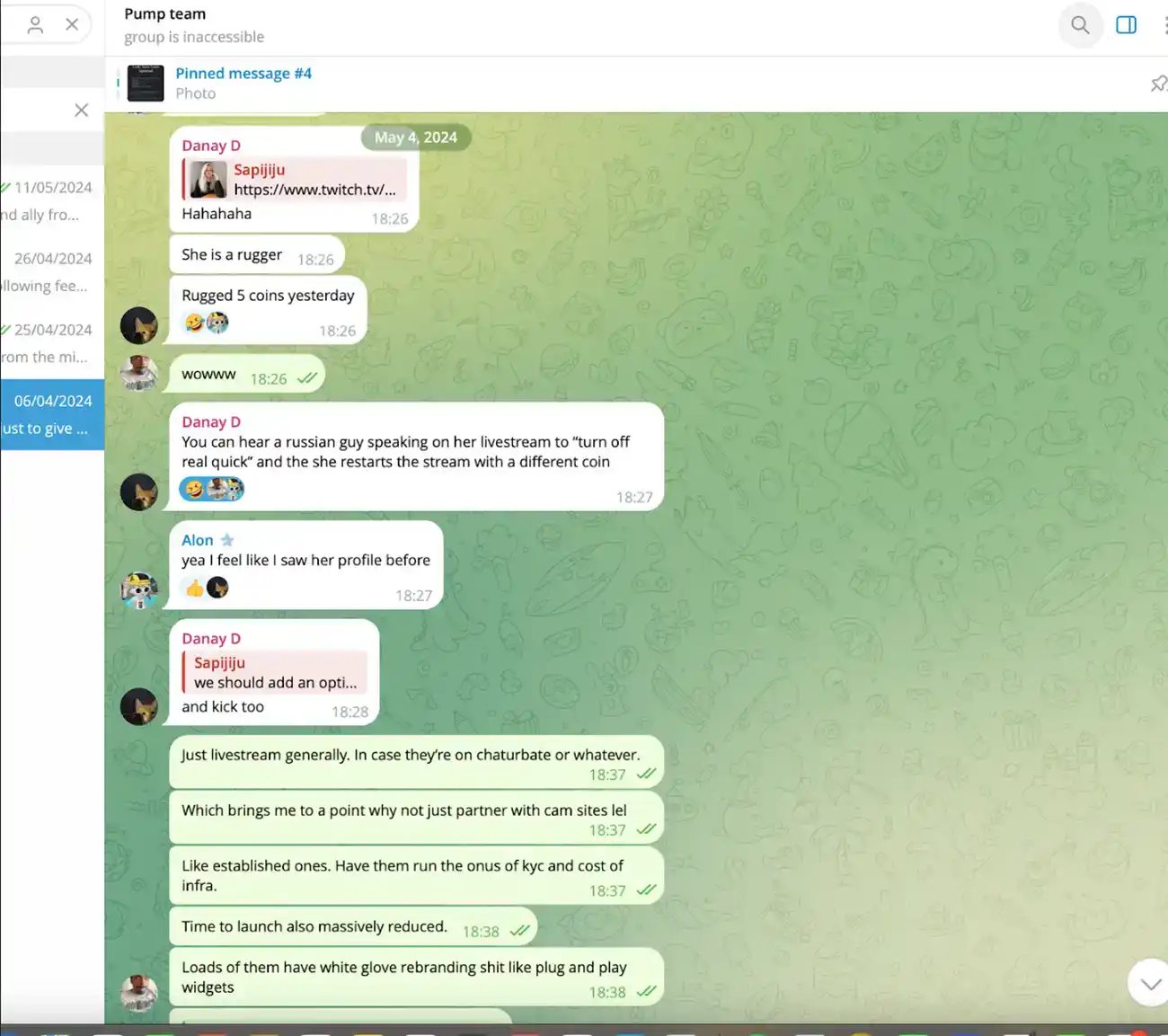
The chat record corresponding to this accusation is as follows. First, pump.fun co-founder Sapijiju shared a Twitch streamer in the pump.fun company group, saying another Twitch streamer had launched a token through pump.fun. An employee stated that this streamer was a Rugger (someone who performs a rug pull) and had rugged 5 tokens the day before.
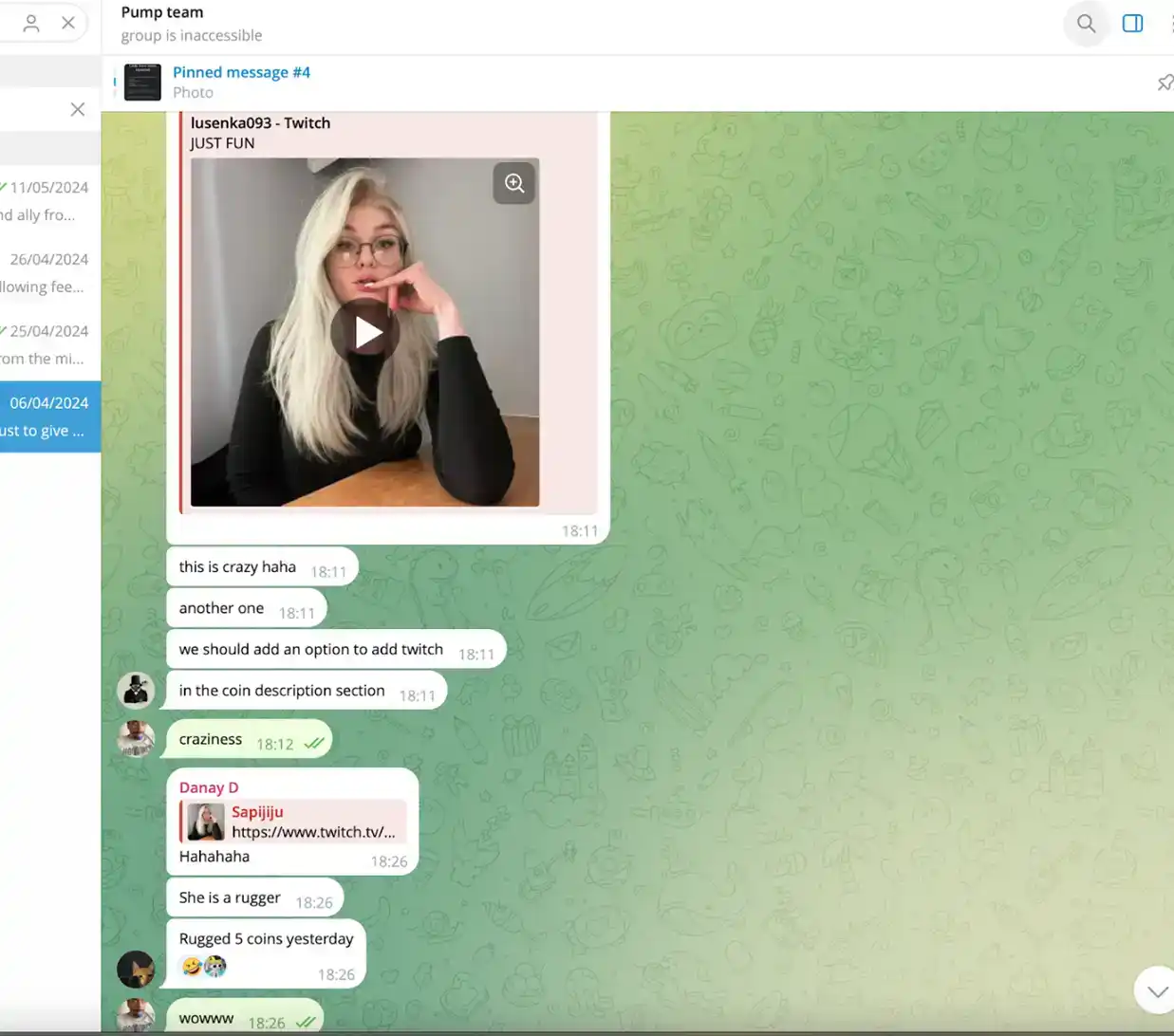
Then this employee said his friend was looking for "models" (to do the same thing). In context, this seems more like a joke. However, Jarett Dunn's suggestion was indeed interspersed, where he took the opportunity to express that partnering with a livestreaming platform would be better, as it would avoid KYC responsibilities and significantly shorten the time needed for pump.fun to launch its livestreaming feature.
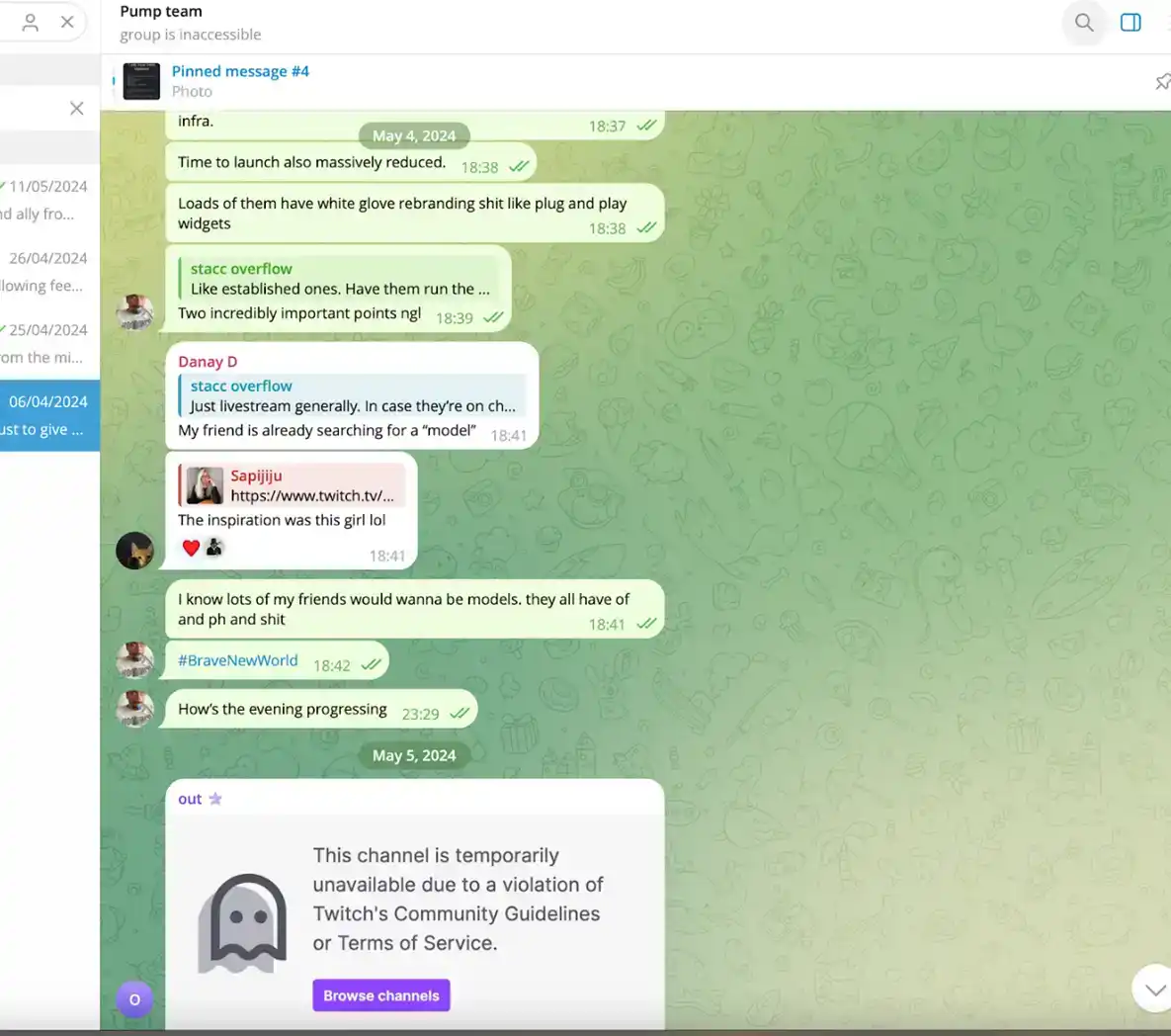
The more significant accusation here should be that the entire team, knowing this was a serial Rugger, still maintained a casual, joking attitude. alon, as a co-founder, stated in the records that he "felt like he had seen her profile before," and then nothing more came of it.
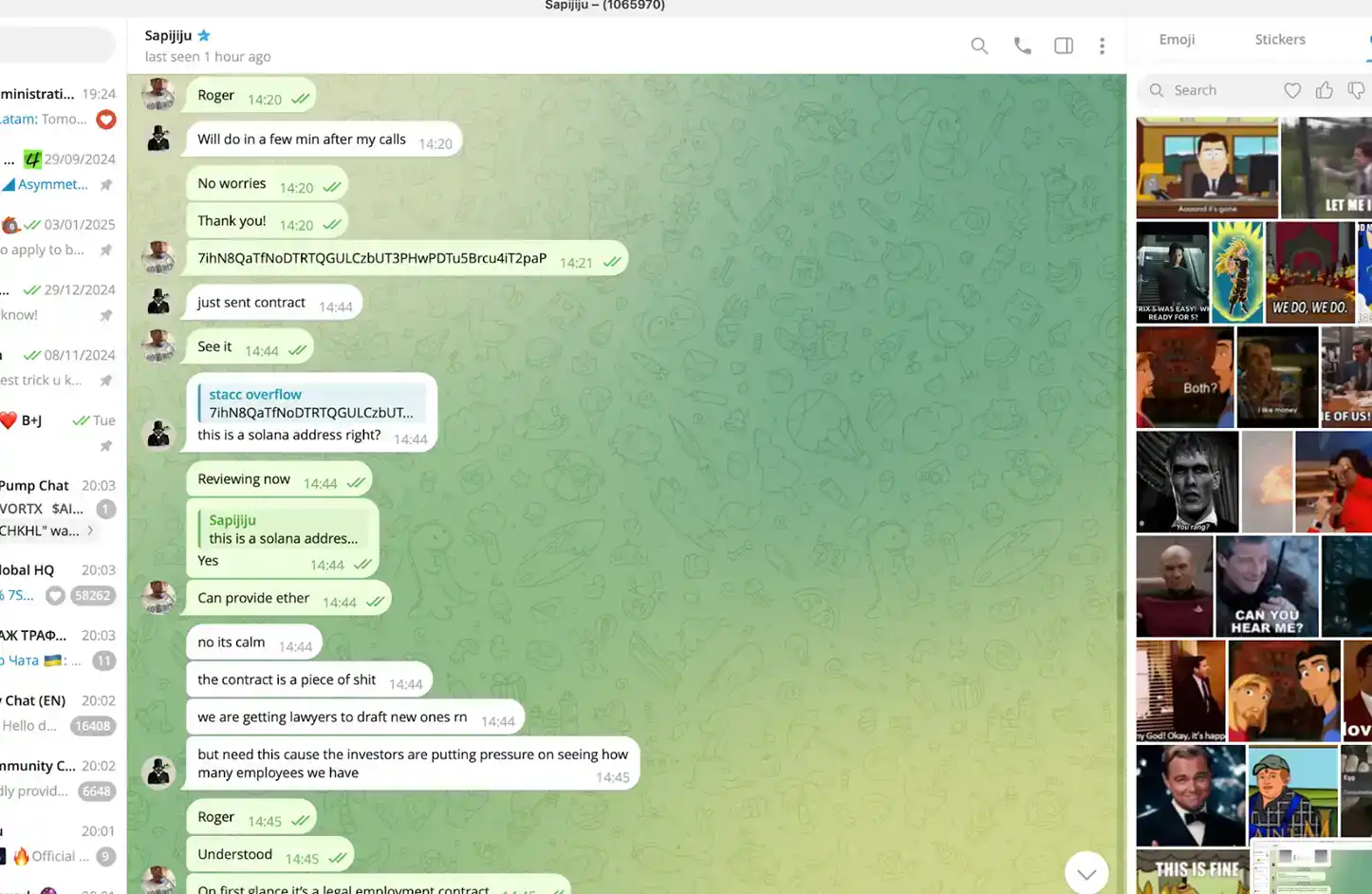
Some other records show the early "makeshift" nature of pump.fun. For example, creating a contract they themselves felt was "a piece of shit" just to handle investor pressure (needing to show investors how many employees the company had), while also looking for lawyers to draft a new one. For a then "young" pump.fun, it's hard to call this a black mark:
The most "explosive" part of the records disclosed by Jarett Dunn might be the release of the phone numbers associated with the Telegram accounts of alon and Sapijiju. Since this involves privacy, screenshots of this part will not be included in this article.

So, what kind of deep grudge is this? From the records, I cannot find the beginning of the enmity between Jarett Dunn and pump.fun, but he is a talented programmer who was also diagnosed with paranoid schizophrenia at the age of 20.

Two years ago, when he attacked pump.fun, his mother had recently passed away. At this time, he had only been with pump.fun for 6 weeks.

Four days after the attack, he was arrested at a hotel located just 90 meters from pump.fun's office in London; he was staying there. After his arrest, he was immediately deemed unfit for questioning by the police and sent to a hospital for a two-week mental health treatment, having been off his medication for months.

At his sentencing hearing two months after pleading guilty, he tried to withdraw his plea, a sudden change that made his legal team quit.

In September 2023, he wrote in a tweet, "I'm homeless, planning to sleep in the park, fighting the bugs I created with 5G."

Yet in the records, pump.fun reimbursed his flight tickets for him to fly from Canada to the UK. Was he happy and fulfilled back then?

Faced with such a complex, life-troubled programmer, I can only sigh at the vicissitudes of life.


Пов'язані питання

QWho was the individual responsible for the $2 million hack of pump.fun and what was his sentence?

AJarett Dunn (also known as Stacc), a former pump.fun employee, was responsible for the hack. He was sentenced to 6 years in prison by a judge in London.

QWhat was the main reason Jarett Dunn gave for his 'whistleblower' act of leaking internal chats?

AHe claimed that he had twice warned the pump.fun team that they needed to complete KYC/AML procedures before launching a live-streaming feature, but they ignored him, which he implied led to the platform's early chaos.

QWhat personal circumstances were mentioned that may have contributed to Jarett Dunn's actions?

AHe was diagnosed with paranoid schizophrenia at age 20, his mother had recently passed away just before the attack, and he had been off his prescribed medication for several months.

QAccording to the article, what was the nature of the most 'explosive' information leaked by Dunn?

AThe most sensitive information leaked was the personal phone numbers associated with the Telegram accounts of pump.fun's co-founders, Alon and Sapijiju.

QHow did the author of the article characterize the internal chat logs that were leaked?

AThe author was initially confused because the logs did not contain evidence of intentional malicious acts like market manipulation or stealing user fees. Instead, they showed a 'ragtag' or immature early-stage startup culture with some questionable jokes and attitudes, but not major ethical scandals.

Пов'язані матеріали

The King of Blind Date Attire in Korea: How SK Hynix Made a Comeback Against Samsung?

In South Korea's dating scene, SK Hynix employees are now highly sought after, a status shift fueled by the company's astronomical profits and employee bonuses, projected to reach up to 6.1 million RMB per person by 2027. This marks a dramatic reversal for the long-time second-place player in memory semiconductors, which has now surpassed its rival Samsung in annual operating profit. The turnaround story began in 2008 when a struggling Hynix, emerging from bankruptcy restructuring, took a risky bet by agreeing to develop High Bandwidth Memory (HBM) with AMD. At the time, HBM had no clear market beyond high-end graphics cards and was a costly, complex technology. Major players like Samsung, pursuing its own HMC technology, declined. For Hynix, with only memory as its core business, it was a gamble born of necessity. The pivotal moment came in 2012 when SK Group Chairman Chey Tae-won acquired Hynix. Defying industry downturns, he invested heavily in R&D and fabrication, sustaining the HBM project through over a decade of commercial uncertainty and internal challenges. A key break occurred around 2016-2017 when Samsung faced production issues supplying HBM2 for Google's TPU, allowing SK Hynix to gain a crucial foothold in the data center market. The AI explosion post-ChatGPT in 2022 was the catalyst, turning HBM into a critical bottleneck for AI accelerators like NVIDIA's GPUs. By 2025, SK Hynix captured 62% of the global HBM market, leaving Samsung at 17%. For the first time, its annual operating profit exceeded Samsung's. Analysts point to the "innovator's dilemma" to explain Samsung's miss: its vast, successful business portfolio made it risk-averse, preventing an all-in bet on the initially niche HBM technology. In contrast, SK Hynix, as a challenger with its back against the wall, had no choice but to commit fully. The story highlights how Korea's chaebol system allows for ultra-long-term bets beyond quarterly pressures. However, SK Hynix's lead isn't guaranteed. Samsung is aggressively catching up on HBM4, and challenges like customer concentration (heavy reliance on NVIDIA) and technical hurdles in advanced packaging remain. The narrative underscores a market truth: the greatest alpha often comes from betting on uncertain, long-term directions others dismiss, much like HBM in 2008.

marsbit15 хв тому

The King of Blind Date Attire in Korea: How SK Hynix Made a Comeback Against Samsung?

marsbit15 хв тому

Understanding Hash in One Article: The "Browser Miner" on Ethereum

Hash is an Ethereum-based ERC-20 token described as a "browser-minable post-quantum token." Its key features include enabling browser-based GPU mining without specialized hardware, a fixed supply cap of 21 million tokens, immutable and permissionless smart contracts with no team allocation or pre-mining, and an emphasis on post-quantum security using Keccak256 hashing. The mining mechanism is a simplified on-chain proof-of-work where miners solve unique challenges tied to their wallet address. Key design elements prevent answer theft, with epochs resetting every 100 blocks (~20 minutes) and a per-block minting limit. Emission follows a Bitcoin-like halving schedule every 100,000 mints, starting at 100 tokens per mint. Projections suggest all tokens could be mined within approximately 294 days if a target rate of one mint per minute is sustained. Hash emphasizes "post-quantum" security by leveraging hash-based primitives like Keccak256, which are considered more resistant to quantum attacks compared to elliptic-curve cryptography. While not a fully post-quantum asset, it aligns with Ethereum's broader post-quantum research narrative. The project completed its Genesis sale at $0.03 and began trading on Uniswap, with its price reaching around $0.19. The initial circulating supply is small, with 5% sold in Genesis and 5% allocated to liquidity. The majority (47.6% of total supply) is allocated to early-stage mining, leading to a front-loaded emission schedule. This structure, combined with low initial liquidity, makes Hash a high-volatility, high-risk project dependent on sustained miner participation and market demand to absorb new supply.

marsbit29 хв тому

Understanding Hash in One Article: The "Browser Miner" on Ethereum

marsbit29 хв тому

OpenAI's Largest Internal Wealth Creation: 600 People Cash Out a Total of $6.6 Billion, 75 Take Home the Maximum $30 Million Each

A Wall Street Journal report reveals OpenAI's unprecedented pre-IPO wealth creation. In a single employee stock sale last October, over 600 current and former employees sold shares, collectively cashing out approximately $6.6 billion. Due to high investor demand, the company tripled the individual sale cap to $30 million, with about 75 employees selling the maximum amount. This event represents the largest such transaction in tech industry history for a private company. OpenAI's valuation was $500 billion for this tender offer. Employees with over two years of tenure were eligible, allowing many post-ChatGPT hires their first liquidity event. The company's stock has reportedly grown over 100-fold in seven years. Following a restructuring, employees collectively hold about 26% of OpenAI. The scale of executive wealth is also staggering. In court testimony related to Elon Musk's lawsuit, President and co-founder Greg Brockman confirmed his OpenAI stake is worth around $30 billion. Analysis indicates about 165 current and former employees hold a combined ~$164.9 billion in equity, averaging nearly $1 billion per person in paper wealth. OpenAI's per-employee stock-based compensation is estimated to be 34 times the average of major tech firms before their IPOs. OpenAI continues its rapid ascent, closing a $122 billion funding round at an $852 billion valuation in March. With monthly revenue hitting $2 billion, over 900 million weekly ChatGPT users, and plans for a potential trillion-dollar IPO in late 2026, this wealth-creation engine shows no signs of stopping.

链捕手51 хв тому

OpenAI's Largest Internal Wealth Creation: 600 People Cash Out a Total of $6.6 Billion, 75 Take Home the Maximum $30 Million Each

链捕手51 хв тому

Торгівля

Спот
Ф'ючерси
活动图片




