South Korea To Unveil Tokenized Securities Rules In July As Crypto Regulation Advances

bitcoinistОпубліковано о 2026-05-16Востаннє оновлено о 2026-05-16

Анотація

South Korea's Financial Services Commission (FSC) plans to release a detailed framework for tokenized securities in July. This initiative follows the passage of the Token Securities Institutionalization Act, which will take effect in February 2027. The regulations aim to allow qualified issuers to launch and trade tokenized securities using distributed ledger technology through licensed intermediaries. FSC Vice Chairman Kwon Dae-young emphasized balancing innovation with trust, market order, and investor protection. The framework will include rules for issuance, infrastructure, and distribution, and permit fractional investment securities. This move is part of South Korea's broader push to regulate digital assets. Concurrently, the country is preparing to implement a 20% income tax on crypto assets starting in 2027, despite some public and political opposition. Lawmakers are also urging the government to prioritize delayed stablecoin legislation.

South Korean authorities are set to release detailed rules for the issuance, infrastructure, and distribution of tokenized securities, as the country advances its efforts to implement crypto market regulations in 2027.

FSC Eyes July Tokenized Securities Framework

On Friday, South Korea’s Financial Services Commission (FSC) revealed it is preparing to publish its framework for tokenized securities in July during the second meeting of the public-private joint “Token Securities Council,” launched in March.

Earlier this year, the National Assembly passed the Token Securities Institutionalization Act, which will take effect on February 4, 2027, to amend the Electronic Securities Act and the Capital Markets Act.

The changes are set to allow qualified issuers to launch tokenized securities using distributed ledger technology and enable the products to be traded as investment contract securities on brokerages and other licensed intermediaries.

FSC’s Vice Chairman Kwon Dae-young highlighted that the “upcoming token securities ecosystem must strike a balance between innovation and trust.” Therefore, the regulatory agency is reviewing measures to subordinate regulations and guidelines for the Tokenized Securities Act.

In addition, the regulator is expected to develop a phased roadmap for tokenizing existing standardized securities, such as stocks and bonds, as well as for on-chain settlements, drawing on international practices.

Discussing the best practices for eligibility and underlying assets, Kwon stated that the FSC will “We will uphold the fundamental principles of market order and investor protection, but we will not take a one-sided regulatory approach.” Notably, the regulator plans to allow the issuance of fractional investment securities by pooling underlying assets of the same type within a certain range.

He also explained that the government’s stance was to design a market structure that enhances trading efficiency, ensures fair competition, and protects users. The FSC’s Vice Chairman added that the regulator will add trading limits on OTC exchanges “in a way that allows the expansion of initial market liquidity while systematizing investor protection, so that the limits do not become a barrier stifling innovation.”

South Korea Prepares For Crypto Rules Implementation

The upcoming rules for tokenized securities come amid South Korea’s push to regulate digital assets and the local crypto market. Over the past few years, the country has worked to develop a framework to supervise the crypto industry and protect users.

Alongside the Token Securities Institutionalization Act, the government is expected to implement the Income Tax Act in 2027, with the tax authority fast-tracking the development of a tax base and tracking system to end years of delays.

As reported by Bitcoinist, South Korea’s National Tax Service (NTS) announced last month that it had begun “full-scale preparations” to implement the long-delayed crypto legislation in January of next year.

Under the Income Tax Act, crypto assets will be subject to a 20% income tax rate, up to 22% including local taxes, starting January 1, 2027. The financial authority plans to create a tax base by formally receiving pertinent data from crypto exchanges, establish a guidance framework for taxpayers subject to virtual asset income tax, and outline criteria for capital gains calculations.

Despite some efforts to abolish the crypto tax, including a People Power Party (PPP)-led bill and a petition with over 30,000 signatures, recent reports noted that the odds of abolishing or delaying it seem slim, as parliamentary petitions rarely lead to legislative action and authorities are committed to the 2027 rollout.

Meanwhile, South Korean lawmakers have repeatedly urged the government to prioritize stablecoin legislation, which has been delayed since late 2025 due to a disagreement between the Bank of Korea (BOK) and the FSC.
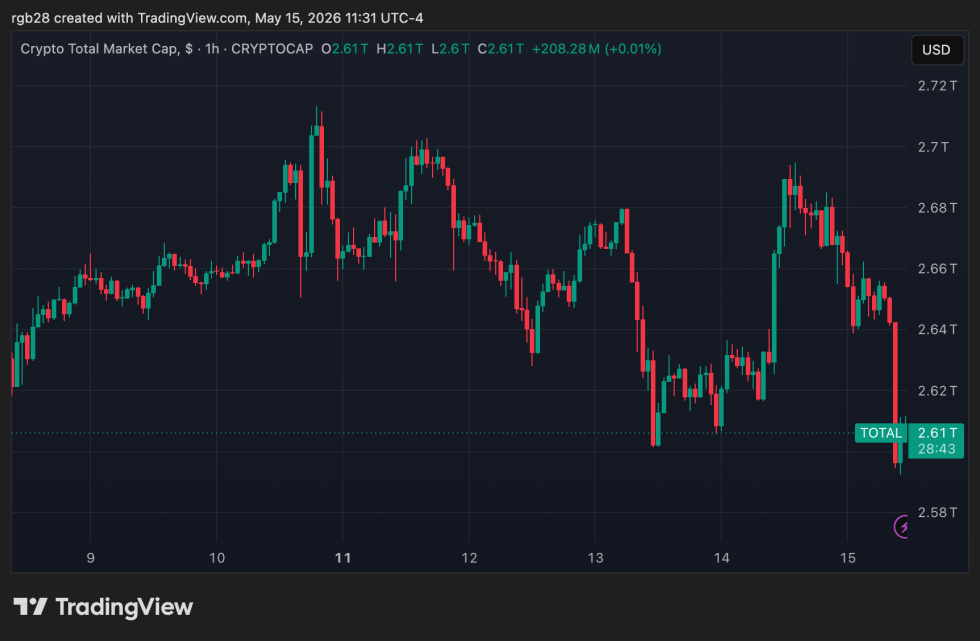
The total crypto market capitalization is at $2.61 trillion in the one-week chart. Source: TOTAL on TradingView

Пов'язані питання

QWhen will South Korea release detailed rules for tokenized securities, and under which legislative act are these rules being developed?

ASouth Korea's Financial Services Commission (FSC) plans to release its framework for tokenized securities in July 2026. These rules are being developed under the Token Securities Institutionalization Act, which was passed earlier in 2026 and amends the Electronic Securities Act and the Capital Markets Act. This legislation is set to take effect on February 4, 2027.

QAccording to FSC Vice Chairman Kwon Dae-young, what key principles will guide the upcoming token securities ecosystem?

AFSC Vice Chairman Kwon Dae-young stated that the upcoming token securities ecosystem must strike a balance between innovation and trust. He emphasized that the regulator will uphold the fundamental principles of market order and investor protection while avoiding a one-sided regulatory approach. The goal is to design a market structure that enhances trading efficiency, ensures fair competition, and protects users.

QWhat are the two main components of South Korea's crypto regulations scheduled for implementation in 2027?

ASouth Korea's crypto regulations scheduled for full implementation in 2027 consist of two main components: the Token Securities Institutionalization Act, which governs the issuance and trading of tokenized securities, and the Income Tax Act, which imposes a tax on crypto asset income. The tax will be levied at a 20% income tax rate, potentially up to 22% including local taxes, starting January 1, 2027.

QWhat preparations is South Korea's National Tax Service (NTS) making for the 2027 crypto tax implementation, and what data will be used?

ASouth Korea's National Tax Service (NTS) has begun 'full-scale preparations' to implement the crypto income tax legislation in January 2027. To create the tax base, the authority plans to formally receive pertinent transaction and user data from crypto exchanges. This data will be used to establish a guidance framework for taxpayers and outline criteria for calculating capital gains on virtual asset transactions.

QWhat is the current status of stablecoin legislation in South Korea, and what has been the primary cause of its delay?

AStablecoin legislation in South Korea has been delayed and has not been prioritized by the government despite urging from lawmakers. The primary cause of the delay is a reported disagreement between the Bank of Korea (BOK) and the Financial Services Commission (FSC) over regulatory responsibilities, which has stalled the process since late 2025.

Пов'язані матеріали

Will the Fed Definitely Raise Interest Rates in September? How Will Crypto and U.S. Stocks Withstand the Pressure?

The market's expectation for a September Fed rate hike surged dramatically in early August, jumping from under 50% to over 80% within a week. This shift followed a contentious July FOMC meeting, where a 9-3 vote to hold rates revealed growing dissent from hawkish members advocating for an immediate hike to combat persistent inflation. The primary catalyst for this repricing is rising oil prices, driven by renewed geopolitical tensions around the Strait of Hormuz, which threaten global supply. Energy costs directly influence inflation metrics, making the upcoming July CPI report (due August 12th) a critical data point. If it shows inflation reaccelerating, the probability of a September hike will solidify. For Bitcoin and crypto assets, this is typically bearish news. Bitcoin continues to behave as a high-beta, liquidity-sensitive risk asset. A rate hike raises the opportunity cost of holding non-yielding assets and could drive capital toward money markets, pressuring crypto prices in the short term. However, historical patterns suggest that if a hike is perceived as the end of a tightening cycle rather than the start, any negative price impact may be brief. U.S. stocks, particularly crypto-linked equities like Coinbase and growth-oriented tech stocks, are also vulnerable. Higher rates increase discount rates in valuation models, putting pressure on high-multiple companies. This coincides with a pivotal tech earnings season where investor focus has shifted from massive AI capital expenditure to tangible revenue and cash flow generation. Companies with negative cash flow and weak growth narratives could face heightened volatility if borrowing costs rise in September. In summary, a September Fed hike has evolved into a mainstream market scenario. Key factors to watch are oil prices, the July CPI report, and Fed communications, which will determine the final decision and its impact on volatile crypto and equity markets.

marsbit6 хв тому

Will the Fed Definitely Raise Interest Rates in September? How Will Crypto and U.S. Stocks Withstand the Pressure?

marsbit6 хв тому

A 'Overlooked' Market Event: Joint US-Japan-South Korea Intervention, Rare US Treasury Involvement, and Bessent's Quiet 'Market Rescue'?

Summary: The United States, Japan, and South Korea executed their largest coordinated foreign exchange intervention in nearly 30 years. The action targeted depreciation pressure on the Japanese yen and South Korean won. This move is seen as a significant effort by the US to stabilize the financial markets of its key allies and prevent the spillover of risks. Key details: * Japan reportedly intervened on July 30 using approximately 8.45 trillion yen (about $52.8 billion). South Korean authorities also intervened that day, selling dollars to support the won. * Notably, the US Treasury Department intervened directly in yen markets for the first time in roughly 30 years. The New York Fed, reportedly acting on behalf of the Treasury, sold euros to buy yen via Goldman Sachs and Morgan Stanley on July 31. Analysts view the use of the euro-yen pair as a way to alleviate yen pressure without adding selling pressure to the US dollar. * Prior to the action, the New York Fed conducted "rate checks" on both USD/JPY and EUR/JPY, a newer signaling tool that falls between verbal and physical intervention. The intervention is interpreted as going beyond traditional currency stabilization. Analysts, such as Michael Hartnett of Bank of America, suggest it resembles a "Price Keeping Operation" for the AI era. The core US objectives are perceived to be: 1. Preventing rapid yen depreciation from triggering a sharp rise in Japanese government bond yields. 2. Containing financial stress from spreading across Asian markets like South Korea and Japan. 3. Reducing the risk of disorderly capital flows impacting the US bond market. This coordinated action underscores the importance of Japan and South Korea as critical partners in the US semiconductor and AI supply chain. Stabilizing their financial markets is seen as vital to mitigating risks to the broader tech industry and the US market itself. The intervention coincides with market pressures, including the KOSDAQ index hitting a low since October 2022. While seen as a move to control volatility, some analysts caution it may not fundamentally reverse existing market trends.

marsbit10 хв тому

A 'Overlooked' Market Event: Joint US-Japan-South Korea Intervention, Rare US Treasury Involvement, and Bessent's Quiet 'Market Rescue'?

marsbit10 хв тому

Will the Federal Reserve Definitely Raise Interest Rates in September? How Will Cryptocurrencies and US Stocks Bear the Pressure?

In early August 2024, market expectations for a September Federal Reserve rate hike surged dramatically, from below 50% to over 80%, driven by renewed inflation concerns. This shift followed a contentious July FOMC meeting where a 9-3 vote to hold rates revealed a growing hawkish faction advocating for an immediate hike, citing prolonged above-target inflation. The key catalyst is escalating conflict near the Strait of Hormuz, which has pushed oil prices up approximately 20% in July, threatening to reignite inflation. The next critical data point is the July CPI report on August 12th; a hot reading could solidify hike expectations. For crypto assets, particularly Bitcoin, this represents near-term pressure. Bitcoin continues to exhibit high-beta, risk-on characteristics, making it sensitive to tightening liquidity and higher opportunity costs. However, historical precedent suggests that if a hike is perceived as the cycle's end rather than its start, the negative impact may be brief, with markets quickly pivoting to anticipate future rate cuts. U.S. stocks, especially crypto-linked equities like Coinbase and high-valuation tech stocks, face amplified volatility. Higher rates increase discount rates in valuation models, pressuring growth stocks. This coincides with a pivotal tech earnings season where investor focus has shifted from massive AI capital expenditures to demonstrable revenue and cash flow generation. Companies with negative cash flows and weak growth narratives could see severe pressure if a September hike materializes, as financing costs would rise. Key indicators to watch include oil prices, upcoming inflation data, and Fed commentary at events like the Jackson Hole symposium.

Odaily星球日报10 хв тому

Will the Federal Reserve Definitely Raise Interest Rates in September? How Will Cryptocurrencies and US Stocks Bear the Pressure?

Odaily星球日报10 хв тому

Торгівля

Спот
活动图片