South Korea Opens To Corporate Crypto Investment, But Sets 5% Cap

bitcoinistОпубліковано о 2026-01-12Востаннє оновлено о 2026-01-12

Анотація

South Korea's Financial Services Commission (FSC) is set to overturn a nine-year ban by allowing corporations and professional investors to invest in cryptocurrencies. The new guidelines, expected to be finalized by February, impose a 5% cap on corporate investments relative to equity capital and restrict investments to the top 20 cryptocurrencies by market cap. While stablecoins like USDT and USDC are currently in the top 20, their eligibility is still under discussion. The move follows the country's earlier announcement in February 2025 to permit institutional participation. Some industry insiders have raised concerns that the investment cap may hinder capital inflow and limit the growth of crypto-focused firms. Additionally, South Korea is planning to introduce spot crypto ETFs this year and is developing a regulatory framework for stablecoins, though disagreements between the FSC and the Bank of Korea over ownership requirements for issuers have caused delays.

South Korea is reportedly planning to allow corporations to invest in crypto, a move that would see the overturn of a nine-year-old ban.

South Korea Sets Crypto Corporate Investing Limit At 5%

South Korea’s Financial Services Commission (FSC) has drafted guidelines to allow listed companies and professional investors to trade crypto, according to a report from South Korean media outlet BusinessKorea. The FSC shared the draft with a public-private task force on January 6th, and according to a high-ranking financial industry official, authorities are expected to release the final guidelines between January and February.

Since 2017, corporate and institutional players in South Korea have been under an effective prohibition from trading and investing in digital assets like Bitcoin, with the government citing speculation and money-laundering risks. The country’s stance began to shift in February 2025, when the FSC announced a plan to gradually allow institutional participation in the space. The latest guidelines are a follow-up to this announcement.

South Korea easing up on corporate crypto investments hasn’t come without restrictions, however. Authorities have reportedly set an investment cap of 5% of equity capital, which companies can only deploy into coins inside the top 20 by market cap list. These assets will be determined based on the semi-annual market cap data sourced from the top five domestic digital asset exchanges.

Stablecoins tied to the US Dollar, like USDT and USDC, currently fall inside the top 20 list, but whether they will be included as permitted investment targets is still being discussed.

While South Korea is planning on a 5% investment cap, other countries like the US or Japan have no such limits on corporate investing. One financial industry insider has raised concerns about the restriction, saying that “investment limit restrictions not found overseas could weaken capital inflow factors and prevent the emergence of virtual currency investment specialist companies.”

South Korea has also made other developments related to the crypto industry recently. The East Asian nation is planning to introduce digital asset spot exchange-traded funds (ETFs) this year, looking to investment vehicles active in the US and Hong Kong as reference points.

The FSC is also working on the next phase of its digital asset legislation, which could see the establishment of a regulatory framework for stablecoins. As reported by Bitcoinist, the bill has so far been delayed due to a dispute between the FSC and the Bank of Korea (BoK).

The BoK, South Korea’s central bank, has been pushing for banks to own at least a 51% stake in any stablecoin issuer seeking approval in the country. While the FSC agrees that financial institutions should be involved in the issuance of won stablecoins, the regulator has raised concerns that a bank majority requirement could limit market participation and innovation.

Bitcoin Price

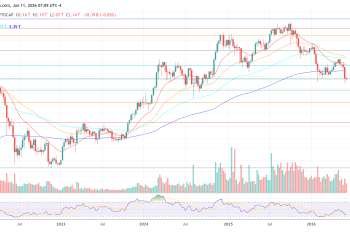
At the time of writing, Bitcoin is trading around $90,600, down 2.5% over the past week.

Looks like the price of the crypto has been moving sideways in recent days | Source: BTCUSDT on TradingView

Пов'язані питання

QWhat is the new investment cap set by South Korea for corporate crypto investments?

ASouth Korea has set an investment cap of 5% of equity capital for corporate crypto investments.

QWhich regulatory body in South Korea drafted the guidelines for corporate crypto investment?

ASouth Korea's Financial Services Commission (FSC) drafted the guidelines for corporate crypto investment.

QWhat type of cryptocurrencies are corporations allowed to invest in under the new guidelines?

ACorporations are only allowed to deploy investments into cryptocurrencies that are inside the top 20 by market cap list.

QWhat is one concern raised by a financial industry insider regarding the 5% investment cap?

AA financial industry insider raised concerns that the investment limit could weaken capital inflow factors and prevent the emergence of virtual currency investment specialist companies.

QWhat other crypto-related financial product is South Korea planning to introduce this year?

ASouth Korea is planning to introduce digital asset spot exchange-traded funds (ETFs) this year.

Пов'язані матеріали

Can Generative Models Finally Be Trained End-to-End? The Core Is a For Loop

This article introduces a novel training paradigm for generative models called Explorative Modeling (XM), which enables true end-to-end training. Traditionally, powerful generative models like autoregressive and diffusion models are not trained end-to-end. They are trained to predict a single small step but require iterative multi-step sampling for inference. This "exposure bias" leads to error accumulation and limits performance. The core challenge XM addresses is "mode blurring." In generative tasks, a single input (e.g., "generate a dog") corresponds to many valid outputs (multiple modes). Standard training objectives like reconstruction loss force the model to average these modes, producing unrealistic, blurry outputs. To avoid this, existing models break generation into many small, almost deterministic steps, sacrificing end-to-end training. XM tackles this by restructuring the training loop itself. Its key insight is to amplify "generative expressivity." For each training input, instead of generating one sample, the model generates K candidate outputs. Only the candidate closest to the real data is used for computing the loss and updating the model via backpropagation. This simple "best-of-K" mechanism is implemented as a short for-loop. By exploring multiple possibilities, the model learns to distribute its guesses across different modes rather than collapsing to their uninformative average. The paper demonstrates that "exploration" acts as a new, powerful scaling axis. Gains from XM increase with model size, data scale, and compute. Experiments show improvements in FID scores for image generation and significant efficiency gains, sometimes outperforming larger models without exploration. When pushed to the limit, XM enables fully single-step, end-to-end generative models. In robotics tasks, an "Explorative Policy" matched the performance of a 100-step Diffusion Policy with a single forward pass, drastically improving inference speed. While the best-of-K concept is not entirely new, the authors' contribution lies in formally understanding it as a direct method to boost generative expressivity without fragmenting the generation process. This work suggests that as models scale, enhancing exploration during training may become crucial for overcoming fundamental performance bottlenecks.

marsbit10 хв тому

Can Generative Models Finally Be Trained End-to-End? The Core Is a For Loop

marsbit10 хв тому

Annual Salary of Millions Competing for Electricians, Meta Rushes to Open Its Own Technical School

The AI boom is facing an unexpected bottleneck: a severe shortage of skilled construction workers and electricians. As tech giants like Meta, OpenAI, and Alphabet race to build massive data centers—such as OpenAI's $16 billion "Stargate" project—they are hitting a critical labor wall. The U.S. needs an estimated 130,000 more electricians, 240,000 construction workers, and 150,000 supervisors by 2030 for AI infrastructure alone, but tens of thousands of electrician jobs go unfilled each year. While AI companies offer high premiums, with electricians earning up to $280,000 annually, worker scarcity still causes massive losses—delays on a single project can cost $14.2 million per month. The complexity of building AI data centers, which require immense power (equivalent to powering hundreds of thousands of homes), sophisticated electrical systems, and advanced liquid cooling solutions, demands highly skilled technicians who are in short supply. To combat this, companies are investing heavily in training. Meta has committed $115 million to a free training school offering tuition, housing, and stipends, targeting 5,000 new workers. OpenAI is partnering with unions to secure skilled labor. These efforts are paying off, with a significant rise in Gen Z interest in trade schools over college. However, the power demands are staggering. AI data centers are driving a rapid surge in electricity consumption, projected to account for up to 12% of U.S. power use by 2028 and raising costs for consumers. Furthermore, the construction boom is project-based, leading to a potential future glut of trained workers once building peaks, which could depress wages industry-wide. The race for AI supremacy now depends as much on skilled hands as on advanced chips.

marsbit1 год тому

Annual Salary of Millions Competing for Electricians, Meta Rushes to Open Its Own Technical School

marsbit1 год тому

Торгівля

Спот
活动图片