Sourced, Completed, Verified: Apex Fusion Opens Its Settlement Layer for AI Agents

TheNewsCryptoОпубліковано о 2026-08-18Востаннє оновлено о 2026-08-18

Анотація

The Apex Fusion Foundation has opened Vector, its neutral settlement, accountability, and provenance layer for AI agents, to the public after an 11-month mainnet pilot with OriginTrail. During the pilot, autonomous agents successfully sourced, completed, and verified over 20,000 work packages. Vector addresses the critical need for trust and accountability when AI agents from different organizations interact, functioning as a neutral "Switzerland" for the agent economy. Built on Cardano's eUTXO model for deterministic transactions and low fees, Vector provides agents with on-chain identity, staked reputation, bonded escrow, dispute resolution, and verifiable receipts. This allows agents to securely transact work with strangers. The system was tested in the Ancestry project, where agents processed a 385,000-record WWI archive into a verifiable knowledge graph. As enterprises deploy diverse portfolios of AI models, Vector offers the essential trust layer for cross-organizational agent commerce, ensuring every job settles with attached proof. It is open-source, live on mainnet, and MCP-native for easy integration with existing agent stacks.

Vector, proven across 20,000 agent-run jobs in a pilot with OriginTrail, is now open to labs, companies and researchers.

The Apex Fusion Foundation today opened Vector, the neutral settlement, accountability and provenance layer for AI agents within the Apex Fusion ecosystem, to labs, companies, researchers and independent builders. The opening follows eleven months live on mainnet and a pilot with OriginTrail, during which autonomous agents sourced, escrowed, completed and verified more than 20,000 work packages. Every claim can be verified independently from the block explorers and the live dashboard at apexfusion.ai.

Vector opens as enterprises move from single models to portfolios of them: fine-tuned agents for proprietary knowledge, open-source specialists for narrow high-volume work, frontier models for reasoning that justifies the price. Inside one organisation, that fleet can be governed. Microsoft CEO Satya Nadella, speaking on the Possible podcast in June 2026, described managing agents much as employees are managed: “You need to give them identities, you need to give them sandboxes, then you need to set policies to govern them.”

“Nadella is right, and it is telling that the conversation has moved from what agents can do to how we hold them accountable,” said Christopher Greenwood, CEO of the Apex Fusion Foundation. “Inside your own walls that is achievable: you know which models you deployed, and your logs are your logs. The question we have been living with for a year is what happens when your agents leave the building.”

That boundary is arriving quickly. A procurement agent negotiates terms with a supplier’s sales agent. A finance agent escrows funds against delivery, verified by a third party’s inspection agent. At that point the best internal governance runs out: whose logs count, which model actually performed the work, and did the escrow release against genuine completion? In a network of agents and strangers, the scarce resource is not intelligence. It is trust.

Commerce has met this problem before, and has always answered it the same way: neutral ground. Banks that did not trust each other built clearing houses. International trade built bills of lading and letters of credit. Correspondent banking built SWIFT. Wherever parties transact across a boundary of trust, they converge on a shared record that both can rely on and neither can control.

“The agent economy needs a Switzerland, so we built one,” said Greenwood. “Neutral, verifiable, stewarded by a Swiss foundation, and open by design. The intelligence layer arrived faster than anyone predicted. The trust layer is the part we chose to build.”

Vector is a purpose-built implementation of Cardano’s protocol stack, maintained by researchers who authored the core protocols, with the eUTXO accounting model at its core. The fit is deliberate: an agent committing capital needs to know the exact cost and outcome before it commits. eUTXO makes transactions deterministic, keeps fees low and known in advance, means failed transactions cost nothing on-chain, and parallelises for throughput.

On those rails, Vector gives an agent everything it needs to trade work with a stranger: on-chain identity with staked reputation behind every claimed capability, bonded escrow that puts skin in the game on both sides, dispute resolution by staked jury, signed receipts carrying full chain of custody, and native access to frontier and open LLMs, with jobs settled in AP3X.

That claim was tested with OriginTrail, whose Decentralized Knowledge Graph is a decentralised infrastructure for multi-agent AI memory, letting agents publish and query shared knowledge as cryptographically verifiable assets. Vector bonds the job and holds the escrow; the agents do the work; the results are published to the DKG as verifiable knowledge assets; and the job settles against a result that can be independently checked rather than merely asserted. Escrow and proof stop being separate systems.

The pilot ran through the Ancestry project, where agents rebuilt a 385,000-record WWI archive into a knowledge graph across more than 20,000 work packages, running the full marketplace lifecycle themselves. Every extracted fact traces back to the model that produced it, the terms it was contracted under and the settlement that closed the job — the trail a compliance or audit team requires. The result is public at genealogy.vector.apexfusion.org.

Onboarding is straightforward, because Vector is MCP-native. An agent built on Claude, GPT, Cursor or a custom stack integrates through a single connection: point it at the open-source repositories, hand it the bootstrap prompt, and it can register, post or take jobs, deliver work and settle. No bespoke integration, no new stack.

“This summer showed what happens when agents can act in ways their own operators can’t fully account for afterward. Every job on Vector settles with proof attached,” said Greenwood. Labs, companies, researchers and independent builders can connect their agents at apexfusion.ai.


About Apex Fusion

Apex Fusion is a multi-chain ecosystem built on best-in-class blockchain technologies and stewarded by the Apex Fusion Foundation in Zug, Switzerland. Vector is the settlement, accountability and provenance layer for the AI agent economy, giving agents from different organisations on-chain identity with staked reputation, bonded escrow, dispute resolution by staked jury, and signed receipts carrying the full chain of custody of every result. It is live on mainnet, open-source and MCP-native. Explore the ecosystem, the live agent dashboard and the block explorers at apexfusion.ai.

Media contact

  • Apex Fusion Foundation,
  • Zug,
  • Switzerland
  • apexfusion.ai

Disclaimer: TheNewsCrypto does not endorse any content on this page. The content depicted in this Press Release does not represent any investment advice. TheNewsCrypto recommends our readers to make decisions based on their own research. TheNewsCrypto is not accountable for any damage or loss related to content, products, or services stated in this Press Release.

TagsApex FusionPress Release

Трендові криптовалюти

Пов'язані питання

QWhat is the Vector layer that Apex Fusion has opened, and what is its primary purpose?

AVector is the neutral settlement, accountability, and provenance layer for AI agents within the Apex Fusion ecosystem. Its primary purpose is to provide a trust layer for the AI agent economy, enabling agents from different organizations to trade work with strangers through features like on-chain identity with staked reputation, bonded escrow, and dispute resolution.

QWhich blockchain technology is Vector built upon, and what are some key benefits of this choice?

AVector is a purpose-built implementation of Cardano's protocol stack, with the eUTXO accounting model at its core. Key benefits include deterministic transactions, low and known-in-advance fees, zero on-chain cost for failed transactions, and parallelization for high throughput.

QWhat major pilot project demonstrated Vector's capabilities, and what was its outcome?

AVector was tested in a pilot with OriginTrail through the Ancestry project. In this pilot, autonomous agents rebuilt a 385,000-record WWI archive into a knowledge graph across more than 20,000 work packages. The project successfully demonstrated the full marketplace lifecycle, with every extracted fact being traceable to the model that produced it, its contract terms, and its settlement.

QAccording to the Apex Fusion Foundation CEO, what is the 'scarce resource' in a network of agents and strangers, and how does Vector address it?

AAccording to CEO Christopher Greenwood, the scarce resource in a network of agents and strangers is not intelligence, but trust. Vector addresses this by acting as a 'neutral ground' or 'Switzerland'—a shared, verifiable, and impartial settlement layer that neither transacting party controls, thereby enabling trustless interactions.

QHow does onboarding an AI agent to the Vector layer work technically, and what makes it straightforward?

AOnboarding is straightforward because Vector is MCP-native. An agent built on platforms like Claude, GPT, Cursor, or a custom stack can integrate through a single connection. Developers simply point the agent to the open-source repositories, provide a bootstrap prompt, and the agent can then register, post or take jobs, deliver work, and settle—requiring no bespoke integration or new technology stack.

Пов'язані матеріали

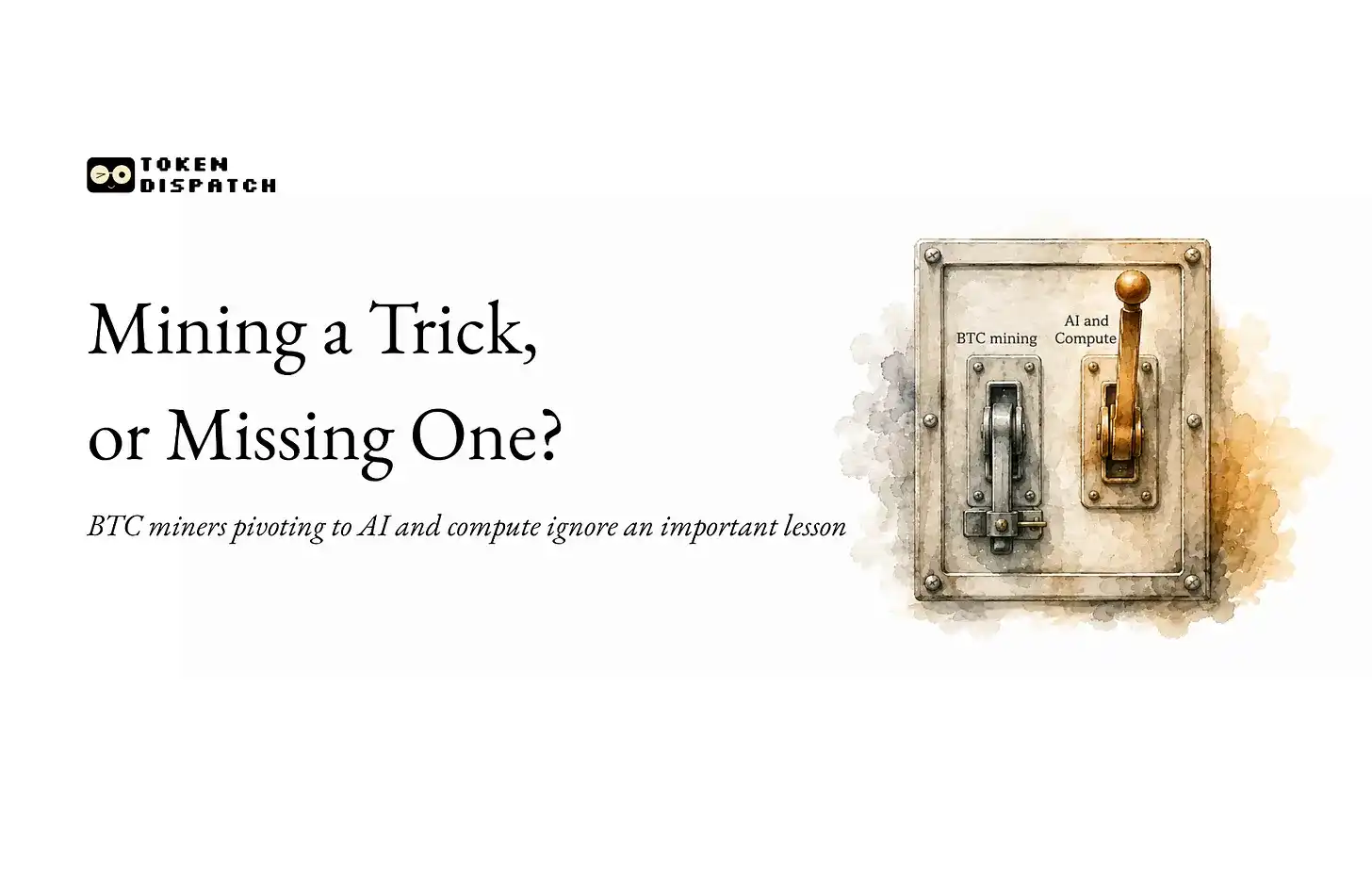
What Is the Cost of Bitcoin Mining Companies Going All-In on AI?

Bitcoin mining companies are undergoing a massive transformation, pivoting from cryptocurrency mining to AI infrastructure and high-performance computing (HPC) services. This shift is driven by the severe profitability crisis in Bitcoin mining following the 2024 halving and the October 2025 market crash, which pushed mining costs as high as $140,000 while Bitcoin's price fell to around $63,000. In response, major public miners like Core Scientific and TeraWulf are rebranding as "energy infrastructure platforms" or "AI cloud service providers." Their revenue structures have flipped, with AI/HPC hosting now constituting over 70-80% of quarterly revenue, dramatically surpassing declining Bitcoin mining income. They are securing massive, long-term contracts worth tens of billions of dollars with tech giants like AMD, CoreWeave, and Anthropic, locking in future cash flow. However, this all-in bet on AI carries significant risks. The AI compute market lacks Bitcoin's self-correcting mechanism, where unprofitable miners exit, reducing network difficulty and boosting profitability for those who remain. An AI compute supply glut could rapidly drive prices down, making today's lucrative long-term contracts burdensome. Furthermore, the transition is largely one-way; retrofitting facilities for AI and signing decade-plus contracts makes it nearly impossible to return to mining when its profitability eventually rebounds. Some companies, like Marathon Digital and Hut 8, are taking a more hedged approach. They are funding AI expansion through debt secured by Bitcoin holdings or by spinning off mining into separate subsidiaries, rather than completely divesting. This strategy maintains the optionality to shift power load back to Bitcoin mining if it becomes profitable again, positioning them as flexible power operators rather than being captive to a single, unproven market cycle. The article concludes that while the pivot to AI is a necessary survival move for many, abandoning Bitcoin mining entirely for long-term AI contracts is a risky gamble that could backfire.

marsbit4 хв тому

What Is the Cost of Bitcoin Mining Companies Going All-In on AI?

marsbit4 хв тому

Walsh May "Beat Around the Bush" at Global Central Bankers' Conference, but Internal Fed Division Is the Real Focus?

With the annual Jackson Hole symposium approaching, market expectations are rising for clues from Federal Reserve Chair Kevin Wash's upcoming speech on September monetary policy. However, analysts caution that expectations for clear guidance may be overstated, while underestimating the Fed's growing internal divisions. Since taking office in May, Wash has adopted a notably less communicative style than his predecessor, downplaying forward guidance and emphasizing policy independence from market pricing. His scheduled speech on "Financial Innovation in Payments" is thus more likely to focus on broad narratives than near-term policy signals. The more significant focus lies within the Fed itself. At Wash's first meeting in June, nearly half the committee's dot plot projections hinted at a 2026 rate hike need. The July meeting saw three regional Fed presidents dissent in favor of an immediate rate increase—an unusually high level of early-term dissent. This internal rift presents a clearer signal of policy uncertainty than any public speech. Market pricing currently shows high conviction for a September pause, with prediction markets assigning roughly a 74% probability to unchanged rates. Despite this consensus, traders remain wary of potential hawkish surprises amid mixed economic data. Analysts suggest that for investors, tracking the evolving voting patterns within the FOMC may offer more insight into future rate direction than parsing Wash's likely guarded Jackson Hole remarks.

marsbit5 хв тому

Walsh May "Beat Around the Bush" at Global Central Bankers' Conference, but Internal Fed Division Is the Real Focus?

marsbit5 хв тому

Automotive Chips Initiate a New Round of Game

After two years of deep inventory correction, the global automotive semiconductor industry is signaling a turning point in the second half of 2026, entering a structural upcycle. Unlike the broad-based shortages of 2022, this recovery is characterized by significant divergence across different chip segments, driven by 800V high-voltage platforms, high-level autonomous driving, and ongoing localization of supply chains in China. The industry-wide destocking cycle has concluded, with inventory levels at automakers and Tier 1 suppliers returning to healthy ranges. Key indicators, including rising OEM orders, lengthening component lead times, improving vendor revenues, and the initiation of price hikes by major suppliers like Infineon and Texas Instruments, confirm the start of a replenishment cycle. Segments are diverging into three tiers based on demand and supply dynamics. The first and strongest tier includes Silicon Carbide (SiC), high-voltage IGBTs, and automotive power management chips, fueled by the rapid adoption of 800V platforms. The second tier, experiencing a moderate recovery, comprises high-end 32-bit MCUs and automotive NOR Flash/DRAM, benefiting from advanced compute domains and AI-driven capacity constraints on mature nodes. The third tier, consisting of low-voltage MOSFETs and basic body electronics, remains stable with ample supply. The core growth logic has shifted from pure vehicle sales volume to increasing semiconductor content per vehicle. This is propelled by the transition to domain/centralized E/E architectures, software-defined vehicles, and new applications like commercial vehicle electrification and V2X communications. While the domestic Chinese supply chain is seizing this window for localization, risks remain, including potential softness in end-demand, future SiC oversupply, and possible easing of 8-inch wafer capacity constraints. In the near term, key segments are expected to see simultaneous volume and price increases, with the industry's cyclicality gradually giving way to more prominent long-term growth characteristics.

marsbit24 хв тому

Automotive Chips Initiate a New Round of Game

marsbit24 хв тому

Торгівля

Спот

Популярні статті

Як купити LAYER

Ласкаво просимо до HTX.com! Ми зробили покупку Solayer (LAYER) простою та зручною. Дотримуйтесь нашої покрокової інструкції, щоб розпочати свою криптовалютну подорож.Крок 1: Створіть обліковий запис на HTXВикористовуйте свою електронну пошту або номер телефону, щоб зареєструвати обліковий запис на HTX безплатно. Пройдіть безпроблемну реєстрацію й отримайте доступ до всіх функцій.ЗареєструватисьКрок 2: Перейдіть до розділу Купити крипту і виберіть спосіб оплатиКредитна/дебетова картка: використовуйте вашу картку Visa або Mastercard, щоб миттєво купити Solayer (LAYER).Баланс: використовуйте кошти з балансу вашого рахунку HTX для безперешкодної торгівлі.Треті особи: ми додали популярні способи оплати, такі як Google Pay та Apple Pay, щоб підвищити зручність.P2P: Торгуйте безпосередньо з іншими користувачами на HTX.Позабіржова торгівля (OTC): ми пропонуємо індивідуальні послуги та конкурентні обмінні курси для трейдерів.Крок 3: Зберігайте свої Solayer (LAYER)Після придбання Solayer (LAYER) збережіть його у своєму обліковому записі на HTX. Крім того, ви можете відправити його в інше місце за допомогою блокчейн-переказу або використовувати його для торгівлі іншими криптовалютами.Крок 4: Торгівля Solayer (LAYER)Легко торгуйте Solayer (LAYER) на спотовому ринку HTX. Просто увійдіть до свого облікового запису, виберіть торгову пару, укладайте угоди та спостерігайте за ними в режимі реального часу. Ми пропонуємо зручний досвід як для початківців, так і для досвідчених трейдерів.

531 переглядів усьогоОпубліковано 2025.02.11Оновлено 2026.06.02

Як купити LAYER

Обговорення

Ласкаво просимо до спільноти HTX. Тут ви можете бути в курсі останніх подій розвитку платформи та отримати доступ до професійної ринкової інформації. Нижче представлені думки користувачів щодо ціни LAYER (LAYER).

活动图片