Solayer Unveils Multi-Asset Perpetual Trading Platform Dubbed Margin Trade

TheNewsCryptoОпубліковано о 2026-05-22Востаннє оновлено о 2026-05-22

Анотація

Solayer, a high-performance Solana Virtual Machine-compatible Layer 1 blockchain, has launched public testing for its multi-asset perpetual trading platform, Margin Trade. Built by former Citadel and Kraken traders, the platform enables unified margin, on-chain trading of both crypto and traditional assets like gold, oil, and a U.S. equities index. Following a private beta, the public testnet launch aims to offer capital efficiency and real-time execution in a single environment, moving away from fragmented traditional platforms. Margin Trade leverages Solayer's InfiniSVM infrastructure, which supports over 330,000 transactions per second with fast finality and low fees via SOL for gas, enabling high-throughput decentralized applications. This launch is part of Solayer's broader financial product diversification, which includes its Solayer Pay stablecoin platform. Backed by a $35 million ecosystem fund, future plans for Margin Trade include adding single-stock equities and volatility products, along with trading competitions and incentive programs.

Solayer, a high-performance Solana Virtual Machine (SVM)-compatible Layer 1 blockchain, has launched public testing for its flagship multi-asset perpetual trading platform, Margin Trade.

Solayer opens Margin Trade to public testing

Built by a team at Solayer Labs, and former traders with backgrounds at Citadel and Kraken, Margin Trade offers unified margin with on-chain trading of both cryptocurrencies and traditional market instruments on a single platform. Its traditional finance offerings include commodities such as gold, silver, and oil, as well as the MT500, a synthetic index that tracks United States equities.

The public launch of the Margin Trade on Solana testnet follows last week’s private beta, which involved early users, partners, and traders from Solayer’s waitlist. During the same period, Solayer finalized protocol integrations, marketing collaborations, and strategic partnerships in preparation for today’s release.

Regarding this, Joshua Sum, the Chief Product Officer at Solayer Labs, stated:

“Most perpetual futures trading infrastructure today remains siloed across separate markets and fragmented collateral account structures. Margin Trade is designed to bring capital efficiency, real-time execution, and multi-asset exposure in a unified environment that feels closer to the vision of truly global financial markets than traditional trading platforms.”

Being native to Solayer’s InfiniSVM, Margin Trade leverages the chain’s hardware-accelerated infrastructure for efficient, scalable, and low-latency functioning. The chain delivers over 330,000 transactions per second (TPS), with roughly 400 milliseconds of finality for its 304,000 users. All these highly valuable features are indispensable for building high-throughput, performance-critical decentralized applications on the network.

Even more, using Solana’s native token (SOL) for gas fees makes transactions exceptionally affordable, as Solana’s fees are among the lowest in the entire crypto ecosystem.

Solayer’s entrance into the financial arena

Margin Trade’s debut further enforces Solayer’s product diversification initiative – from building infrastructure to live financial markets. Among its financial products is Solayer Pay, the stablecoin payments platform that recently launched a physical card to support merchant-customer transactions. Margin Trade’s launch also shows the utility of the $35 million ecosystem fund backing high-throughput on-chain applications.

In the future, Margin Trade plans on expanding its offerings to include single-stock equities and volatility products. Solayer is also planning trading competitions, ranking systems, and referral-based incentive programs as part of its broader ecosystem development.


TagsBlockchainSolayer

Трендові криптовалюти

Пов'язані питання

QWhat is Margin Trade, and what types of assets does it support for trading?

AMargin Trade is Solayer's flagship multi-asset perpetual trading platform. It supports on-chain trading of both cryptocurrencies and traditional market instruments, including commodities like gold, silver, and oil, as well as the MT500 synthetic index which tracks US equities.

QOn which blockchain is Margin Trade built, and what are some of its key technical advantages?

AMargin Trade is built on Solayer, a high-performance SVM-compatible Layer 1 blockchain. It leverages the chain's hardware-accelerated infrastructure for efficient, scalable, and low-latency functioning. Solayer achieves over 330,000 transactions per second (TPS) with roughly 400 milliseconds of finality, which is crucial for high-throughput decentralized applications.

QWho developed Margin Trade, and what is notable about the team's background?

AMargin Trade was built by a team at Solayer Labs, which includes former traders with professional backgrounds at major financial institutions like Citadel and the cryptocurrency exchange Kraken.

QWhat did Joshua Sum, CPO at Solayer Labs, highlight as a key problem with current perpetual futures trading, and how does Margin Trade address it?

AJoshua Sum stated that most perpetual futures trading infrastructure today remains siloed across separate markets and has fragmented collateral account structures. Margin Trade is designed to address this by bringing capital efficiency, real-time execution, and multi-asset exposure in a unified environment that aligns with the vision of truly global financial markets.

QWhat future plans does Solayer have for the Margin Trade platform and its broader ecosystem?

AIn the future, Margin Trade plans to expand its offerings to include single-stock equities and volatility products. Solayer also plans trading competitions, ranking systems, and referral-based incentive programs as part of its broader ecosystem development.

Пов'язані матеріали

Olympus DAO Myth Reappears? A "Sovereign On-Chain Central Bank" Written with 4000 Lines of Immutable Code

A new project called The Standard Reserve has emerged, branding itself as a "sovereign on-chain central bank." It aims to replicate core central bank functions—currency issuance, money supply adjustment, and reserve accumulation—entirely through 4,000 lines of immutable code, with no human governance. Its core mechanism is a "reflexive monetary policy" based on a single signal: the net ETH flow into or out of the system's sole Uniswap v4 ETH/$STANDARD pool. Sustained net ETH inflows trigger an "expansion" phase, increasing $STANDARD issuance and using protocol fees to buy tokenized gold as a permanent hard reserve. Net outflows (or zero flow) trigger an immediate "contraction" phase, reducing issuance and using fees to buy back and burn $STANDARD. The system involves six key entities: the $STANDARD token (hard-capped at 1 billion), the central Uniswap pool, the Central Bank contract, Charter NFTs (acting as "banking licenses"), Branch units under each Charter (which earn a share of newly minted $STANDARD), and separate Vaults for expansion (buying gold) and contraction (buying back $STANDARD). To participate, users ideally acquire a Founding Charter NFT (initially 1,000 are free via allowlist/public mint). Each Charter comes with one Branch; more can be opened by burning $STANDARD for "expansion permits," increasing revenue share. Retiring a Branch lets users claim accumulated $STANDARD but imposes a dynamic exit fee (higher if many exit simultaneously), with half the fee burned and half distributed to remaining participants. All protocol revenue (from pool fees and Charter auctions) is allocated: 70% to the active Vault (for gold or buybacks), 15% to permanent protocol-owned liquidity, and 15% to the team. The project presents an innovative, game-theoretic model where user actions (expanding Branches by burning tokens or exiting) align with system goals of building reserves or inducing deflation. However, it is fully anonymous, with key parameters undefined and unaudited code, posing significant risks.

marsbit17 хв тому

Olympus DAO Myth Reappears? A "Sovereign On-Chain Central Bank" Written with 4000 Lines of Immutable Code

marsbit17 хв тому

US Jobs, China PMI, and Inflation on Stage: Can Global Growth Maintain Resilience?

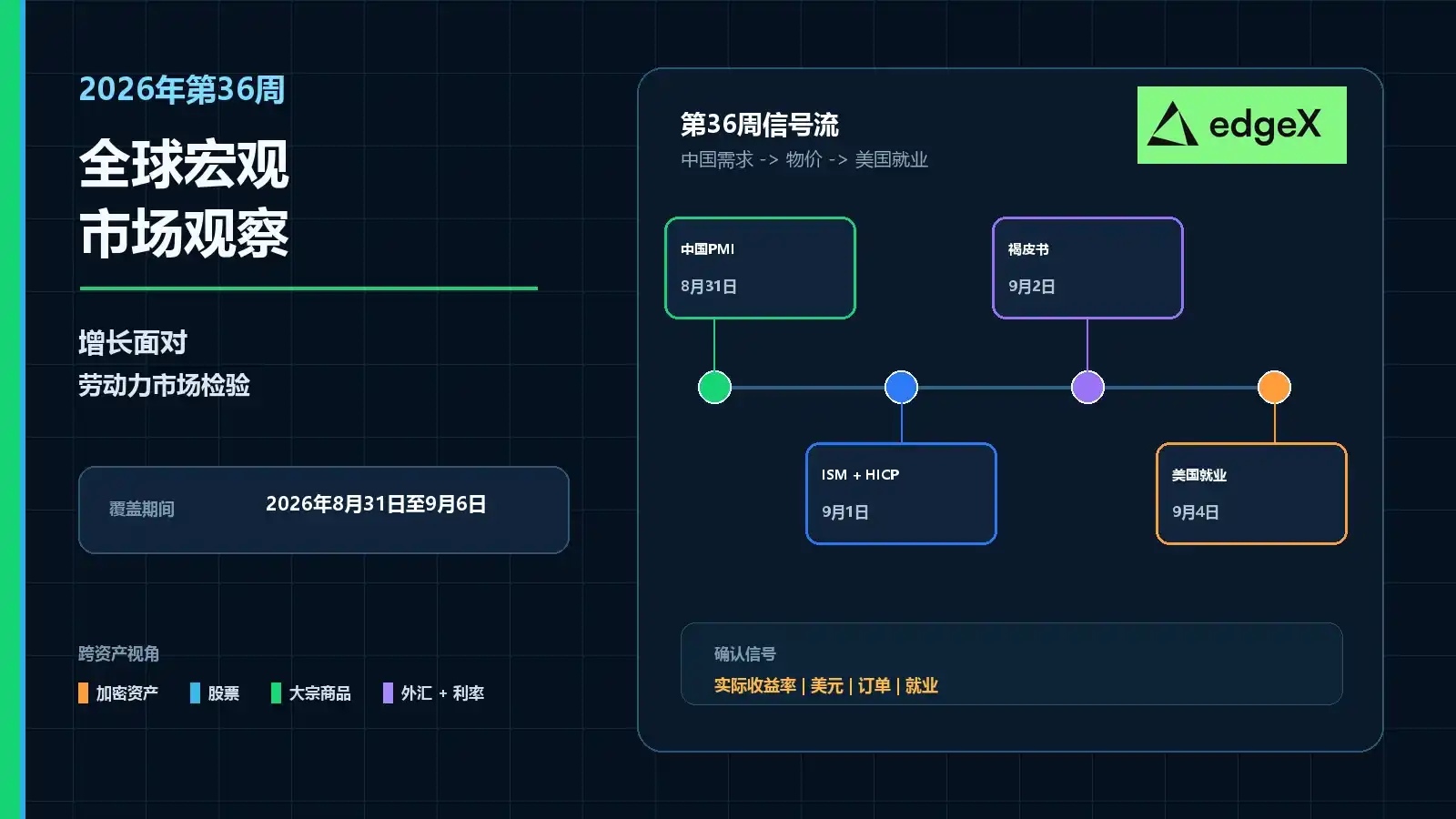
**Week 36 Macro Outlook: Key Data to Test Global Growth Resilience** The week from August 31 to September 6 will shift focus from policy discussions to a critical test of global economic activity. The sequence of events is key, starting with China's official August PMI on Aug 31, which will provide early signals on factory orders, services, and employment following July's contraction. The data flow then broadens. On September 1, US ISM Manufacturing PMI and the Eurozone's flash inflation estimate will offer simultaneous checks on demand, prices, and regional divergence. The subsequent US Federal Reserve Beige Book on September 2 adds granular, qualitative evidence on consumer spending, wages, and regional conditions. Australian Q2 GDP and Canadian trade and jobs data will test resilience in other major economies. The week's pivotal event, however, is the US August employment report on September 4. It will decisively influence expectations for interest rates, the US dollar, and broader risk appetite, acting as a final cross-check for the preceding data. The core question for markets is whether global growth can remain resilient. An ideal outcome would combine a rebound in China's PMI, stable US jobs growth, cooling inflation, and signs of a gradual demand slowdown. Conversely, weak Chinese manufacturing, sticky Eurozone prices, and disappointing US non-farm payrolls would create a more complex scenario of reduced corporate confidence and limited room for aggressive monetary easing, increasing pressure on cyclical assets. Investors should monitor the breadth of improvements—such as new orders and employment—rather than headline PMI figures alone. Confirmation across different data points is crucial. A positive combination of steady activity and disinflation could support equities, industrial commodities, and risk assets like crypto. However, if a growth slowdown triggers lower yields, it must be distinguished from a scenario of rising recession risks that would pressure corporate earnings, potentially limiting rallies. The market's final reaction will hinge on whether the week's signals align to either reinforce or challenge the current growth narrative.

marsbit19 хв тому

US Jobs, China PMI, and Inflation on Stage: Can Global Growth Maintain Resilience?

marsbit19 хв тому

Торгівля

Спот

Популярні статті

Як купити LAYER

Ласкаво просимо до HTX.com! Ми зробили покупку Solayer (LAYER) простою та зручною. Дотримуйтесь нашої покрокової інструкції, щоб розпочати свою криптовалютну подорож.Крок 1: Створіть обліковий запис на HTXВикористовуйте свою електронну пошту або номер телефону, щоб зареєструвати обліковий запис на HTX безплатно. Пройдіть безпроблемну реєстрацію й отримайте доступ до всіх функцій.ЗареєструватисьКрок 2: Перейдіть до розділу Купити крипту і виберіть спосіб оплатиКредитна/дебетова картка: використовуйте вашу картку Visa або Mastercard, щоб миттєво купити Solayer (LAYER).Баланс: використовуйте кошти з балансу вашого рахунку HTX для безперешкодної торгівлі.Треті особи: ми додали популярні способи оплати, такі як Google Pay та Apple Pay, щоб підвищити зручність.P2P: Торгуйте безпосередньо з іншими користувачами на HTX.Позабіржова торгівля (OTC): ми пропонуємо індивідуальні послуги та конкурентні обмінні курси для трейдерів.Крок 3: Зберігайте свої Solayer (LAYER)Після придбання Solayer (LAYER) збережіть його у своєму обліковому записі на HTX. Крім того, ви можете відправити його в інше місце за допомогою блокчейн-переказу або використовувати його для торгівлі іншими криптовалютами.Крок 4: Торгівля Solayer (LAYER)Легко торгуйте Solayer (LAYER) на спотовому ринку HTX. Просто увійдіть до свого облікового запису, виберіть торгову пару, укладайте угоди та спостерігайте за ними в режимі реального часу. Ми пропонуємо зручний досвід як для початківців, так і для досвідчених трейдерів.

567 переглядів усьогоОпубліковано 2025.02.11Оновлено 2026.06.02

Як купити LAYER

Обговорення

Ласкаво просимо до спільноти HTX. Тут ви можете бути в курсі останніх подій розвитку платформи та отримати доступ до професійної ринкової інформації. Нижче представлені думки користувачів щодо ціни LAYER (LAYER).

活动图片