Solana Meme Coins Surge Again! PIPPIN Soars 35% to Lead the AI Track, Investors Shift to Crypto Assets with Substantial Technology

bitcoinistОпубліковано о 2025-12-25Востаннє оновлено о 2025-12-25

Анотація

In the current selective bull market, Solana-based AI meme coins are surging interest, led by PIPPIN, which saw a 35% price increase as its market cap neared $500 million. This rally reflects a broader market shift from pure speculation toward crypto assets with substantive technology, particularly those integrating AI agents and blockchain. The trend highlights a growing investor preference for utility-driven projects. Other Solana ecosystem tokens like SNOWBALL also posted significant gains, while privacy-focused blockchain CANTON demonstrated stable, institutional-grade performance. This indicates capital is moving toward protocols with real-world applications and robust technological infrastructure. A key development is the maturation of Bitcoin Layer 2 solutions. Among these, Bitcoin Hyper ($HYPER) stands out by integrating the Solana Virtual Machine (SVM) to boost Bitcoin's transaction capacity from 7 TPS to tens of thousands. It utilizes a canonical bridge and zero-knowledge proofs (ZK-Proofs) to secure transactions on the mainnet while offering Rust compatibility for easy migration of Solana applications. Bitcoin Hyper's presale has raised over $297 million, signaling strong market confidence. Its staking mechanism has already locked over 1.3 billion $HYPER tokens, indicating long-term holder sentiment. The project represents a major opportunity for investors seeking exposure to a high-performance Bitcoin ecosystem before its official launch. The conclusion is cle...

As the cryptocurrency market enters a highly selective and strong phase in late 2025, AI meme coins on the Solana chain have once again become the center of attention. According to the latest market monitoring, the AI-driven benchmark token PIPPIN recorded an astonishing increase of over 35% in the past 24 hours, with its market capitalization once approaching the $500 million mark. This surge is not merely speculative hype but signifies a new trend of deep integration between "AI Agents" and blockchain technology. As an autonomous AI entity developed by the founder of BabyAGI, PIPPIN's success reflects a strong market desire for alternative assets with a solid technological foundation.

From Pure Speculation to Technology Premium: AI and RWA Dual Engines Drive Market Revaluation

In this wave of market activity, the profile of the winners in late 2025 is becoming increasingly clear. In addition to PIPPIN's impressive performance, multiple projects in the Solana ecosystem have also risen, such as snowball, which recorded a gain of over 50% in a short period, indicating investors' pursuit of new assets that combine language models with social interaction. At the same time, the Layer-1 blockchain Canton, which emphasizes privacy and regulated financial applications, has also shown stable institutional-level momentum. This reflects a shift of funds from purely speculative assets to protocols with more utility value and technological infrastructure support. Market participants are beginning to realize that only projects with the ability to solve real problems can maintain vitality amid volatility.

This flow of funds seeking "high-performance infrastructure" has also led astute investors to turn their attention back to the cornerstone of the crypto world—Bitcoin. Market analysts have observed that with the maturation of Bitcoin Layer2 technology, BTC, which was once only a store of value, can now support efficient smart contracts and AI applications like Solana. In this wave of technological transformation, funds are quietly positioning themselves in Bitcoin ecosystem projects with high scalability, attempting to find the next investment target with a technology premium during the mainstream coin correction.

Revolutionary Technology Enters the Scene: How Does Bitcoin Hyper ($HYPER) Redefine Bitcoin Layer2?

Among the many Bitcoin scaling solutions, Bitcoin Hyper ($HYPER) has demonstrated remarkable market appeal. Unlike traditional Layer2 solutions, Bitcoin Hyper introduces the powerful Solana Virtual Machine (SVM) as its execution engine. This means it can instantly upgrade Bitcoin's mainnet processing capacity from just 7 TPS to an ultra-high-performance level of tens of thousands of TPS. Through this technological integration, Bitcoin is no longer just "digital gold" but a modern network capable of supporting complex DeFi protocols, decentralized AI agents, and high-frequency trading.

Additionally, Bitcoin Hyper adopts leading Canonical Bridge and Zero-Knowledge Proof (ZK-Proofs) technologies. This ensures that every high-speed transaction conducted on Layer2 can be securely anchored to the immutable ledger of the Bitcoin mainnet. For developers, Bitcoin Hyper is compatible with Rust development kits, allowing excellent applications originally on Solana to seamlessly migrate to the Bitcoin ecosystem. This is the core reason why it has attracted a large influx of "smart money" in a short period.
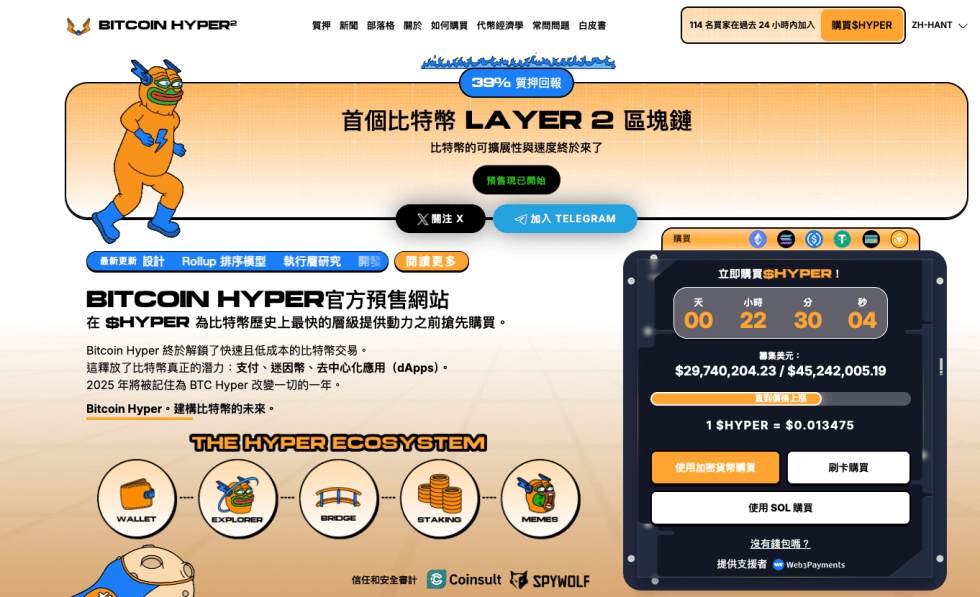
Presale Amount Exceeds $29.7 Million: A Collective Frenzy of Global Retail Investors and Whales

According to the latest official data, the presale activity of Bitcoin Hyper has entered the final sprint stage, with the total fundraising officially exceeding $29.7 million. This figure not only represents market recognition of its L2 narrative but also reflects investors' strong demand for "high-performance Bitcoin." The current presale price is set at $0.013475, which is seen as the last low-price entry window before the official listing.

In addition to its technical advantages, Bitcoin Hyper's economic model is also a major highlight. The platform has already opened its staking function, with an extremely competitive annual percentage yield (APY). Data shows that over 1.3 billion $HYPER tokens have been locked in the staking pool, indicating that investors are generally adopting a long-term holding strategy.

For those who missed the early explosive gains of Solana, investing in Bitcoin Hyper, which has not yet officially launched and possesses a strong technological moat, is undoubtedly the best choice for optimizing their 2026 investment portfolio.

If you want to seize the opportunity before the next wave of the Bitcoin ecosystem explosion, you can learn more about the In-Depth Analysis: Complete Guide on How to Buy Bitcoin Hyper

Bitcoin Hyper Official Presale

Conclusion: The Winners of 2026 Will Belong to "Technology-Driven" Assets

Looking at the market trends at the end of 2025, from the frenzy of PIPPIN's surge to the advancement of real-world asset tokenization, the message is very clear: artificial intelligence and institutional-level applications have become the core drivers of growth in the blockchain industry. The era of relying solely on sentiment-driven movements is coming to an end. The future belongs to projects like Bitcoin Hyper, which combine top-tier security with innovative efficiency. In the ever-changing crypto market, learning to allocate funds to emerging L2 tokens with strong fundraising support and genuine technological narratives will be the key strategy for retail investors to stand out in the next wave.


Трендові криптовалюти

Пов'язані питання

QWhat is the significant price increase of the AI meme coin PIPPIN on the Solana blockchain, as mentioned in the article?

APIPPIN recorded a surge of over 35% in the past 24 hours.

QWhich technology does Bitcoin Hyper ($HYPER) integrate to significantly increase Bitcoin's transaction processing capacity?

ABitcoin Hyper integrates the Solana Virtual Machine (SVM) to boost Bitcoin's processing capacity from 7 TPS to tens of thousands of TPS.

QWhat is the total amount raised in the Bitcoin Hyper ($HYPER) presale, according to the article?

AThe presale fundraising for Bitcoin Hyper has exceeded $29.7 million.

QWhat two key technologies does Bitcoin Hyper use to ensure secure and fast transactions anchored to the Bitcoin mainnet?

ABitcoin Hyper uses a Canonical Bridge and Zero-Knowledge Proofs (ZK-Proofs) to secure transactions and anchor them to the Bitcoin mainnet.

QAccording to the article's market trend analysis, what type of assets are becoming the focus for investors by the end of 2025?

AInvestors are shifting their attention towards assets with substantive technology and utility value, such as those driven by AI and institutional-grade applications, moving away from purely speculative assets.

Пов'язані матеріали

Two Legends Lost in Three Days: Is Google's AI Talent Dam Cracking?

In three days, Google lost two AI legends. On June 18, Noam Shazeer, co-author of the seminal "Attention is All You Need" paper and Gemini co-lead, left for OpenAI. Just 48 hours later, John Jumper, 2024 Nobel laureate and AlphaFold lead, departed DeepMind for Anthropic. This follows Andrej Karpathy joining Anthropic in May. These moves highlight a structural trend: top AI talent is concentrating at mission-driven, pre-IPO firms like OpenAI and Anthropic, while Google becomes a primary source. The exodus stems from a core mission mismatch. Google's ad-centric model often subordinates AI research to product and revenue goals, creating friction for pioneers like Shazeer, who returned in 2024 only to leave again. In contrast, OpenAI and Anthropic offer singular focus on pushing AI boundaries, whether towards AGI or safety-aligned models, which deeply appeals to top researchers like Jumper. Financial incentives amplify the pull. With both OpenAI and Anthropic nearing IPO, employees stand to gain immensely from equity, an upside Google's mature stock cannot match. Furthermore, the 2023 merger of Google Brain and DeepMind, intended to consolidate strength, has instead created cultural tension and slowed the path from research to product, as evidenced by Gemini's pace. This talent redistribution is reshaping the AI landscape. While Google retains vast data and compute resources, its true crisis is the quiet, continuous loss of the people who define the field's future. The real moat in AI is not infrastructure, but the concentration of brilliant minds—a battle Google is currently losing.

marsbit1 год тому

Two Legends Lost in Three Days: Is Google's AI Talent Dam Cracking?

marsbit1 год тому

Behind the AI Report Card, Lies a Chinese 'Exam Setter'

Beyond the familiar performance charts like MMLU-Pro and MMMU, which major AI models strive to ace, stands a key "examiner": Chinese-Canadian researcher Wenhu Chen. An assistant professor at the University of Waterloo and founder of TIGERLab, Chen addresses the crucial need for more rigorous AI evaluation. As models like GPT-4 began scoring near-perfect results on older benchmarks like MMLU, it became difficult to distinguish their true capabilities. In response, Chen introduced MMLU-Pro in 2024, featuring harder, more reasoning-focused questions with more answer choices, successfully reintroducing meaningful performance gaps. His work extends to multi-modal evaluation with MMMU and its enhanced version, MMMU-Pro. These benchmarks test a model's ability to understand and reason with complex information from images, charts, and text across diverse academic subjects, exposing the significant challenges even top models face in genuine comprehension. Chen's background in complex QA, table reasoning, and his experience at Google DeepMind on projects like Gemini inform his approach. He understands that effective benchmarks must anticipate how models might "cheat" by memorizing data or avoiding visual analysis. His lab also actively researches video understanding and generation models (e.g., UniVideo, Vamba), ensuring his evaluation work is grounded in practical model-building challenges. Now at Meta's Super Intelligence Lab, Chen continues his focus on multi-modal data and evaluation, representing the deep yet often unseen contributions of Chinese talent in shaping the fundamental tools of the AI industry.

marsbit1 год тому

Behind the AI Report Card, Lies a Chinese 'Exam Setter'

marsbit1 год тому

Alliance Co-founder's Letter to Entrepreneurs: Written at the Moment Cursor Sold for $600 Billion

Alliance Co-founder's Letter to Entrepreneurs: On Cursor's $60 Billion Sale Many aspiring founders see massive exits like Cursor's $60B sale and wonder why they can't achieve the same, often concluding opportunities are exhausted. But great companies aren't built in obvious, crowded spaces. Cursor, like Stripe, Figma, and Shopify before it, started with a non-consensus belief about the future. Before ChatGPT, they believed AI would transform knowledge work. They focused on a genuinely exciting domain, became their own customer, and obsessed over power users. Their journey involved years of "glass-chewing" effort before the market was ready. The pattern is consistent: identify a long-term technological shift, find a missed entry point, and execute for years before the trend becomes obvious. First-generation products (PayPal, Adobe, Amazon) prove a market exists. Second-generation winners (Stripe, Figma, Shopify) rebuild that market around new insights, technology, or changing customer behaviors. Founders must identify their phase in the cycle. Early entrants like Coinbase or Cursor focus on making new technology usable for power users. Later entrants find the "yin" to the established "yang"—the blind spots incumbents miss as they grow distant from individual users. The key is deep market immersion. Use every product in your space. Talk to users. Build an audience. Stop looking for ideas and start *seeing* them everywhere. Then, choose one. The idea must offer a 10x improvement or solve a "hair-on-fire" pain point—something severe enough that users are already crafting workarounds. When building, avoid feature bloat. Ask: why would someone switch? Great startups rarely force new behaviors; they improve familiar workflows with drastically lower friction (e.g., Cursor forked VS Code instead of creating a new editor). Distribution is the underestimated moat. Before product-market fit, achieve distribution-market fit. How do customers discover new tools? Founders like those at Airbnb, Stripe, and Cursor did unscalable, manual work to recruit early users. The final, unteachable ingredient is resilience. Cursor built for years pre-market, faced rejection, and persisted. So did Airbnb, Nvidia, and Rain (which launched post-FTX collapse). The lesson isn't that these founders were smarter, but that they stayed in the game long enough for their insights to compound. Framework: Spot technological cycles. Cultivate unique insight. Obsess over your market. Talk to customers. Find a hair-on-fire problem. Build the simplest wedge. Win your distribution channel. Above all, don't quit when it gets hard. Most people won't do these things consistently. The few who do build the next generation of great companies. Go build.

marsbit1 год тому

Alliance Co-founder's Letter to Entrepreneurs: Written at the Moment Cursor Sold for $600 Billion

marsbit1 год тому

Weekly Editor's Picks (0613-0619)

Weekly Editor's Picks (0613-0619): Market Insights & Analysis This weekly digest curates in-depth analysis often lost in the information flow, focusing on key insights across macro trends, investment, and technology. **Macro & Geopolitics:** With the Strait of Hormuz reopening and military conflict shifting to negotiation, markets are pivoting from "war shock" to "supply restoration." Trades include shorting crude risk premiums, longing airlines/tourism, Asian energy importers, and bond duration, while shorting inflation expectations. LNG, fertilizer, and chemical chains are also being repriced. **Investment & VC:** Ray Dalio advises against betting on concentrated AI giants dominating indices, advocating for diversified portfolios of high-quality, low-correlation assets instead. Analysis covers the 4-year crypto cycle, predicting the core surviving product by 2029 will be asset trading markets. Current BTC metrics suggest a potential bottoming zone, presenting a patient accumulation window. SpaceX's high-profile IPO at a $2.1T valuation faces scrutiny over fundamentals, with key watchpoints being its likely inclusion in the Nasdaq index and Q2 earnings. Concerns are raised about potential "gamma squeeze" and systemic risks if its narrative-driven valuation gets amplified by passive index funds. Robinhood (HOOD) is noted for breaking its high correlation with crypto, bolstered by its stock trading and new underwriting business. **Web3 & AI:** A warning highlights ~$1.8T in off-balance-sheet AI infrastructure commitments (purchase commitments, leases) as a potential systemic risk if AI monetization lags. AI models are being used for World Cup predictions, adding a new layer for betting markets. A cost breakdown of a $20 AI subscription reveals the supply chain from model companies to cloud, GPUs, and power. **Prediction Markets:** The emergence of prediction market "concept stocks" is noted, with Robinhood developing its own platform, Rothera, signaling a shift from market competition to a "channel war" for user access. **CeFi & DeFi:** The SpaceX IPO tested perpetual contract mechanisms for pre-IPO assets, highlighting challenges in handling corporate actions like stock splits on-chain. The de-pegging of STRC (Strategy's preferred share) to ~$89 reflects market concerns over MicroStrategy's capital structure and BTC-backed leverage model. BlackRock's covered-call Bitcoin ETF (BITA) offers yield but caps upside, appealing to yield-seeking institutions. **Ethereum:** An opinion piece argues Ethereum's core strength is its vast developer community and composability, solidifying its role as the default operating system for the financial internet. **Weekly Hot Topics:** Include the US-Iran deal reopening the Strait of Hormuz, Fed's hawkish hold, Anthropic restricting model access, SpaceX acquiring Cursor, and a humorous stock surge for "Liuliumei" due to its "LLM" ticker.

marsbit1 год тому

Weekly Editor's Picks (0613-0619)

marsbit1 год тому

Alliance's Co-Founder's Letter to Entrepreneurs: Written on the Occasion of Cursor's $60 Billion Sale

In this letter to entrepreneurs, Alliance reflects on the success of Cursor's $60 billion sale to Elon Musk, using it as a case study to counter the misconception that opportunities in crowded fields like AI or crypto are exhausted. The piece argues that great companies like Cursor, Stripe, Figma, and Shopify are not built by geniuses with perfect ideas, but by founders who start with a non-consensus belief about the future and build for years before that future becomes obvious to everyone. They identify long-term shifts, find overlooked entry points, and execute relentlessly. The framework for success involves: 1. **Identifying your place in the technology cycle**: Early-stage opportunities focus on making new tech usable for power users (e.g., Coinbase, Cursor). Later-stage opportunities involve finding the "yin" to an existing "yang"—the blind spots of first-generation players (e.g., Stripe vs. PayPal, Figma vs. Adobe). 2. **Cultivating unique insights**: Immerse yourself deeply in the market. Use every product, talk to users, and build an audience. Insights will emerge naturally from deep engagement. 3. **Finding a "hair-on-fire" problem**: Look for a 10x improvement or a severe, urgent pain point. The strongest signal is people already building clumsy workarounds. 4. **Building a focused MVP**: Don't just add features because you can. Ask why users would abandon their current tool for yours. The best startups rarely force new behaviors; they improve familiar workflows with drastically lower friction. 5. **Winning a distribution channel**: Distribution is often the moat. Before product-market fit, achieve channel-market fit. Find where your customers are and build an engine to reach them, even through unscalable, manual efforts initially. 6. **Persistence**: The final, unteachable ingredient is resilience. Success stories like Cursor, Airbnb, and Nvidia involved years of grinding, rejection, and perseverance when the path forward seemed unclear. The conclusion is that there is no secret. Most people fail to consistently execute these steps over the long term. The few who do build the companies that define the next era. The world is yours to create.

链捕手1 год тому

Alliance's Co-Founder's Letter to Entrepreneurs: Written on the Occasion of Cursor's $60 Billion Sale

链捕手1 год тому

Торгівля

Спот
Ф'ючерси

Популярні статті

Що таке MEME 2.0

Memecoin 2.0: Поява $MEME 2.0 у світі криптовалюти Вступ У постійно змінному ландшафті криптовалюти з'явився новий претендент. Memecoin 2.0, що символізується як $MEME 2.0, підносить концепцію мем-криптовалют на захоплюючий новий рівень. Як побічний продукт оригінального Memecoin, цей проєкт привернув увагу крипто-спільноти, змістивши акцент з типової фінансової вигоди на захоплюючий і розважальний досвід. Працюючи на блокчейні Ethereum, Memecoin 2.0 сміливо переосмислює залучення спільноти у криптосфері. Що таке Memecoin 2.0, $MEME 2.0? У своїй основі, Memecoin 2.0 є криптовалютним проєктом, який надає пріоритет спільнотному духу і розвагам, пов'язаним з мем-культурою. На відміну від звичайних криптовалют, які зосереджені на практичних випадках використання та матеріальних вигодах, Memecoin 2.0 вирізняється тим, що обіймає легшу сторону цифрової валюти. Цей проєкт існує без обіцянок утиліти, структурованої дорожньої карти чи фінансових повернень, зосереджуючи увагу на створенні яскравої спільноти навколо мемів та спільних розваг. Зробивши це, він використовує зростаючу тенденцію мем-культури у онлайн-пробі, що робить його унікальним гравцем у світі цифрових активів. Творець Memecoin 2.0, $MEME 2.0 Не зважаючи на численні дослідження витоків Memecoin 2.0, чітка особистість його творця залишається невідомою. Ця анонімність не є рідкістю у крипто-спільноті, де багато проєктів очолюються особами або групами, які надають перевагу залишатися за лаштунками. Відсутність публічно доступної інформації про творця може розглядатися як стратегічний крок, що ставить в центр уваги залучення спільноти, а не індивідуальної популярності у цій сфері. Інвестори Memecoin 2.0, $MEME 2.0 Інформації щодо інвесторів або фінансової підтримки Memecoin 2.0 замало. Відсутність деталей може свідчити про те, що проєкт є самофінансованим або що його увага до спільноти, а не традиційних інвестиційних структур, привабила інший тип підтримки. Оскільки світ мем-криптовалют зазвичай передбачає більше участі низового рівня, а не інституційних інвестицій, цей підхід узгоджується з етосом проєктів, що управляються спільнотою. Як працює Memecoin 2.0, $MEME 2.0? Memecoin 2.0 повністю працює на блокчейні Ethereum, використовуючи його потужні функції безпеки та масштабованості. Використовуючи сильні сторони Ethereum, Memecoin 2.0 може запропонувати безпечне середовище для взаємодії користувачів, забезпечуючи при цьому, що транзакції є ефективними та економічними. Одна з унікальних характеристик Memecoin 2.0 полягає в його структурі, що керується спільнотою. Цінність та популярність токена $MEME 2.0 походять з активної участі його користувачів, а не з вродженої утиліти. Ця концепція підкреслює акцент проєкту на розважальному аспекті криптовалюти, натякаючи на те, що сміх та залучення спільноти є справжніми валютами, що ведуть до його успіху. Крім того, проєкт вписується в ширшу екосистему мем-криптовалют, де цінність кожної мем-криптовалюти коливається залежно від культури, тенденцій і участі спільноти, а не традиційних економічних принципів. Хронологія Memecoin 2.0, $MEME 2.0 Щоб краще зрозуміти еволюцію та віхи Memecoin 2.0, ось хронологія, що підкреслює значні події в його історії: 2024: Зародження Memecoin 2.0 вважається відгалуженням оригінального Memecoin, яке встановлює себе в процвітаючому контексті мем-криптовалют, працюючи на блокчейні Ethereum. 13 липня 2024: Memecoin 2.0 офіційно позиціонує себе як мем-криптовалюта, орієнтована на спільноту, в мережі Ethereum, підкреслюючи свій підхід, зосереджений на розвагах, який запрошує користувачів брати участь у його розвитку. Ключові моменти про Memecoin 2.0, $MEME 2.0 Кілька критичних характеристик визначають Memecoin 2.0: Спільнотно-центричний підхід: Основною метою Memecoin 2.0 є створення веселого, захоплюючого досвіду для спільноти, використовуючи колективне задоволення, що випливає з меметичної культури. Побудовано на Ethereum: Робота на блокчейні Ethereum надає проєкту важливу інфраструктуру, що забезпечує безпеку та масштабованість. Відсутність утиліти або дорожньої карти: У вражаючому відході від традиційних криптовалют, Memecoin 2.0 не обіцяє жодних утилітарних функцій або фінансових повернень, підтверджуючи свою прихильність до участі спільноти та соціального залучення. Акцент на меметичній культурі: Обіймаючи гумористичні та культурні аспекти мем-періоду, Memecoin 2.0 надає платформу для користувачів для залучення до крипти офлайн та онлайн. Додатковий контекст: Значення мем-криптовалют Мем-криптовалюти з'явилися як окрема класифікація криптовалюти, часто керуючись гумором та легким підходом до торгівлі. Ці валюти, як правило, не мають значної утиліти або розробницьких дорожніх карт, залучаючи користувачів обіцянкою розваг, взаємодії в спільноті та культурної значущості. В рамках ширшої екосистеми криптовалют, мем-криптовалюти відновлюють важливість залучення спільноти, протистоячи лише прибутковим підходам. Проєкти, такі як Memecoin 2.0, відкривають еру, в якій розваги можуть гармонізувати з фінансовими прагненнями, перетворюючи блокчейн на ігровий майданчик для творчості та соціальної взаємодії. Висновок Memecoin 2.0, або $MEME 2.0, втілює нову хвилю криптовалюти, яка надає пріоритет залученню спільноти над жорсткими фінансовими структурами. Зосереджуючись на гуморі та соціальній взаємодії, він використовує захоплення навколо мем-культури. Працюючи на блокчейні Ethereum, Memecoin 2.0 використовує можливості технології, залишаючись непохитним у своїй прихильності до розважальної цінності цифрової валюти. Коли простір навколо криптовалют продовжує еволюціонувати, Memecoin 2.0 служить доказом того, що майбутнє цифрових активів може значною мірою залежати від спільних досвідів, сміху та надійних зв'язків у спільноті. У непередбачуваному світі крипто, можливо, радість може бути такою ж цінною, як і традиційний фінансовий прибуток.

113 переглядів усьогоОпубліковано 2024.04.04Оновлено 2024.12.03

Що таке MEME 2.0

Як купити MEME

Ласкаво просимо до HTX.com! Ми зробили покупку Memeland (MEME) простою та зручною. Дотримуйтесь нашої покрокової інструкції, щоб розпочати свою криптовалютну подорож.Крок 1: Створіть обліковий запис на HTXВикористовуйте свою електронну пошту або номер телефону, щоб зареєструвати обліковий запис на HTX безплатно. Пройдіть безпроблемну реєстрацію й отримайте доступ до всіх функцій.ЗареєструватисьКрок 2: Перейдіть до розділу Купити крипту і виберіть спосіб оплатиКредитна/дебетова картка: використовуйте вашу картку Visa або Mastercard, щоб миттєво купити Memeland (MEME).Баланс: використовуйте кошти з балансу вашого рахунку HTX для безперешкодної торгівлі.Треті особи: ми додали популярні способи оплати, такі як Google Pay та Apple Pay, щоб підвищити зручність.P2P: Торгуйте безпосередньо з іншими користувачами на HTX.Позабіржова торгівля (OTC): ми пропонуємо індивідуальні послуги та конкурентні обмінні курси для трейдерів.Крок 3: Зберігайте свої Memeland (MEME)Після придбання Memeland (MEME) збережіть його у своєму обліковому записі на HTX. Крім того, ви можете відправити його в інше місце за допомогою блокчейн-переказу або використовувати його для торгівлі іншими криптовалютами.Крок 4: Торгівля Memeland (MEME)Легко торгуйте Memeland (MEME) на спотовому ринку HTX. Просто увійдіть до свого облікового запису, виберіть торгову пару, укладайте угоди та спостерігайте за ними в режимі реального часу. Ми пропонуємо зручний досвід як для початківців, так і для досвідчених трейдерів.

332 переглядів усьогоОпубліковано 2024.12.12Оновлено 2026.06.02

Як купити MEME

Обговорення

Ласкаво просимо до спільноти HTX. Тут ви можете бути в курсі останніх подій розвитку платформи та отримати доступ до професійної ринкової інформації. Нижче представлені думки користувачів щодо ціни MEME (MEME).

活动图片