Shiba Inu Whales Are On The Move Again, But In What Direction?

bitcoinistОпубліковано о 2026-03-10Востаннє оновлено о 2026-03-10

Анотація

Shiba Inu whale activity has intensified as large holders move billions of SHIB tokens away from centralized exchanges, causing exchange reserves to hit a record low of 80.9 trillion SHIB. This significant withdrawal, coupled with a dramatic spike in the SHIB burn rate—including a 53,950% surge in a single day—suggests growing deflationary pressure and reduced circulating supply. While SHIB continues to trade weakly amid broader market uncertainty, these movements indicate that whales may be accumulating in anticipation of a potential price rebound or major market shift.

Shiba Inu (SHIB) whale activity has intensified as major token holders shift their assets away from centralized exchanges (CEXs). Exchange reserves have plummeted to record lows, while the SHIB burn rate has accelerated dramatically, suggesting these investors may be preparing for significant market movements. These developments raise the question of whether the whales are positioning ahead of a potential market rebound or simply taking advantage of price declines to accumulate.

Shiba Inu Whales Execute Massive Exchange Withdrawals

Shiba Inu has experienced a dramatic shift in whale behavior, as billions of SHIB tokens have recently moved away from crypto exchanges. This shift comes at a time when the broader cryptocurrency and meme coin market faces major headwinds, with Shiba Inu continuing to trade without clear directional momentum even as its price weakens.

On March 8, on-chain analytics platform CryptoQuant detected a sharp decline in exchange net flow, with a total outflow of 166.16 billion SHIB tokens across major exchanges, nearly double the previous day’s 88 billion tokens. Even earlier, on March 6, exchanges recorded a negative net flow of 170.53 billion tokens, indicating sustained large-scale withdrawals by whales.
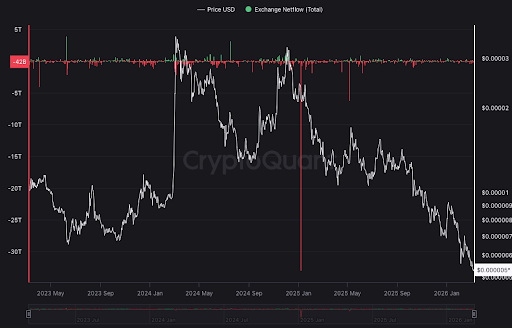
Source: Chart from CryptoQuant

Reports from WhaleScan on X have revealed that these whales have been active for a while now, securing their positions ahead of any major market movement. Usually, when whales move tokens from exchanges, it means those tokens are being removed from circulation. This reduces the supply of tokens available for trading on markets, which can create upward price pressure if demand continues to rise.

The recent whale movement also signals conviction in Shiba Inu despite its weakened fundamentals and recent sideways trading. Notably, WhaleScan has reported that due to the massive token exodus from exchanges, reserves on these crypto platforms have hit a record low of 80.9 trillion SHIB. This suggests that while weak hands are watching short-term price action, whales are accumulating, contributing to the decreasing supply.

SHIB Deflationary Pressures Build As Burn Rate Spikes

In addition to declining reserves, Shiba Inu’s burn rate has accelerated dramatically, increasing by 27.4% just last week. Most notably, on March 6, the burn rate skyrocketed by over 53,950% in just 24 hours, reflecting a staggering increase in tokens being removed from circulation.

Combined with the billions of tokens that recently flowed out of exchanges, Whale Scan has noted that Shiba Inu’s supply crunch is becoming increasingly clear and difficult to ignore. Recent burn statistics paint the picture of token holders seeking deflation amid weakening price action.

Approximately 337 billion SHIB tokens were burned on March 3, last week, as the Shibarium ecosystem prepared for the anticipated FHE privacy upgrade for Q2 2026. These developments indicate that Shiba Inu’s deflationary pressure is building as supply continues to decrease on exchanges.

SHIB trading at $0.000005 on the 1D chart | Source: SHIBUSDT on Tradingview.com

Трендові криптовалюти

Пов'язані питання

QWhat is the main reason for the recent significant drop in Shiba Inu (SHIB) exchange reserves?

AThe main reason is that Shiba Inu whales have been executing massive withdrawals, moving billions of SHIB tokens away from centralized exchanges, which has caused the reserves to plummet to a record low of 80.9 trillion SHIB.

QAccording to the article, what are the two possible motivations behind the whales' movement of SHIB off exchanges?

AThe two possible motivations are that the whales are either positioning ahead of a potential market rebound or simply taking advantage of price declines to accumulate more tokens.

QHow did the SHIB burn rate change on March 6, and what does this indicate?

AOn March 6, the SHIB burn rate skyrocketed by over 53,950% in 24 hours, indicating a massive and accelerated removal of tokens from circulation, which increases deflationary pressure.

QWhat on-chain analytics platform detected the sharp decline in SHIB exchange net flow, and what was the outflow amount on March 8?

AThe on-chain analytics platform CryptoQuant detected the sharp decline. On March 8, the total outflow was 166.16 billion SHIB tokens across major exchanges.

QWhat broader market context is Shiba Inu facing, as mentioned in the article?

AShiba Inu is facing major headwinds in the broader cryptocurrency and meme coin market, continuing to trade without clear directional momentum even as its price weakens.

Пов'язані матеріали

Can Generative Models Finally Be Trained End-to-End? The Core Is a For Loop

This article introduces a novel training paradigm for generative models called Explorative Modeling (XM), which enables true end-to-end training. Traditionally, powerful generative models like autoregressive and diffusion models are not trained end-to-end. They are trained to predict a single small step but require iterative multi-step sampling for inference. This "exposure bias" leads to error accumulation and limits performance. The core challenge XM addresses is "mode blurring." In generative tasks, a single input (e.g., "generate a dog") corresponds to many valid outputs (multiple modes). Standard training objectives like reconstruction loss force the model to average these modes, producing unrealistic, blurry outputs. To avoid this, existing models break generation into many small, almost deterministic steps, sacrificing end-to-end training. XM tackles this by restructuring the training loop itself. Its key insight is to amplify "generative expressivity." For each training input, instead of generating one sample, the model generates K candidate outputs. Only the candidate closest to the real data is used for computing the loss and updating the model via backpropagation. This simple "best-of-K" mechanism is implemented as a short for-loop. By exploring multiple possibilities, the model learns to distribute its guesses across different modes rather than collapsing to their uninformative average. The paper demonstrates that "exploration" acts as a new, powerful scaling axis. Gains from XM increase with model size, data scale, and compute. Experiments show improvements in FID scores for image generation and significant efficiency gains, sometimes outperforming larger models without exploration. When pushed to the limit, XM enables fully single-step, end-to-end generative models. In robotics tasks, an "Explorative Policy" matched the performance of a 100-step Diffusion Policy with a single forward pass, drastically improving inference speed. While the best-of-K concept is not entirely new, the authors' contribution lies in formally understanding it as a direct method to boost generative expressivity without fragmenting the generation process. This work suggests that as models scale, enhancing exploration during training may become crucial for overcoming fundamental performance bottlenecks.

marsbit11 хв тому

Can Generative Models Finally Be Trained End-to-End? The Core Is a For Loop

marsbit11 хв тому

Annual Salary of Millions Competing for Electricians, Meta Rushes to Open Its Own Technical School

The AI boom is facing an unexpected bottleneck: a severe shortage of skilled construction workers and electricians. As tech giants like Meta, OpenAI, and Alphabet race to build massive data centers—such as OpenAI's $16 billion "Stargate" project—they are hitting a critical labor wall. The U.S. needs an estimated 130,000 more electricians, 240,000 construction workers, and 150,000 supervisors by 2030 for AI infrastructure alone, but tens of thousands of electrician jobs go unfilled each year. While AI companies offer high premiums, with electricians earning up to $280,000 annually, worker scarcity still causes massive losses—delays on a single project can cost $14.2 million per month. The complexity of building AI data centers, which require immense power (equivalent to powering hundreds of thousands of homes), sophisticated electrical systems, and advanced liquid cooling solutions, demands highly skilled technicians who are in short supply. To combat this, companies are investing heavily in training. Meta has committed $115 million to a free training school offering tuition, housing, and stipends, targeting 5,000 new workers. OpenAI is partnering with unions to secure skilled labor. These efforts are paying off, with a significant rise in Gen Z interest in trade schools over college. However, the power demands are staggering. AI data centers are driving a rapid surge in electricity consumption, projected to account for up to 12% of U.S. power use by 2028 and raising costs for consumers. Furthermore, the construction boom is project-based, leading to a potential future glut of trained workers once building peaks, which could depress wages industry-wide. The race for AI supremacy now depends as much on skilled hands as on advanced chips.

marsbit1 год тому

Annual Salary of Millions Competing for Electricians, Meta Rushes to Open Its Own Technical School

marsbit1 год тому

Торгівля

Спот

Популярні статті

Як купити MOVE

Ласкаво просимо до HTX.com! Ми зробили покупку Movement (MOVE) простою та зручною. Дотримуйтесь нашої покрокової інструкції, щоб розпочати свою криптовалютну подорож.Крок 1: Створіть обліковий запис на HTXВикористовуйте свою електронну пошту або номер телефону, щоб зареєструвати обліковий запис на HTX безплатно. Пройдіть безпроблемну реєстрацію й отримайте доступ до всіх функцій.ЗареєструватисьКрок 2: Перейдіть до розділу Купити крипту і виберіть спосіб оплатиКредитна/дебетова картка: використовуйте вашу картку Visa або Mastercard, щоб миттєво купити Movement (MOVE).Баланс: використовуйте кошти з балансу вашого рахунку HTX для безперешкодної торгівлі.Треті особи: ми додали популярні способи оплати, такі як Google Pay та Apple Pay, щоб підвищити зручність.P2P: Торгуйте безпосередньо з іншими користувачами на HTX.Позабіржова торгівля (OTC): ми пропонуємо індивідуальні послуги та конкурентні обмінні курси для трейдерів.Крок 3: Зберігайте свої Movement (MOVE)Після придбання Movement (MOVE) збережіть його у своєму обліковому записі на HTX. Крім того, ви можете відправити його в інше місце за допомогою блокчейн-переказу або використовувати його для торгівлі іншими криптовалютами.Крок 4: Торгівля Movement (MOVE)Легко торгуйте Movement (MOVE) на спотовому ринку HTX. Просто увійдіть до свого облікового запису, виберіть торгову пару, укладайте угоди та спостерігайте за ними в режимі реального часу. Ми пропонуємо зручний досвід як для початківців, так і для досвідчених трейдерів.

386 переглядів усьогоОпубліковано 2024.12.13Оновлено 2026.06.02

Як купити MOVE

Обговорення

Ласкаво просимо до спільноти HTX. Тут ви можете бути в курсі останніх подій розвитку платформи та отримати доступ до професійної ринкової інформації. Нижче представлені думки користувачів щодо ціни MOVE (MOVE).

活动图片