SEC Chair Confirms Crypto Taxonomy Guidance In Line With CLARITY Act Framework

bitcoinistОпубліковано о 2026-02-13Востаннє оновлено о 2026-02-13

Анотація

SEC Chair Paul Atkins announced plans to develop formal guidance on token classification, aligning with the anticipated CLARITY Act framework, during a House Financial Services Committee hearing. He emphasized the need for regulatory certainty and a comprehensive federal framework to support investors and innovators. While acknowledging recent SEC efforts, Atkins stressed that durable reform requires bipartisan legislation. The SEC will collaborate with the CFTC through Project Crypto to develop a token taxonomy and consider tailored exemptions for blockchain transactions. Additionally, Atkins directed a review of the Consolidated Audit Trail (CAT) to assess governance, efficiency, and cybersecurity. Meanwhile, crypto markets experienced a significant downturn, with Bitcoin falling to $65,000 and Ethereum to $1,916, reducing total market capitalization to $2.23 trillion.

Speaking before the House Financial Services Committee on Wednesday, US Securities and Exchange Commission (SEC) Chair Paul Atkins outlined plans to develop formal guidance on token classification, aligning the agency with the anticipated crypto market structure legislation known as the CLARITY Act.

Aiming For Lasting Crypto Clarity

Atkins told lawmakers that regulatory certainty for digital assets is long overdue and pledged that the Commission is prepared to act once Congress finalizes the CLARITY Act. He emphasized that a comprehensive federal framework would provide much‐needed clarity for both investors and innovators.

While noting that SEC staff—under Commissioner Hester Peirce’s leadership of the agency’s Crypto Task Force—have offered more guidance over the past year than in the previous decade, Atkins argued that durable reform ultimately requires bipartisan legislation.

In his view, no regulatory adjustment undertaken solely by the Commission can “future‐proof” the rulebook as effectively as a clear market structure law passed by Congress.

As lawmakers continue their work, Atkins said the SEC intends to collaborate closely with the Commodity Futures Trading Commission (CFTC) to bridge the gap until legislation is enacted. He and CFTC Chairman Mike Selig plan to coordinate through a joint initiative known as Project Crypto.

As part of that effort, regulators will examine the development of a token taxonomy designed to define digital assets more precisely and clarify which rules apply to different categories.

The agencies are also considering tailored exemptions that could allow market participants to transact directly on blockchain networks, a move aimed at accommodating innovation while maintaining oversight.

Atkins Signals Regulatory Overhaul

Beyond digital assets, Atkins used his testimony to signal a broader reassessment of existing regulatory systems. He announced that he has directed SEC staff to conduct a comprehensive review of the Consolidated Audit Trail (CAT), the market surveillance system launched in November 2016.

The review will examine the following areas: governance, funding, cost efficiency, system design, scope, regulatory utility, and cybersecurity safeguards, encompassing the crypto sector as well.

Throughout his remarks, Atkins reiterated his broader regulatory philosophy. He said oversight should be intelligent, effective, and carefully tailored within the SEC’s statutory authority.

In his view, the existing framework has at times made the path to becoming a public company more restrictive and expensive, layering on requirements that may create more friction than benefit.

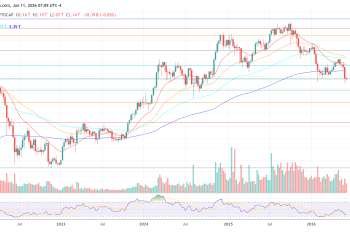
Meanwhile, the broader market has seen a notable downtrend, with crypto prices sharply retracing and sparking fears of an unfolding bear market. As of this writing, Bitcoin (BTC) has returned to the $65,000 level after failing to surpass the $70,000 resistance level earlier in the week.

Ethereum (ETH) has followed suit, mirroring BTC’s price action and currently trading at around $1,916 per token. Consequently, the total market capitalization has plummeted to nearly half of its October highs, currently valued at $2.23 trillion.

The daily chart shows the total crypto market cap’s crash toward $2.2 trillion. Source: TOTAL on TradingView.com

Featured image from OpenArt, chart from TradingView.com

Пов'язані питання

QWhat did SEC Chair Paul Atkins announce regarding crypto token classification?

ASEC Chair Paul Atkins announced plans to develop formal guidance on token classification, aligning with the anticipated CLARITY Act framework to provide regulatory certainty for digital assets.

QWhich legislative act is the SEC aligning its crypto guidance with?

AThe SEC is aligning its crypto guidance with the CLARITY Act, which is an anticipated crypto market structure legislation currently being finalized by Congress.

QWhat is the name of the joint initiative between SEC and CFTC to coordinate crypto regulation?

AThe joint initiative between the SEC and CFTC is called 'Project Crypto,' through which the agencies plan to collaborate on regulatory coordination until comprehensive legislation is enacted.

QWhat broader regulatory system did Atkins announce would undergo a comprehensive review?

AAtkins announced a comprehensive review of the Consolidated Audit Trail (CAT), the market surveillance system launched in 2016, examining areas including governance, funding, cost efficiency, system design, scope, regulatory utility, and cybersecurity safeguards.

QWhat was the total crypto market capitalization mentioned in the article at the time of writing?

AThe total crypto market capitalization was $2.23 trillion at the time of writing, having plummeted to nearly half of its October highs.

Пов'язані матеріали

The Shutdown of Claude Mythos Revealed the True Cost of Renting AI to Me

The sudden shutdown of Claude Mythos this week starkly highlights a critical, often overlooked risk for founders: when your core capability relies entirely on someone else's platform, your fate is not in your own hands. The key question becomes: who truly owns the intelligence your product depends on? For years, the debate around open-source models focused on cost. Now, the evidence is clear: fine-tuned open-source models can achieve frontier-level quality for specific, mission-critical tasks at a fraction of the cost. However, the deeper issue is control. Relying on a third-party API is like renting; it works until the landlord changes the rules, raises the rent, or asks you to leave—as Mythos experienced. The lesson is not to stop using frontier models—they are incredible infrastructure. The goal is ownership. Ownership means starting with a powerful open-source model and shaping it around what makes your company unique: your data, workflows, domain expertise, and definition of "good." Over time, the model becomes less generic and more reflective of your business, creating durable value. The optimistic conclusion is that AI's future doesn't hinge on one superior model. There is no single frontier. The frontier includes proprietary models, models fine-tuned on company-specific knowledge, specialized models for narrow problems, and intelligent routers orchestrating model ensembles. The most interesting development is not models getting smarter, but intelligence becoming increasingly customizable. The winning companies will be those that transform intelligence into a unique, owned asset. Looking ahead, the vision is not one model dominating all, but many teams owning the part of the frontier that matters most to them.

marsbit23 хв тому

The Shutdown of Claude Mythos Revealed the True Cost of Renting AI to Me

marsbit23 хв тому

Tiger Research: U.S. Strategic Bitcoin Reserve - Should the Market Be Happy or Disappointed?

Tiger Research analyzes the evolution of U.S. legislative efforts regarding a strategic Bitcoin reserve, concluding the market impact is limited in the short term but potentially positive long-term. The core event was a March 2025 executive order by former President Trump, which designated confiscated Bitcoin as a strategic reserve and promised not to sell existing holdings (approx. 190k BTC). As it contained no mandate to purchase new Bitcoin, the market reacted negatively, with prices dropping 5.7%. Legislative history shows a significant retreat from initial ambitions. The 2024 "BITCOIN Act" proposed mandatory purchases of 1 million BTC over five years. Reintroduced in 2025, it stalled due to high fiscal costs, concerns over dollar hegemony, and opposition from the Treasury Secretary. The current frontrunner, the 2026 "American Retirement and Monetary Advancement (ARMA) Act," is a compromise. It lacks any purchase requirement, instead focusing on consolidating existing government-held Bitcoin and legally prohibiting its sale for at least 20 years. While ARMA has higher passage odds due to bipartisan support and no purchase mandate, its immediate market effect is neutral. It eliminates potential government selling pressure but creates no new demand. The long-term significance is that formally establishing Bitcoin as a national reserve asset in law could later reignite debates on mandatory purchases. Therefore, the path to a government buyer is longer than initially priced by the market, but the directional narrative remains intact.

marsbit26 хв тому

Tiger Research: U.S. Strategic Bitcoin Reserve - Should the Market Be Happy or Disappointed?

marsbit26 хв тому

US Stock Market Trend (June 16): SpaceX Rises 42% in Two Days, New Fed Chairman Takes Office Today

**U.S. Stocks Trend (June 16): SpaceX Soars 42% in Two Days, New Fed Chair Takes Office Today** Markets surged on Monday following former President Trump's social media announcement of a completed U.S.-Iran deal to reopen the Strait of Hormuz, pending a June 19 signing. The news triggered a broad risk-on rally: oil prices crashed, tech stocks soared, bond yields fell, and defensive sectors lagged. **Market Performance:** The Nasdaq jumped 3.07%, led by semiconductor stocks like Micron (+9.2%). The S&P 500 gained 1.65%, and the Dow rose 0.92% to a record high. However, the Russell 2000 small-cap index underperformed (+0.72%). SpaceX continued its hot streak, rising another 5% pre-market after disclosures of large buys by an Australian billionaire and Cathie Wood's ARK. Boeing also rallied on the transportation optimism. Conversely, energy stocks like Chevron fell over 3% on the oil price plunge, with other defensive sectors also selling off. The day's action showed a clear rotation of funds from energy/defensive plays into AI and tech narratives. **Macro & Outlook:** The VIX fear index fell 8.37%. Treasury yields declined, and WTI crude dropped over 5%. Attention now shifts to a packed schedule: the Bank of Japan is widely expected to hike rates to 1.0% on Tuesday. The Fed's June meeting concludes Wednesday, marking new Chair Wash's debut. While rates are expected to hold, his tone on stubborn inflation and the "dot plot" will be crucial for gauging the 2024 rate path. The formal Iran deal signing is set for Friday. **Trend Perspective:** While the peace deal is a genuine positive, Monday's explosive rally may have gotten ahead of itself, pricing in a swift resolution to inflation concerns. The shortened trading week faces a triple test: BoJ tightening, the Fed's policy stance, and deal implementation details. Tech and semiconductors, which led the surge, remain vulnerable to any disappointment from these key events. The real price discovery begins with the central banks' communications this week.

marsbit47 хв тому

US Stock Market Trend (June 16): SpaceX Rises 42% in Two Days, New Fed Chairman Takes Office Today

marsbit47 хв тому

Торгівля

Спот
Ф'ючерси

Популярні статті

Як купити HOUSE

Ласкаво просимо до HTX.com! Ми зробили покупку Housecoin (HOUSE) простою та зручною. Дотримуйтесь нашої покрокової інструкції, щоб розпочати свою криптовалютну подорож.Крок 1: Створіть обліковий запис на HTXВикористовуйте свою електронну пошту або номер телефону, щоб зареєструвати обліковий запис на HTX безплатно. Пройдіть безпроблемну реєстрацію й отримайте доступ до всіх функцій.ЗареєструватисьКрок 2: Перейдіть до розділу Купити крипту і виберіть спосіб оплатиКредитна/дебетова картка: використовуйте вашу картку Visa або Mastercard, щоб миттєво купити Housecoin (HOUSE).Баланс: використовуйте кошти з балансу вашого рахунку HTX для безперешкодної торгівлі.Треті особи: ми додали популярні способи оплати, такі як Google Pay та Apple Pay, щоб підвищити зручність.P2P: Торгуйте безпосередньо з іншими користувачами на HTX.Позабіржова торгівля (OTC): ми пропонуємо індивідуальні послуги та конкурентні обмінні курси для трейдерів.Крок 3: Зберігайте свої Housecoin (HOUSE)Після придбання Housecoin (HOUSE) збережіть його у своєму обліковому записі на HTX. Крім того, ви можете відправити його в інше місце за допомогою блокчейн-переказу або використовувати його для торгівлі іншими криптовалютами.Крок 4: Торгівля Housecoin (HOUSE)Легко торгуйте Housecoin (HOUSE) на спотовому ринку HTX. Просто увійдіть до свого облікового запису, виберіть торгову пару, укладайте угоди та спостерігайте за ними в режимі реального часу. Ми пропонуємо зручний досвід як для початківців, так і для досвідчених трейдерів.

379 переглядів усьогоОпубліковано 2025.04.27Оновлено 2026.06.02

Як купити HOUSE

Обговорення

Ласкаво просимо до спільноти HTX. Тут ви можете бути в курсі останніх подій розвитку платформи та отримати доступ до професійної ринкової інформації. Нижче представлені думки користувачів щодо ціни HOUSE (HOUSE).

活动图片